The Hidden Chemistry of the Holiday Baking & Confectionery Season
Between November and January—from Thanksgiving through Christmas and New Year's Day—home kitchens and commercial bakeries across the United States, Europe, the UK, Canada, Australia, and around the world experience their sharpest annual production surge. From brandy- and rum-aged Holiday Fruitcakes & Christmas Plum Cakes, German Stollen, Italian Panettone, and sculpted Festive Marzipan to striped Peppermint Candy Canes, Candied Citrus Peel & Mixed Candied Fruit, Bûche de Noël (Yule Logs), Pecan & Pumpkin Pies, and Holiday Gingerbread, global demand for dried fruits, tree nuts, warm spices, cocoa, and dairy butter skyrockets by 300% to 500%.
Whenever seasonal demand outstrips authentic agricultural supply, economic food fraud follows. Mass-market manufacturers and seasonal wholesale suppliers routinely cut ingredient costs by 50% to 70% through sophisticated chemical substitutions:
- Replacing spirit-macerated dried fruits (Raisins & Sultanas, Dried Figs, Medjool Dates, Glacé Cherries) and genuine Orange or Lemon zest peel with boiled unripe Papaya or gourd cubes dyed with synthetic petroleum azo dyes and bleached with excessive Sulfur Dioxide (SO2).
- Masking pale, un-aged cake batters with Industrial Class III and Class IV Ammonia-Process Caramel Color (E150c / E150d) containing 4-Methylimidazole (4-MEI)—listed as a carcinogen under California Proposition 65 and classified as a Group 2B carcinogen by the IARC.
- Substituting expensive blanched sweet Almonds in marzipan and almond paste with bitter apricot or peach kernels (Persipan) containing cyanogenic amygdalin (HCN), All-Purpose / Refined Wheat Flour, undeclared Peanuts, and petrochemical synthetic benzaldehyde.
- Replacing pure Dairy Butter with cheap hydrogenated palm oil / vegetable shortening and adulterating holiday spices like Whole Nutmeg & Mace, True Ceylon Cinnamon, and Whole Cloves with high-coumarin Cassia bark, spent oil-exhausted hulls, and mycotoxin-contaminated seeds.
Below is our complete scientific field guide to auditing every finished holiday confection and raw baking staple in your pantry before you bake, gift, or serve your family.
Master Holiday Baking & Confectionery Safety Matrix
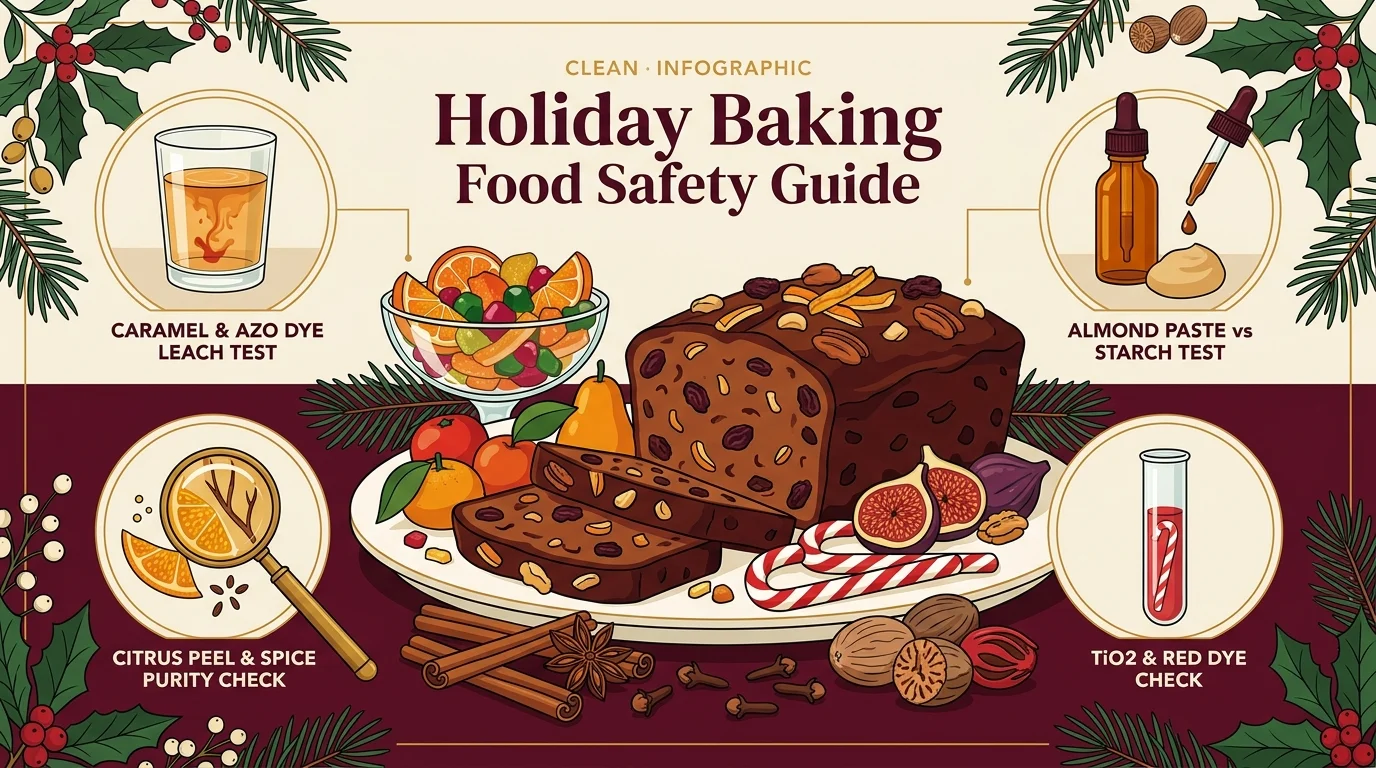
Use this master reference table to identify the primary adulterant, toxicological hazard, and 60-second kitchen test for every holiday treat and baking staple:
| Holiday Item / Ingredient | Primary Adulterant / Fraud | Chemical & Health Hazard | 60-Second Home Test | Safety Verdict |
|---|---|---|---|---|
| Holiday Fruitcake & Plum Cake | Class III/IV Caramel Dye, Palm Shortening, Dyed Papaya | 4-MEI Carcinogen, Industrial Trans/Saturated Fats, Mycotoxins | Warm Water Crumb Leach: Instant dark black-brown water & pale crumb = Chemical Caramel | Discard if Moldy or Chemically Dyed |
| Candied Citrus Peel & Mixed Fruit | Boiled Unripe Papaya replacing Citrus Peel, Excess SO2 | Synthetic Azo Dyes (Red 40 / Yellow 5), Sulfite Asthma | Zest Pore & Warm Water Test: No oil pores + neon dye bleed in 5 mins = Fake Peel | Soak & Rinse or Candy Own Peel |
| Festive Marzipan & Almond Paste | Apricot Kernel (Persipan), Wheat Flour, Synthetic Benzaldehyde | Cyanogenic Glycosides (HCN), Salmonella (raw Egg) | Iodine & Water Emulsion Test: Blue-black stain = Starch filler; harsh chemical burn = Synthetic ester | Strictly Discard if Bitter/Starchy |
| Candy Canes & Peppermint Bark | Titanium Dioxide (TiO2), FD&C Red No. 3 / Red 40, Paraffin Wax | E171 Nanoparticles, Erythrosine Thyroid Toxicity | Warm Water Dissolution: Milky chalky sediment = TiO2/Chalk; waxy flakes on blade = Paraffin | Choose Natural Beet/Mint Canes |
| Nutmeg & Mace | Hollow Spent Seeds, Dyed Wild Myristica malabarica, Internal Mold | Hepatotoxic Aflatoxins, Synthetic Red Azo Dyes | Water Float & Dye Leach: Floating nutmeg = Hollow/spent; red water bleed = Dyed wild mace | Buy Whole Sound Nutmeg Only |
| Raisins, Figs & Dates | Mineral Oil Gloss, Glucose Syrup Glaze, Sulfur Bleach, Mold | Petroleum Hydrocarbons (MOSH/MOAH), Aspergillus Spores | Paper Rub & Slice Check: Greasy stain = Mineral oil; slice figs/dates open for black mold dust | Wash in Warm Water & Slice Open |
| Ceylon Cinnamon & Cloves | Chinese Cassia Bark, Exhausted De-Oiled Clove Buds | Hepatotoxic Coumarin (in Cassia), Zero Eugenol | Quill Layer & Float Test: Thick single-curl bark = Cassia; horizontal floating cloves = Exhausted | Use Multi-Quill Ceylon & Sinking Cloves |
| Dairy Butter & Clarified Butter | Hydrogenated Palm Shortening / Margarine, Starch Fillers | Industrial Trans-Fats, Endothelial Inflammation | Palm Melt & Iodine Test: Pure butterfat melts cleanly at 32–35°C (90–95°F); blue iodine = Starch | Discard if Waxy or Starchy |
| Cocoa Powder (Upcoming Guide) | Cocoa Shells/Husks, Red Iron Oxide, Cereal Starch, High Cadmium | Heavy Metals (Cadmium/Lead), Gastric Irritation | Cold Water & Iodine Test: Gritty red-brown sediment at bottom = Husk/earth; blue-black = Starch | Buy 100% Pure Unadulterated Cocoa |
| Vanilla Extract (Upcoming Guide) | Synthetic Lignin Vanillin, Mexican Tonka Bean Extract | Coumarin Liver & Blood-Thinning Toxicity (FDA Banned) | Evaporation & Chill Test: Real vanilla has complex floral resins & clouds slightly when chilled | Verify 'Pure Vanilla Extract' (21 CFR 169.175) |
| Condensed Milk (Upcoming Guide) | Palm Oil Filled Milk, Cornstarch, High-Fructose Syrups | Oxidized Tropical Oils, Glycemic Spike | Iodine & Fridge Test: Blue-black = Starch; oily yellow slick separating on top = Palm oil substitute | Check Label for Whole Milk + Sugar Only |
| Semolina & Desiccated Coconut (Upcoming) | Iron Grit, Spent Oil-Extracted Copra Meal, Sulfite Bleach | Sulfite Sensitivity, Rancid Lauric Acid | Magnet & Paper Press Test: Pass magnet over grain; press shredded coconut on paper for natural oil | Use Unsweetened Full-Fat Coconut |
Part 1: Deep-Dive Diagnostics for the 5 Core Holiday Specialties
1. Holiday Fruitcake & Christmas Plum Cake: Detecting 4-MEI Caramel Dye, Palm Shortening & Hidden Mold
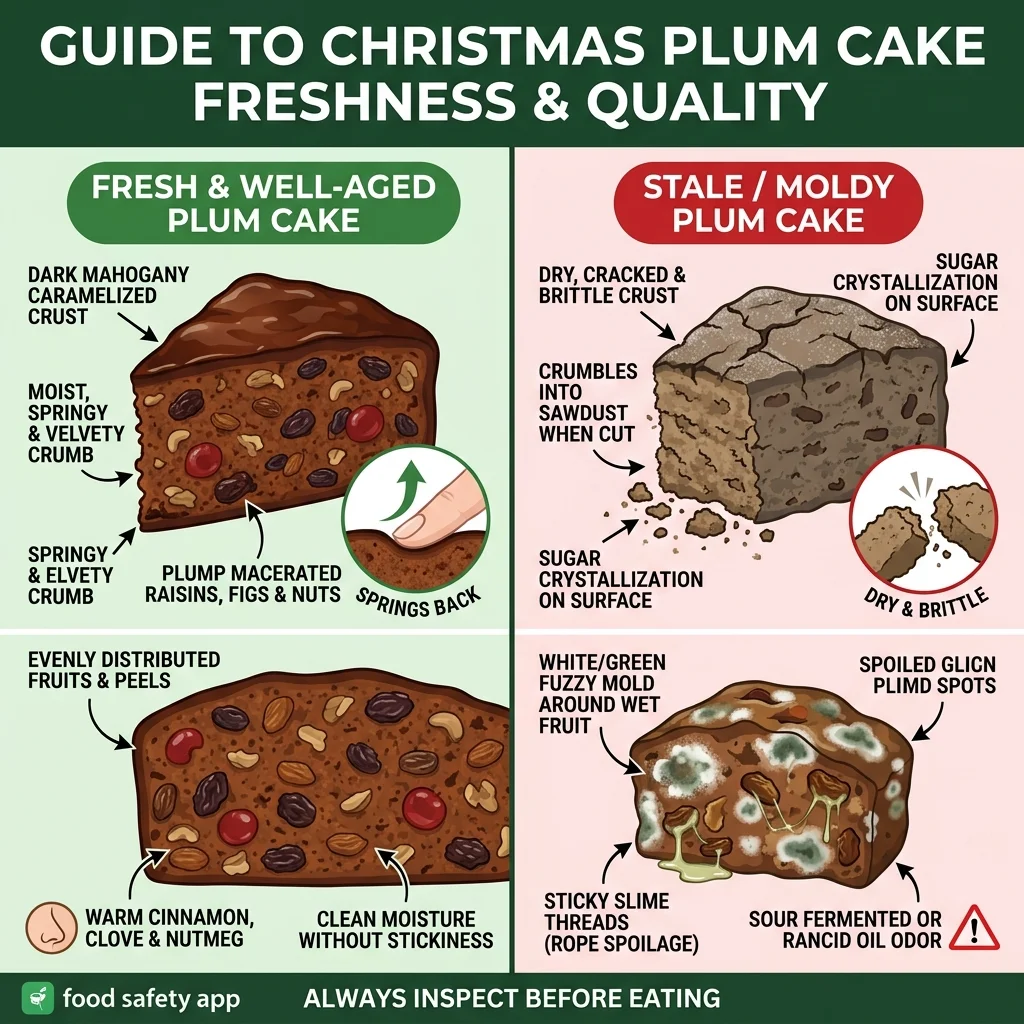
An authentic Christmas Plum Cake or Traditional Holiday Fruitcake derives its deep mahogany crumb naturally from two sources: slow Maillard caramelization of Cane Sugar, dark brown sugar, or molasses, and weeks of macerating Raisins & Sultanas, Dried Figs, Dates, Glacé Cherries, and Candied Citrus Peel in aged brandy, rum, bourbon, or spiced Orange juice.
In mass-market commercial bakeries, this 6-week maturation process is bypassed in 60 minutes. Producers mix plain Refined Wheat Flour batter with Industrial Class III (E150c) or Class IV (E150d) Ammonia-Sulfite Caramel Color, replace Dairy Butter with cheap hydrogenated palm oil or vegetable shortening, and fold in un-soaked, neon-dyed Papaya cubes masquerading as candied fruit.
# 4 Step-by-Step Home Tests for Holiday Fruitcake & Plum Cake
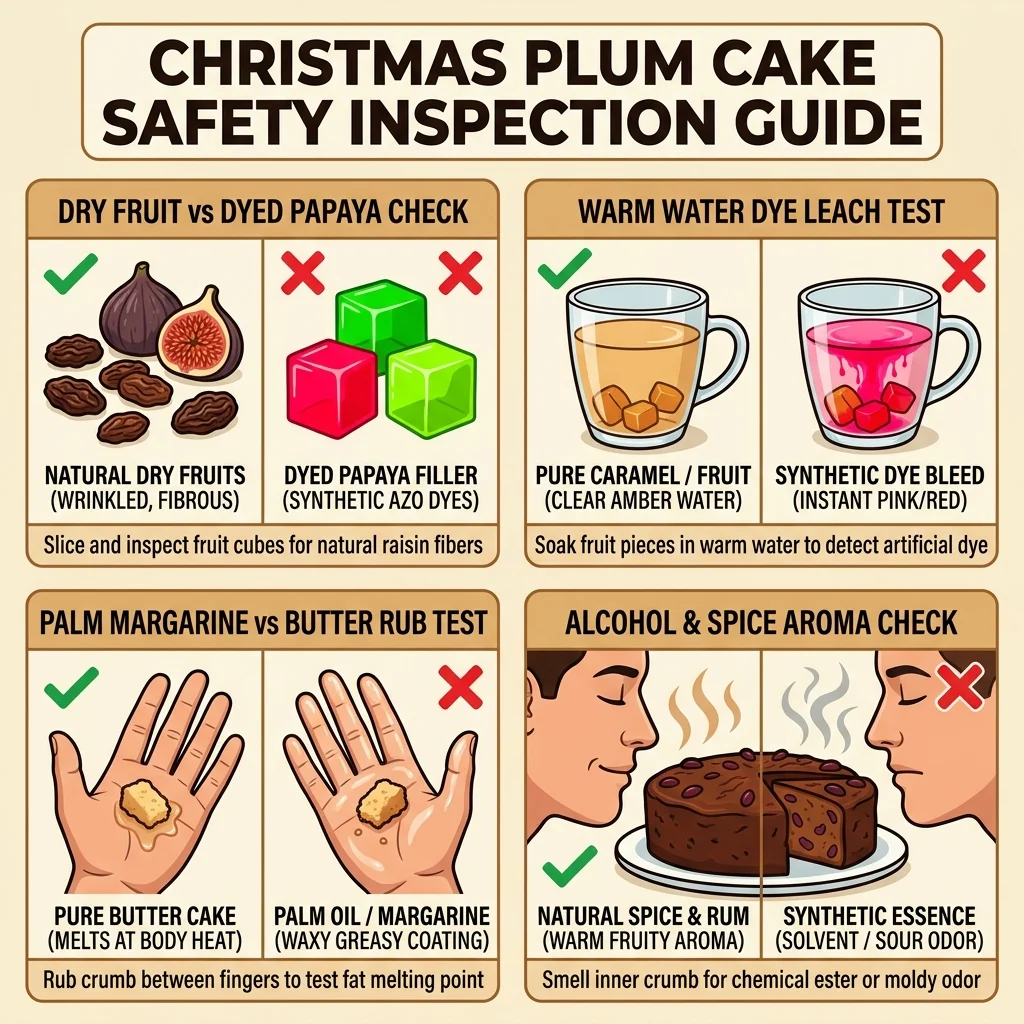
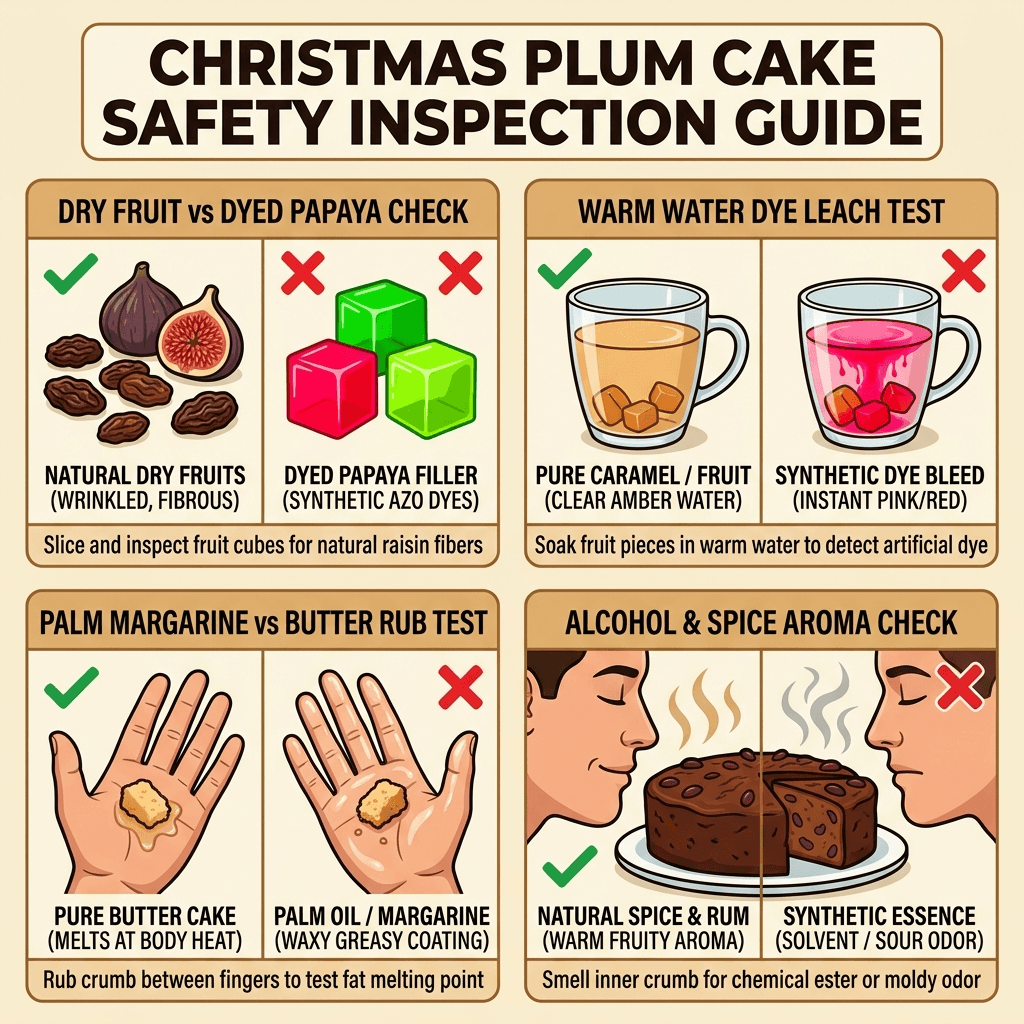
- The Warm Water Caramel Leach Test (Detecting Class III/IV Caramel Dye): Crumble a 2 cm piece of the dark brown cake crumb (avoiding fruit pieces) into a clear glass of lukewarm water (110°F / 45°C) and let sit undisturbed for 3 minutes.
- Authentic Aged Fruitcake: The water tints slowly to a mild, translucent amber-tea shade while the cake crumb retains its natural baked brown color.
- Chemical Caramel Adulteration: Dark blackish-brown dye streams rapidly into the water within 60 seconds, leaving a pale, grey-white bleached flour crumb at the bottom. Class III and IV caramel colors are manufactured with ammonia and sulfites, generating 4-Methylimidazole (4-MEI).
- The Crumb Rub & Palate Melt Check (Butter vs. Palm Shortening): Rub a small piece of cake crumb between your thumb and forefinger, then let a small bite melt on your tongue.
- Pure Dairy Butter Crumb: Softens and melts cleanly at human body temperature (90–95°F / 32–35°C) with a warm creamy aroma.
- Palm Margarine / Hydrogenated Shortening: Leaves a heavy, waxy, greasy film coating your fingers and the roof of your mouth because industrial palm stearin and hydrogenated vegetable fats melt above 102–108°F (39–42°C).
- The Macerated Fruit vs. Dyed Filler Audit: Pick out 3–4 colorful fruit cubes from the slice and soak them in warm water. If synthetic red and green dyes bleed out immediately and the cubes are uniform, translucent blocks lacking citrus oil pores, the bakery substituted cheap dyed Papaya (tutti-frutti) for real Candied Citrus Peel and Cherries.
- The Crevice & Fruit-Pocket Mold Inspection: Break the cake open through the center where moist fruit pieces cluster. Under bright light, inspect the air pockets around Raisins and Figs. Fine cobweb-like white or bluish-green threads indicate Aspergillus or Penicillium mold growth—discard the entire loaf immediately, as mycotoxins (Ochratoxin A and Aflatoxin B1) diffuse throughout soft cake crumb.
2. Candied Citrus Peel & Mixed Candied Fruit: Real Orange/Lemon Rind vs. Dyed Papaya & Sulfites
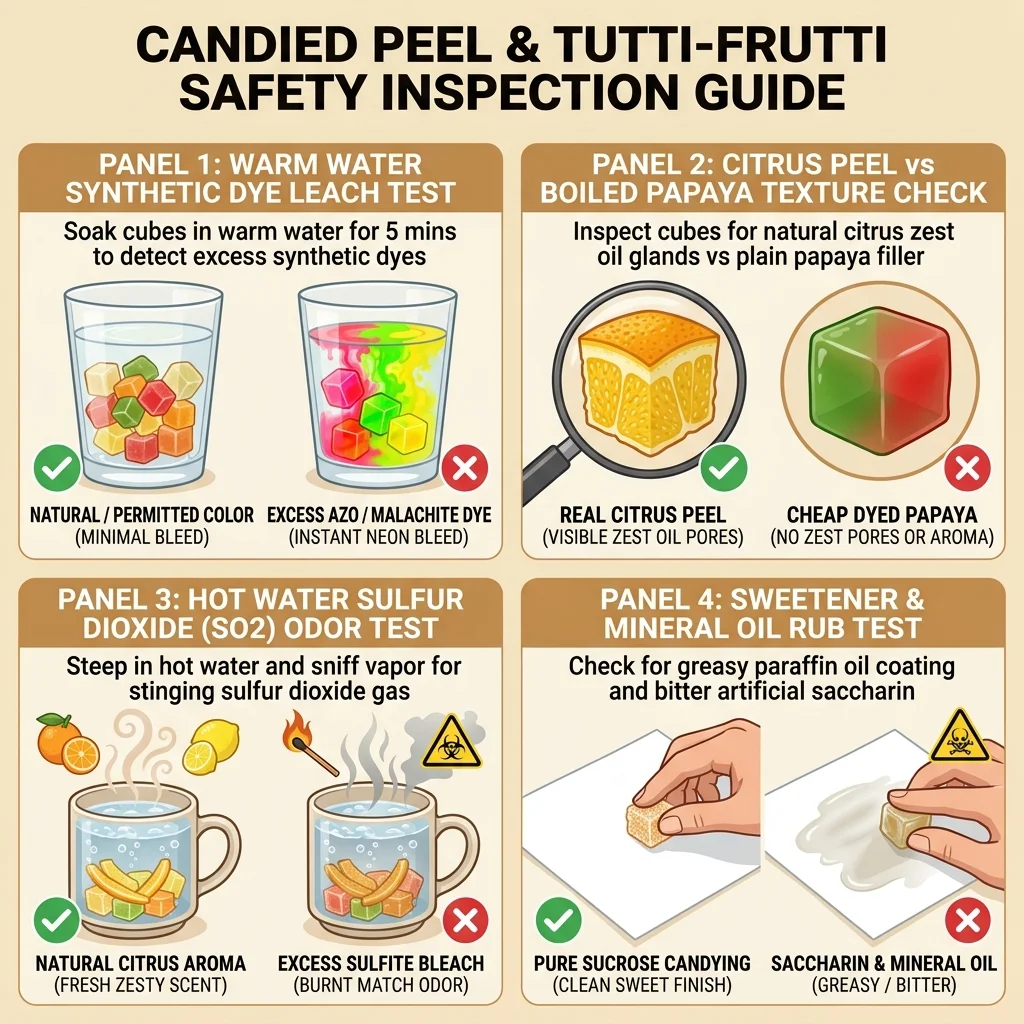
Whether you are baking Italian Panettone, German Christstollen, British Mince Pies, or American Holiday Fruitcake, candied citrus peel is the aromatic backbone of winter baking. However, inspect the tubs of budget "Mixed Candied Fruit & Peel" sold in seasonal grocery aisles: many economy mixes contain little to no real citrus rind. Instead, processors dice unripe green Papaya (Carica papaya) or winter melon, boil it in calcium hydroxide (slaked lime) to artificially harden the cell walls, bleach it with Sulfur Dioxide (SO2), and saturate it with invert corn syrup and synthetic petroleum dyes (FD&C Red No. 40, Red No. 3, Yellow No. 5 / Tartrazine, Yellow No. 6 / Sunset Yellow, Blue No. 1).
# 4 Step-by-Step Home Tests for Candied Peel & Mixed Fruit
- The Citrus Oil-Gland Pore Inspection (Botanical Anatomy Test): Hold a piece of "candied peel" up to a bright light or phone magnifier and slice it in half.
- Genuine Candied Orange, Lemon, or Citron Peel: Displays distinct, pin-prick spherical essential oil glands (flavedo zest pores) along the outer colored skin layer, transitioning into a slightly fibrous white pith (albedo). Pressing it releases a bright burst of natural D-limonene citrus oil aroma.
- Dyed Raw Papaya / Gourd Substitute: Uniformly translucent, rubbery, and completely featureless on all six faces—zero zest pores, zero pith gradient, and zero natural citrus fragrance.
- The 5-Minute Warm Water Dye Bleed Test: Place 1 tablespoon of multi-colored candied fruit cubes in a glass of warm water (120°F / 50°C) with a few drops of white vinegar for 5 minutes.
- Naturally Colored / Properly Glazed Peel: Water remains nearly clear or takes on a very faint pastel tint while the peel retains its natural orange/yellow hue.
- Excess Synthetic Azo Dyes: Water rapidly turns into a vivid, glowing neon red, green, or yellow bath, leaving the cubes pale and blotchy.
- The Steaming Water Sulfur Dioxide (SO2) Odor Test: Pour freshly boiled water over a spoonful of candied peel in a small cup, cover for 45 seconds, and sniff the rising steam carefully. A sharp, stinging, burnt-matchstick odor confirms heavy sodium metabisulfite (SO2) bleaching residue, which can trigger acute bronchospasm in asthmatic individuals.
- The White Paper Mineral Oil & Post-Harvest Citrus Wax Check: Press dry cubes onto white blotting paper. Permanent translucent grease halos indicate petroleum mineral oil used as an anti-clumping coat. When making homemade candied peel from fresh Oranges and Lemons, always buy organic unwaxed fruit or scrub rinds thoroughly with warm baking-soda water to remove post-harvest fungicides (Imazalil and Thiabendazole), which concentrate in citrus peel oil glands.
3. Festive Marzipan & Almond Paste: Cyanogenic Apricot Kernels (Persipan), Starch Fillers & Raw Egg Risks
From German Lübeck Marzipan pigs and Stollen cores to Spanish Mazapán de Toledo, Italian Frutta Martorana, and Scandinavian Kransekake, authentic Marzipan and Almond Paste is crafted strictly from finely ground blanched sweet Almonds (Prunus dulcis)—or in certain regional traditions, roasted Cashews—blended with Sugar or Honey.
Because blanched sweet almonds are one of the most expensive bulk confectionery ingredients, unscrupulous manufacturers dilute marzipan with debittered or insufficiently detoxified apricot and peach kernels (Persipan), undeclared Peanut or soy meal, Refined Wheat Flour, potato starch, and corn syrup, masking the missing almond flavor with harsh petrochemical benzaldehyde (artificial bitter almond essence).
- ⚠️ Critical Cyanide Hazard in Apricot Kernel Paste: Bitter almonds and apricot/peach kernels contain high levels of amygdalin, a cyanogenic glycoside. When chewed or digested, the enzyme beta-glucosidase hydrolyzes amygdalin into Hydrogen Cyanide (HCN), which blocks cellular oxygen utilization and can cause headache, dizziness, rapid breathing, vomiting, and acute cyanide poisoning—particularly in children. European food law requires commercial Persipan to contain 0.5% added starch specifically so inspectors can unmask it inside marzipan using a simple iodine drop test.
Authentic & Pure Benchmarks
Adulteration & Spoilage Red Flags
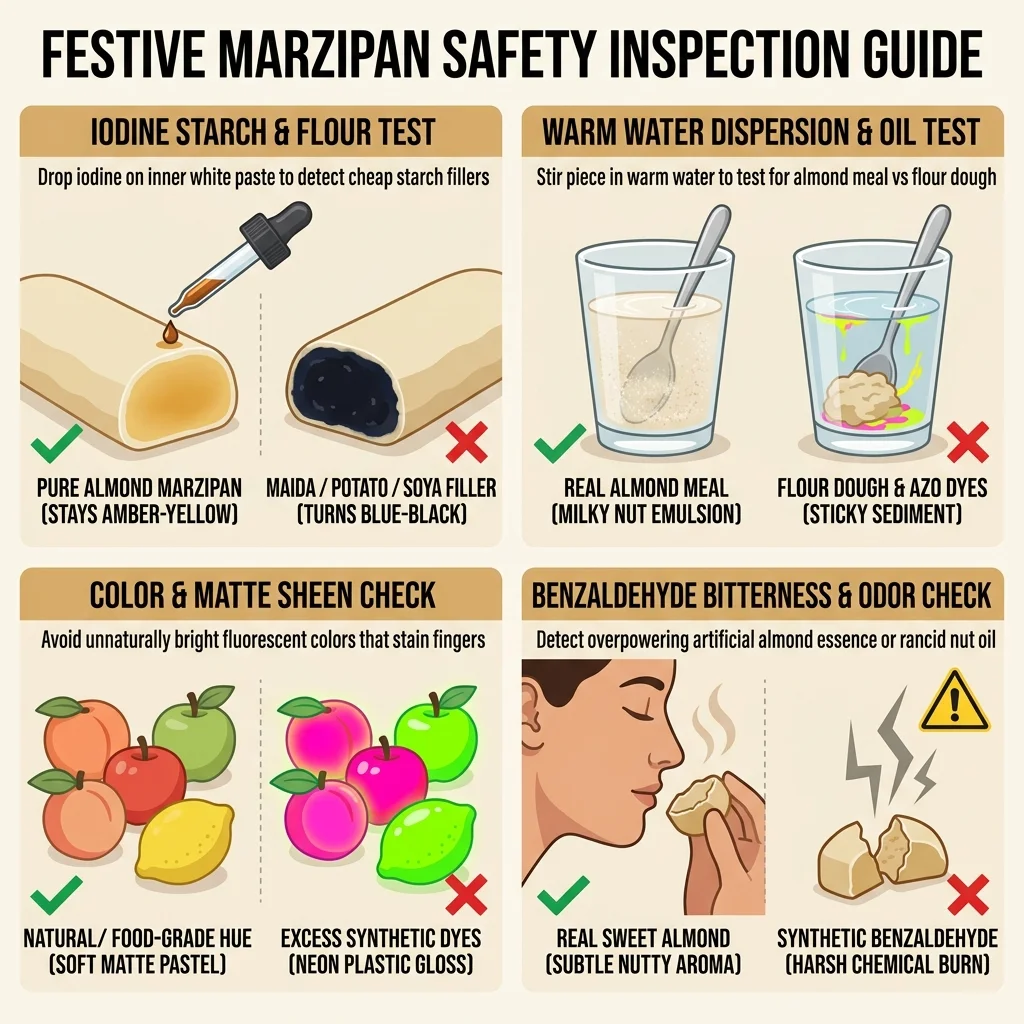
# 4 Step-by-Step Home Tests for Marzipan & Almond Paste
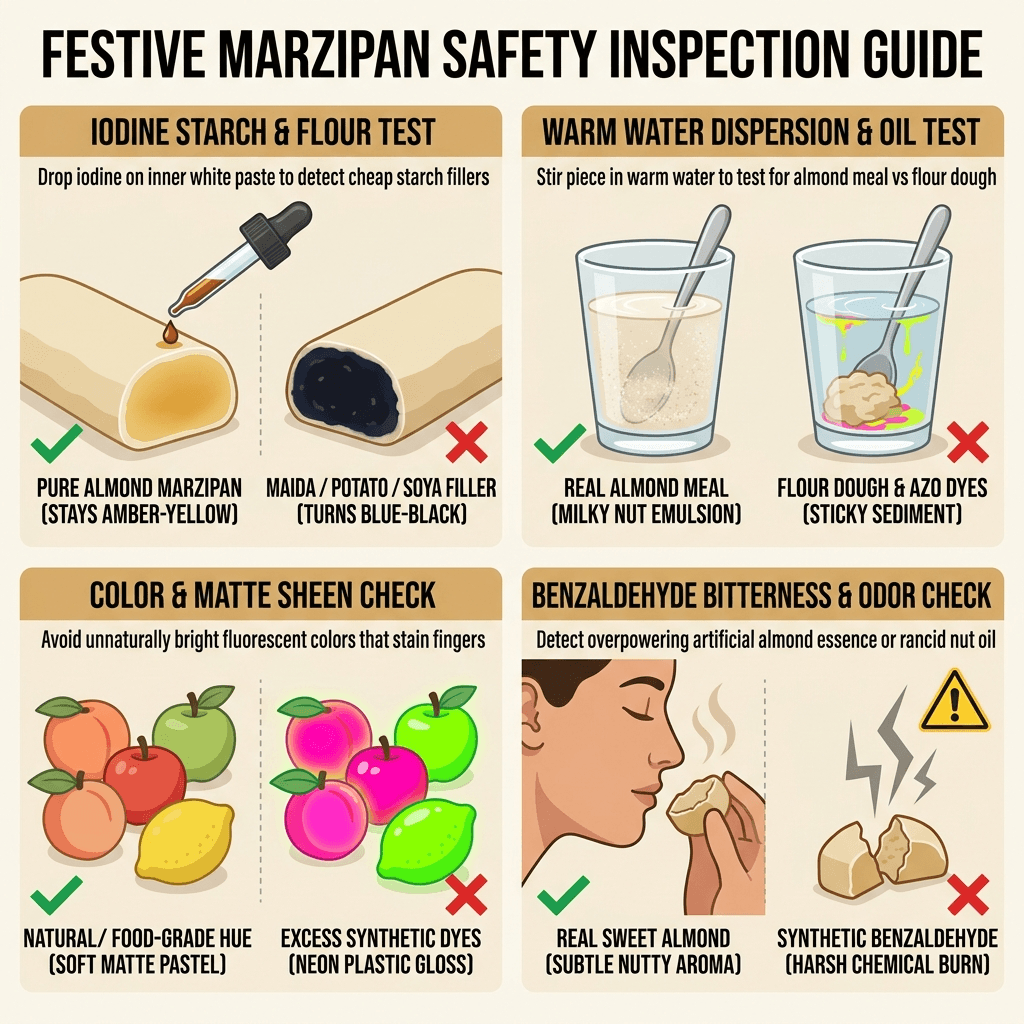
- The Tincture Iodine Starch Test (Detecting Flour, Potato & Persipan): Scrape a pea-sized sample from the uncolored ivory interior of the marzipan, mash it in 1 tablespoon of warm water, and add 1–2 drops of tincture iodine (or Povidone-Iodine).
- 100% Pure Sweet Almond Marzipan: Blanched sweet almonds contain virtually zero starch (<1–2%); the mixture stays pale yellow-amber.
- Adulterated with Flour, Potato Starch, or Persipan: Turns an immediate, opaque dark blue, violet, or ink-black, confirming that the almond paste was cut with cheap cereal/tuber starch or starch-tagged apricot-kernel persipan.
- The Warm Water Nut-Emulsion vs. Gluten-Sludge Test: Stir a piece of marzipan in warm water for 60 seconds and let stand. Genuine marzipan disperses into a fragrant milky almond emulsion with fine nut meal settling cleanly. Flour-adulterated paste forms a sticky, elastic gluten dough lump at the bottom and bleeds synthetic surface dyes into the water.
- The Benzaldehyde Sniff & Bitterness Check: Break a piece of marzipan in half and inhale immediately. Pure almond marzipan offers a warm, subtle, roasted nut aroma with a clean, creamy finish. If it hits your nose with a sharp, medicinal "cherry-cough-syrup" chemical vapor that evaporates quickly and leaves a bitter chemical burn on the tongue, it is flavored with synthetic benzaldehyde.
- Raw Egg White & Edible Silver Leaf Safety Check: Artisanal or homemade marzipan bound with raw, unpasteurized egg whites carries a risk of Salmonella Enteritidis. Always use pasteurized egg whites or the cooked sugar-syrup method (heated to 240°F / 116°C). If festive marzipan or holiday truffles are garnished with metallic silver leaf, rub a flake between your fingers: pure edible silver leaf (E174) vanishes into a fine sparkle, whereas toxic aluminium foil rolls into a grey metal ball.
4. Candy Canes & Peppermint Hard Candy: Titanium Dioxide (TiO2), FD&C Red No. 3 & Paraffin Glazes
Striped red-and-white Candy Canes and crushed Peppermint Bark are staples of the winter holidays, yet their bright visual contrast often relies on controversial industrial additives:
- Titanium Dioxide (TiO2 / E171): Used by budget manufacturers to make the white core look opaque bright white without proper mechanical sugar-pulling. In 2022, the European Union (EFSA) banned Titanium Dioxide (E171) as a food additive after concluding that TiO2 nanoparticles can accumulate in intestinal lymphoid tissue and cannot be ruled out for genotoxicity (DNA strand damage)—yet E171 remains widespread in US and imported seasonal hard candies.
- FD&C Red No. 3 (Erythrosine / E127) & Red No. 40 (Allura Red AC): In January 2025, the US FDA officially revoked the authorization of FD&C Red No. 3 in food and ingested drugs under the Delaney Clause due to thyroid tumor induction in laboratory studies. However, older stock and unregulated imports still use Erythrosine or heavy doses of synthetic azo dyes linked to neurobehavioral hyperactivity in sensitive children.
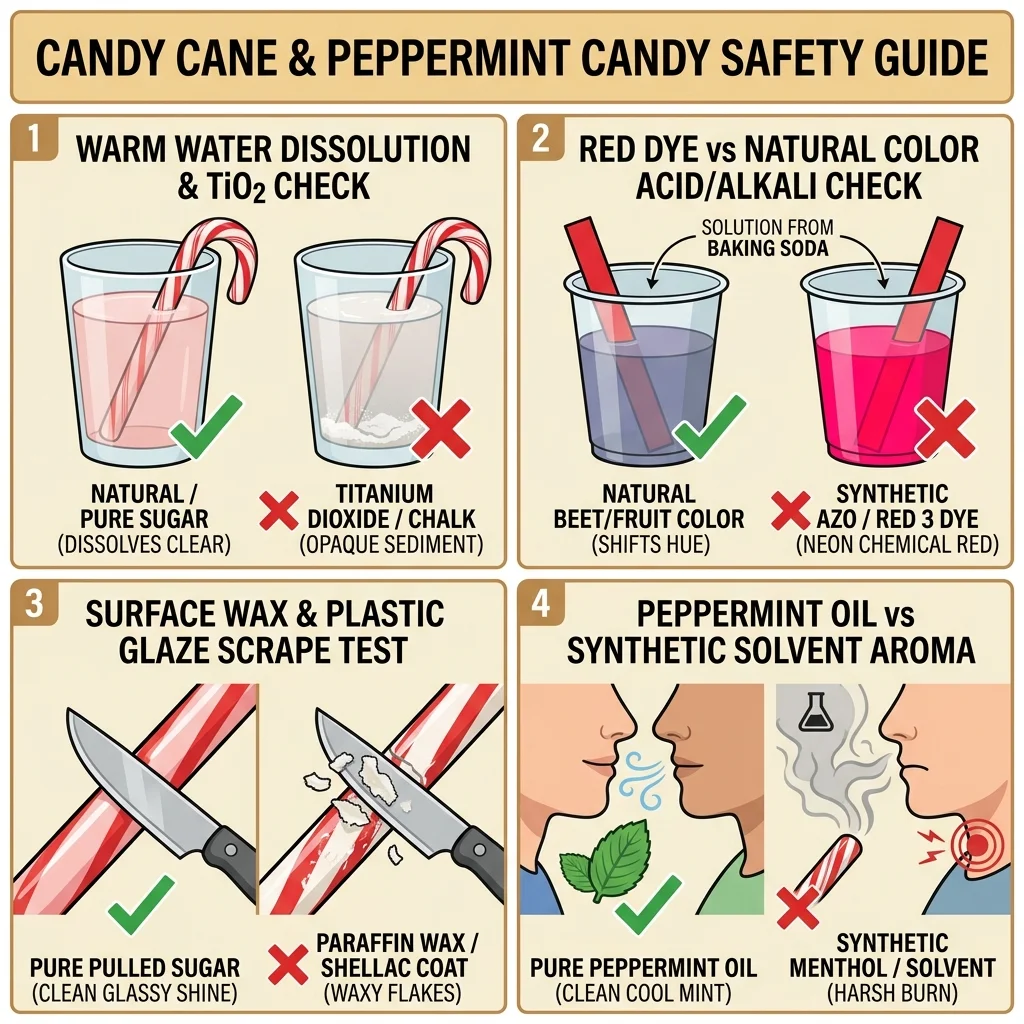
# 4 Step-by-Step Home Tests for Candy Canes
- The Warm Water Dissolution & TiO2 Turbidity Test: Break off a 1-inch (3 cm) piece of a candy cane and dissolve it completely in half a glass of warm water.
- Authentic Mechanically Pulled-Sugar Candy Cane: Traditional confectioners create a satin-white core by stretching and folding hot Cane Sugar syrup over a hook to trap millions of microscopic air bubbles (aerated pulled sugar). When dissolved in water, those air bubbles escape and the liquid becomes 100% transparent crystal-clear (tinted clear light pink from the stripe).
- Titanium Dioxide (TiO2) or Chalk (CaCO3) Adulteration: Because TiO2 and mineral chalk are water-insoluble, the water remains permanently milky-opaque or cloudy, and a fine white mineral powder settles at the bottom. Adding a few drops of Lemon juice or vinegar to the sediment causes fizzing if calcium carbonate chalk was used, whereas TiO2 remains inert.
- The Baking Soda pH Dye-Shift Test (Natural Beet/Berry Red vs. Synthetic Red Dye): Pour two tablespoons of the pink dissolved candy solution into a white cup and stir in a pinch of Baking Soda (Sodium Bicarbonate) (alkaline).
- Natural Anthocyanin / Beetroot / Radish / Elderberry Red: Natural plant pigments are pH-sensitive and shift visibly toward purple, bluish-violet, or brownish-yellow in alkaline baking-soda water.
- Synthetic Petroleum Dyes (Red 40, Red 3 / Erythrosine, Ponceau 4R): Remain stubbornly glowing neon pink-red or crimson regardless of pH change.
- The Knife-Edge Paraffin Wax Scrape Test: Unwrap a candy cane and gently scrape the outer glossy surface at a 45° angle with a clean paring knife. Pure hard-crack sugar yields fine glassy sugar dust that dissolves completely in warm water. Cheap bulk candies coated with petroleum paraffin wax or mineral oil to prevent humidity sticking peel off in greasy, translucent waxy curls that float on water.
- The Hot Vapor Peppermint Oil vs. Synthetic Solvent Sniff Test: Dissolve a piece in hot water and smell the steam. Pure steam-distilled Mentha × piperita peppermint oil releases a clean, herbaceous, cooling menthol aroma. Synthetic racemic menthol carried in industrial solvents emits a harsh, medicinal, chemical vapor with a burning throat aftertaste.
5. Nutmeg & Mace & The Holiday Baking Spice Rack Audit
No holiday eggnog, mulled wine (Glühwein), pumpkin pie, gingerbread cookie, German Pfeffernüsse, or Christmas Fruitcake is complete without the warm, aromatic bouquet of Whole Nutmeg & Mace, True Ceylon Cinnamon, Whole Cloves, Star Anise, Green Cardamom, Ginger, and Whole Black Pepper. Because whole nutmegs (Myristica fragrans) and their lacy crimson arils (mace) command high prices during winter, global spice supply chains face severe adulteration and mycotoxin risks.
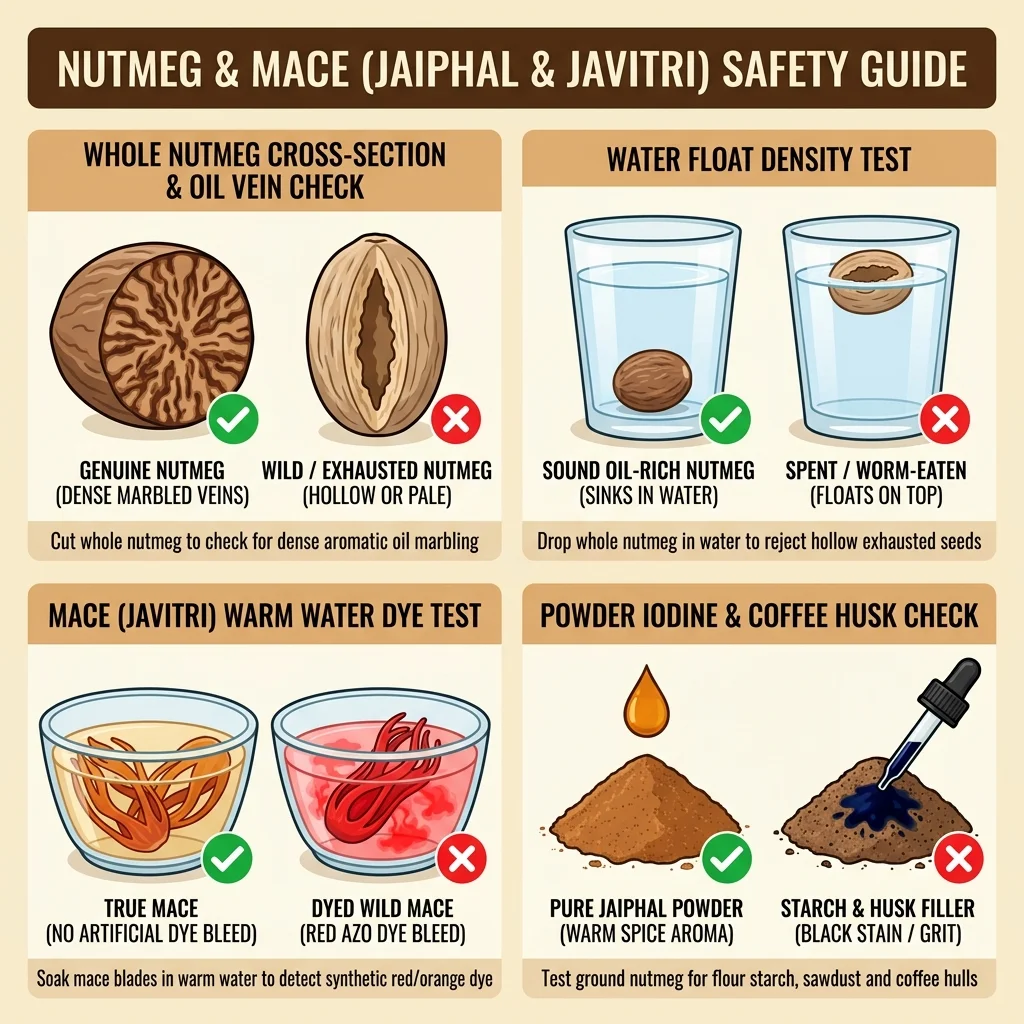
# How to Audit Your Holiday Spice Rack in 3 Minutes
- Whole Nutmeg — Water Float & Cross-Section Vein Test:
- Drop whole nutmeg kernels into a bowl of water. Sound, essential-oil-rich nutmegs have a high density and sink rapidly to the bottom. Exhausted (steam-distilled), immature, or beetle-hollowed nutmegs float bobbing at the top.
- Cut a nutmeg kernel in half before grating: genuine Myristica fragrans is plump and oval with dark reddish-brown, waxy oil veins marbling a cream interior and an intense sweet-spicy myristicin fragrance. Elongated, pale, corky, odorless kernels are wild Bombay Nutmeg (Myristica malabarica). If you see grey-green or black powdery dust inside an internal cavity, discard the seed immediately—nutmeg is one of the top spices flagged by EU RASFF and the US FDA for heat-stable Aflatoxin B1 and Ochratoxin A.
- Mace Blades — Warm Water Dye Leach Check:
- True mace consists of supple, horn-like crimson-orange to amber blades that exude essential oil when pressed with a fingernail.
- Fraudsters take pale, papery, odorless wild Myristica malabarica arils and coat them in synthetic red/orange azo dyes. Soak 2 blades in warm water for 5 minutes: genuine mace leaves water clear or faintly straw-tinted, whereas dyed wild mace bleeds bright red or orange chemical dye.
- Cinnamon — True Ceylon Cinnamon vs. High-Coumarin Cassia:
- Over 90% of ground "cinnamon" sold in US and international supermarkets is actually Cassia (Cinnamomum cassia), not True Ceylon Cinnamon (Cinnamomum verum).
- Whole Ceylon cinnamon quills look like a delicate, multi-layered cigar roll of paper-thin tan bark that crumbles easily and contains negligible coumarin (<0.004%). Cassia forms a thick, hard, single-layer hollow scroll and contains up to 1% Coumarin—a natural hepatotoxin that can trigger reversible liver enzyme elevation when consumed heavily in holiday cinnamon rolls, snickerdoodles, and mulled cider.
- Drop whole Cloves in a glass of water: fresh buds rich in eugenol oil sink or float vertically (head up, stem down), while spent de-oiled cloves float flat horizontally.
- Inspect Star Anise pods for mulled wine: culinary Chinese star anise (Illicium verum) has plump, 8-pointed boat-shaped follicles with a sweet licorice scent. Reject shriveled, hook-beaked pods with a harsh turpentine/cardamom smell, which indicate adulteration with toxic Japanese Star Anise (Illicium anisatum) containing neurotoxic anisatin.
- For spiced Pfeffernüsse and gingerbread, float Whole Black Pepper in water/alcohol to spot hollow berries or dried Papaya seeds.
Part 2: The Pre-Soak Dried Fruit & Tree Nut Audit (Before You Bake)
In classic fruitcakes, Panettone, Stollen, and holiday nut pies, dried fruits and tree nuts represent up to 50% of the recipe weight. If a single rancid or moldy ingredient enters your soaking jar or batter, its mineral oil, sulfites, or mycotoxins will taint the entire batch. Perform this 5-minute check before chopping:
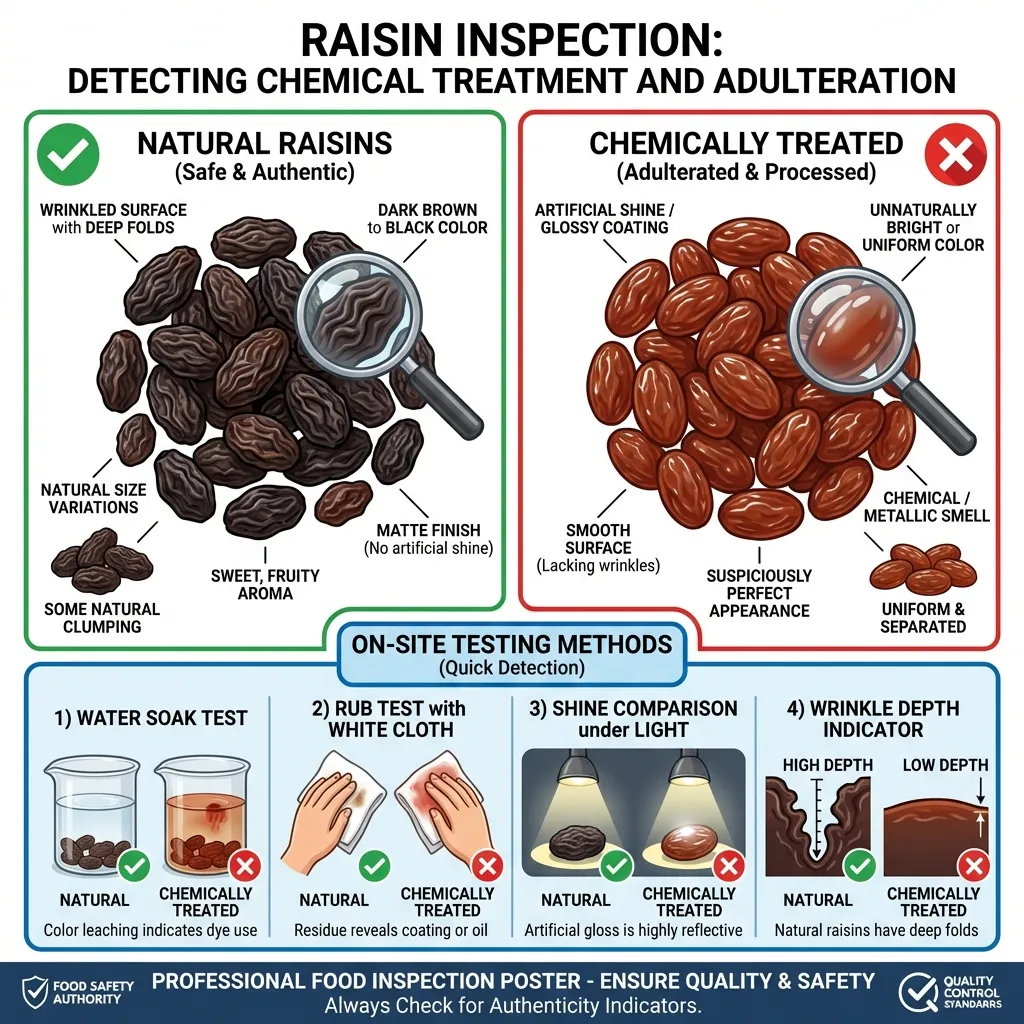
- Raisins & Sultanas: Rub a handful vigorously on white paper. A slick, translucent grease stain indicates petroleum mineral oil (liquid paraffin) applied to prevent clumping and fake a glossy sheen. Steep golden raisins in hot water and sniff the steam: a sharp burnt-matchstick odor reveals excessive Sulfur Dioxide (SO2) bleaching.
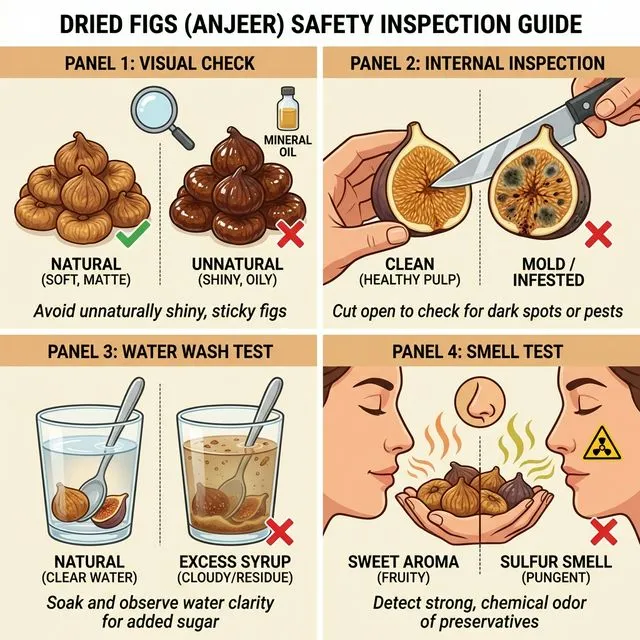
- Dried Figs & Medjool / Deglet Noor Dates: Never chop whole figs or dates blindly! Always slice every fig and date open lengthwise first. Inspect the internal seed cavity of figs and the pit channel of dates under bright light for black powdery Aspergillus niger mold spores (a major carrier of nephrotoxic Ochratoxin A), white sugar mites, or webbing.
- Glacé Cherries, Dried Apricots, Prunes / Dried Plums & Dried Cranberries / Berries: Commercial bright-red glacé cherries are heavily bleached with sulfur dioxide (SO2) to strip their natural pigment before being boiled in corn syrup and FD&C Red No. 40 or Red No. 3 (Erythrosine). Rinse and soak in warm water for 10 minutes to leach out excess surface dye and sulfites, or choose cherries colored with natural beet/blackcurrant juice.
- Almonds, Cashews, Walnuts & Pistachios:
- Bite one kernel from each bag before baking. A sharp, bitter, soapy, or "old oil paint" aftertaste in Walnuts, pecans, or Almonds indicates lipid peroxidation (oxidized polyunsaturated fats)—roasting will not fix rancid nuts and will ruin a holiday pie or cake.
- Rub bright green Pistachios with a damp white tissue to ensure cheap yellowed kernels haven't been sprayed with synthetic green dyes.
Part 3: Essential Holiday Baking Staples — Dairy, Sweeteners, Cocoa & Extracts
Beyond fruits and spices, the structural chemistry of holiday cookies, pies, and confections depends on butterfat, flours, sweeteners, cocoa, and flavor extracts. Here is how to verify both our linked Food Guard staples and additional holiday pantry essentials:
1. Dairy Butter, Clarified Butter (Ghee), Milk, Eggs & Table Salt
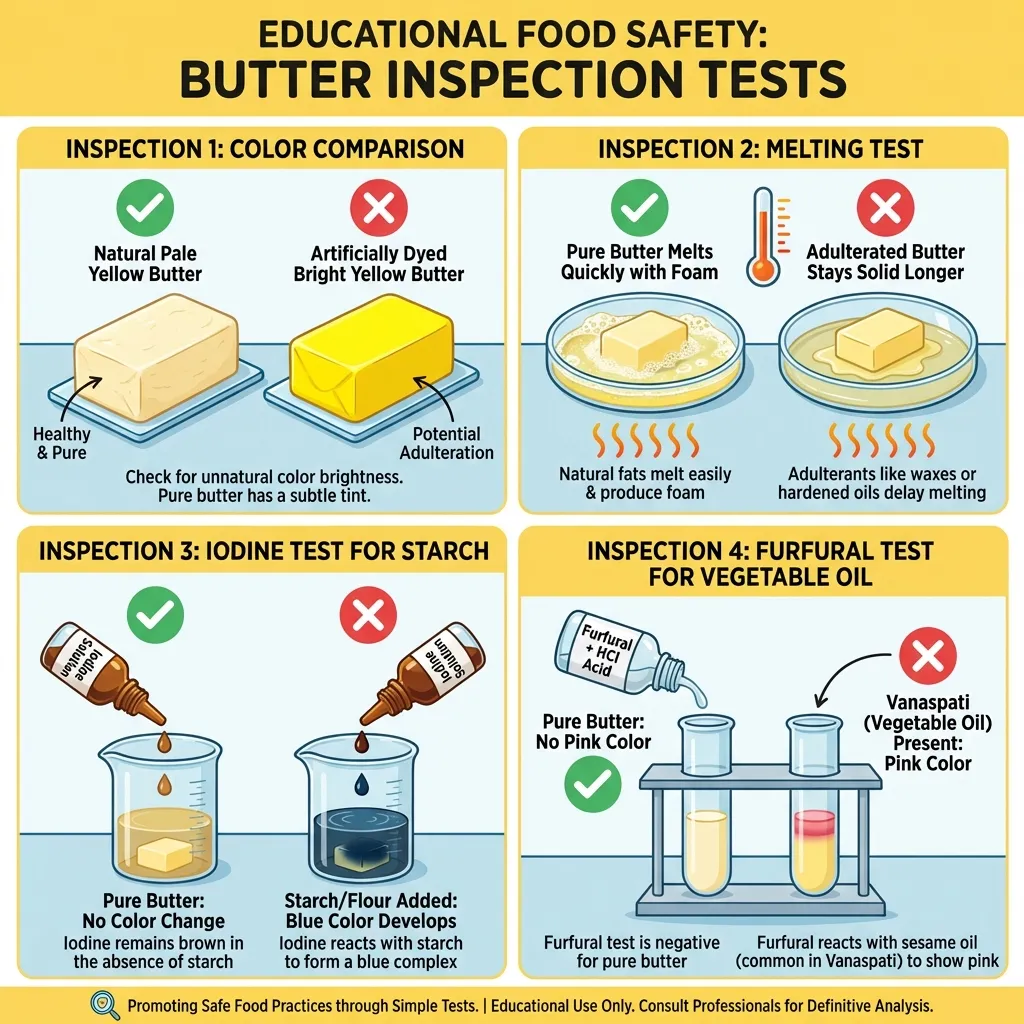
- Butter vs. Vegetable Shortening & Palm Blends: Melt 1 teaspoon of Butter gently in a clear glass dish: pure dairy butter separates cleanly into golden butterfat and a thin layer of white milk solids that brown with a nutty aroma when heated. Adulterated butter blended with palm oil or hydrogenated vegetable shortening leaves a cloudy, waxy film and turns blue with iodine if starchy moisture-binding fillers were added.
- Egg Freshness & Shell Safety (For Eggnog, Custards & Meringues): Before cracking Eggs for holiday eggnog, yule log sponge, or royal icing, perform the Cold Water Bowl Float Test: fresh eggs sink horizontally to the bottom, whereas stale eggs with enlarged internal air cells float upright and must be discarded.
- Flour & Salt Purity: Inspect All-Purpose & Pastry Flour and Table Salt in water to rule out insoluble mineral whiteners, chalk (CaCO3), or storage pest contamination before mixing holiday doughs.
2. Cane Sugar, Raw Sugar / Jaggery, Honey, Pure Maple Syrup & Dark Chocolate
- Powdered / Confectioner's Sugar Starch Check: Commercial powdered sugar used for royal icing, peppermint bark, and dusting Stollen is permitted up to 3–5% food-grade cornstarch as an anti-caking agent, but budget bulk packs are sometimes cut with 20–35% cheap flour, calcium carbonate chalk, or titanium dioxide. Stir 1 tablespoon of powdered sugar in warm water: pure sugar + trace cornstarch forms a slightly hazy liquid with minimal sediment, whereas chalk settles as a heavy white sludge that fizzes with Lemon juice.
- Pure Maple Syrup & Honey (Maple Syrup, Honey & Unrefined Cane Sugar): Pure Grade-A dark Maple Syrup and raw Honey are prime targets for dilution with cheap high-fructose corn syrup (HFCS), cane invert syrup, or rice syrup flavored with synthetic fenugreek/caramel esters. Use our linked guides to check viscosity crystallization and water-drop thread integrity.
- Dark Chocolate & Couverture (Upcoming Guide): True couverture baking chocolate (used in Bûche de Noël, ganache, and Peppermint Bark) uses 100% Cocoa Butter, which snaps crisply at room temperature and melts sharply just below human body temperature (93°F / 34°C). Cheap "compound baking chocolate" or "confectionery coating" replaces cocoa butter with hydrogenated palm kernel or coconut oil, leaving a greasy, waxy film on the palate.
3. Additional Holiday Pantry Essentials to Test at Home (Upcoming Food Guard Profiles)
Even for specialized holiday baking ingredients whose dedicated BioLens scanner profiles are upcoming, you can run these rapid laboratory-principled checks right in your kitchen:- Cocoa Powder (Used in Yule Logs, Chocolate Crinkle Cookies, Hot Cocoa & Fruitcakes):
- Primary Fraud: Adulteration with pulverized cocoa bean shells/husks, roasted chicory, cereal starch, or red iron oxide / mineral earth to darken cheap alkalized powder, alongside soil-absorbed heavy metals (Cadmium and Lead—flagged in recent US Consumer Reports audits of dark chocolate and cocoa powders).
- 60-Second Home Test: Stir 1 teaspoon of cocoa powder into a glass of cold water and let stand for 2 minutes. Pure cocoa powder stays suspended or settles very slowly as a fine, velvety layer. Gritty, dark brown or reddish particles sinking rapidly to the bottom indicate ground cocoa shells or mineral earth; adding iodine to a boiled-and-cooled diluted sample reveals cereal starch filler.
- Pure Vanilla Extract vs. Imitation Vanillin & Toxic Tonka Bean Extract:
- Primary Fraud: Over 90% of cheap "vanilla flavoring" sold globally contains zero Vanilla planifolia bean extract—it is made from synthetic vanillin synthesized from petrochemical guaiacol or paper-pulp lignin. Far more dangerously, some bargain holiday "Mexican Vanilla" bottles sold to tourists or online are actually made from Tonka Bean Extract (Dipteryx odorata), which is strictly banned in food by the US FDA (21 CFR 189.130) because it contains high concentrations of Coumarin (a potent hepatotoxin and anticoagulant drug precursor that causes liver damage and internal bleeding).
- 60-Second Home Test: Check the label for the exact legal designation "Pure Vanilla Extract" (requiring 13.35 oz of vanilla beans per gallon in a minimum 35% alcohol base under US FDA 21 CFR 169.175). Place 2 drops on white blotting paper and let the alcohol evaporate for 15 minutes: synthetic vanillin leaves a flat, one-dimensional scent and often precipitates white needle crystals, whereas genuine pure vanilla extract (containing 250+ organic compounds) evolves into a complex, warm, woody-floral aroma with tiny natural amber resin droplets.
- Sweetened Condensed Milk (Used in Holiday Fudge, Magic Cookie Bars, Tres Leches & Pumpkin Pie):
- Primary Fraud: Substitution of whole cow's milk fat with refined palm oil or palmolein ("Filled Milk" or "Sweetened Dairy Creamer"), corn syrup solids, and starch thickeners.
- 60-Second Home Test: Dilute 1 teaspoon of condensed milk in 2 tablespoons of warm water and add 1 drop of tincture iodine. Pure whole milk + sucrose stays creamy yellow-amber; starch-thickened imitation condensed milk turns blue-violet. Always check the fine print on the can: if it lists "Vegetable Oil / Palm Oil" instead of "Milk and Sugar", it is a filled-milk substitute.
- Semolina, Cornmeal & Desiccated Shredded Coconut (Used in Holiday Macaroons, Seven-Layer Bars & Semolina Cakes):
- Primary Fraud: Desiccated Shredded Coconut is frequently spent copra meal (from which natural coconut oil has already been mechanically extracted for the cosmetics industry) bleached snow-white with Sulfur Dioxide (SO2) or coated in propylene glycol, while coarse grain meals like Semolina can harbor storage weevils or metallic grit.
- 60-Second Home Test: Press a pinch of Desiccated Coconut firmly inside folded white paper for 30 seconds: genuine full-fat shredded coconut leaves a natural coconut-oil spot and tastes rich and milky, whereas spent copra meal leaves the paper bone-dry and chews like tasteless sawdust. Steep a spoonful in hot water and smell the vapor to check for pungent SO2 bleach.
5 Golden Rules for a Safe, Chemical-Free Holiday Baking Season
- Audit Every Bakery & Confectionery Label for E-Numbers, Dyes & Fats: Reject store-bought fruitcakes, stollen, and holiday candies that list Class III/IV Caramel Color (E150c/E150d), Titanium Dioxide (E171), FD&C Red No. 3 (Erythrosine) / Red No. 40, Hydrogenated Palm Kernel Oil, or Artificial Flavors instead of real dairy butter, aged dried fruits, and pure botanical extracts.
- Wash & Slice Dried Fruits Before Macerating: Even when buying premium Raisins, Dried Figs, Dates, and Candied Citrus Peel, give them a 3-minute rinse in warm water and pat thoroughly dry before soaking in spirits or juice—this strips away up to 70% of surface sulfur dioxide (SO2) and mineral oil polish. Always slice whole figs and dates open to rule out internal Aspergillus mold.
- Buy Whole Holiday Spices & Grate Fresh: Pre-ground "Pumpkin Pie Spice" or "Mixed Cake Spice" is the easiest hiding place for high-coumarin Cassia bark, spent clove stems, and nutshell fillers. Buy whole Nutmeg & Mace, True Ceylon Cinnamon, Whole Cloves, Star Anise, and Green Cardamom, perform the water float test, and grate fresh.
- Control Water Activity (aw) When Aging Fruitcakes & Storing Marzipan: Wrap maturing Holiday Fruitcakes in brandy-brushed parchment paper and foil inside an airtight tin in a cool cupboard, and refrigerate Marzipan below 40°F (4°C) if prepared with egg whites.
- Never Scrape Off Visible Mold from Soft Cakes or Nut Pastes: Unlike hard aged cheeses, porous baked goods and moist almond pastes allow invisible fungal hyphae and heat-stable mycotoxins (Aflatoxins, Ochratoxin A) to penetrate deep into the loaf.
Explore Interactive BioLens Food Guard Safety Profiles
Click any card below to launch the interactive Risk Calculator Checklist, Multilingual Local Names, and Lab vs. Home Test Guides for your holiday baking ingredients:
Test 157+ Foods, Spices & Festive Sweets at Home
Explore interactive purity checklists, 60-second kitchen chemistry tests, freshness comparison guides, and multilingual safety profiles across 15+ languages.