Candied Peel & Tutti-Frutti Adulteration & Freshness Guide: Detect Synthetic Azo Dyes, Dyed Papaya Fraud, Sulfites & Saccharin
You can test Candied Citrus Peel and Tutti-Frutti at home for cheap boiled raw papaya cubes masquerading as real candied citrus peel or berries, overdosed or banned synthetic azo/malachite dyes, excessive sulfur dioxide (SO2) bleaching, artificial saccharin sweetener, and mineral oil anti-clumping coatings using the 5-Minute Warm Water Dye Leach Test, the Macro Zest-Pore Inspection, and the Hot Water Sulfite Odor Check. Post-harvest citrus peel fungicides (imazalil/thiabendazole) require laboratory LC-MS/MS analysis.
Drop Candied Peel & Tutti-Frutti photo here to test purity
or click to browse • Supports JPG, PNG, WEBP • Paste with Ctrl+V
Inspection Guide
Click to enlarge
How to Test Candied Peel & Tutti-Frutti for Fake Papaya, Chemical Dyes & Sulfites at Home
🔬 Scientific Home Adulteration Tests
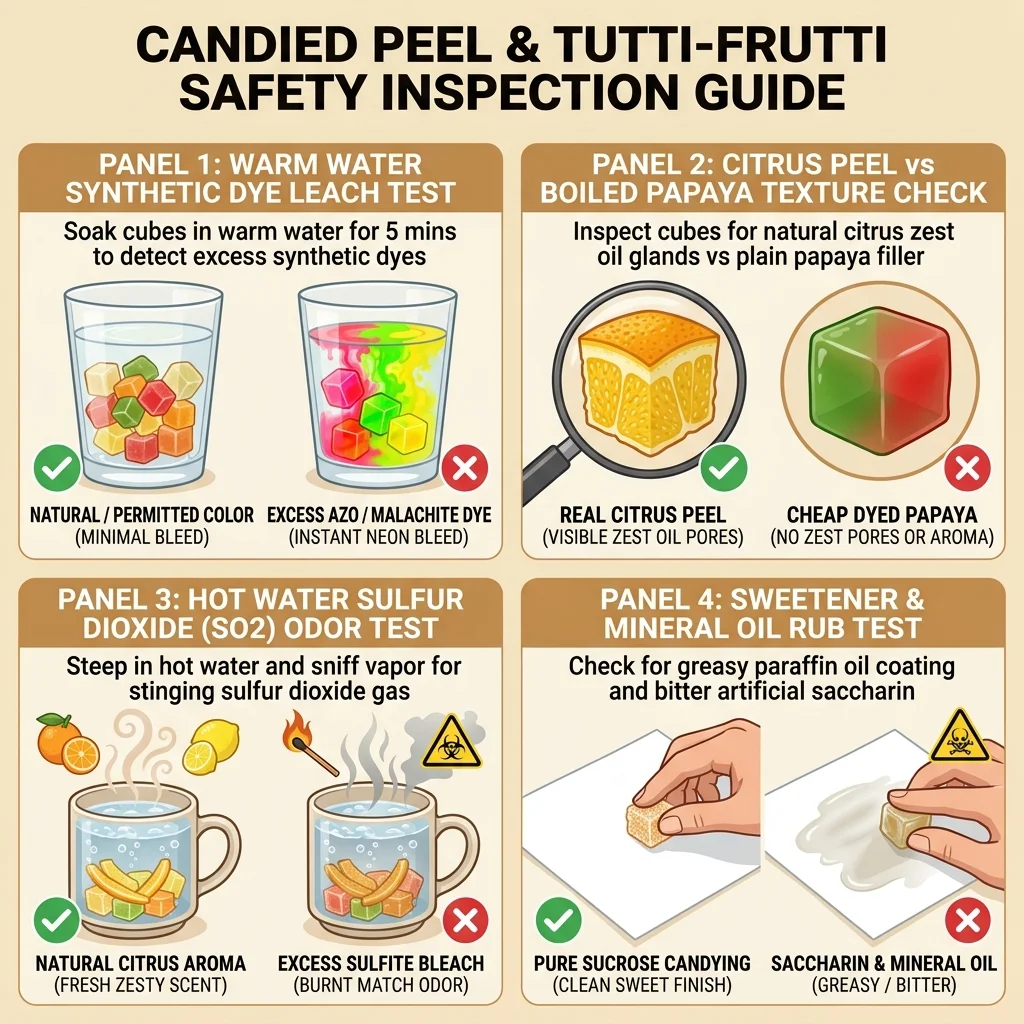
1. Macro Zest-Pore & Fiber Inspection (Real Candied Citrus Peel vs. Dyed Papaya Fraud)
Rinse 4–5 cubes of "mixed candied peel" in lukewarm water, blot dry, slice a cube in half, and inspect the surface under bright light (or phone camera zoom).
- Genuine Candied Orange / Lemon Peel: Shows two distinct anatomical layers—a colored outer flavedo dotted with tiny spherical essential-oil glands (zest pores) and a denser inner pith (albedo). Pressing or biting releases an unmistakable burst of natural citrus zest oil.
- Dyed Raw Papaya (Tutti-Frutti Substitution): Uniformly smooth, featureless, semi-translucent cellular blocks on all 6 sides with zero oil pores, zero rind curvature, and zero natural citrus zest aroma.
2. 5-Minute Warm Water Dye Leach Test
Place 1 tablespoon of red, green, and yellow tutti-frutti or candied peel cubes into a clear glass of warm water (50°C) with 3 drops of white vinegar and stir for 2 minutes.
- Naturally Colored or Properly Processed Fruit: Water remains nearly clear or takes on a very faint pastel tint while the fruit cubes retain their internal color.
- Overdosed Azo Dyes / Malachite Green / Rhodamine B: Within 60–120 seconds, intense neon crimson, fluorescent green, or bright yellow dye bleeds into the water, leaving the cubes pale and blotchy.
3. Boiling Water Vapor Check for Sulfur Dioxide (SO2) Bleach
Steep 1 tablespoon of candied peel or tutti-frutti in half a cup of freshly boiled water, cover with a saucer for 1 minute, lift the cover, and cautiously sniff the steam.
- Clean Osmotically Candied Fruit: Releases a sweet, fruity, or fragrant orange-lemon blossom aroma.
- Sulfite-Bleached Stock: Emits a sharp, stinging, burnt-matchstick odor (SO2 gas) that irritates the nostrils, confirming heavy metabisulfite bleaching.
4. Blotting Paper Mineral-Oil Rub & Saccharin Taste Audit
Press and rub several dry cubes firmly onto a sheet of white tissue or blotting paper, then taste one rinsed cube.
- Pure Sucrose-Candied Cubes: Leave either a dry sugar crystal trace or a water-soluble syrup mark that dries without a translucent grease halo, and taste cleanly sweet.
- Mineral Oil & Saccharin Adulterated: Leave a permanent, non-drying translucent grease stain on the paper (petroleum mineral oil coating) and a harsh, lingering metallic-bitter aftertaste on the tongue (sodium saccharin).
Click to enlarge
Candied Peel & Tutti-Frutti Freshness, Brix Stability & Storage Guide
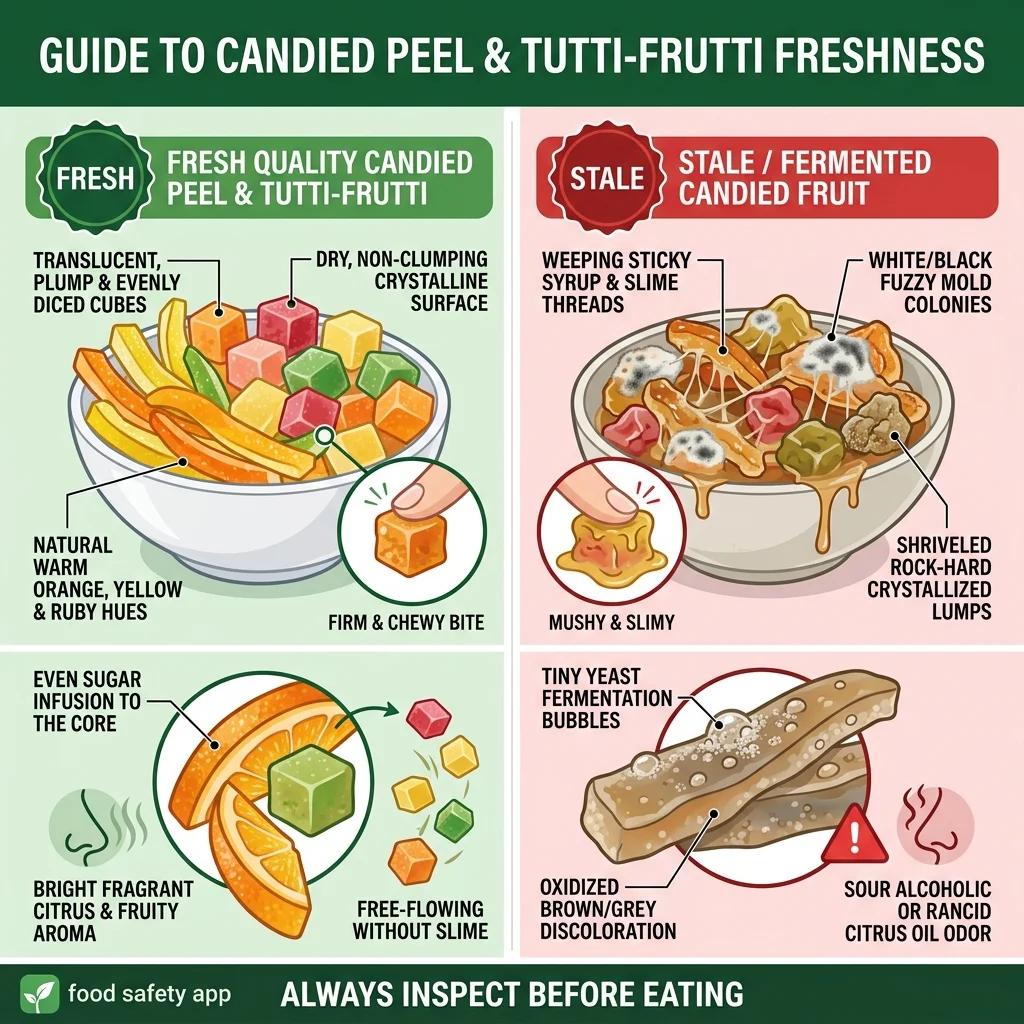
📊 Fresh Quality vs. Stale / Fermented Candied Peel & Tutti-Frutti Comparison
| Quality Marker | ✅ Fresh Properly Candied Peel & Tutti-Frutti | ❌ Stale / Fermented / Under-Candied Stock |
|---|---|---|
| Cube Appearance & Flow | Plump, jewel-like, semi-translucent cubes or strips that flow freely without sticking | Clumped into a wet, slimy mass, OR shriveled into rock-hard sugar-crusted pebbles |
| Surface Moisture | Dry micro-crystalline sugar glaze; zero pooling liquid at the bottom of the jar | Weeping sticky syrup, tiny frothy bubbles, or stringy mucilage threads |
| Bite & Texture | Firm, tender-chewy bite infused evenly with sugar right to the center | Mushy, waterlogged, and disintegrating (low Brix), or tough and leathery |
| Aroma Profile | Bright zesty citrus (orange/lemon peel) or clean fruity sweetness | Sour alcoholic yeast smell, vinegary odor, or paint-like oxidized limonene smell |
🏠 Storage & Shelf-Life Best Practices
- Why Sugar Concentration (°Brix) Matters: Properly candied fruit reaches 68–72° Brix (water activity aw < 0.75), which naturally inhibits bacterial growth for 6 to 12 months in a sealed container. However, cheap budget tutti-frutti is rushed at low sugar concentration (45–55° Brix) to retain water weight—causing it to ferment and grow mold within weeks at room temperature!
- Refrigerate After Opening: Store opened packs of tutti-frutti and candied citrus peel in a clean, dry airtight glass jar in the refrigerator (2–5°C), and always scoop with a dry spoon.
Quick Safety Tips
- Before soaking mixed fruit for Christmas Plum Cake, always rinse commercial tutti-frutti and candied peel in warm water for 2 minutes and drain to wash away excess surface azo dyes and sulfites.
- Look closely for tiny dimpled zest oil pores to verify you are buying real candied orange and lemon peel rather than cheap dyed papaya cubes.
- Avoid glowing fluorescent-green or neon-pink tutti-frutti sold in unsealed roadside plastic sacks.
- When making homemade candied peel, scrub oranges and lemons in warm baking-soda water first to remove post-harvest morpholine wax and surface fungicides.
- Store candied peel and tutti-frutti in an airtight glass jar in the refrigerator once opened to prevent yeast fermentation.
Primary Chemical Concerns
Health Risks & Impacts
Test Individual Raw Ingredients in Candied Peel & Tutti-Frutti
Unlike single raw commodities, prepared sweets and bakery items can harbor adulteration across multiple base ingredients. Click any raw ingredient below to run its dedicated kitchen purity test:
Multilingual Local Names
Common Storage Pests
Osmophilic Yeasts (Zygosaccharomyces bailii) & Xerophilic Molds
high riskPreservative-resistant, sugar-tolerant yeasts and molds that spoil under-candied (< 68° Brix) tutti-frutti and citrus peel.
Detection
- Sticky, weeping syrup pooling at the bottom of the pouch with tiny white foam bubbles
- Sour, fermented wine-like odor and fuzzy white or black mold spots on clumped cubes
Prevention
- Buy dry, free-flowing candied fruit with >= 70° Brix and transfer to a refrigerated glass jar after opening
- Never touch cubes inside the storage jar with wet fingers
Corrective Action: What to do?
Discard the entire pack if any fermentation odor, bubbling, sliminess, or mold is present.
Dried Fruit Beetle (Carpophilus hemipterus) & Sugar Mites
medium riskSap beetles and microscopic mites that infest open bulk sacks of candied peel and tutti-frutti in wholesale markets.
Detection
- Tiny brown beetles (3–4 mm) or bore tunnels inside sticky candied fruit clumps
- Fine dusty frass or gritty debris stuck to the syrupy surface of loose tutti-frutti
Prevention
- Avoid buying loose uncovered tutti-frutti from open market bins; choose sealed food-grade pouches
- Keep pantry jars tightly sealed and refrigerated
Corrective Action: What to do?
Discard insect-contaminated batches immediately.
Regulatory Corner: FSSAI / Codex Alimentarius (CXS 260 / Candied Fruits)
Regulation: FSS (Food Products Standards and Food Additives) Regulations — Clause 2.3.37 (Candied, Crystallized or Glazed Fruit & Peel / Category 4.1.2.7)
Legal Limit:Total soluble solids (TSS) min 70% (°Brix); Permitted synthetic food colors max 100–200 mg/kg; Zero Malachite Green, Rhodamine B, mineral oil, or artificial sweeteners (unless labeled); Sulfur dioxide max 100–350 ppm.
Report Adulteration to FSSAI / Codex Alimentarius (CXS 260 / Candied Fruits)What CANNOT be Verified (Lab-Only)
- HPLC-DAD Synthetic Dye & Illegal Basic Dye Screening (FSSAI Category 4.1.2.7): Quantifies permitted synthetic colors (Ponceau 4R, Carmoisine, Erythrosine, Tartrazine, Sunset Yellow FCF, Brilliant Blue FCF) against regulatory limits and screens for zero-tolerance basic dyes (Rhodamine B, Malachite Green, Auramine O).
- QuEChERS LC-MS/MS Citrus Peel Pesticide Panel: Quantifies systemic post-harvest fungicides (Imazalil, Thiabendazole, Orthophenylphenol, Pyrimethanil) in candied citrus rinds.
- Monier-Williams Sulfite (SO2) & Refractometric Brix Assay: Verifies minimum 68–70° Brix sugar concentration required for microbial stability and measures residual sulfur dioxide.
- GC-FID Hydrocarbons & HPLC Sweetener Assay: Detects food-grade vs. technical mineral oil (MOSH/MOAH) coatings and undeclared saccharin/cyclamate.