How to Tell if Eggs Are Still Good: Salmonella Safety & Cold Water Float Test
⚡ Quick 60-Second Egg Freshness & Salmonella Verdict
Salmonella & Spoilage Hazard: Eggs deteriorate from the inside as moisture evaporates through porous shells, increasing the internal air cell and risking Salmonella enteritidis bacterial proliferation.
Place whole egg in a bowl of cold water. Sinks flat horizontally = very fresh (1–7 days). Stands tilted on end = older but safe to cook. Floats to the surface = spoiled (discard!).
Crack egg onto a flat plate. Fresh egg: yolk stands as a plump high dome surrounded by thick, tight albumen. Stale egg: yolk is flat, breaks easily, and white is watery.
In a dark room, place your smartphone flashlight against the wide end of the shell. Fresh egg shows a tiny air cell (<3mm). Large dark air cell or cloudy spots indicate decay.
Drop Egg photo here to test purity
or click to browse • Supports JPG, PNG, WEBP • Paste with Ctrl+V
Inspection Guide
Click to enlarge
US Egg Purity & Salmonella Safety Audit
Eggs (huevos) are a fundamental kitchen staple, but they present specific safety challenges in the United States. Unlike in Europe, where hens are widely vaccinated against Salmonella and eggs are stored unwashed at room temperature, US egg safety is highly regulated by the USDA. Commercial eggs in the US must undergo a compulsory hot-water wash and chlorine sanitizing spray to eliminate dirt and surface bacteria. However, this process strips away the egg's natural, protective waxy coating (the cuticle or bloom), making the shell highly porous. Therefore, US eggs must be continuously refrigerated at or below 45°F (7°C) to prevent bacteria from entering the pores and multiplying.
1. The Cold Water Float Test (Age Audit):
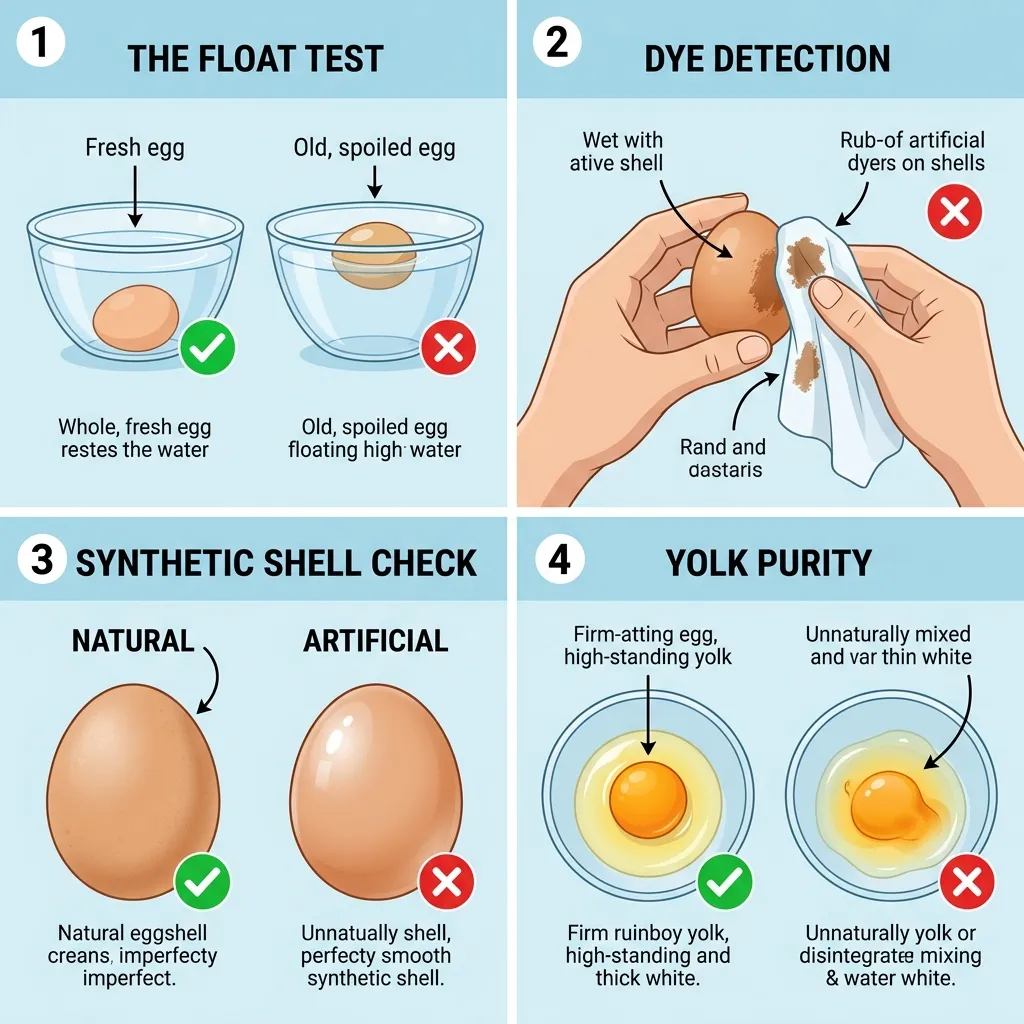
Place the egg in a deep bowl of cold water. A freshly laid egg will sink directly to the bottom and lie completely flat on its side. An egg that is 1-2 weeks old will sink to the bottom but stand upright or tilt slightly; this egg is still perfectly safe to eat. An egg that floats to the surface is very old and must be discarded. Floating occurs because eggshells are porous; over time, moisture evaporates out, and air enters to replace it, causing the air cell at the wide end of the egg to expand and act as a flotation device.
2. Pasteurization vs. Regular Eggs for Raw Dishes:
Raw or undercooked eggs are required in traditional US recipes like Caesar salad dressing, eggnog, hollandaise sauce, and homemade mayonnaise. However, Salmonella enteritidis can infect the egg internally (inside the yolk) before the shell is even formed. For any raw or undercooked preparation, you must exclusively use pasteurized eggs (eggs that have been gently heated in their shells to a precise temperature that kills Salmonella without cooking the egg). Regular eggs should always be cooked until both the yolk and white are completely firm (an internal temperature of 160°F / 71°C).
3. 'Best By' vs. Actual Freshness:
The 'Best By,' 'Sell By,' or 'Expiration' date printed on US egg cartons is a quality guideline, not a safety limit. USDA-graded eggs are usually perfectly safe to eat for 3 to 5 weeks after the purchase date, provided they have been kept continuously refrigerated at or below 45°F (7°C). Use the cold water float test to verify their freshness rather than relying solely on the carton date.
4. Shell Integrity and Micro-Crack Audit:
Inspect the eggshell closely under a bright light. Avoid eggs with hairline cracks, powdery white mold spots, or a damp/sticky surface. Hairline cracks act as direct, open entryways for Salmonella bacteria from the environment.
Click to enlarge
Egg Freshness & Yolk Integrity Audit
Evaluating cracked egg characteristics is the most reliable way to check raw quality.
1. Yolk and Albumen Integrity:
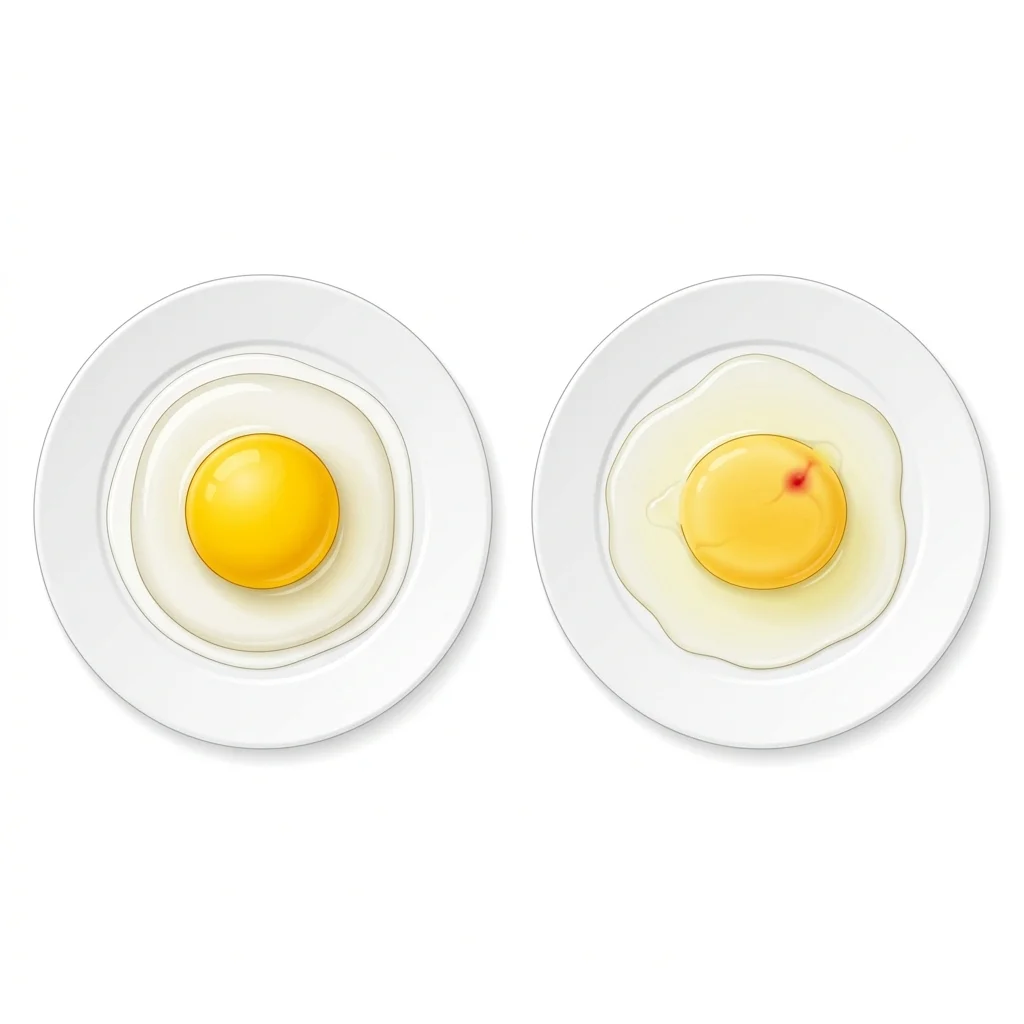
Crack the egg onto a flat plate. A fresh egg has a high, well-domed, rounded yolk, and the white (albumen) is thick, firm, and clings tightly to the yolk. In an old egg, the yolk is completely flat, breaks easily, and the white is watery, thin, and spreads out rapidly across the plate.
2. Sour or Fishy Odor Check:
Fresh eggs have absolutely no smell. If you detect a sour, sulfurous ('rotten egg'), or fishy odor immediately after cracking, the egg is spoiled and must be discarded.
3. Blood Spots Safety:
Occasionally, you may see a tiny red spot on the yolk. This is a blood spot caused by a ruptured capillary during egg formation. It is not an indicator of spoilage or Salmonella; it is completely safe to eat, though you can scoop it out with a spoon for cosmetic reasons.
Quick Safety Tips
- Use the cold water float test: discard any eggs that float to the surface, as they are very old and have a high risk of bacterial growth
- Keep US washed eggs continuously refrigerated at or below 45°F (7°C); never leave them on the kitchen counter at room temperature
- Exclusively use pasteurized eggs for raw preparations like eggnog, Caesar dressing, or hollandaise sauce to avoid Salmonella
- Reject any eggs with visible hairline cracks, damp spots, or those that smell sour or sulfur-like when cracked
Primary Chemical Concerns
Health Risks & Impacts
Multilingual Local Names
Regulatory Corner: US FDA / USDA FSIS / FSSAI (Poultry & Egg Standards 2020)
Regulation: FDA 21 CFR Part 118 (Egg Safety Final Rule) & FSSAI Standards for Table Eggs
Legal Limit:Salmonella enteritidis: Negative in 25g sample; Veterinary antibiotic residues (Chloramphenicol, Nitrofurans): 0.0 ppb (Zero tolerance)
Report Adulteration to US FDA / USDA FSIS / FSSAI (Poultry & Egg Standards 2020)