How to Test Salt for Adulteration (Chalk Powder, Talcum Powder, Microplastics)
⚡ Quick 60-Second Salt Purity & Mineral Filler Verdict
Chalk Powder & Mineral Grit Bulking: Unrefined or adulterated table salt frequently contains insoluble white chalk powder (Calcium Carbonate), gypsum, or sand grit to artificially increase weight, alongside inadequate potassium iodate stabilization.
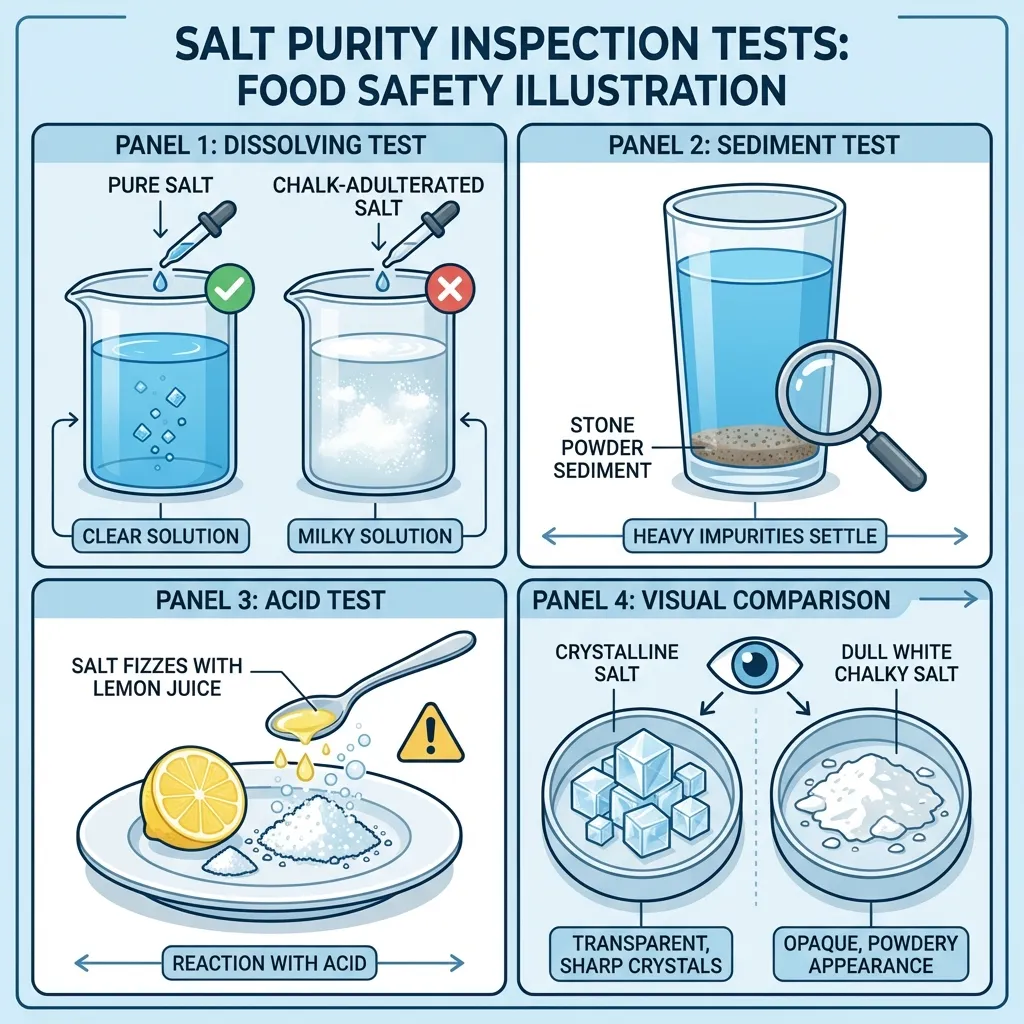
Dissolve 1 tbsp salt in a clear glass of water. Pure refined/iodized salt dissolves completely, leaving water 100% crystal-clear. White turbidity, milkiness, or chalk settling at the bottom indicates adulteration with chalk or plaster.
Add 10 drops of lemon juice or dilute vinegar to 1 tsp dry salt. Pure salt shows zero reaction. Vigorous effervescence or bubbling reveals Calcium Carbonate (chalk powder).
Boil 1 tsp salt in 10ml water, cool, and add 2 drops povidone iodine. A deep blue/purple color indicates illegal starch filler added to create dry-pour texture.
To learn more about food safety tests and home adulteration detection, read our guides on Black Pepper (Whole) and Ayurvedic Products.
Drop Salt photo here to test purity
or click to browse • Supports JPG, PNG, WEBP • Paste with Ctrl+V
Inspection Guide
Click to enlarge
Salt Purity & Safety Audit
Table salt can be adulterated with chalk powder or talc to increase weight or may contain high levels of microplastics from environmental pollution.
1. The Water Solubility Test (Chalk Detection):
Dissolve a spoonful of salt in a glass of clear water. Pure salt will dissolve completely, making the water transparent. If the water remains cloudy or a white sediment (chalk/talc) settles at the bottom, it is adulterated.
2. The Acid Fizz Test:
Take a small sample of salt and add a few drops of lemon juice or vinegar. If the salt starts to fizz or bubble, it contains chalk powder (calcium carbonate). Pure salt will not react.
3. The Microplastic Check (Visual):
Dissolve a large quantity of salt in a liter of water and filter it through a fine white cloth or coffee filter. Examine the residue under bright light. Tiny colorful "fibers" or glassy fragments indicate the presence of microplastics.
4. The Taste and Smell:
Pure salt has zero odor and a clean, sharp salty taste. If it has a chemical "laboratory" smell or feels "chalky" on the tongue, suspect anti-caking agents or mineral fillers.
Quick Safety Tips
- Perform the water solubility test - cloudiness indicates chalk/talc
- Use the acid fizz test to detect calcium carbonate fillers
- Select "Unrefined" Sea Salt or Rock Salt (Sendha Namak) for trace minerals and fewer additives
- Avoid salts with excessive "Anti-caking" agents like Potassium Ferrocyanide
Primary Chemical Concerns
Health Risks & Impacts
Multilingual Local Names
Common Storage Pests
Not Applicable
low riskSalt is a natural preservative and does not host pests.
Detection
- Moisture clumping
Prevention
- Store in a dry, airtight glass or ceramic container
- Avoid using wet spoons
Corrective Action: What to do?
Keep in a dry place to prevent clumping.
Regulatory Corner: FSSAI (Food Safety and Standards Authority of India) / US FDA
Regulation: Food Safety and Standards (Food Products Standards) Regulations 2011, Clause 2.9.30: Iodized Salt & FDA 21 CFR 184.1634
Legal Limit:Sodium Chloride (NaCl): Min 96.0% on dry basis; Iodine content: Min 15 ppm (retail level) / 30 ppm (manufacturer level); Water insoluble matter: Max 1.0%; Chalk powder, gypsum, soapstone filler: 0.0%
Report Adulteration to FSSAI (Food Safety and Standards Authority of India) / US FDA