How to Test Dates for Adulteration (Sugar Syrup, Mineral Oil, Sulfites, Mold)
⚡ Quick 60-Second Dates Purity, Syrup & Mold Verdict
Hidden Sugar Syrup & Internal Infestation Hazards: Low-grade, desiccated dates are frequently soaked in industrial liquid glucose or inverted sugar syrup to artificially increase weight by up to 30%, while old stocks are polished with petroleum mineral oils. Internally, dates often conceal microscopic mites, black frass (insect feces), and toxic Aspergillus mold in the seed cavity.
Pry the date completely open along the seam under bright light. Pure dates reveal clean, amber-translucent fibrous pulp around a smooth stone. Discard immediately if you observe black powdery dust (frass), silky webbing, crawling mites, or greyish fuzz.
Immerse the date in a glass of warm water (~40°C) for 3 minutes without agitating. Natural date skin holds its structure. If a heavy, cloudy syrup layer rapidly dissolves into the water leaving the date shriveled and sticky, it was steeped in artificial glucose.
Gently scrape the shiny outer skin with a clean knife. Pure dates have a natural matte or delicately wrinkled bloom. If an oily, petroleum-scented sheen or waxy flakes coat the blade, the fruit was buffed with non-food grade mineral oil for display.
To learn more about dried fruit and nut safety tests, read our companion guides on Figs (Anjeer), Raisins, Almonds, Cashews, and Peanuts. For a complete seasonal kitchen audit covering all holiday treats and baking staples, read our Christmas & Holiday Baking Food Safety Guide. To inspect traditional Indian sweets and festive ingredients, read our Festive Mithai & Celebration Sweets Safety Guide.
Drop Dates (Khajoor / Medjool) photo here to test purity
or click to browse • Supports JPG, PNG, WEBP • Paste with Ctrl+V
Inspection Guide

Click to enlarge
Dates Purity & Adulteration Inspection Guide
Dried dates are energy-dense superfoods revered across traditional cuisines, but their sticky texture and hollow seed cavity make them prime targets for chemical glazing, weight tampering, and insect concealment.
1. The Mandatory Internal Split Test:
Never consume a whole date without splitting it open lengthwise under bright, direct illumination. High-quality natural dates (such as Medjool, Ajwa, or Deglet Noor) feature a clean, translucent amber flesh that firmly embraces the stone. If you detect fine black powder (insect frass), silken cocoon webbing, dead dried fruit beetles (Carpophilus), or dark powdery mold (Aspergillus niger), discard the date. Washing or cooking does not neutralize heat-stable fungal mycotoxins.
2. The Warm Water Glucose Dissolution Test:
Unscrupulous traders submerge hardened, low-grade dates in boiling industrial liquid glucose or inverted corn syrup baths to plump them up and add 20–35% fraudulent water weight. Drop 2 dates into a transparent glass of warm water (approx. 40°C) for 3 minutes without stirring. A pure date's skin remains intact, with clear water. If thick, syrupy streaks immediately leach into the water and turn it murky sweet while the date loses its exterior plumpness, artificial syrup soaking is confirmed.
3. Surface Mineral Oil & Wax Scrape:
To make dull, oxidized dates gleam enticingly in open market baskets, sellers spray them with petroleum-based mineral oil or paraffin wax. Rub your thumb firmly across the skin or scrape lightly with a clean knife edge. If your fingers feel greasy, or if scraping yields an oily residue with a faint kerosene or mechanical smell, avoid consuming the skin.
4. Boil Scent & Sulfite Sniff Test:
Golden and amber date varieties (such as Deglet Noor and Zahidi) are frequently over-fumigated with sulfur dioxide gas to artificially prevent natural darkening and eradicate pest larvae. Place 2 dates in a small cup of boiling water for 90 seconds. Inhale the rising vapor gently. Pure dates release a warm, honey-caramel aroma. A sharp, stinging, matchstick chemical odor indicates unsafe sulfur dioxide residues.
5. The Tongue & Sweetness Balance Test:
Natural dates contain complex fruit sugars (fructose, glucose, and trace sucrose) accompanied by dietary fiber, delivering a rich, caramel-like sweetness with an earthy finish. Dates adulterated with saccharin or artificial glucose hit the front of the tongue with a harsh, cloying sweetness followed by a dry, metallic, or bitter aftertaste.
Click to enlarge
Dates Freshness, Ripeness Stages & Storage Protocol
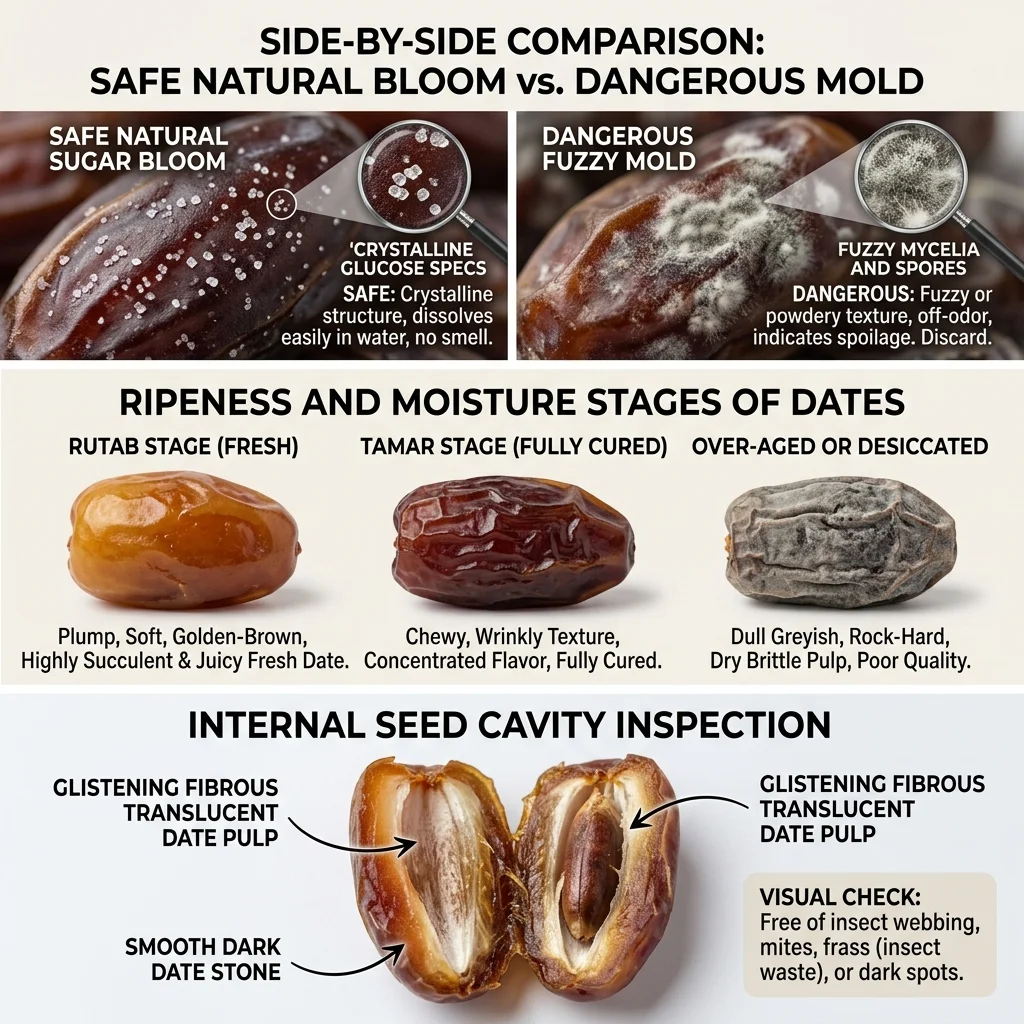
Evaluating date freshness requires distinguishing between harmless natural sugar bloom and dangerous toxic mold, while understanding maturity phases:
1. Natural Sugar Bloom vs. Hazardous Mold:
As whole dates cure and age, natural glucose crystals gradually migrate through the porous skin and precipitate on the surface as tiny white specks or a powdery coating. To verify: touch and moisten the white patch with a drop of warm water on your fingertip. Authentic sugar bloom dissolves immediately, feels slightly gritty, and tastes sweet. By contrast, mold mycelia (Aspergillus, Penicillium) are fuzzy, velvety, or web-like, do not dissolve in water, and release a stale, musty cellar odor.
2. Ripeness & Moisture Classifications:
- Rutab Stage (Fresh/Semi-Ripe): Plump, soft, golden-brown, with 30–35% moisture content. Highly succulent and honeyed, but highly perishable; requires continuous cold storage.
- Tamar Stage (Fully Cured): Sun-cured on the palm, deep rich mahogany-to-ebony color, 18–24% moisture. Wrinkled skin, chewy, pliable flesh, and stable shelf life at room temperature.
- Desiccated / Over-Aged Stock: Dull, ash-grey exterior, rock-hard core, leathery skin separated completely from the pulp, and hollow interior indicating severe moisture depletion.
3. Seed Cavity Anatomy Check:
Upon opening, the seed cavity should reveal an intact, moist date stone nestled against glistening amber pulp fibers. Any presence of black granular dust, insect frass, or tiny crawling dried-fruit mites (Carpoglyphus lactis) renders the fruit unfit for consumption.
4. Proper Storage Protocol:
Store cured Tamar dates in an airtight glass or BPA-free container in a cool, dark, dry pantry (below 20°C) for up to 6 months. For soft varieties (such as Iranian Mazafati, fresh Medjool, or Barhi Rutab), store in the refrigerator (0–4°C) for up to 12 months or freeze for up to 2 years.
Quick Safety Tips
- CRITICAL: Always pry open and inspect the seed cavity under bright light before eating
- Wash whole dates in clean drinking water right before consumption to remove dust and surface residues
- Avoid dates with an oily, slick, wet-look shine sold from unsealed open bulk sacks
- Store soft dates (like Mazafati/Kimia or fresh Rutab) in the refrigerator (<4°C) to prevent fermentation
Primary Chemical Concerns
Health Risks & Impacts
Festive Sweets & Bakery Items Using Dates (Khajoor / Medjool)
Adulterated Dates (Khajoor / Medjool) is frequently concealed inside prepared festive sweets and baked goods. Inspect these composite dishes where Dates (Khajoor / Medjool) is a core ingredient:
Multilingual Local Names
Common Storage Pests
Dried Fruit Beetle (Carpophilus hemipterus)
high riskSmall, oval dark beetles that enter dates on the palm or in warehouse storage.
Detection
- Small entry hole near the calyx/stem end
- Black powdery frass inside the seed cavity
Prevention
- Store in airtight glass or thick plastic containers
- Refrigerate below 4°C
Sawtoothed Grain Beetle (Oryzaephilus surinamensis)
medium riskSlender, brown beetles with serrated thorax edges that attack dried fruits.
Detection
- Visible crawling insects
- Fine powdery debris at the bottom of the packaging
Prevention
- Inspect packages before purchase
- Freeze new purchases for 48 hours to kill eggs
Date Moth (Cadra cautella / Spectrobaphes)
high riskMoths whose larvae spin fine silk webbing and feed on the sweet date pulp.
Detection
- Silken webbing inside the seed cavity
- Clumped frass particles adhering to the stone
Prevention
- Keep containers tightly sealed
- Avoid purchasing from open bulk street displays
Regulatory Corner: Codex Alimentarius (Codex Stan 143-1985 for Dates) / FSSAI / US FDA Defect Action Levels
Regulation: Food Safety and Standards (Food Products Standards and Food Additives) Regulations 2011, Clause 2.3.47 (Dried Fruits); US 21 CFR 110.110
Legal Limit:Total Added Sugar/Liquid Glucose: 0.0% (Zero tolerance in whole dates); Sulfur Dioxide (SO2): Max 100 ppm (with mandatory allergen declaration); Total Aflatoxins: Max 10 ppb; Insect filth / damaged fruit: Max 5% by count; Mineral Oil: Absent
Report Adulteration to Codex Alimentarius (Codex Stan 143-1985 for Dates) / FSSAI / US FDA Defect Action Levels