
Candy Cane & Holiday Peppermint Candy Safety Guide: Detect Titanium Dioxide (E171), Red 3 / Azo Dyes & Paraffin Wax
You can test Holiday Candy Canes and Peppermint Hard Candies at home for insoluble Titanium Dioxide (TiO2 / E171) or mineral chalk whiteners, synthetic Red 3 (Erythrosine) / Red 40 azo dyes vs. natural plant pigments, industrial paraffin wax surface glazes, and synthetic chemical menthol solvents using the Warm Water Dissolution Clarity Test, the Baking Soda pH Dye Shift Test, and the Blade Scrape Float Check. Quantifying trace lead in imported wrappers or exact ppm of E171 nanoparticles requires laboratory ICP-MS analysis.
Drop Candy Cane & Peppermint Hard Candy photo here to test purity
or click to browse • Supports JPG, PNG, WEBP • Paste with Ctrl+V
Inspection Guide
Click to enlarge
How to Test Candy Canes for Titanium Dioxide, Synthetic Red Dyes & Wax at Home
🔬 Scientific Home Adulteration Tests
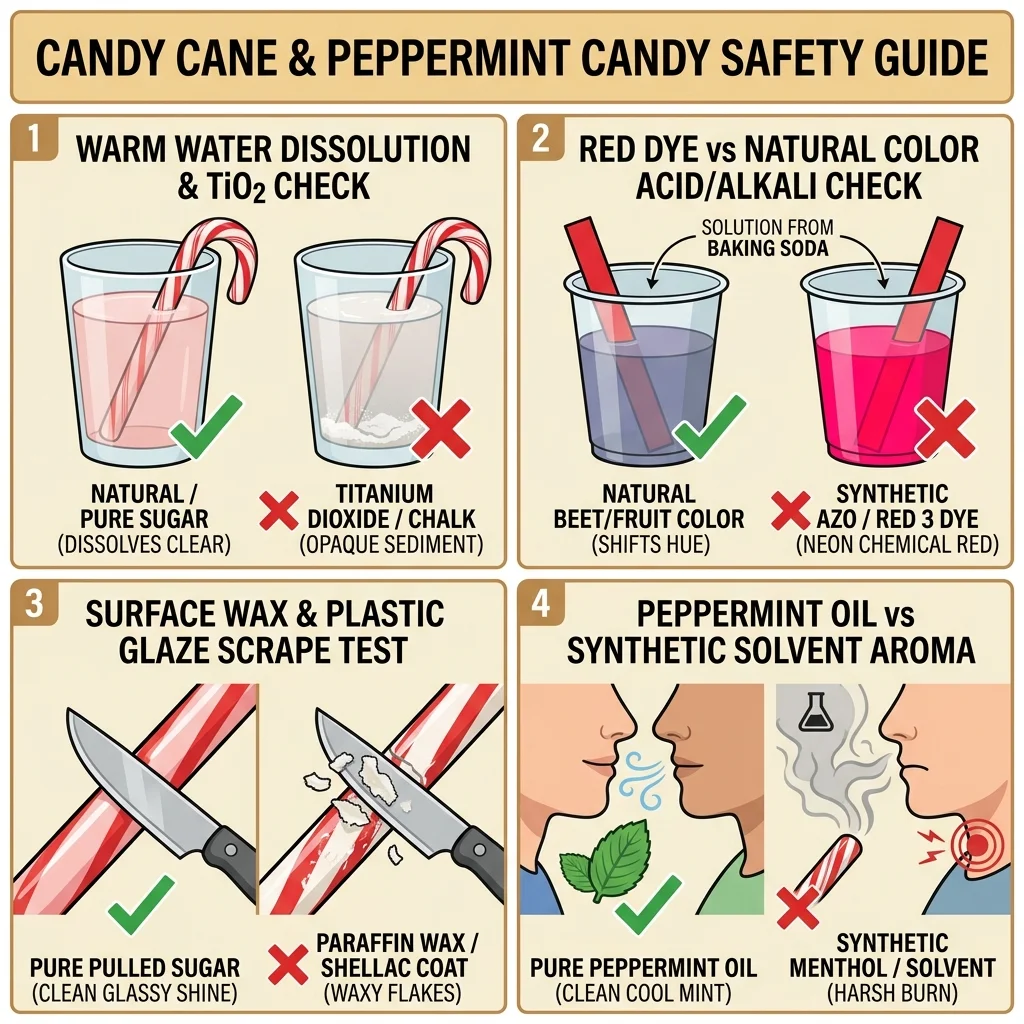
1. Warm Water Dissolution & Clarity Test (Pulled Sugar Air vs. Titanium Dioxide TiO2 / Chalk)
Break off a 3 cm piece of a candy cane (especially the white striped section), drop it into half a glass of warm water (50°C), stir until completely dissolved, and hold the glass against a bright light after 2 minutes.
- Authentic Mechanically Pulled Sugar Candy: The satin whiteness comes from microscopic trapped air bubbles created during hook-pulling. Once dissolved in water, the air escapes and the liquid becomes 100% transparent crystal-clear (or clear pale pink) with zero cloudiness or bottom sediment.
- Titanium Dioxide (E171) or Chalk Adulterated: TiO2 and calcium carbonate are water-insoluble minerals. The water turns permanently milky-opaque or cloudy, and a fine chalky white mineral sediment settles at the bottom of the glass.
2. Baking Soda pH Color-Shift Test (Natural Beet/Berry Red vs. Synthetic Red 3 / Red 40 Dye)
Dissolve the red outer stripe of a candy cane in 2 tablespoons of warm water in a white cup, then stir in 1/4 teaspoon of household baking soda (alkaline sodium bicarbonate).
- Natural Anthocyanin / Beetroot / Elderberry Color: Natural plant pigments are pH-sensitive and shift visibly toward purple, bluish-violet, or brownish-yellow in alkaline baking soda water.
- Synthetic Petroleum Dyes (Red 40, Ponceau 4R, Erythrosine Red 3): Remain unchanged, glowing neon pink-red or fluorescent crimson even after adding baking soda.
3. Blade Scrape & Water Float Test for Paraffin Wax Coating
Unwrap the candy cane and gently scrape the outer glossy surface along its length with the back of a clean butter knife, then drop any scrapings into warm water.
- Pure Hard-Crack Sugar Glaze: Produces only fine, brittle glassy sugar dust that dissolves completely in warm water.
- Paraffin / Mineral Wax Coating: Peels off as greasy, translucent waxy curl flakes that refuse to dissolve and float as oily specs on the surface of warm water.
4. Hot Water Vapor & Palate Cooling Test (Steam-Distilled Peppermint Oil vs. Synthetic Menthol Solvent)
Dissolve a piece of candy cane in a cup of hot water, waft the steam toward your nose, and taste a small piece.
- Pure Mentha piperita Peppermint Oil: Delivers a rounded, herbaceous, sweet-minty aroma and a smooth, gentle cooling sensation (L-menthol) on the tongue.
- Synthetic Chemical Menthol / Solvent Essence: Emits a sharp, medicinal, camphor- or turpentine-like vapor that stings the eyes and leaves a harsh, bitter, burning chemical aftertaste in the throat.
Click to enlarge
Candy Cane Freshness, Texture & Humidity Storage Guide
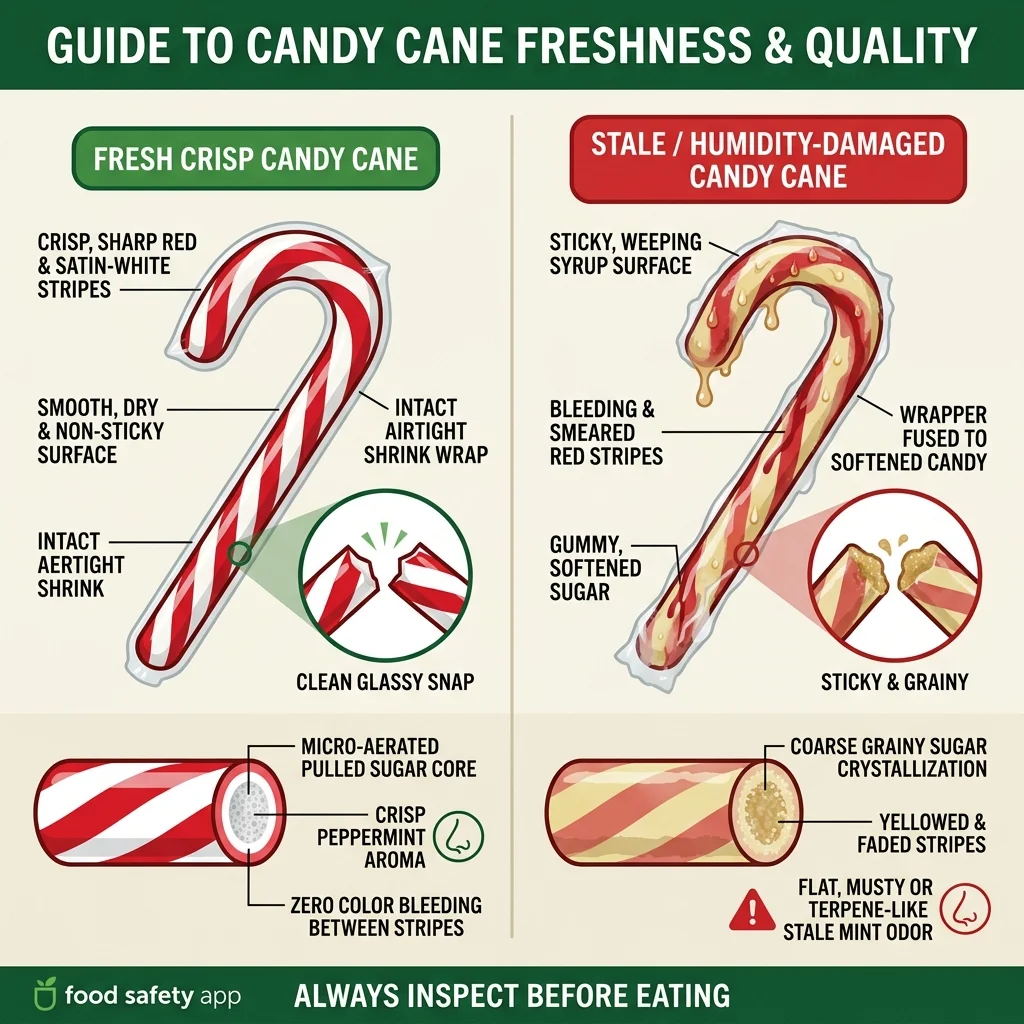
📊 Fresh Crisp vs. Stale / Humidity-Damaged Candy Cane Comparison
| Quality Marker | ✅ Fresh Pulled-Sugar Candy Cane | ❌ Stale / Weeping / Grained Candy Cane |
|---|---|---|
| Surface & Wrapper | Dry, smooth, satin-glossy surface; shrink-wrap slides off cleanly without sticking | Sticky, weeping syrup surface ("sweating"); plastic wrapper fused to the candy |
| Stripe Definition | Razor-sharp contrast between satin-white core and vibrant red/green stripes | Smeared, bleeding red dye running into yellowed, blotchy white sections |
| Fracture & Bite | Breaks with a crisp, clean glassy snap; micro-porous pulled core dissolves smoothly | Soft and bendable from humidity, OR crumbly, chalky, and coarse ("grained" sugar recrystallization) |
| Aroma Profile | Bright, cool, herbaceous peppermint (or warm cinnamon) aroma | Flat, musty cardboard smell or harsh oxidized terpene/turpentine odor |
🏠 Storage & Shelf-Life Best Practices
- Protect Against Hygroscopic Weeping: Hard-crack pulled sugar contains less than 1–2% water and is fiercely hygroscopic (absorbs moisture from the air). Once exposed to > 55% relative humidity, the amorphous sugar glass absorbs water, becomes tacky, bleeds dye, and eventually recrystallizes ("grains") into a crumbly, chalky rod.
- Do Not Refrigerate Unsealed: Never place unwrapped or loosely wrapped candy canes in a humid refrigerator—condensation will melt the surface within hours. Store intact shrink-wrapped candy canes in an airtight glass jar with a food-safe silica gel packet in a cool, dark pantry (18–22°C) for up to 12 months.
Quick Safety Tips
- Check the ingredient label for "Titanium Dioxide", "E171", or "INS 171"—authentic pulled-sugar candy canes achieve their white stripes purely through mechanical aeration of sugar and corn syrup without mineral whiteners.
- For young children, choose candy canes colored with natural radish, beet, blackcurrant, or turmeric extracts rather than Red 3 (Erythrosine) or Red 40.
- Ensure the clear plastic shrink-wrap is colorless and that colored ink on the outer wrapper does not rub off onto your fingers or touch the candy directly.
- Store candy canes in cool, low-humidity airtight jars—above 60% humidity, hard candy absorbs moisture, turns sticky, and leaches dye.
- Verify the purity of your base sugar, cinnamon, and cloves when making homemade holiday hard candies.
Primary Chemical Concerns
Health Risks & Impacts
Test Individual Raw Ingredients in Candy Cane & Peppermint Hard Candy
Unlike single raw commodities, prepared sweets and bakery items can harbor adulteration across multiple base ingredients. Click any raw ingredient below to run its dedicated kitchen purity test:
Multilingual Local Names
Common Storage Pests
Sugar Ants (Camponotus & Tapinoma spp.) & Cockroaches
medium riskHousehold pests drawn to microscopic syrup weeping along the twisted ends of candy cane shrink-wrap.
Detection
- Tiny pinholes chewed through the twisted plastic ends of the candy cane wrapper
- Ants trapped inside sticky surface syrup on unsealed holiday ornaments or bowls
Prevention
- Store wrapped candy canes inside sealed glass mason jars rather than open decorative bowls in warm climates
- Inspect wrapper ends before hanging candy canes on Christmas trees or gifting
Corrective Action: What to do?
Discard any candy cane whose individual shrink-wrap is punctured, sticky on the outside, or breached by insects.
Hygroscopic Sugar Graining & Surface Osmophilic Yeasts
medium riskPhysical sugar recrystallization followed by surface yeast growth when absorbed humidity lowers surface sugar concentration.
Detection
- Sticky liquid syrup droplets weeping on the surface followed by a rough, chalky, opaque crust
- Faint fermented or stale musty odor when unwrapping old stock
Prevention
- Keep relative humidity below 50% by storing with a food-grade desiccant packet in a cool cupboard
- Never store hard candies near dishwashers, kettles, or humid windowsills
Corrective Action: What to do?
Discard weeping or sticky candy canes whose wrappers do not peel off cleanly.
Regulatory Corner: US FDA / EFSA (EU Reg 2022/63) / FSSAI
Regulation: FSSAI Category 5.2 (Hard Boiled Sugar Confectionery) & EU Reg 2022/63 (Ban on E171 Titanium Dioxide) & US FDA Red No. 3 Revocation
Legal Limit:Moisture max 2.0%; Sulfated ash max 1.5%; Acid-insoluble ash max 0.2%; Titanium Dioxide (E171) 0% in EU; Permitted synthetic food colors max 100 mg/kg (FSSAI).
Report Adulteration to US FDA / EFSA (EU Reg 2022/63) / FSSAIWhat CANNOT be Verified (Lab-Only)
- ICP-MS & TEM Nanoparticle Characterization (EFSA 2021 Protocol): Detects and quantifies Titanium Dioxide (TiO2 / E171) particle size distribution (< 100 nm nanoparticles) and checks for trace heavy metals (Lead, Arsenic, Cadmium).
- HPLC-DAD Synthetic Colorant Assay (FDA 21 CFR Part 74 / FSSAI): Separates FD&C Red No. 3 (Erythrosine, banned in US foods/ingestibles per 2025 FDA revocation), Allura Red AC (E129), Ponceau 4R (E124), and illegal Rhodamine B.
- Chiral GC-MS Menthol Enantiomer Analysis: Distinguishes natural botanical (-)-L-menthol and menthone from Mentha piperita oil against synthetic racemic DL-menthol synthesized from m-cresol or citral.
- Karl Fischer Titration & Polarimetry: Measures residual moisture (< 1.5% in hard-crack candy) and sucrose-to-glucose inversion ratios.