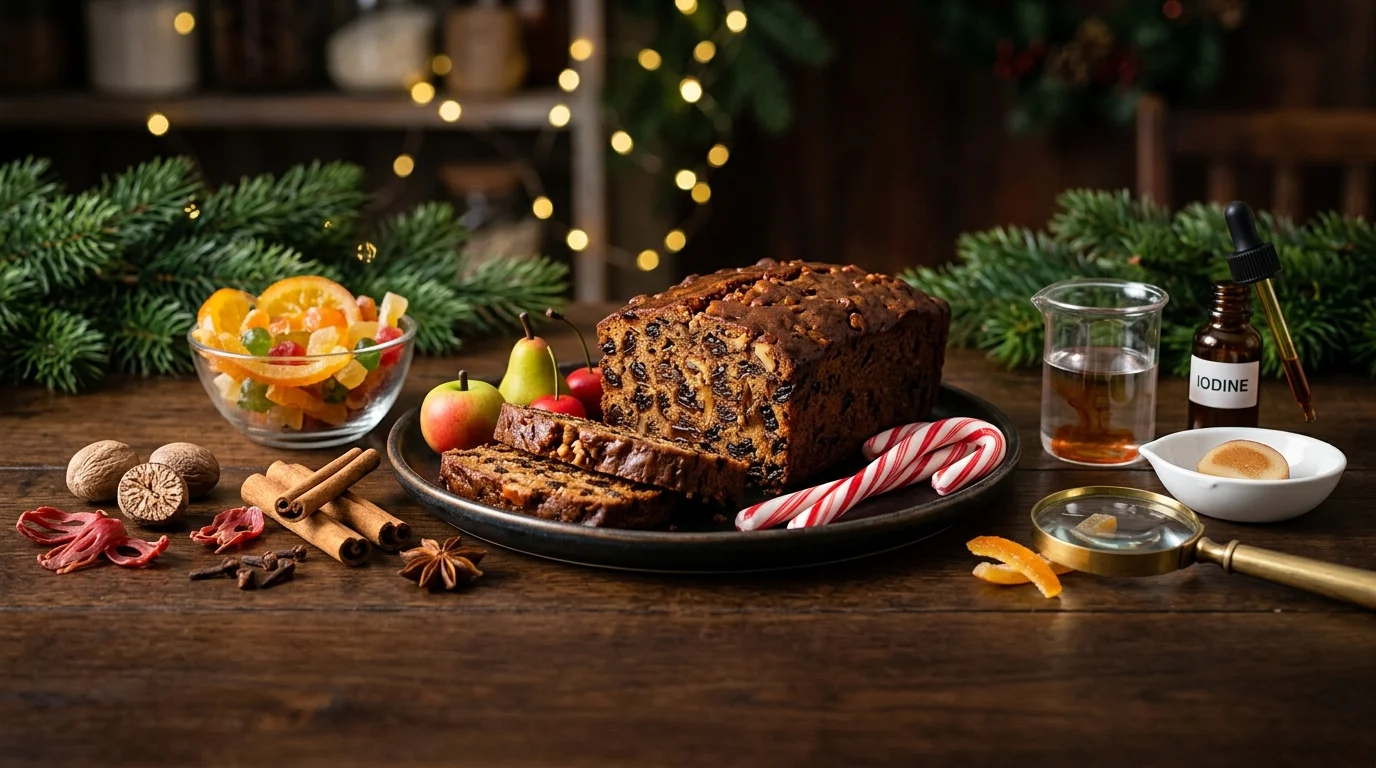
Christmas Plum Cake Adulteration & Freshness Guide: Detect Dyed Papaya, Palm Margarine & Mold
You can detect synthetic azo dyes bleeding from fake tutti-frutti (dyed raw papaya), cheap hydrogenated palm margarine replacing dairy butter, liquid glucose syrup glazes, and internal fungal mold or rope spoilage at home using the Warm Water Dye Leach Test, the Crumb Rub Test, and visual fruit-fiber inspection. Mycotoxins (Ochratoxin A) and exact trans-fat percentages require laboratory GC-MS or HPLC analysis.
Drop Christmas Plum Cake photo here to test purity
or click to browse • Supports JPG, PNG, WEBP • Paste with Ctrl+V
Inspection Guide
Click to enlarge
How to Test Christmas Plum Cake for Adulteration at Home
🔬 Scientific Home Adulteration Tests
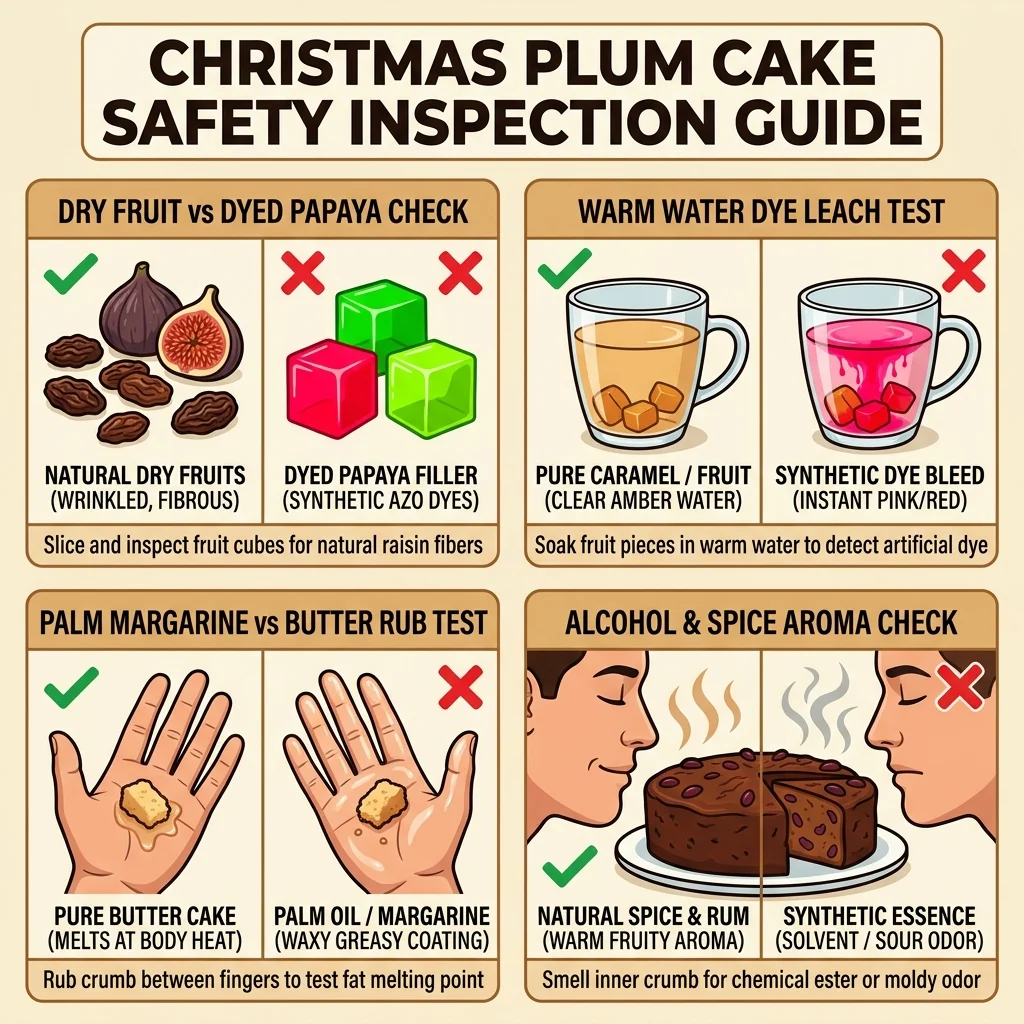
1. Dry Fruit vs. Dyed Raw Papaya Dissection Test
Extract 6–8 fruit pieces from the center of your Christmas plum cake, rinse off the surrounding cake crumb, and slice them in half under bright light.
- Authentic Plum Cake: Contains real wrinkled raisins, tiny crunchy seeds from dried figs, fibrous dates, and aromatic citrus peel with visible oil glands.
- Adulterated Cake: Dominated by uniform, cubical, semi-translucent, rubbery blocks in neon red, green, or yellow. These are boiled raw papaya cubes soaked in sugar syrup and synthetic coal-tar dyes to mimic expensive berries and cherries.
2. Warm Water Dye & Caramel Leach Test
Place a spoonful of extracted cake fruit pieces and dark cake crumb into a glass of lukewarm water (45°C) and stir gently for 2 minutes.
- Pure Cake: The water turns a mild, translucent amber-brown from natural caramelized sugar, jaggery, and fruit tannins.
- Adulterated Cake: The water rapidly turns bright neon pink, fluorescent yellow, or inky black-brown, indicating unbound synthetic azo dyes or excessive industrial ammonia caramel color (INS 150c/d).
3. Finger Rub Fat Melting Test (Butter vs. Palm Margarine)
Take a small piece of cake crumb (avoiding fruit pieces) and rub it firmly between your thumb and index finger for 15 seconds.
- Pure Dairy Butter Cake: Dairy fat melts cleanly at human body temperature (32–35°C), leaving a light, non-sticky sheen and a natural creamy aroma.
- Vanaspati / Margarine Cake: Leaves a thick, waxy, greasy film that refuses to melt at body heat and coats the roof of the mouth when eaten—a classic marker of hydrogenated palm stearin or vanaspati.
4. Spice & Essence Aroma Inspection
Warm a small slice for 10 seconds and smell the interior crumb immediately.
- Authentic Cake: Releases warm, layered notes of real cinnamon, cloves, cardamom, and natural fruit fermentation.
- Adulterated Cake: Emits a sharp, nail-polish-like chemical ester odor (synthetic rum/vanilla essence) or a musty, sour smell concealed under heavy artificial flavoring.
Click to enlarge
How to Judge Christmas Plum Cake Freshness, Aging & Spoilage
📊 Freshness & Quality Comparison
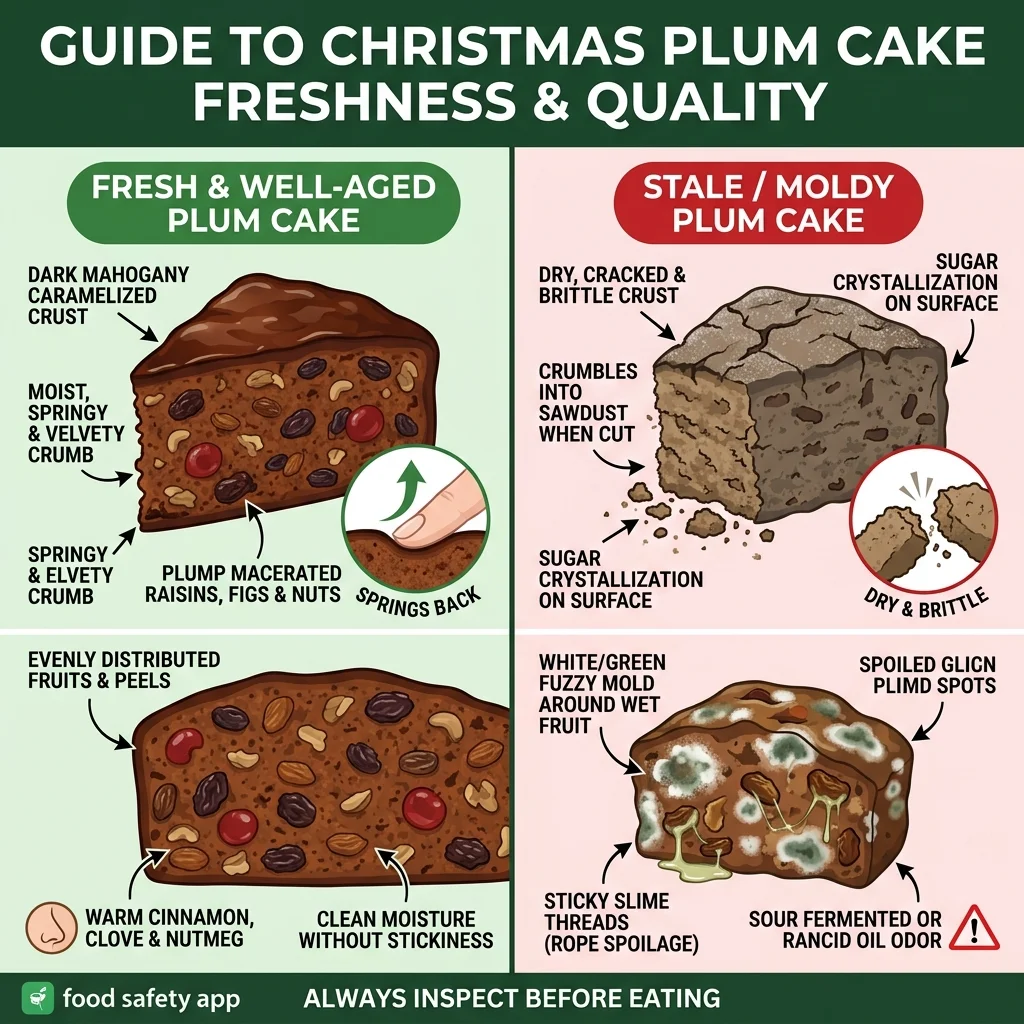
| Quality Marker | Fresh / Properly Aged Plum Cake | Stale / Spoiled / Moldy Plum Cake |
|---|---|---|
| Crumb Texture | Moist, velvety, cohesive; springs back gently when pressed | Dry, crumbly like sawdust, OR sticky/slimy in the center |
| Crust Appearance | Deep mahogany-brown with a natural satin sheen | Cracked, brittle, dull grey-brown, or encrusted with white sugar crystals |
| Fruit & Nut Pockets | Plump, glossy macerated fruits; crisp ivory nut interiors | Shriveled hard fruits, white/green fuzzy mold around wet fruit pockets |
| Aroma & Flavor | Warm caramel, real spices, and mellow dried-fruit sweetness | Harsh sour fermentation, rancid oil ("old paint"), or musty cellar odor |
🏠 Home Storage & Shelf-Life Best Practices
- Alcohol-Aged vs. Non-Alcoholic Plum Cake: Traditional rum- or brandy-macerated cakes have lower water activity (aw < 0.80) and can mature wrapped in parchment and foil in an airtight tin for 4–8 weeks in a cool, dark cupboard.
- Commercial / Juice-Soaked Plum Cake: Cakes made without alcohol have higher free moisture and must be consumed within 5–7 days at room temperature or stored in the refrigerator (wrapped tightly to prevent condensation) for up to 3 weeks.
- Preventing Mold & "Rope" Spoilage: Never store warm cake in plastic wrap; trapped steam creates moisture pockets around raisins and figs where Aspergillus and Penicillium molds proliferate.
Quick Safety Tips
- Inspect the ingredient label — real rich plum cake lists raisins, currants, figs, dates, and butter ahead of candied papaya (tutti-frutti) and hydrogenated vegetable oil.
- Avoid cakes with neon-red or glowing-green cherry toppings that stain the surrounding crumb or paper liner.
- Press the cake crumb gently; if it leaves a sticky, stringy residue or smells like fermenting pineapple, discard immediately due to Bacillus ("rope") spoilage.
- Check roasted cashews and almonds inside the cake for yellowing or a paint-like bitter aftertaste caused by lipid oxidation.
- Always verify individual raw ingredients like raisins, figs, butter, and spices using their dedicated BioLens Food Guard guides before baking at home.
Primary Chemical Concerns
Health Risks & Impacts
Test Individual Raw Ingredients in Christmas Plum Cake
Unlike single raw commodities, prepared sweets and bakery items can harbor adulteration across multiple base ingredients. Click any raw ingredient below to run its dedicated kitchen purity test:
Multilingual Local Names
Common Storage Pests
Dried Fruit Moth / Indian Meal Moth (Plodia interpunctella)
high riskA major pest carried into plum cakes via improperly inspected raisins, figs, dates, cashews, or almonds, or infesting unsealed cakes during storage.
Detection
- Silken webbing threads binding crumbs, nuts, or dried fruit pieces near the crust
- Tiny cream-colored caterpillars (larvae) or fine granular frass inside nut cavities
Prevention
- Inspect all dried fruits and nuts before baking and store finished cakes in airtight metal tins
- Refrigerate non-alcoholic fruit cakes if storing longer than 5 days in warm climates
Corrective Action: What to do?
Discard the affected cake immediately and inspect all open dry-fruit and nut jars in your pantry.
Xerophilic Storage Molds (Aspergillus & Wallemia spp.) & Rope Bacillus
high riskFungi and heat-resistant bacterial spores (Bacillus subtilis) that survive baking inside raw flour or spices and germinate in moist fruit pockets.
Detection
- Fuzzy white, greyish-green, or brown mold colonies forming around moist raisins or cherries
- Sticky, mucilaginous brown threads ("rope") pulling between crumbs accompanied by a sour fruity odor
Prevention
- Cool cakes completely on a sanitized wire rack before wrapping to prevent steam condensation
- Maintain low humidity by wrapping in parchment paper followed by airtight foil inside a cool tin
Corrective Action: What to do?
Do not scrape off visible mold from soft bakery items; mycotoxins and hyphae penetrate deep into the porous crumb. Discard the entire cake.
Regulatory Corner: FSSAI / Codex Alimentarius
Regulation: FSS (Food Products Standards and Food Additives) Regulations — Fine Bakery Wares (Category 7.2)
Legal Limit:Synthetic food colors max 100 ppm (only in candied fruit inclusions); Trans-fat < 2% of total oils/fats; Sorbic acid max 1000 mg/kg; Zero visible mold.
Report Adulteration to FSSAI / Codex AlimentariusWhat CANNOT be Verified (Lab-Only)
- 4-Methylimidazole (4-MEI) in Class III/IV Caramel Color: Requires Liquid Chromatography-Tandem Mass Spectrometry (LC-MS/MS).
- Trans-Fatty Acid Profile & Reichert-Meissl (RM) Value: Determined via Gas Chromatography (GC-FID) of extracted cake lipids.
- Ochratoxin A & Aflatoxin B1 in Macerated Fruits/Nuts: Quantified via Immunoaffinity Column Cleanup with HPLC-Fluorescence Detection.
- Benzoic Acid & Sorbic Acid Preservative Limits: Measured via High-Performance Liquid Chromatography (HPLC-UV) against FSSAI / Codex limits (max 1000 mg/kg sorbic acid in fine bakery wares).