How to Test Silver Foil (Chandi ka Vark) for Adulteration & Animal Gut Contamination
⚡ Quick 60-Second Silver Leaf (Chandi ka Vark) Purity & Vegetarian Verdict
Toxic Aluminum Foil Substitution & Animal Gut Hammering: Commercial festival sweets frequently replace costly pure silver leaf (Ag) with neurotoxic industrial aluminum foil (Al), or utilize unhygienic artisanal vark hammered inside slaughtered ox/bullock intestines (aau) that leaves animal tissues on vegetarian sweets.
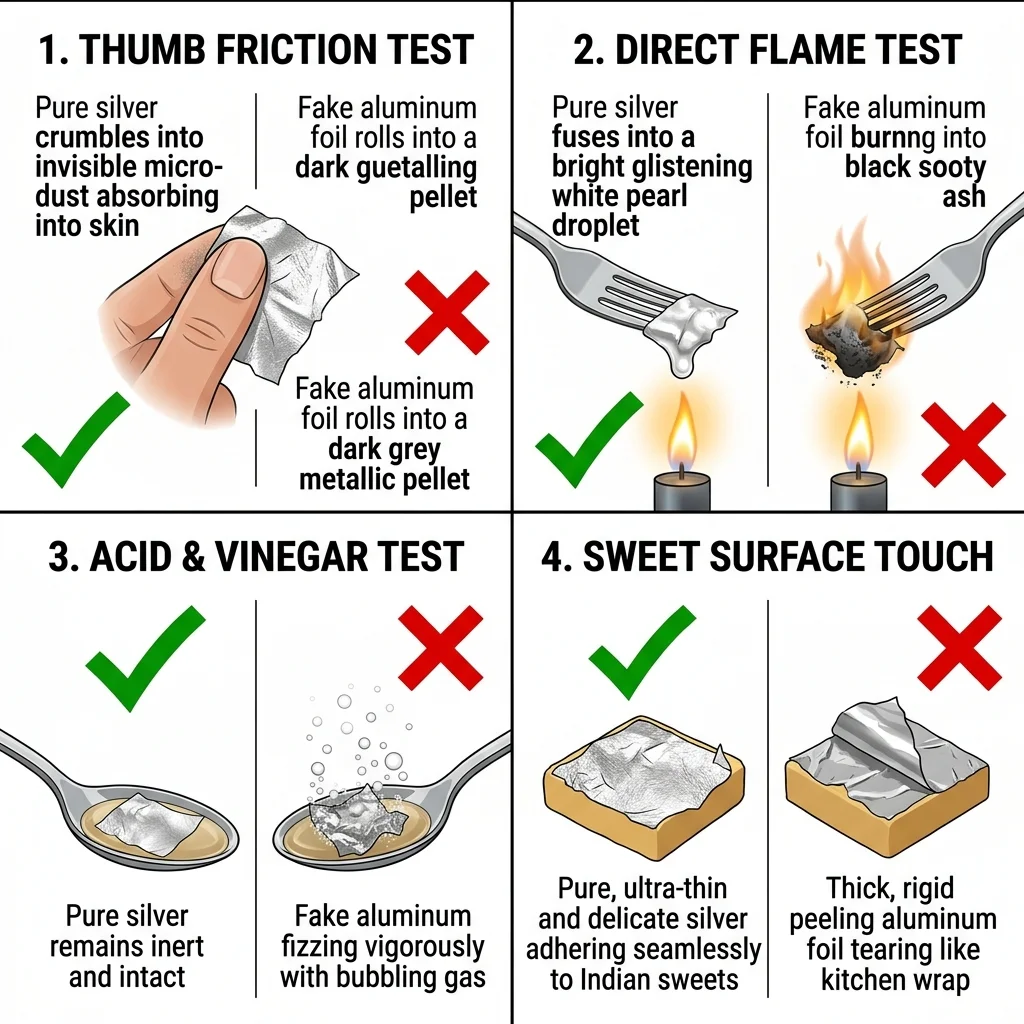
Scrape a flake onto your dry thumb and rub vigorously. Pure silver crumbles into microscopic dust and absorbs invisibly into skin pores. Fake aluminum foil will not crumble; it rolls into a dark, greasy, visible metallic pellet.
Expose a detached piece to a direct flame. Pure silver fuses into a glistening bright silver-white droplet with zero odor. Toxic aluminum burns into black sooty ash. If it emits a foul burning-hair/keratin smell, animal gut was used.
Drop a scrap into white vinegar or dilute acid. Pure silver remains completely inert with no reaction. Fake aluminum foil effervesces violently with bubbling hydrogen gas as it dissolves.
To learn more about festive food safety and companion adulteration tests, explore our guides on Cashews (Kaju Katli), Khoya / Mawa (Barfi & Peda), Desi Ghee, Cardamom, and Almonds.
Drop Silver Leaf / Chandi ka Vark photo here to test purity
or click to browse • Supports JPG, PNG, WEBP • Paste with Ctrl+V
Inspection Guide
Click to enlarge
Edible Silver Foil (Vark) Adulteration Audit: Pure Silver vs. Toxic Aluminum
Edible silver foil (chandi ka vark) is one of the most widely used decorative elements on Indian festive sweets (mithai) such as Kaju Katli, Peda, Besan Ladoo, and dry fruit delicacies. However, due to the enormous cost disparity between pure silver (~₹90,000/kg) and industrial aluminum foil (~₹250/kg), commercial food fraud is rampant. Ingesting toxic aluminum poses severe systemic neurological and gastric risks.
1. The Thumb Friction & Skin Absorption Test (Instant 10-Second Physical Check):
Take a small piece of the silver leaf from the surface of the sweet and place it on your dry thumb. Rub it firmly with your index finger for 10 to 15 seconds. Pure silver leaf is beaten down to less than 0.2 microns in thickness; upon friction with dry skin, its microscopic crystal lattice crumbles instantly into invisible micro-particles that absorb seamlessly into your skin creases, leaving only a subtle sheen. In contrast, toxic aluminum foil possesses high tensile strength; it will NEVER crumble or absorb. Instead, it wrinkles, tears into strips, and rolls into a distinct, dark grey, greasy metallic pellet.
2. The Direct Flame & Ashing Test:
Detach a scrap of the foil using a clean metal fork or tweezer and hold it directly over a clean flame (such as a lighter or gas burner). Pure food-grade silver is heat-resistant up to 961°C; when touched with flame, it does not burn black. Instead, it contracts and fuses into a glistening, bright, silver-white droplet or lustrous white ash. Toxic aluminum foil instantly catches fire, burns with a bright flare, and degrades into a crusty, sooty black residue with an acrid metallic odor.
3. The Dilute Acid / Household Vinegar Test:
Drop a piece of the foil into a small glass containing dilute hydrochloric acid (HCl) or ordinary household white vinegar (acetic acid). Pure silver (Ag) is a noble metal and does not react with dilute acids; it remains intact, shiny, and settles peacefully in the liquid. Fake aluminum foil (Al) reacts vigorously with acid, fizzing with bubbling hydrogen gas ($2Al + 6H^+ \rightarrow 2Al^{3+} + 3H_2\uparrow$) and completely dissolves within minutes.
4. The Sweet Surface Adhesion & Foil Tearing Test:
Examine how the foil adheres to the sweet. Authentic silver vark fuses microscopically with the natural moisture and fats of the sweet (such as the cashew butter in Kaju Katli); it cannot be peeled off cleanly as an intact sheet. If you can pinch the edge of the foil and peel it off like a layer of kitchen wrapping foil or plastic film, it is synthetic aluminum foil and must not be consumed.
Click to enlarge
Vegetarian vs. Animal Gut Audit: Modern Machine-Beaten vs. Intestine-Hammered Vark
Beyond toxic metal adulteration, consumers face a profound ethical and dietary crisis: traditional vs. vegetarian silver leaf. For centuries, traditional vark was produced using slaughterhouse animal membranes, contaminating strictly vegetarian festive foods with animal residues.
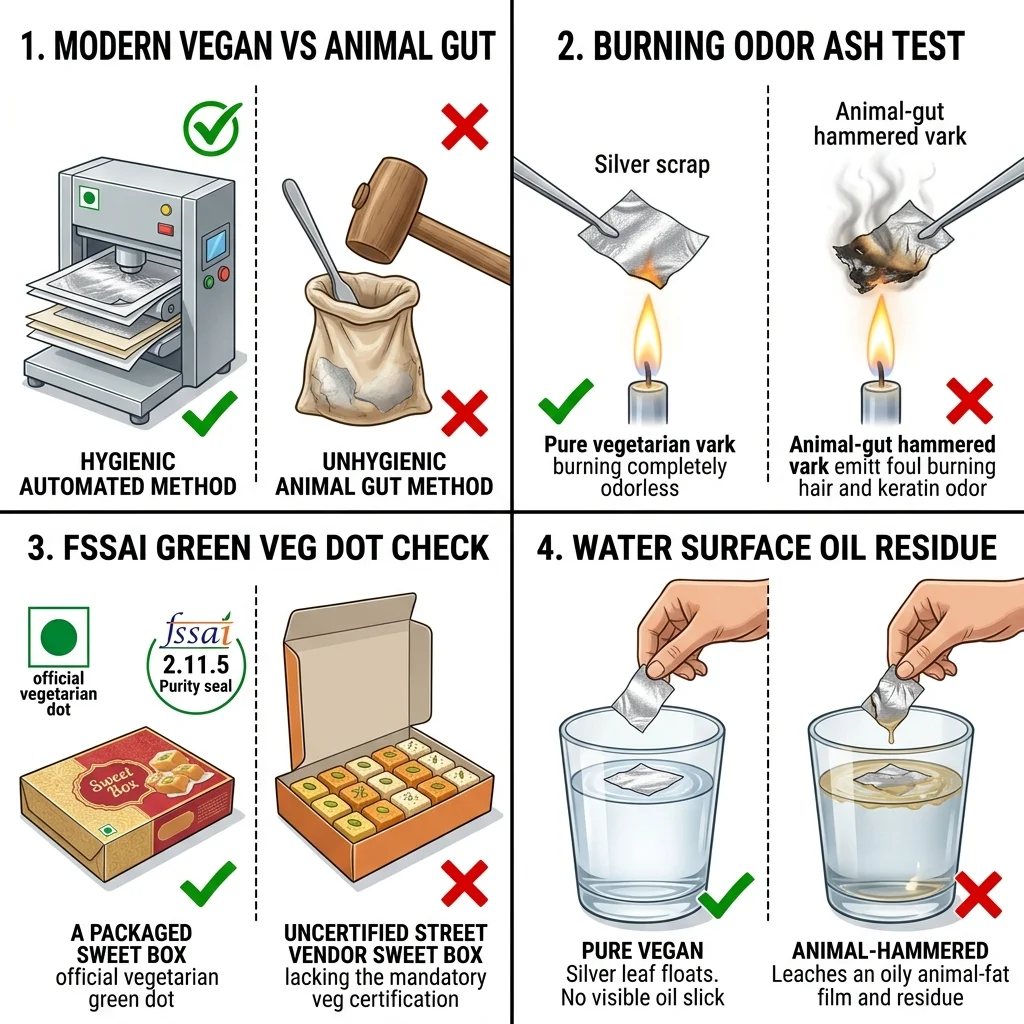
1. The Traditional Ox-Gut Hammering Process (Aau Technique):
In traditional manual workshops, silver ingots are placed between hundreds of sheets of aau—the epidermal lining of the intestines of freshly slaughtered bullocks or calves. The natural animal fats, epidermal lipids, and mucus within the gut prevent the ultra-thin silver sheets from sticking together or tearing while artisan workers beat them with heavy wooden mallets for 8–10 hours. Inevitably, microscopic animal tissue fragments, bovine lipids, blood proteins, and slaughterhouse bacteria leach onto the surface of the silver foil.
2. The Modern German Automated Machine Method:
Modern, ethical food processing has replaced manual animal-gut hammering. Automated German beating machines pound silver ingots inside sterile, food-grade synthetic polyester sheets or high-density cellulose parchment paper. The entire process is 100% untouched by animal parts, free from bovine contamination, and completely vegetarian and vegan certified.
3. The Combustion Odor Test (Burning Hair / Keratin Detection):
Place a scrap of the foil on a metal spoon and heat it over an open flame until it glows red hot. Sniff the rising vapor carefully. If the foil was hammered inside animal intestines, the residual bovine proteins and epidermal lipids incinerate, releasing a pungent, unmistakable foul odor of burning hair, feathers, or burnt leather (keratin decomposition). Pure machine-beaten vegetarian silver foil is completely inorganic and burns with zero odor.
4. The Water Surface Oil Slick Test:
Drop a clean piece of the silver leaf onto the surface of a glass of warm water. Pure vegetarian silver leaf floats or settles cleanly on the water without disturbing the surface. Animal-hammered vark, however, releases hydrophobic slaughterhouse fats and grease into the warm water, forming a faint iridescent oily film or greasy ring around the floating metal scrap.
5. FSSAI Regulation 2.11.5 & Green Dot Compliance:
In 2016 and 2018, the Food Safety and Standards Authority of India (FSSAI) formally banned the use of animal intestinal membranes in silver leaf manufacturing. Under Regulation 2.11.5, silver leaf must be of 99.9% purity and produced through animal-free mechanical processes. All authentic manufacturers must print the official Green Vegetarian Dot on the outer packaging. Always inspect sweet boxes for this mandatory green certification.
Quick Safety Tips
- Never consume sweets if the silver foil rolls into a dark metallic grey pellet when rubbed between fingers
- Pure silver turns into a glistening bright silver droplet when heated; aluminum burns into black soot
- Verify the mandatory FSSAI Green Vegetarian Dot on the outer sweet packaging before purchase
- Avoid sweets with thick, peeling, or crinkly foil that behaves like aluminum kitchen wrap
Primary Chemical Concerns
Health Risks & Impacts
Multilingual Local Names
Regulatory Corner: FSSAI (Food Safety and Standards Authority of India) / Regulation 2.11.5
Regulation: Food Safety and Standards (Food Product Standards and Food Additives) Regulations 2011, Clause 2.11.5: Silver Leaf (Chandi-ka-Vark)
Legal Limit:Purity: Minimum 99.9% pure silver (Ag); Animal Origin: STRICTLY PROHIBITED (must not be manufactured using animal intestinal tract membranes); Aluminum: 0.0% (Zero tolerance); Heavy Metals: Lead max 10 ppm, Cadmium max 2 ppm; Mandatory Green Vegetarian Logo on all packaging.
Report Adulteration to FSSAI (Food Safety and Standards Authority of India) / Regulation 2.11.5