Honey Purity Tests: Detect Sugar Syrup & HFCS
⚡ Quick 60-Second Honey Purity Verdict (Sugar Syrup & HFCS)
Global Food Fraud Risk: Up to 70% of commercial supermarket honey is diluted with ultra-filtered C4 rice syrup, high fructose corn syrup (HFCS), or inverted sugar syrup that circumvents basic lab tests.
Drop 1 tsp honey into water without stirring. Pure honey sinks intact as a dense lump to the bottom. Fake sugar syrup dissolves and clouds the water immediately.
Place 1 drop on your thumb. Pure raw honey stays as a dome-shaped droplet without spilling. Diluted honey spreads out, runs, or drips off your finger.
Dip a dry matchstick in honey and strike it. Pure honey (<18% moisture) ignites cleanly. Adulterated honey sizzles and fails to light due to added water.
Drop Honey photo here to test purity
or click to browse • Supports JPG, PNG, WEBP • Paste with Ctrl+V
Inspection Guide
Click to enlarge
Honey Purity & Adulteration Audit
Honey is one of the most adulterated foods globally, mixed with sugar syrup, high fructose corn syrup, jaggery, molasses, and starch to increase volume and reduce cost.
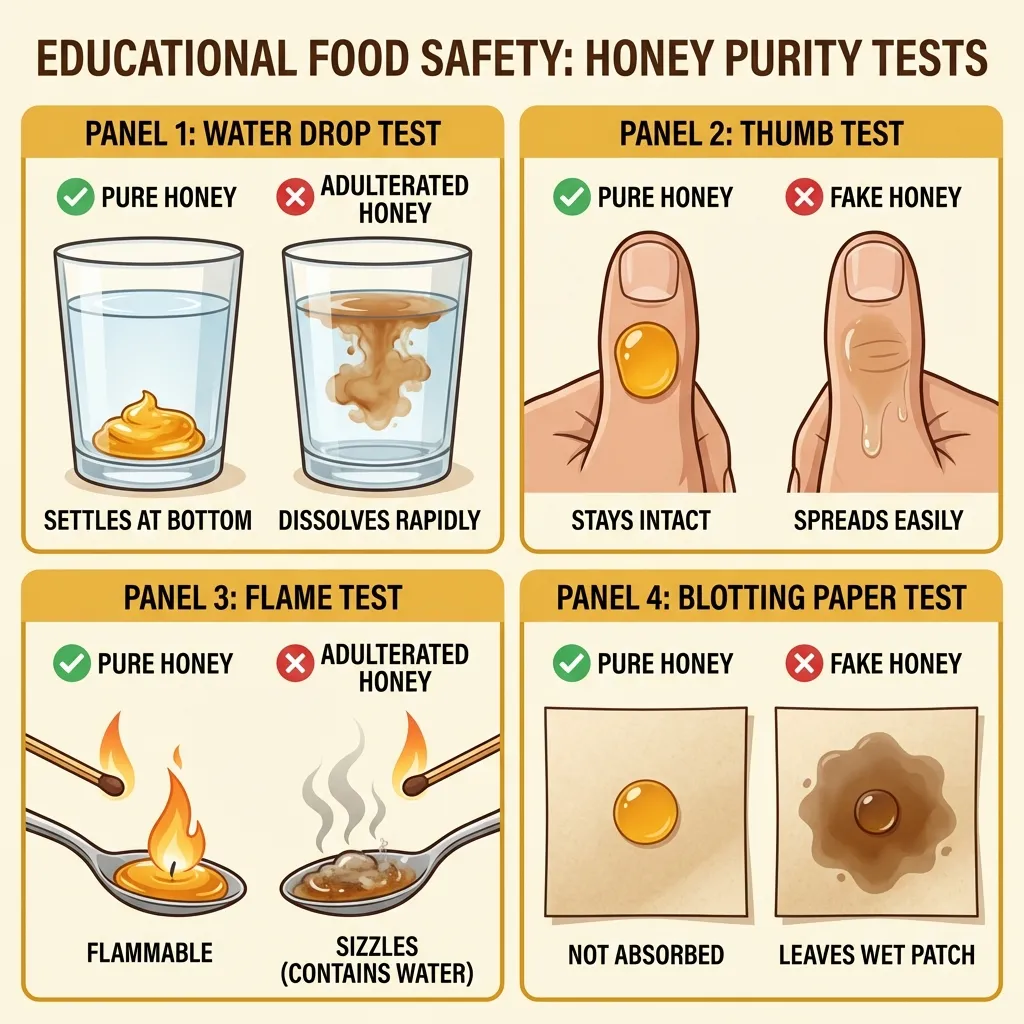
1. The Water Drop Test:
Fill a glass with water and drop a spoonful of honey into it without stirring. Pure honey will settle at the bottom as a lump and dissolve very slowly. Adulterated honey (with sugar syrup) will dissolve quickly and disperse in water, creating cloudiness.
2. The Thumb Test:
Put a small drop of honey on your thumb. Pure honey will stay intact in a bead shape and won't spread or drip. Adulterated honey with added water/syrup will spread easily and may drip from your thumb. This tests viscosity.
3. The Flame Test:
Dip a dry matchstick or cotton wick in honey and try to light it. Pure honey is flammable because it has low moisture content - the match will light and honey will burn steadily. Adulterated honey with water/sugar syrup will sizzle, produce moisture, and won't catch fire easily.
4. The Blotting Paper Test:
Put a drop of honey on blotting paper or newspaper. Pure honey is very thick and won't get absorbed - it will stay on the surface as a bead. Fake honey with added water/syrup will get absorbed into the paper, leaving a wet patch or ring around it.
5. The Refrigerator Test:
Put honey in the refrigerator. Pure honey will crystallize over time (forming sugar crystals) and become thick/granular. Adulterated honey remains liquid or develops layers because of different sugar compositions. Pure honey never separates into layers.

Click to enlarge
Honey Freshness, Crystallization & Quality Standards Guide
Pure sealed honey does not expire due to natural acidity and low moisture, but excess moisture triggers yeast fermentation and heat destroys enzymes:
| Quality Grade | Visual Appearance & Texture | Aroma & Flavor Profile | Food & Health Recommendation |
|---|---|---|---|
| 1. Raw Wild Honey (Optimal) | Dense, opaque or smoothly crystallized | Rich floral nectar aroma, gentle throat tickle, velvety texture | ✅ Highest Grade — Raw consumption, immunity, herbal elixirs |
| 2. Pasteurized Commercial Honey | Sparkling clear liquid, zero pollen sediment | Flat sweetness, subdued aroma from thermal filtration | ⏳ Acceptable — Suitable for baking; enzymes and pollen are reduced |
| 3. Fermented Honey (Excess Moisture) | White foaming layer on surface, visible bubbling | Sour, yeasty or alcoholic odor, sharp fizzy sting on tongue | ⚠️ Spoiled — Osmophilic yeast active due to >20% moisture; discard |
| 4. Fake Sugar Syrup Honey | Artificially runny and shiny, never crystallizes | Pure cane sugar or caramel flavor, zero floral undertones | ❌ Food Fraud — Diluted with corn or rice syrup; avoid consuming |
Critical Spoilage & Quality Signs:
- White Foam on Rim: Indicates unripened honey harvested at >20% moisture where osmophilic yeasts ferment sugars into alcohol.
- Absence of Throat Tickle: Real honey produces a distinct, gentle scratch or warmth in the throat from formic and gluconic acids.
Optimal Storage Practices:
- Store at room temperature (18°C–24°C) in an airtight glass jar in a dry, dark pantry.
- Do not refrigerate: cold accelerates hard, uneven crystallization.
- To decrystallize, place the jar in a warm water bath under 40°C.
Quick Safety Tips
- Pure honey settles at the bottom in the water drop test
- Thumb test - pure honey stays as a neat bead and doesn't run
- Avoid honey that never crystallizes in the cold (a sign of heavy ultra-filtration or corn syrup)
- Always check the blotting paper absorption rate
Primary Chemical Concerns
Health Risks & Impacts
Multilingual Local Names
Common Storage Pests
Osmophilic Yeast (Fermentation)
medium riskMicroscopic fungi that multiply when honey moisture exceeds 20%, turning sugar into alcohol and vinegar.
Detection
- White foam bubbling on surface
- Sour alcoholic or vinegary smell
- Jar hiss upon opening
Prevention
- Keep lid tightly sealed
- Never use wet utensils in jar
Corrective Action: What to do?
Discard for raw eating; safe only for high-temperature cooked baked goods.
Sugar Ants
low riskCommon household ants attracted to sticky drips on the outer jar threading.
Detection
- Ant trail leading to rim
- Ants trapped in surface layer
Prevention
- Wipe jar rim with a damp cloth after each pour
- Store jar on an ant-moat saucer
Corrective Action: What to do?
Scoop out any contaminated top layer with a clean spoon and sanitize rim.
Wax Moth & Hive Debris
low riskMicroscopic wax fragments and pollen grain specks in unpasteurized raw comb honey.
Detection
- Tiny dark or tan specks floating on top
Prevention
- Strain honey through fine cotton cheesecloth if desired
Corrective Action: What to do?
Harmless natural apicultural residue; scoop off if aesthetically undesirable.
Regulatory Corner: FSSAI (Food Safety and Standards Authority of India) / BIS (IS 4941) / Codex Stan 12-1981
Regulation: Food Safety and Standards (Food Products Standards) Regulations 2011, Clause 2.8.2: Honey Standards (as amended 2020)
Legal Limit:C4 sugar syrup (Corn syrup): Max 7.0%; SMR (Rice syrup marker): Absent (Zero tolerance); TMR (Invert sugar marker): Absent; HMF: Max 80 mg/kg; Moisture: Max 20.0%; Specific Enzyme (Diastase activity): Min 8 Schade units
Report Adulteration to FSSAI (Food Safety and Standards Authority of India) / BIS (IS 4941) / Codex Stan 12-1981