Marzipan Adulteration & Freshness Guide: Detect Maida/Soya Fillers, Synthetic Benzaldehyde & Azo Dyes
You can test Festive Marzipan at home for cheap refined flour (maida), potato, arrowroot, or soya flour replacing blanched almonds or cashews, synthetic benzaldehyde (artificial bitter almond chemical), excessive neon azo food dyes, and nut oil rancidity using the Inner-Paste Iodine Test, the Warm Water Nut-Emulsion Test, and sensory aroma inspection. Quantifying exact hydrocyanic acid (prussic acid) from bitter almonds or peanut allergen traces requires laboratory ELISA/HPLC testing.
Drop Marzipan photo here to test purity
or click to browse • Supports JPG, PNG, WEBP • Paste with Ctrl+V
Inspection Guide
Click to enlarge
How to Test Festive Marzipan for Flour Fillers, Fake Essence & Dyes at Home
🔬 Scientific Home Adulteration Tests
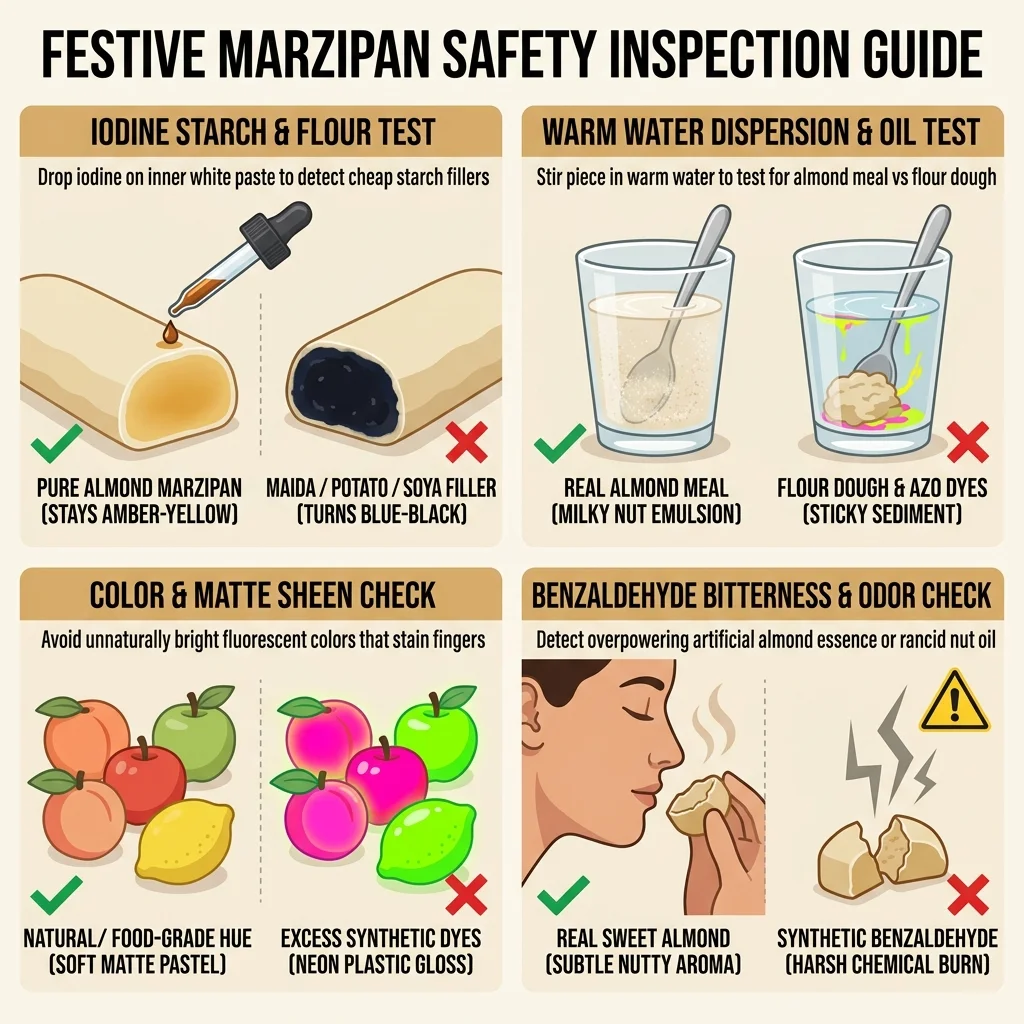
1. Inner-Paste Iodine Test for Flour, Potato & Starch Fillers
Cut a marzipan sweet in half, scrape a small piece of the pale uncolored interior paste (avoiding any colored outer glaze), mash it in 2 teaspoons of water, and add 1–2 drops of Iodine solution.
- Pure Almond Marzipan: Blanched almonds contain almost zero starch (< 2%), so pure almond marzipan remains pale yellow-amber with no blue-black color change! (Authentic Goan cashew marzipan contains modest natural nut starch and shows only a soft amber-violet tint).
- Adulterated with Maida / Potato / Rice Starch: Turns an instant, intense ink-black or dark indigo-blue, proving the paste is heavily bulked out with cheap flour or boiled potato starch.
2. Warm Water Dispersion & Oil Emulsion Test
Drop a 5-gram piece of marzipan into half a glass of warm water (50°C), stir briskly for 60 seconds, and observe the suspension.
- Pure Nut Marzipan: Dissolves into a fragrant, milky-ivory nut emulsion with fine, uniform almond or cashew meal suspended in the liquid and a delicate droplet sheen of natural nut oil on top.
- Flour / Vegetable Fat Adulterated: Forms a sticky, gummy, elastic dough lump at the bottom of the glass (gluten from maida) or leaves a thick, waxy film of hydrogenated palm fat on the water surface while bleeding neon dye.
3. Synthetic Benzaldehyde vs. Natural Nut Aroma Check
Break a fresh piece of marzipan in half and inhale the aroma immediately, then taste a tiny crumb on the tip of your tongue.
- Authentic Marzipan: Offers a subtle, warm, sweet roasted nut aroma with a gentle hint of rosewater or vanilla and a clean, creamy finish.
- Synthetic Essence Adulterated: Hits the nose with a sharp, chemical "cherry-cough-syrup" or nail-polish-like blast of synthetic benzaldehyde that quickly evaporates and leaves a harsh, bitter chemical burn on the tongue.
4. Surface Dye Rub & Silver Leaf Check
Dampen a white tissue paper and dab the colored surface of sculpted marzipan fruits.
- Safe Food-Grade Coloring: Uses soft, matte pastel shades applied lightly with minimal transfer.
- Excess Synthetic Dye: Neon fluorescent pinks, greens, and yellows bleed heavily onto the damp tissue and stain fingers and lips. If decorated with metallic leaf, verify with the finger-rub test that it is pure silver vark and not aluminium.
Click to enlarge
How to Judge Marzipan Freshness, Nut Oil Stability & Spoilage
📊 Freshness & Quality Comparison
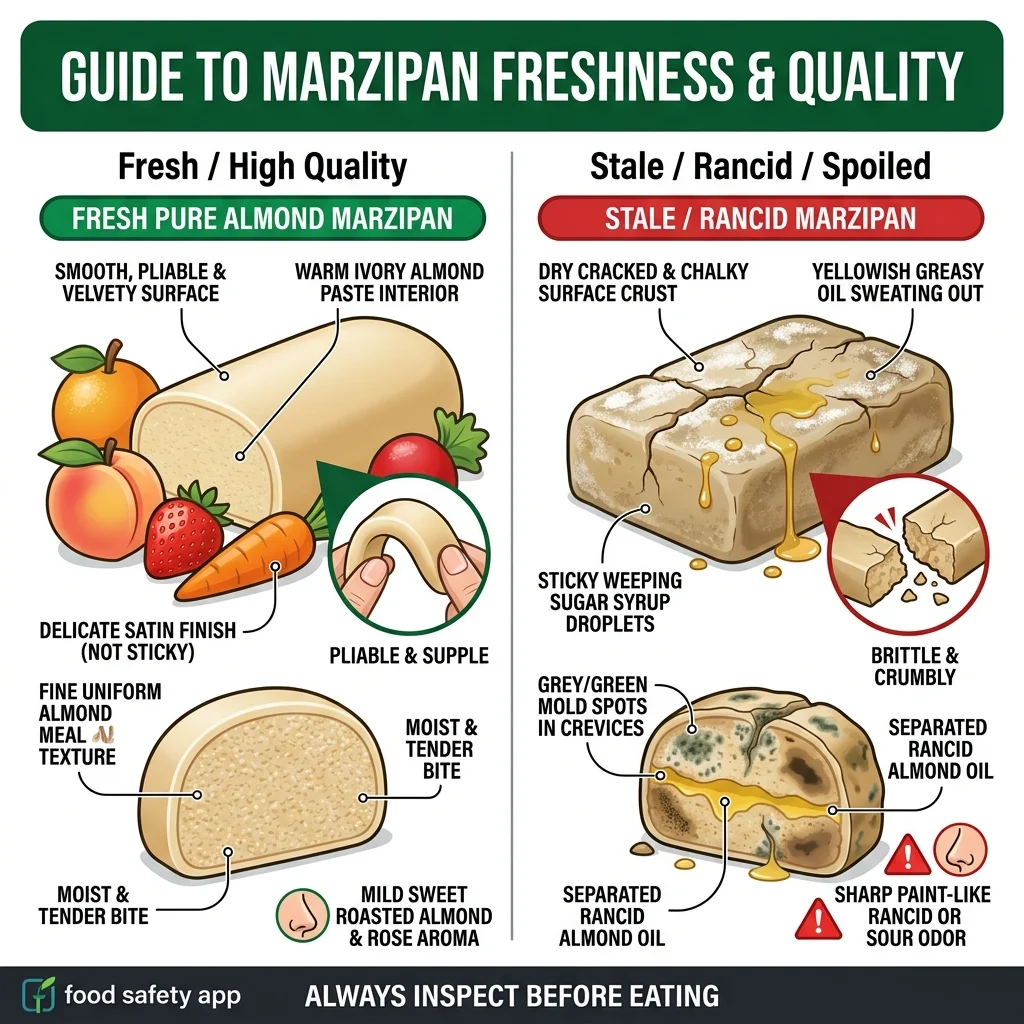
| Quality Marker | Fresh Pure Nut Marzipan | Stale / Rancid / Spoiled Marzipan |
|---|---|---|
| Paste Texture | Pliable, supple, smooth clay-like consistency; bends slightly before breaking cleanly | Dry, chalky, brittle crust that cracks when bent, OR sticky weeping syrup |
| Interior Color | Warm, uniform pale ivory or creamy gold | Yellowed, translucent, greasy patches where oxidized nut oil has separated |
| Surface Finish | Delicate satin-matte sheen; dry to the touch | Sweating oil droplets, white sugar-bloom crust, or dark mold spots in creases |
| Aroma & Taste | Mild, sweet, buttery almond/cashew and rosewater note | Sharp "old paint" or crayons odor (lipid rancidity), soapy taste, or sour egg smell |
🏠 Home Storage & Shelf-Life Best Practices
- Pure Almond & Sugar Marzipan (Cooked / Egg-Free): Because of its high sugar-to-moisture ratio, cooked egg-free almond marzipan wrapped tightly in food-grade parchment and stored in an airtight tin in a cool pantry (15–18°C) stays fresh for 3–4 weeks (or up to 2 months refrigerated).
- Egg-White Bound Festive Marzipan: Traditional marzipan bound with egg whites has higher microbiological sensitivity and must be stored in an airtight container in the refrigerator and consumed within 7–10 days.
- Preventing Oil Separation & Drying: Keep marzipan away from direct sunlight and warm oven vents; temperatures above 26°C cause almond and cashew oils to sweat out and turn rancid rapidly.
Quick Safety Tips
- Use the Iodine Test on almond marzipan—since real almonds are virtually starch-free, any dark blue-black reaction instantly exposes starch or flour adulteration.
- Check the ingredient percentage: European quality standards (e.g., Lübeck Marzipan) require at least 50–70% raw almond paste and no more than 30–50% sugar.
- If you have a peanut allergy, never buy loose, unlabelled marzipan—cheap peanut paste flavored with artificial almond essence is a common fraudulent substitute.
- Avoid artisanal marzipan made with raw, unpasteurized egg whites unless the sugar syrup was cooked to the hot thread stage (115°C+) to pasteurize the mixture.
- Inspect individual ingredients like almonds, cashews, sugar, eggs, pistachios, and silver foil using their BioLens Food Guard guides before making marzipan at home.
Primary Chemical Concerns
Health Risks & Impacts
Test Individual Raw Ingredients in Marzipan
Unlike single raw commodities, prepared sweets and bakery items can harbor adulteration across multiple base ingredients. Click any raw ingredient below to run its dedicated kitchen purity test:
Multilingual Local Names
Common Storage Pests
Indian Meal Moth (Plodia interpunctella) & Merchant Grain Beetle
medium riskLepidopteran and coleopteran pests strongly attracted to almond and cashew meal in improperly sealed marzipan boxes.
Detection
- Fine silk webbing or tiny pinholes on the surface of marzipan loaves and fruit shapes
- Powdery nut crumbs (frass) accumulating at the bottom of the gift box
Prevention
- Wrap marzipan tightly in food-grade parchment and foil inside a rigid airtight container
- Inspect raw almonds and cashews for pinhole weevil damage before grinding
Corrective Action: What to do?
Discard the infested marzipan box and sanitize surrounding storage shelves.
Xerophilic Molds (Eurotium / Aspergillus glaucus) & Salmonella spp.
high riskSugar-tolerant surface molds growing in humid crevices and pathogenic bacteria surviving in unheated egg-white binders.
Detection
- Tiny grey, green, or brown velvety spots in the indented creases of shaped marzipan fruits
- Slimy, weeping sugar droplets and an off-putting sour or sulfurous odor
Prevention
- Always use cooked sugar syrup or pasteurized egg whites and refrigerate egg-containing marzipan below 5°C
- Avoid storing marzipan in humid kitchens without moisture-barrier wrapping
Corrective Action: What to do?
Discard any marzipan showing surface mold, weeping slime, or off-odors immediately.
Regulatory Corner: FSSAI / EU Food Law (EC 1334/2008) / Codex
Regulation: FSS (Food Products Standards and Food Additives) Regulations — Nut & Confectionery Products / German Leitsätze for Marzipan
Legal Limit:Authentic almond marzipan must contain zero added starch/flour fillers; Hydrocyanic acid max 50 mg/kg; Mandatory allergen declaration for Tree Nuts, Peanuts, Soy, and Egg; Permitted food colors max 100 mg/kg.
Report Adulteration to FSSAI / EU Food Law (EC 1334/2008) / CodexWhat CANNOT be Verified (Lab-Only)
- Peanut (Ara h 1 / Ara h 2) & Soya Protein Adulteration: Detected via Lateral Flow Immunoassay or Quantitative ELISA (detects down to < 2 ppm undeclared peanut allergen).
- Persipan (Apricot/Peach Kernel Paste) Detection: Identified via PCR DNA barcoding (Prunus armeniaca vs. Prunus dulcis) and Vitamin E (tocopherol isomer) HPLC profiling.
- Hydrocyanic Acid (Cyanide) Content: Measured via enzymatic/titrimetric distillation (EU Regulation EC 1334/2008 limits hydrocyanic acid in marzipan/nougat to max 50 mg/kg).
- Synthetic Benzaldehyde vs. Natural Bitter Almond Oil: Differentiated via Isotope Ratio Mass Spectrometry (SNIF-NMR / GC-IRMS).