How to Test Sugar for Adulteration: 5 Rapid Home Tests (Chalk, Washing Soda & Urea)
White granulated sugar and powdered (icing) sugar are frequently adulterated with Chalk Powder (Calcium Carbonate), Washing Soda (Sodium Carbonate), Urea, and Plaster of Paris to artificially increase bulk weight and impart cosmetic whiteness.
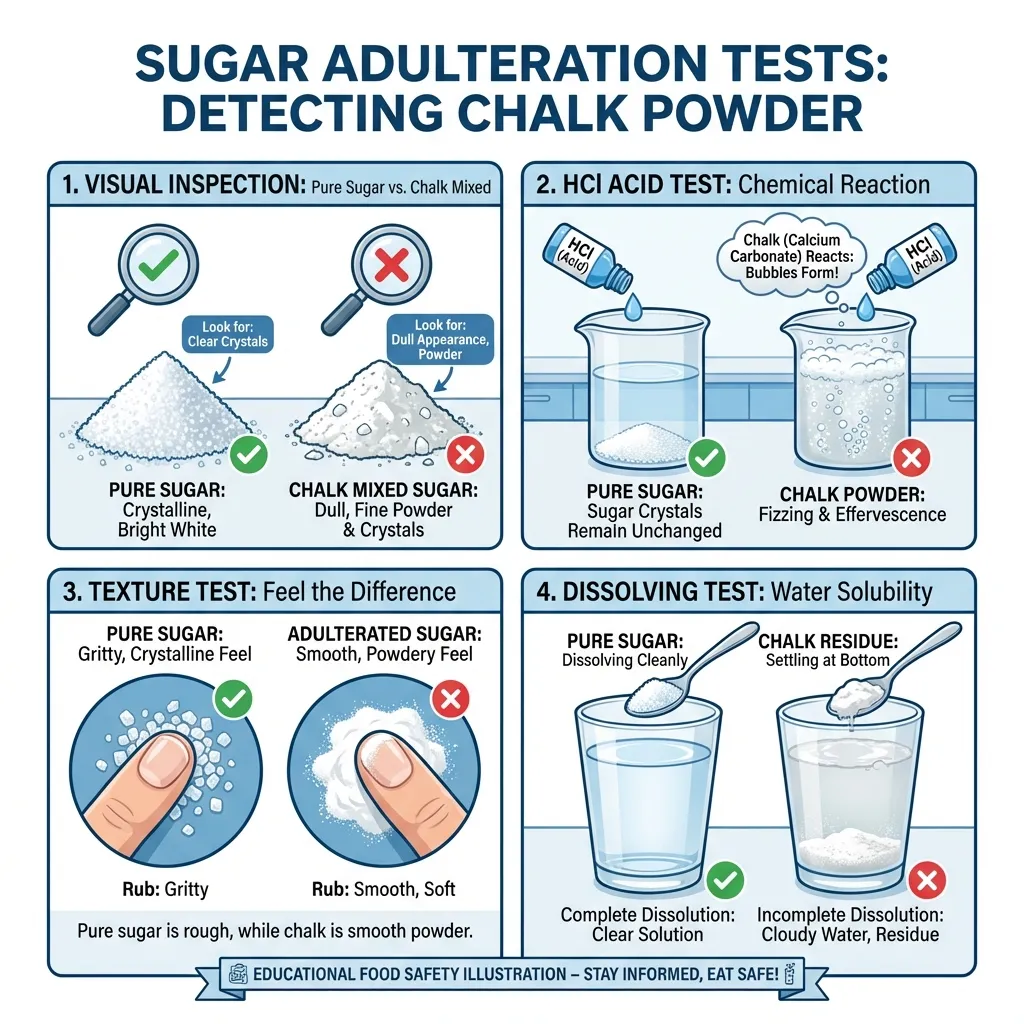
• 1. Water Clarity Test: Stir 1 tbsp sugar in a glass of water → Pure sugar dissolves 100% crystal clear. Chalk powder or Plaster of Paris forms a cloudy white sediment at the bottom.
• 2. Lemon Juice / Vinegar Fizz Test: Add 3–4 drops of lemon juice to dry sugar → Immediate vigorous effervescence/bubbling confirms alkaline Washing Soda (Na2CO3) or Chalk (CaCO3).
• 3. Dry Spoon Heat Test: Heat 1/2 tsp sugar on a dry spoon → Sharp pungent ammonia odor reveals industrial Urea.
• 4. Iodine Starch Test: Add 1 drop iodine to powdered sugar → Instant blue-black color reveals maida/flour bulking.
Drop Sugar photo here to test purity
or click to browse • Supports JPG, PNG, WEBP • Paste with Ctrl+V
Inspection Guide
Click to enlarge
Sugar Adulteration Detection Protocol — 5 Home Tests
🔍 Why Sugar Is Adulterated
Because granulated sugar is a high-volume daily household staple, unscrupulous vendors adulterate it with cheap white minerals like chalk, plaster of Paris, and washing soda to artificially boost weight by 10% to 20% while cutting procurement costs. Use the 5 verified home and laboratory methods below to test your kitchen sugar.
🧪 Test 1: The Water Clarity & Sedimentation Test (Official FSSAI DART Method)
Detects insoluble mineral adulterants: Chalk Powder, Plaster of Paris, Fine Sand, and Soapstone.
1. Procedure: Take a clean transparent glass tumbler and fill it with 100 ml of lukewarm water.
2. Sample Addition: Add 1 tablespoon (approx. 10g) of sugar.
3. Mixing: Stir thoroughly with a spoon for 30–45 seconds and allow the glass to stand undisturbed for 1 minute.
4. Result:
- ✅ Pure Sugar: Dissolves completely into a 100% transparent, clear liquid with zero residue at the bottom.
- ❌ Adulterated Sugar: The water turns cloudy/milky. A distinct dense white sediment settles at the bottom of the glass, indicating insoluble chalk powder, soapstone, or plaster of Paris.
🍋 Test 2: The Lemon Juice / Vinegar Acid Effervescence Test
Detects reactive alkaline carbonates: Washing Soda (Sodium Carbonate) & Chalk (Calcium Carbonate).
1. Procedure: Place 1 teaspoon of sugar crystals on a dry white ceramic saucer or glass plate.
2. Acid Addition: Squeeze 4 to 5 drops of fresh lemon juice (or concentrated white vinegar) directly onto the sugar crystals.
3. Result:
- ✅ Pure Sugar: No reaction occurs. The sugar crystals simply dissolve slowly into the acid liquid with zero gas bubbles.
- ❌ Adulterated Sugar: Immediate vigorous fizzing, foaming, and bubbling (CO2 gas release) occurs. Rapid violent fizzing indicates Washing Soda (Na2CO3), while persistent steady fizzing indicates Chalk (CaCO3).
🔥 Test 3: The Dry Spoon Heat & Ammonia Test (Urea Detection)
Detects industrial urea added to create artificial whiteness and shiny crystal reflection.
1. Procedure: Place 1/2 teaspoon of dry sugar onto a clean stainless steel tablespoon.
2. Heating: Hold the spoon carefully over a medium candle flame or low gas burner for 30 to 45 seconds.
3. Olfactory Check: As the sugar begins to melt and bubble, gently waft the rising vapor toward your nose.
4. Result:
- ✅ Pure Sugar: Melts into a golden-brown caramel liquid emitting a delicious, sweet toffee aroma.
- ❌ Adulterated Sugar: Emits a sharp, choking, pungent ammonia smell (resembling commercial hair dye or restroom fumes), confirming thermal decomposition of urea ($CO(NH_2)_2 \rightarrow NH_3\uparrow$).
🖐️ Test 4: The Touch & Moist Finger Luster Check
Distinguishes caustic washing soda from genuine crystalline sucrose.
1. Procedure: Moisten your thumb and index finger with a drop of clean water, take a pinch of sugar, and rub it vigorously between your fingertips for 15 seconds.
2. Result:
- ✅ Pure Sugar: Feels slightly sticky and tacky as the sucrose dissolves into syrup.
- ❌ Adulterated with Washing Soda: Feels distinctly slippery, soapy, and slick (saponification reaction of alkaline soda on skin oils). It may produce a mild warm tingling sensation.
💧 Test 5: The Iodine Tincture Test (For Powdered / Icing Sugar)
Detects cheap starch, maida, or cornflour added to bulk powdered sugar and prevent caking.
1. Procedure: Dissolve 1 teaspoon of powdered/icing sugar in 30 ml of warm water. Let it cool.
2. Reagent: Add 1 drop of 2% Iodine Tincture (or medical Betadine/Povidone Iodine).
3. Result:
- ✅ Pure Sugar: Solution remains pale amber-yellow.
- ❌ Adulterated with Starch: Solution immediately turns deep blue-black or purple, indicating the formation of starch-iodine complex.
Quick Safety Tips
- Step 1: Perform the Water Clarity Test — pure sugar leaves 100% clear water without white chalk sediment
- Step 2: Add lemon juice or vinegar — any fizzing or frothing indicates toxic washing soda or chalk
- Step 3: Check powdered sugar with iodine — a blue-black stain reveals flour/starch bulking
- Avoid sugar that looks dull, powdery, and matte under direct sunlight
- Never consume sugar that emits an ammonia or pungent chemical odor when heated
- Store granulated sugar in airtight glass jars away from humidity to prevent microbial clumping
Primary Chemical Concerns
Health Risks & Impacts
Multilingual Local Names
Regulatory Corner: FSSAI (Food Safety & Standards Authority of India) / Codex Alimentarius
Regulation: Food Safety and Standards (Food Products Standards and Food Additives) Regulations 2011, Clause 2.8.1: Cane Sugar & Refined Sugar Standards.
Legal Limit:Sucrose: Minimum 99.5% by weight; Total Insoluble Matter: Maximum 0.1%; Heavy Metals & Minerals: 0.0%
Report Adulteration to FSSAI (Food Safety & Standards Authority of India) / Codex AlimentariusWhat CANNOT be Verified (Lab-Only)
Confirmatory Forensic & Laboratory Testing Methods
- Gravimetric Insoluble Matter Determination (AOAC 920.175): Dissolve 20g sugar in 100ml hot distilled water, filter through a pre-weighed Gooch crucible (porosity 4), wash with boiling water, dry at 105°C for 2 hours, and weigh insoluble residue. Purity standard: Maximum 0.1% insoluble matter.
- Flame Photometry & Atomic Absorption Spectroscopy (AAS): Quantifies excess Calcium ($Ca^{2+}$) from chalk and Sodium ($Na^+$) from washing soda.
- Urease Enzymatic Colorimetric Assay: Detects urea by conversion to ammonium carbonate catalyzed by urease, measured spectrophotometrically at 540 nm using Nessler's reagent.
- Polarimetric Sucrose Assay (ICUMSA GS2/3-1): Measures the optical rotation ($[\alpha]_D^{20} = +66.5°$) using an automatic polarimeter to verify minimum 99.5°Z sugar purity.