How to Test Ghee for Adulteration (Vanaspati, Starch, Animal Fat)
⚡ Quick 60-Second Desi Ghee Purity Verdict
Hydrogenated Fat & Tallow Risk: Pure cow/buffalo desi ghee is adulterated with cheap Vanaspati (trans-fat hydrogenated vegetable oil), mashed boiled potatoes/sweet potatoes (starch), animal body fat, and coal tar dyes.
Place 1/2 tsp ghee on your palm. Pure ghee melts instantly at body temperature (32–35°C). Adulterated Vanaspati or tallow remains solid or takes long rubbing to melt.
Heat 1 tsp ghee in a pan on medium flame. Pure ghee melts immediately and turns rich golden-brown. Adulterated ghee takes longer to melt and stays pale yellow.
Melt 1 tsp ghee and add 2 drops of iodine tincture. A blue-black or violet color instantly confirms added starch (mashed potato or flour filler). Pure ghee stays yellow/brown.
Drop Ghee (Clarified Butter) photo here to test purity
or click to browse • Supports JPG, PNG, WEBP • Paste with Ctrl+V
Inspection Guide
Click to enlarge
Ghee (Clarified Butter) Purity Detection
Ghee is frequently adulterated with Vanaspati (vegetable oil), starch (potatoes), and toxic coal tar dyes for color.
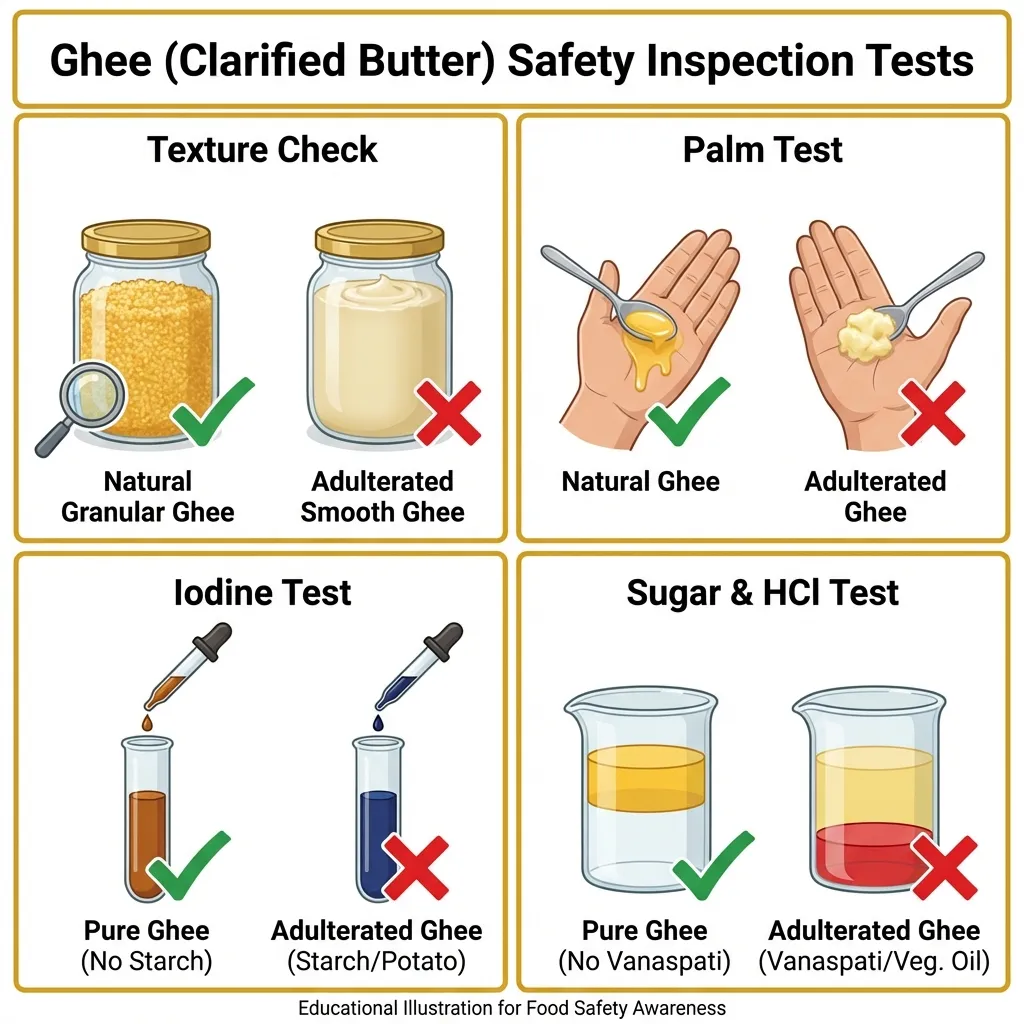
1. The Palm Test (Melting Point):
Put a small amount of ghee on your palm. Pure ghee melts instantly at body temperature. If it takes time to melt or remains solid on your palm, it contains Vanaspati or other fats.
2. The Texture Check:
Pure ghee has a characteristic "granular" (daanedaar) texture when it solidifies. Adulterated ghee often feels smooth, pasty, or wax-like without the natural granules.
3. The Iodine Test (Starch Detection):
Melt a bit of ghee and add a drop of iodine solution. If it turns blue-black, it indicates the presence of starch (added potatoes or flour). Pure ghee will stay brown/yellow.
4. The Sugar and HCl Test (Vanaspati Detection):
Mix a spoonful of ghee with a bit of sugar and 10ml of HCl (Hydrochloric acid). Shake well and wait. If a red color appears in the lower layer, it indicates the presence of Vanaspati (sesame oil mixed in Vanaspati reacts).
5. Adulteration in Butter:
Similar Vanaspati and starch adulterations are highly prevalent in solid butter. Refer to our home test guide for Butter.
Quick Safety Tips
- Pure ghee melts instantly on your palm
- Check for natural granular texture
- Perform iodine test for starch detection
- Avoid ghee with unnatural bright yellow color
Primary Chemical Concerns
Health Risks & Impacts
Multilingual Local Names
Common Storage Pests
Not Applicable
low riskGhee is a natural preservative and does not host traditional pests.
Detection
- Musty or rancid smell
- Cloudy white strands (fungus)
Prevention
- Store in a dry, airtight glass or ceramic jar
- Use a clean, dry spoon
Corrective Action: What to do?
Discard rancid or fungus-contaminated ghee immediately.
Regulatory Corner: FSSAI (Food Safety and Standards Authority of India) / Codex Standard 280-1973
Regulation: Food Safety and Standards (Food Products Standards) Regulations 2011, Clause 2.1.8: Ghee Standards & Codex Milkfat Standards
Legal Limit:Milk fat: Min 99.5%; Moisture: Max 0.5%; Reichert-Meissl (RM) value: Min 28.0; Polenske value: 1.0–2.0; Baudouin test for Vanaspati: Negative (0.0%); Animal Tallow: 0.0%
Report Adulteration to FSSAI (Food Safety and Standards Authority of India) / Codex Standard 280-1973