How to Test Cinnamon for Adulteration (Cassia Bark, Lead Chromate, Artificial Dyes)
⚡ Quick 60-Second Cinnamon vs Toxic Cassia Verdict
Toxic Cassia Substitution (Coumarin Hazard): Genuine Ceylon cinnamon is routinely substituted with cheap Chinese/Indonesian Cassia, which contains up to 1% liver-toxic Coumarin.
Look at the cut edge. Pure Ceylon cinnamon is rolled in multiple paper-thin, delicate concentric layers like a cigar. Toxic Cassia is a single, thick, hard, hollow woody bark.
Try snapping a stick between fingers. Ceylon cinnamon is soft, crumbly, and breaks easily with fingers. Cassia bark is rock-hard, fibrous, and difficult to break.
Chew a small crumb. Ceylon cinnamon is delicately sweet, warm, and citrusy. Cassia is intensely harsh, pungent, peppery, and leaves a bitter aftertaste.
To learn more about food safety tests and home adulteration detection, read our guides on Ginger and Coriander Seeds (Dhania).
Drop Cinnamon (Dalchini) photo here to test purity
or click to browse • Supports JPG, PNG, WEBP • Paste with Ctrl+V
Inspection Guide
Click to enlarge
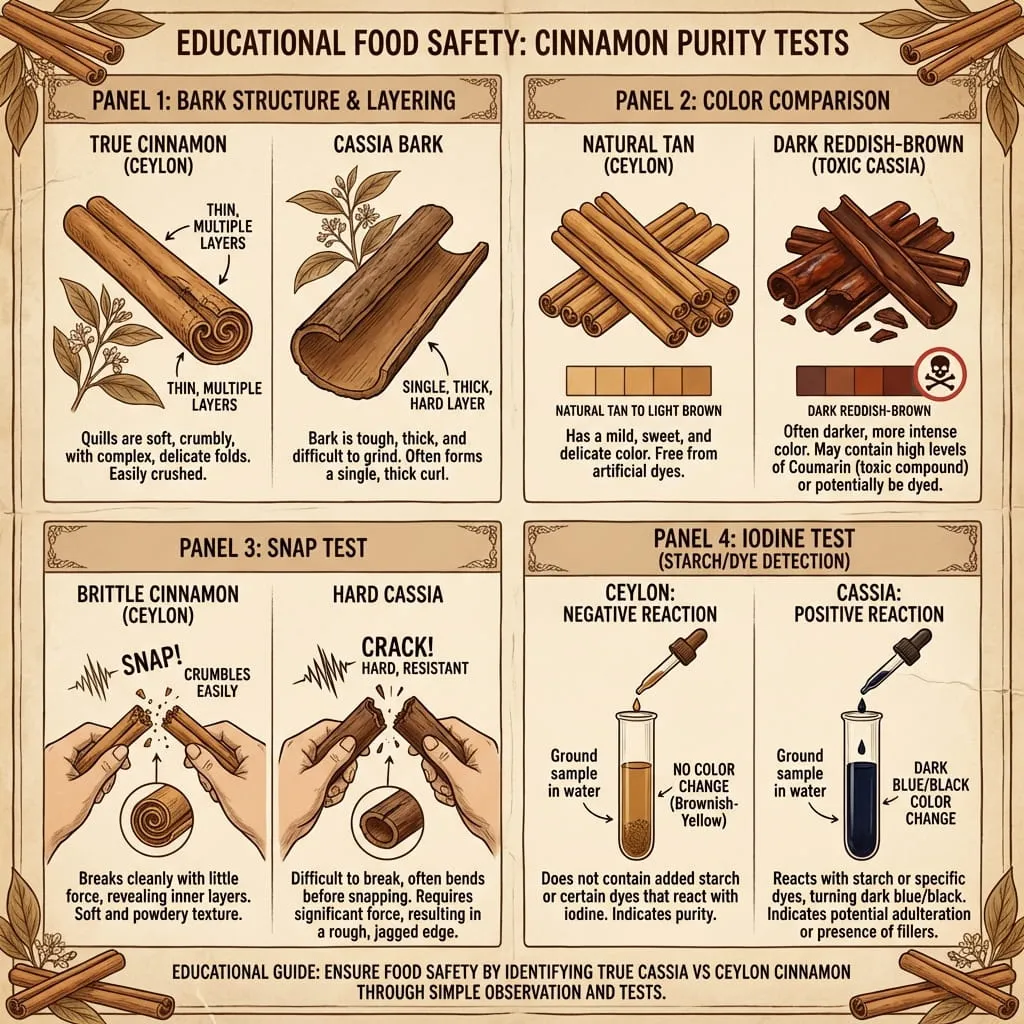
Cinnamon vs. Cassia Detection
True Cinnamon (Ceylon) is often replaced with Cassia bark, which contains high levels of Coumarin—a compound that can be toxic to the liver in large amounts.
1. The Layer and Texture Test (Visual):
- True Cinnamon (Ceylon): Has multiple thin, paper-like layers rolled into a quill. It is brittle and can be easily crushed with fingers.
- Cassia Bark: Is thick, hard, and usually forms a single thick layer or a few coarse layers. It is very difficult to break.
2. The Shape Test:
Look at the ends of the sticks. Ceylon cinnamon looks like a cigar with many fine layers inside. Cassia bark often curls inward from both sides like a scroll or forms a single thick "U" shape.
3. The Color Test:
Ceylon cinnamon has a light tan to medium brown color. Cassia bark is usually a darker, reddish-brown color. If the color looks too vibrant or uniform, it might be dyed with lead chromate.
4. The Iodine Test (Starch Detection):
Mix a bit of cinnamon powder in water and add a drop of iodine. If the solution turns blue-black, it indicates the presence of starch or certain fillers. Pure cinnamon has a very minimal reaction.
5. The Aroma and Taste:
True cinnamon is sweet and delicate in flavor. Cassia has a much stronger, spicy, and "hot" flavor with a coarser texture.
6. Exhausted Spice Concerns:
Essential oil extraction and substitution are shared risks among spices. See our test guide for Cardamom.
Quick Safety Tips
- True Ceylon cinnamon has many thin layers like a cigar
- Avoid thick, hard bark (Cassia) for regular consumption
- Light tan color is a sign of Ceylon cinnamon
- Cinnamon quills should be brittle and easy to break
Primary Chemical Concerns
Health Risks & Impacts
Multilingual Local Names
Common Storage Pests
Drugstore Beetles
low riskSmall brown beetles that bore tiny holes into spice barks.
Detection
- Tiny circular holes in the bark
- Fine powdery residue (frass) at the bottom of the container
Prevention
- Store in airtight glass jars
- Keep in a cool, dark place
Corrective Action: What to do?
Discard if infestation is heavy; light surface holes can sometimes be washed off if the interior is intact.
Regulatory Corner: FSSAI (Food Safety and Standards Authority of India) / European Commission / US FDA
Regulation: Food Safety and Standards (Food Products Standards) Regulations 2011, Clause 2.9.6: Cinnamon & EC Regulation No 1334/2008 & FDA 21 CFR 182.10
Legal Limit:Volatile oil: Min 1.0% (v/w); Coumarin limit in True Ceylon Cinnamon (Cinnamomum verum): Max 10 ppm; Cassia (Cinnamomum cassia containing up to 10,000 ppm coumarin) substitution: Prohibited unless distinctly labeled as Cassia
Report Adulteration to FSSAI (Food Safety and Standards Authority of India) / European Commission / US FDA