How to Test Milk for Adulteration (Urea, Detergent, Starch)
⚡ Quick 60-Second Milk Purity & Adulteration Verdict
FSSAI & WHO Alert: Over 68% of non-compliant milk samples in commercial surveys contain water dilution, synthetic detergent (lathering agent), urea (SNF booster), or starch. Raw milk must pass 3 quick home checks before boiling.
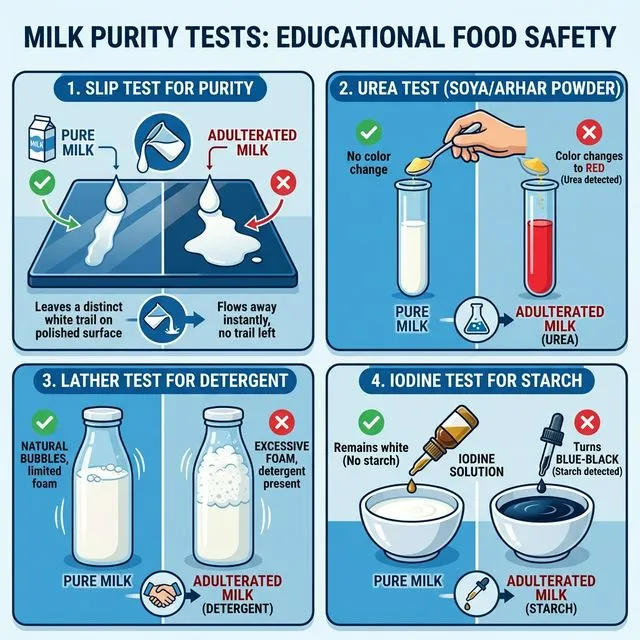
Put 1 drop on a polished slanting surface. Pure milk flows slowly, leaving a distinct white trail behind. Watered milk flows instantly with zero white trace.
Shake 10ml milk + 10ml water vigorously in a bottle for 20s. Pure milk forms light foam that settles in seconds. Detergent forms thick, long-lasting soap lather.
Boil 5ml milk, cool, and add 2 drops of iodine tincture. Turns blue-black = adulterated with starch/flour. Stays pale yellow/white = pure.
Drop Milk photo here to test purity
or click to browse • Supports JPG, PNG, WEBP • Paste with Ctrl+V
Inspection Guide
Click to enlarge
Milk Purity and Adulteration Detection
Milk is frequently adulterated with water, urea, detergent, and starch to increase volume and thickness.
1. The Shake Test (Detergent Check):
Shake a small amount of milk in a glass bottle or container. Pure milk forms small bubbles that disappear quickly. Detergent-adulterated milk forms thick, dense foam that persists for a long time.
2. The Slip Test (Water Dilution):
Put a drop of milk on a polished slanted surface (like a steel plate). Pure milk flows slowly, leaving a distinct white trail behind. Water-diluted milk flows instantly without leaving any trail.
3. The Iodine Test (Starch Detection):
Add a drop of iodine to a small sample of milk. If the milk turns blue-black, it indicates the presence of starch or flour used as a thickener.
4. The Texture Test (Urea/Soap):
Rub a few drops of milk between your fingers. If it feels unusually slippery or soapy, it likely contains detergent or urea.
Quick Safety Tips
- Dense foam after shaking indicates detergent
- Pure milk leaves a white trail on slanted surfaces
- Iodine test for starch/flour detection
- Buy from trusted dairies and check for organic certification
Primary Chemical Concerns
Health Risks & Impacts
Multilingual Local Names
Common Storage Pests
Spoilage Bacteria
high riskMicroorganisms like Lactobacillus that cause milk to sour or curdle.
Detection
- Sour or "off" smell
- Separation of solids (curdling)
Prevention
- Keep refrigerated below 4°C
- Ensure the container is sanitized
Corrective Action: What to do?
Discard immediately if sour or curdled.
Regulatory Corner: FSSAI (Food Safety and Standards Authority of India) / US FDA
Regulation: Food Safety and Standards (Food Products Standards) Regulations 2011, Clause 2.1.1: Standards for Milk & FDA 21 CFR 131.110
Legal Limit:Milk Fat: Min 3.5% (Cow) / 6.0% (Buffalo); Solids-Not-Fat (SNF): Min 8.5% (Cow) / 9.0% (Buffalo); Added Water: 0.0%; Urea, Detergent, Neutralizers, Starch: 0.0% (Strictly Prohibited); Aflatoxin M1: Max 0.5 µg/kg
Report Adulteration to FSSAI (Food Safety and Standards Authority of India) / US FDA