Cloves Purity Guide: Detect Spent Exhausted Cloves, Mineral Oil Polish & Twigs
⚡ Quick 60-Second Cloves Purity Verdict
Essential Oil Stripping & Mineral Oil Fraud: Commercial cloves are frequently 'spent' (exhausted of eugenol essential oil via industrial steam distillation for pharma/perfumes), dried, and coated with petroleum mineral oil to fake a dark, shiny, premium appearance.
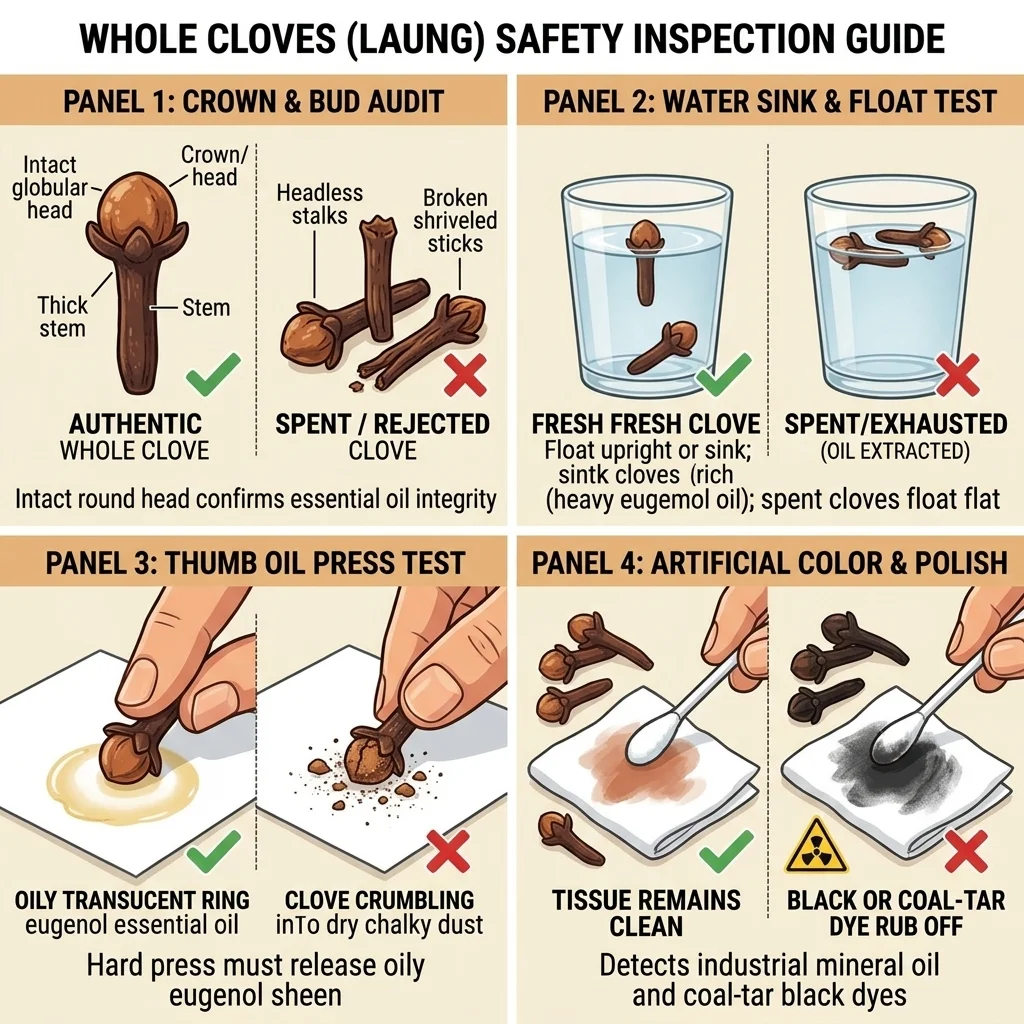
Drop 5 whole cloves into a glass of clean water. Pure, oil-rich cloves stand vertically upright with the crown at the top or sink to the bottom. Spent, exhausted cloves with stripped essential oils float completely flat horizontally on their side.
Press your thumbnail firmly into the hypanthium (stem). Pure cloves release visible oily eugenol that leaves a peppery, tongue-numbing sensation when tasted. Spent cloves feel brittle, dry, and chalky with zero oil seepage.
Press a clove firmly against clean white blotting paper. Volatile clove oil evaporates cleanly over 24 hours. A greasy, permanent translucent ring that refuses to disappear indicates cheap petroleum mineral oil polish.
To explore related spice purity standards and whole spice testing guides, explore our verified tests on Cinnamon, Cardamom, Black Pepper, Tea Leaves, and Basmati Rice.
Drop Cloves (Laung / Lavangam) photo here to test purity
or click to browse • Supports JPG, PNG, WEBP • Paste with Ctrl+V
Inspection Guide
Click to enlarge
Cloves Purity, Eugenol Oil Content & Exhaustion Audit
Cloves (Syzygium aromaticum) are the unopened flower buds of an evergreen tree native to the Maluku Islands. Eugenol oil, which gives cloves their medicinal numbing power and intense aroma, is extremely valuable in the pharmaceutical and dentistry industries. A major commercial fraud involves steam-distilling the cloves to extract 100% of their eugenol, redrying the spent husk, polishing it with petroleum mineral oil, and selling it as fresh culinary cloves.
1. The Water Float Orientation Test (The Gold Standard):
Drop 6 to 8 cloves into a glass of plain room-temperature water.
✅ Authentic Fresh Cloves: Rich in heavy eugenol essential oil (specific gravity ~1.06 g/ml, denser than water). They either sink directly to the bottom or float vertically upright with their flower bud head pointing toward the surface.
❌ Exhausted Spent Cloves: Because their dense oil has been completely extracted, they become hollow and light; they float completely flat horizontally on their side on the water surface.
2. The Thumbnail Puncture & Oil Seepage Test:
Press your thumbnail deep into the plump central stem (hypanthium).
✅ Pure Cloves: A tiny bead of oily resin immediately wells up around your nail. If you touch this to your tongue, it delivers an instant, intense, warm, spicy, and noticeably numbing sensation.
❌ Spent Cloves: The stem is dry, brittle, fibrous, or hollow. It crumbles under your nail with zero oil release and leaves only a dry wood taste.
3. The White Blotting Paper Mineral Oil Test:
To conceal the dull greyish color of spent cloves, blenders roll them in drums with mineral oil or engine oil sweepings.
✅ Natural Clove Oil: Pressing a clove firmly onto white paper may leave a faint natural essential oil stain, but this volatile ring completely evaporates and disappears over 24 hours.
❌ Mineral Oil Polish: Leaves an immediate greasy, translucent, permanent ring on the paper that never dries or evaporates, even when heated with a hair dryer.
4. Anatomical Head Crown & Bud Inspection:
Examine the top of the clove closely.
✅ Premium Whole Cloves: Retains a compact 4-toothed calyx cradling a plump, round, slightly lighter-colored unopened bud (crown).
❌ Substituted Debris: Headless cloves, wrinkled seed pods (mother cloves), or straight woody twigs and stems packed with astringent tannins instead of eugenol.
Click to enlarge
Cloves Freshness, Aroma Potency & Storage Quality
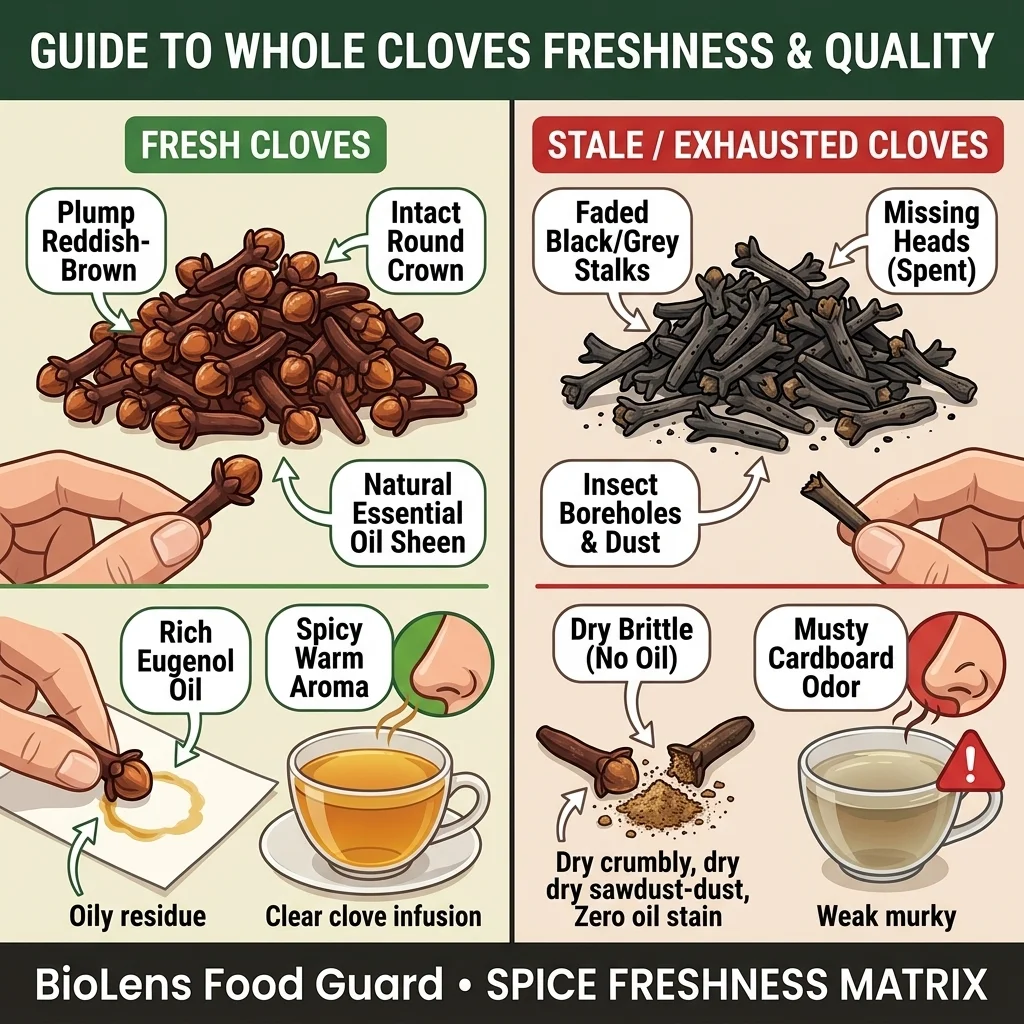
Whole cloves are exceptionally durable when stored properly, retaining their active volatile oils for up to 3 years in airtight containers. Here is how to evaluate clove quality:
✅ Plump Reddish-Brown Stem, Intact Pale Crown & Heavy Oil = PRIME QUALITY
The clove is heavy, oily, reddish-brown in color, with a tight unopened round head and an intense pungent eugenol scent.
⚠️ Dark Brown, Dry Brittle Stem with Minor Bud Damage = FAIR (Cook with 1.5x Amount)
The clove has lost some superficial moisture but still contains sufficient core volatile oils; suitable for long-simmering biryanis and stocks.
❌ Shriveled Black Sticks, Missing Heads, Crumbles to Powder = EXHAUSTED (Discard)
Zero therapeutic or culinary value. The spice has either been steam-stripped or oxidatively decayed over years of improper storage.
❌ Chemical Kerosene Smell, Persistent Greasy Sheen = MINERAL OIL FRAUD (Toxic — Discard)
Artificially polished with hazardous industrial petroleum oils to simulate fresh stock.
Quick Summary Table:
| Appearance & Texture | Float Test & Scent | Food Safety Action |
|---|---|---|
| Plump reddish-brown, intact 4-toothed crown | Sinks or floats vertically; intense numbing scent | ✅ Prime Quality — Use normally in cooking & chai |
| Dark brown, slightly dry, crown intact | Floats vertically; moderate warm eugenol aroma | ✅ Safe — Good for curries, teas, and garam masala |
| Shriveled hollow black stick, no head crown | Floats horizontally flat; zero scent or numb | ❌ Discard (Spent Exhausted Cloves) |
| Sticky glossy surface, greasy paper stain | Faint petroleum or kerosene smell | ❌ Discard (Mineral Oil / Liquid Paraffin Polish) |
| White dusty mold coating in calyx crevice | Musty, damp, cellar-like stench | ❌ Discard Immediately (Mold / Mycotoxin Hazard) |
Quick Safety Tips
- Always perform the water float test: cloves floating horizontally on their sides are spent and oil-stripped
- Check for an oily release when puncturing the stem with your thumbnail — genuine cloves must numb your tongue
- Avoid cloves that look oily and unnaturally black; they may have been treated with petroleum mineral oil
- Ensure the round flower bud crown inside the four-pointed star calyx is fully intact and unbroken
- Store whole cloves in airtight glass jars; never purchase pre-ground clove powder where exhaustion is undetectable
Primary Chemical Concerns
Health Risks & Impacts
Multilingual Local Names
Regulatory Corner: ISO 2254 / FSSAI (Food Products Standards Reg. 2011) / Codex Alimentarius (CXS 354R-2023)
Regulation: FSSAI Food Safety and Standards (Food Products Standards) Regulation 2.4.6: Cloves Standard
Legal Limit:Volatile Essential Oil: Min 17.0% (v/w) for whole cloves (min 15.0% by ISO); Extraneous Clove Stems: Max 5.0%; Headless Cloves: Max 5.0%; Mother Cloves / Twigs: Max 2.0%; Mineral Oil / Paraffin: Strictly Prohibited (0.0%)
Report Adulteration to ISO 2254 / FSSAI (Food Products Standards Reg. 2011) / Codex Alimentarius (CXS 354R-2023)