Pistachios Safety Guide: Detect Shell Bleach, Green Dyes, Mechanical Pliers & Aflatoxins
⚡ Quick 60-Second Pistachio Purity & Toxin Verdict
Chemical Shell Bleaching & Malachite Dye Alert: Cheap commercial pistachios are heavily bathed in toxic hydrogen peroxide (H2O2) and sulfur dioxide (SO2) to bleach stained shells chalk-white, while yellowed stale kernels are dipped in carcinogenic Malachite Green or Tartrazine dyes.
Examine the outer shell under natural light. Pure natural pistachios display a creamy ivory, light beige, or slightly tanned hue with natural wood-grain freckles. Stark, paper-white, chalky shells with no blemishes indicate chemical hydrogen peroxide bleaching.
Pinch the shell seam between thumb and forefinger. Naturally ripe pistachios split open on the tree; their suture cannot be pinched closed. Immature closed nuts forced open mechanically with industrial pliers show jagged tool marks and easily pinch shut.
Drop 4 shelled kernels into a small bowl of warm water with a strip of white blotting paper. Natural pistachio chlorophyll is bound within cell walls and does not bleed into water. Fast-bleeding emerald green or bright yellow water confirms synthetic dyeing.
To explore related healthy dry fruit inspections and nut freshness tests, read our verified guides on Walnuts, Raisins, Pure Honey, Greek Yogurt, and Ice Cream.
Drop Pistachios (Pista) photo here to test purity
or click to browse • Supports JPG, PNG, WEBP • Paste with Ctrl+V
Inspection Guide
Click to enlarge
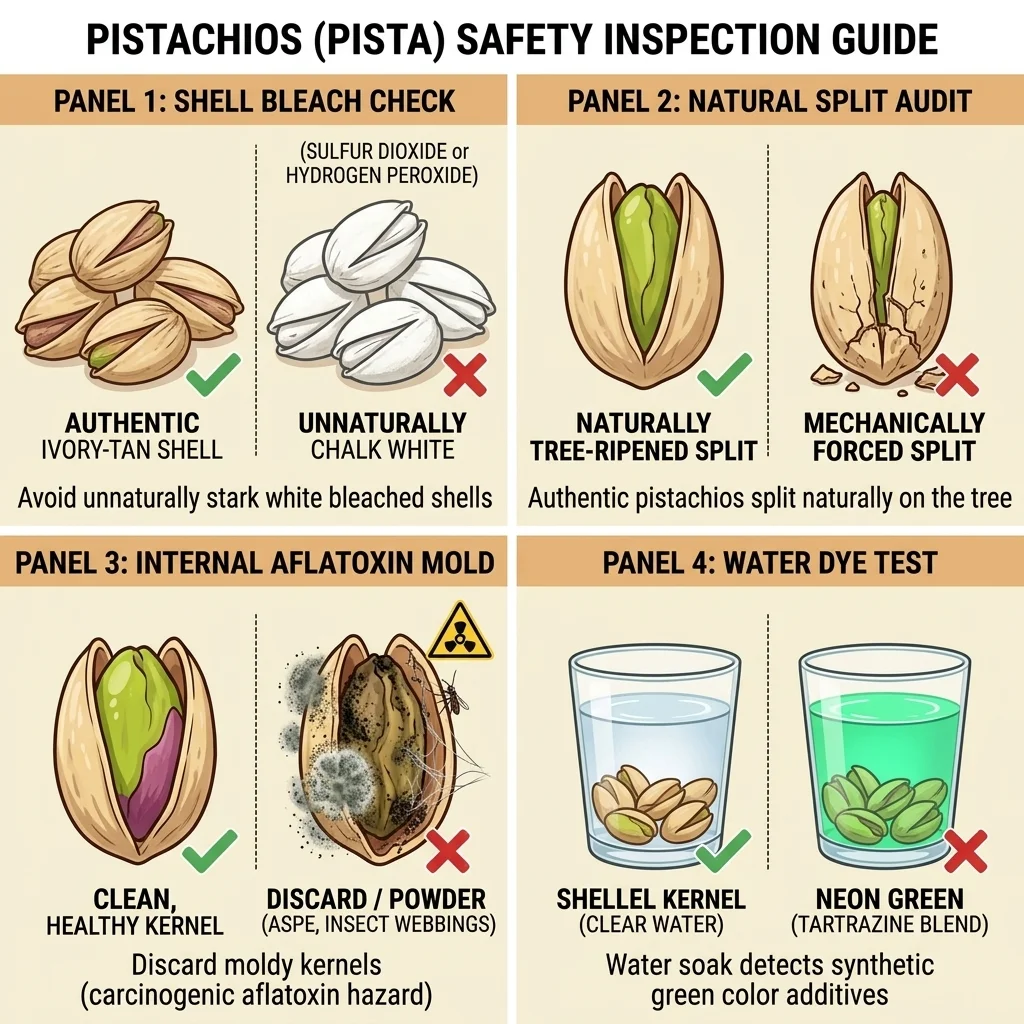
Pistachio Shell Bleaching, Dyeing & Aflatoxin Detection Audit
Pistachios (Pistacia vera) are among the world’s most coveted and expensive tree nuts. Because shell staining naturally occurs when the outer fleshy hull splits late on the tree, commercial suppliers use aggressive chemical treatments to mask cosmetic defects and sell low-grade crops at top-tier prices.
1. Natural Ivory-Tan vs Chemical Bleached White Shell Check:
Look closely at the shell color under direct white daylight.
✅ Authentic Natural Pistachios: Shells have an organic creamy ivory, beige, or pale tan hue with subtle natural wood grain lines and occasional harmless light brown tanning marks.
❌ Chemically Bleached Shells: Look unnaturally chalky, stark snow-white like bleached typing paper, with a powdery surface texture and a faint pungent odor of chlorine or burnt matchsticks (SO2).
2. The Natural Smile vs Industrial Plier Crack Test:
When pistachios ripen on the tree, the expanding kernel naturally bursts the wooden shell open along its suture (the smile).
✅ Naturally Split Nut: The gap between the shell halves is wide, symmetrical, and rounded. If you squeeze the two halves together with your fingers, they cannot be forced shut because the plump kernel completely fills the interior cavity.
❌ Mechanically Cracked Immature Nut: Unscrupulous processors harvest unripe closed nuts (which have tiny, shriveled, flavorless kernels) and use industrial hydraulic plier blades to force a crack. These shells easily snap closed when pinched and often show jagged tool fracture lines.
3. The Water Soak Dye Extraction Test:
To conceal stale, oxidatively yellowed, or moldy kernels, processors soak shelled pistachios in green dye solutions.
✅ Pure Kernel: The exterior skin naturally features purple, violet, and pale rosy anthocyanin pigments, while the meat inside is vibrant chartreuse or light green. Submerging kernels in warm water leaves the water crystal clear.
❌ Artificially Dyed Kernel: The exterior is a uniform, neon, or artificial emerald green. Within 5 minutes in warm water, the dye bleeds into the liquid and stains a submerged white paper towel bright green.
4. 365nm UV Light Mold & Aflatoxin Screening:
Pistachios are highly susceptible to Aspergillus flavus mold, which produces lethal Aflatoxin B1.
✅ Clean Nut Under UV: Shell and kernel show faint dull violet or dark purple absorption.
❌ Mycotoxin Contamination: Emits a bright, glowing, greenish-yellow fluorescence (BGYF) under a 365nm UV blacklight torch, signaling dangerous mycotoxin presence.
Click to enlarge
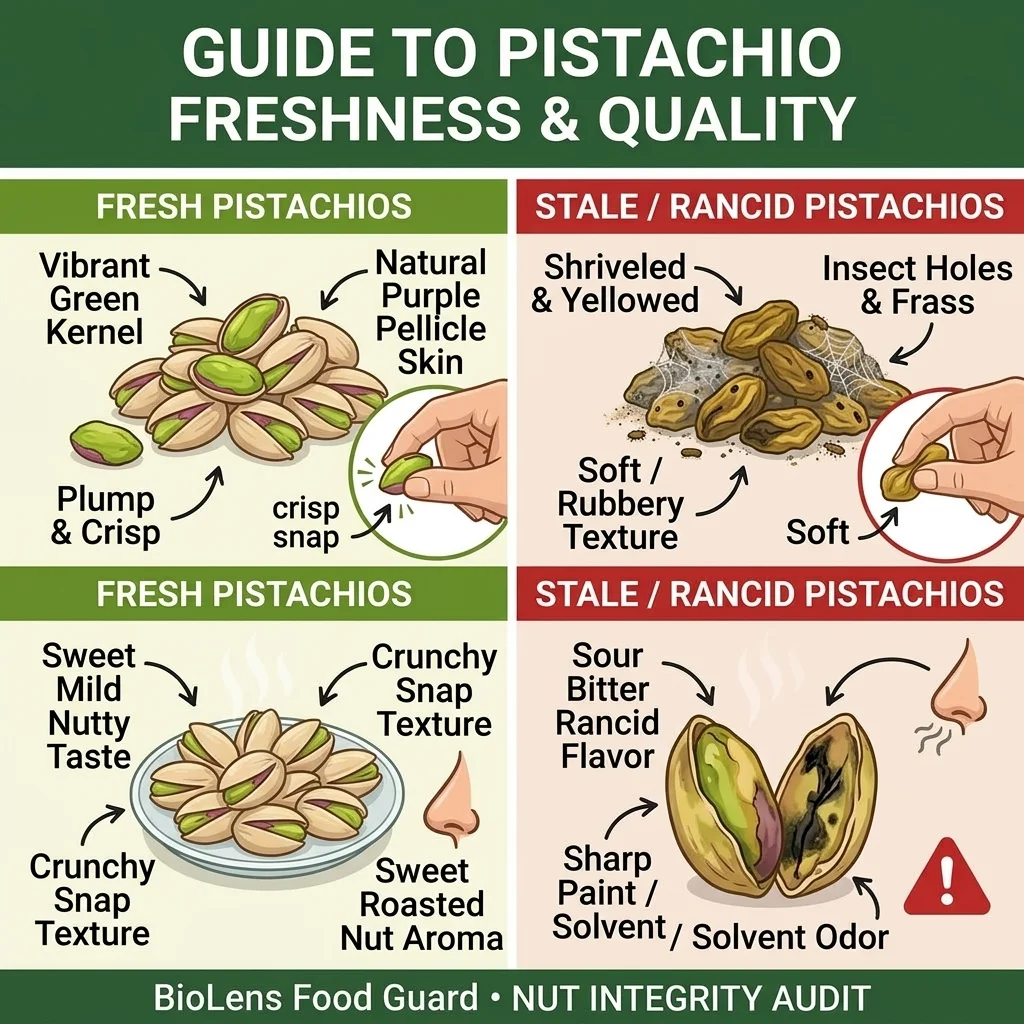
Pistachio Freshness, Rancidity & Aflatoxin Spoilage Matrix
Pistachios contain over 45% delicate monounsaturated and polyunsaturated fatty acids. When exposed to heat, air, and moisture, these lipids oxidize into acrid peroxides, while fungal molds produce carcinogens. Here is how to evaluate freshness:
✅ Crisp Snap, Sweet Nutty Flavor, Purple-Green Kernel = PRIME FRESHNESS
The nut cracks cleanly with an audible snap. The kernel is sweet, crunchy, and features natural purple skin with rich green meat.
⚠️ Slightly Soft / Chewy Texture, Muted Nutty Aroma = STALE (Toast Before Use)
The nut has absorbed environmental humidity and lost its crunch. Still safe to eat if there is no off-taste; roast in a dry pan at 150°C for 5 minutes to restore crispness.
❌ Paint-Like Chemical Taste, Bitter Oil, Yellowed Shriveled Meat = RANCID (Discard)
Lipid oxidation has produced free radicals and toxic aldehydes. Ingestion can cause stomach cramping and systemic inflammation.
❌ Dark Powdery Fuzz Inside Shell, Bitter Dusty Mouthfeel = AFLATOXIN HAZARD (Discard Immediately)
Fungal colonization by Aspergillus. Do not swallow; rinse your mouth immediately. Aflatoxins are heat-stable and cannot be destroyed by roasting or cooking.
Quick Summary Table:
| Appearance & Texture | Shell Suture & Flavor | Food Safety Action |
|---|---|---|
| Creamy tan shell, firm vibrant green & purple kernel | Open smile; sweet, rich, crisp crunch | ✅ Prime Quality — Store chilled in airtight glass |
| Slightly soft chewiness, shell intact | Faint nutty scent, zero bitter off-taste | ⚠️ Stale / Humid — Re-crisp in dry oven at 150°C |
| Stark chalky white shell, chemical matchstick scent | Chemical sulfur smell, bleached surface | ❌ Discard (Hydrogen Peroxide / SO2 Bleach) |
| Uniform neon-green exterior, bleeds color in water | Water turns green; artificial dye flavor | ❌ Discard (Malachite Green / Tartrazine Dye) |
| Black/green mold dust, bitter acrid paint taste | BGYF glow under UV; rancid bitter sting | ❌ Discard Immediately — Severe Aflatoxin Hazard |
Quick Safety Tips
- Avoid pistachios with stark paper-white shells — natural shells should be creamy beige or light tan
- Try to squeeze the shell closed: if it easily snaps shut, it was forced open with pliers rather than ripened naturally
- Reject any pistachio kernel that tastes bitter, sour, or like old oil paint, which indicates toxic rancidity
- Never eat a nut with visible grey, black, or greenish powdery fuzz inside the shell cavity
- Store in an airtight container in the refrigerator to prevent aflatoxin mold growth and oil rancidity
Primary Chemical Concerns
Health Risks & Impacts
Multilingual Local Names
Regulatory Corner: US FDA (CPG Sec. 570.375) / European Food Safety Authority (EFSA) / UNECE (Standard DDP-09)
Regulation: Codex General Standard for Contaminants and Toxins in Food (CXS 193-1995) & FDA CPG Sec. 570.375
Legal Limit:Aflatoxin B1: Max 8.0 ppb (EU ready-to-eat) / Max 12.0 ppb (EU processing); Total Aflatoxins (B1+B2+G1+G2): Max 10.0 ppb (EU) / Max 20.0 ppb (FDA Action Level); Sulfur Dioxide (SO2): Max 50 mg/kg; Malachite Green: Strictly 0.0 ppb (Zero Tolerance)
Report Adulteration to US FDA (CPG Sec. 570.375) / European Food Safety Authority (EFSA) / UNECE (Standard DDP-09)