How to Test Apricot for Adulteration (Sulfur Dioxide, Artificial Orange Dye, Pesticide)
⚡ Quick 60-Second Apricot (Fresh & Dried) Sulfur & Purity Verdict
Excessive Sulfur Dioxide Fumigation & Mineral Oil Glaze: Dried apricots are heavily treated with sulfur dioxide gas to maintain an artificial neon-orange hue (hazardous to asthmatics) and coated with paraffin for gloss.
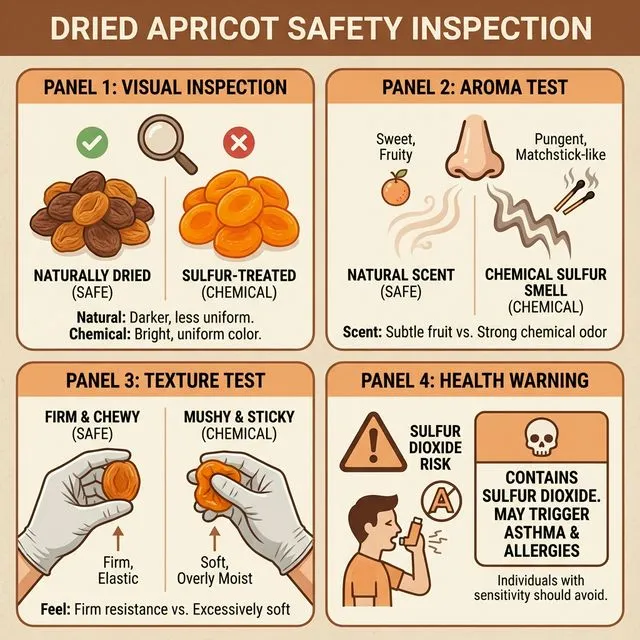
Observe the color tone. Naturally sun-dried apricots turn dark amber-brown or caramel-toned. An unnaturally vivid, translucent neon-orange color indicates heavy sulfur dioxide chemical bleaching.
Drop 3 dried apricots into a glass of hot water for 3 minutes. Sniff the rising steam. A sharp, pungent odor of burnt matchsticks or brimstone confirms high residual sulfur dioxide levels.
Rub the apricot surface on clean white tissue. Mineral oil and liquid paraffin polish leave a greasy translucent circle that does not evaporate or dissolve in cold water.
To learn more about food safety tests and home adulteration detection, read our guides on Custard Apple (Sitaphal) and Cherries.
Drop Apricot photo here to test purity
or click to browse • Supports JPG, PNG, WEBP • Paste with Ctrl+V
Inspection Guide
Click to enlarge
Apricot Purity & Preservative Audit
Dried apricots are almost universally treated with sulfur dioxide to maintain their bright orange color. Naturally dried apricots turn dark brown and look less "appealing" but are chemical-free.
1. The Color Check (Sulfur Detection):
Look at the color. If the dried apricot is bright, vibrant, "neon" orange, it has been heavily treated with sulfur dioxide. Naturally dried apricots are dark brown, chewy, and less "inflated" in appearance.
2. The Smell Test:
Take a deep sniff of the package. If you detect a sharp, "burning match," or acidic chemical smell, high levels of sulfur are present. Natural dried apricots smell like honey and concentrated fruit.
3. The Water Rehydration:
Soak a few dried apricots in warm water for 20 minutes. If the water turns bright orange or yellow, artificial coloring has been added to make them look even more vibrant.
4. The Texture and Stickiness:
Naturally dried apricots are slightly tacky and firm. If they feel unnaturally "soft" or "spongy" while being vibrant orange, they have been chemically treated to retain moisture.
Quick Safety Tips
- Choose dark brown dried apricots - they are the only naturally dried ones
- Avoid bright "neon" orange apricots if you have asthma or respiratory sensitivity
- Wash dried apricots in warm water before consumption to reduce surface sulfur
- Select organic apricots which are sun-dried without chemicals
Primary Chemical Concerns
Health Risks & Impacts
Multilingual Local Names
Common Storage Pests
Dried Fruit Beetle
medium riskSmall beetles that infest dried fruits during storage.
Detection
- Small holes in the fruit
- Fine powder or insect debris in the package
Prevention
- Store in an airtight container in the refrigerator
- Keep away from heat
Corrective Action: What to do?
Discard infested fruit; clean the storage container with vinegar.
Regulatory Corner: US FDA (21 CFR 130.9 / 21 CFR 101.100) / FSSAI (Food Products Standards) Reg. 2.3.47 / Codex Stan 130-1981
Regulation: FDA 21 CFR 101.100 (Sulfiting agents) & FSSAI (Food Products Standards) Regulations 2011, Clause 2.3.47
Legal Limit:Sulfur Dioxide (SO2): Max 2000 ppm (FSSAI) / 2500 ppm (Codex); Mandatory allergen label disclosure required for SO2 > 10 ppm; Mineral oil / paraffin: Prohibited (0.0%)
Report Adulteration to US FDA (21 CFR 130.9 / 21 CFR 101.100) / FSSAI (Food Products Standards) Reg. 2.3.47 / Codex Stan 130-1981