
Nutmeg & Mace (Jaiphal & Javitri) Adulteration & Freshness Guide: Detect Wild Bombay Mace, Exhausted Seeds & Aflatoxins
You can test Nutmeg (Jaiphal) and Mace (Javitri) at home for odorless wild Bombay nutmeg/mace (Myristica malabarica) substitution, spent de-oiled or insect-hollowed kernels, synthetic azo dyes on pale mace blades, and coffee husk or flour starch fillers in ground nutmeg powder using the Water Float Density Test, the Seed Cross-Section Vein Inspection, and the Warm Water Dye Leach Test. Quantifying aflatoxin B1 and safrole/myristicin oil ratios requires laboratory HPLC/GC-MS analysis.
Drop Nutmeg & Mace (Jaiphal & Javitri) photo here to test purity
or click to browse • Supports JPG, PNG, WEBP • Paste with Ctrl+V
Inspection Guide
Click to enlarge
How to Test Nutmeg (Jaiphal) & Mace (Javitri) for Adulteration at Home
🔬 Scientific Home Adulteration Tests
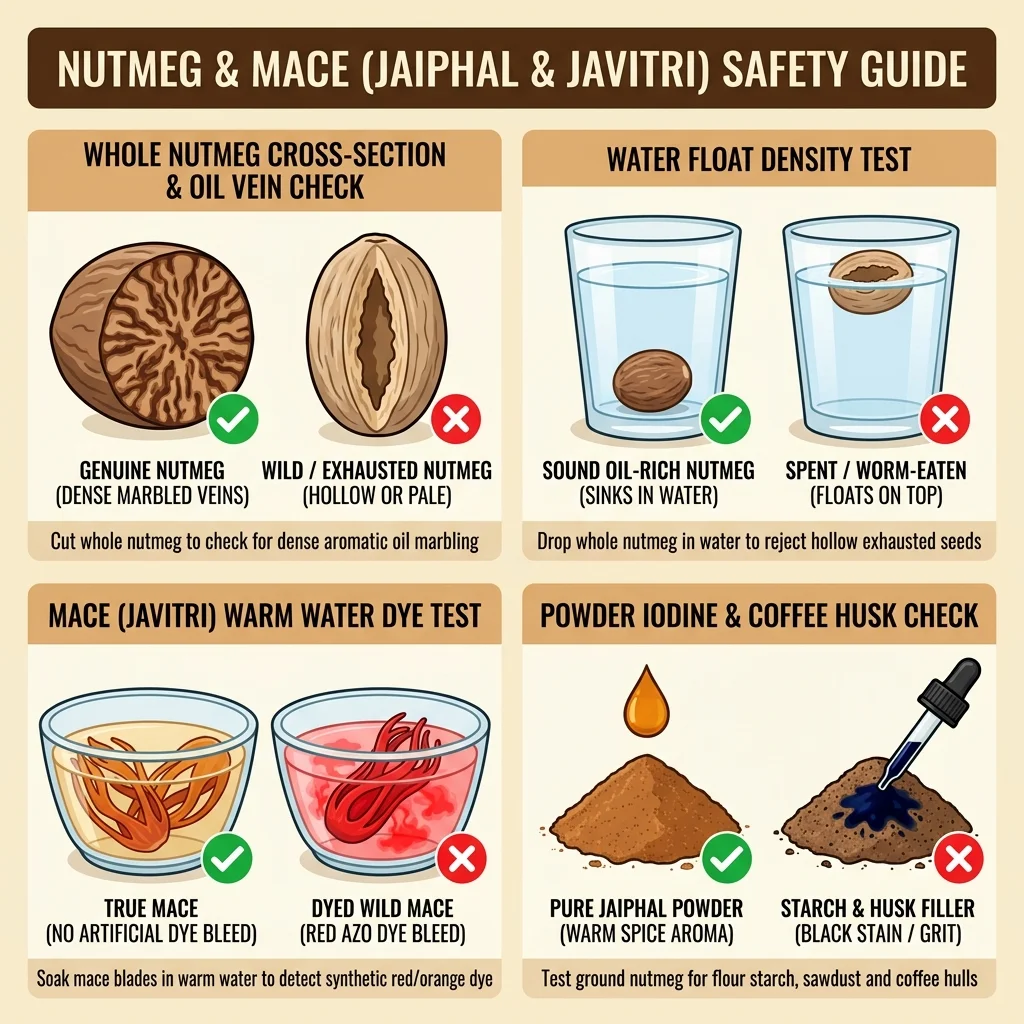
1. Water Float Density Test (For Whole Nutmeg / Jaiphal)
Drop 4–5 whole unshelled or shelled nutmeg kernels into a tall glass of clean room-temperature water and observe for 30 seconds.
- Authentic Oil-Rich Nutmeg: Sound, mature Myristica fragrans kernels are dense with 30–40% fixed nutmeg butter and 7–15% volatile essential oil—they sink rapidly to the bottom (or suspend very low).
- Exhausted / Worm-Eaten / Immature Nutmeg: Spent kernels (from which essential oil was extracted) or seeds hollowed out by cigarette beetles bob immediately to the top surface. Crack open any floating nutmeg to check for internal mold or insect frass.
2. Cross-Section Marbling & Shape Check (True Nutmeg vs. Wild Myristica malabarica)
Cut a whole nutmeg kernel in half lengthwise with a heavy knife or nutcracker and press the cut surface with your thumbnail.
- Genuine Myristica fragrans:Broadly oval/rounded (2–3 cm long), displaying a rich dark reddish-brown perisperm network marbling a pale buff endosperm. Pressing with a thumbnail exudes a slight oily sheen and releases an immediate, intense sweet-spicy aroma.
- Adulterated Wild Nutmeg (M. malabarica): Distinctly elongated, narrow, and cylinder-shaped (3.5–4.5 cm), pale corky brown inside with sparse marbling, dry woody texture, and virtually zero nutmeg aroma.
3. Warm Water & Rub Dye Test for Mace (Javitri)
Place 2–3 blades of mace (Javitri) in a small white bowl of warm water (or with a few drops of rubbing alcohol/vinegar) for 5 minutes.
- Pure True Mace: Consists of flattened, horn-like, brittle-yet-oily crimson-orange to amber-yellow blades that keep the water clear or impart only a faint, slow natural yellowish tint.
- Dyed Wild Bombay Mace: Wild mace is naturally pale buff/yellow and tasteless, so fraudsters dye it crimson. In warm water, synthetic red or orange coal-tar dye bleeds rapidly into the liquid, leaving pale, Narrow, brittle grass-like lobes behind.
4. Iodine & Water Sediment Test for Ground Nutmeg/Mace Powder
Stir 1/2 teaspoon of ground nutmeg powder into half a glass of warm water, let stand 2 minutes, and test a cooled pinch with 1 drop of Iodine solution.
- Pure Ground Nutmeg: Releases a warm spicy aroma; natural seed starch gives only a mild brownish-grey tint with iodine, and no gritty woody shells sink instantly.
- Adulterated Powder: Turns deep blue-black with iodine (confirming cheap maida or cereal starch filler), while heavy dark coffee husks, ground nutshells, or sandy grit settle rapidly at the bottom of the glass.
Click to enlarge
Nutmeg & Mace Freshness, Aroma & Storage Guide
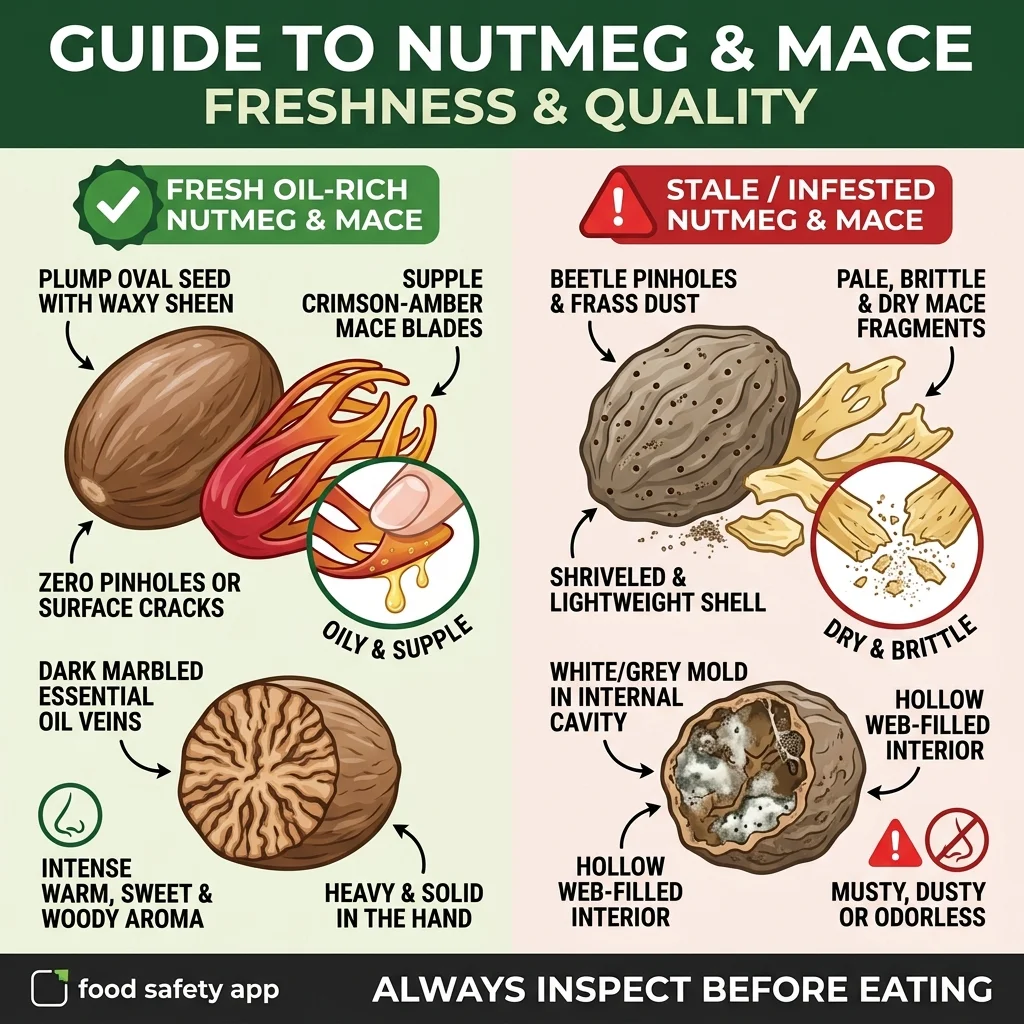
📊 Fresh vs. Stale / Infested Nutmeg & Mace Comparison
| Quality Marker | ✅ Fresh Grade-A Nutmeg & Mace | ❌ Stale / Moldy / Infested Spice |
|---|---|---|
| Whole Nutmeg Weight & Shell | Heavy, solid, plump oval seed; smooth greyish-brown furrowed surface with zero pinholes | Lightweight, hollow-sounding when rattled; tiny 1–2 mm round beetle exit holes |
| Internal Kernel Cross-Section | Dense, waxy, dark brown oil veins marbling a cream matrix; exudes oil under fingernail | Chalky white/grey mold mycelium, black powdery insect frass, or dry corky woodiness |
| Mace (Javitri) Blades | Pliable, slightly leathery/oily crimson-orange to golden-amber lacy blades | Bleached whitish-straw color, shatters into dry odorless dust, or neon-red dyed |
| Aroma & Flavor Profile | Intense, warm, sweet-woody, slightly camphoraceous fragrance upon scratching | Musty, damp cellar smell, acrid rancid fat note, or completely flat and odorless |
🏠 Storage & Shelf-Life Best Practices
- Whole Kernels vs. Ground Powder: Whole nutmeg kernels retain their essential oils inside their dense lipid matrix for 3 to 4 years when stored in an airtight glass jar in a cool, dark cupboard. Whole mace blades stay vibrant for 18–24 months, whereas pre-ground nutmeg loses 60% of its volatile aroma within 3–6 months.
- Humidity & Mold Control: Never store nutmeg or mace above a steamy stove or dip a wet spoon into spice jars; moisture above 10% triggers internal Aspergillus flavus growth.
- Freezer Quarantine: Freeze newly purchased whole nutmeg and mace at -18°C for 72 hours (in a sealed bag) to eliminate any dormant spice beetle eggs before transferring to pantry jars.
Quick Safety Tips
- Always buy whole nutmeg kernels (Jaiphal) and whole intact mace blades (Javitri) rather than pre-ground powders, which quickly lose volatile oils and hide husk fillers.
- Perform the Water Float Test on whole nutmegs before grating them into Christmas Plum Cake or Peda—discard any light seeds that float.
- Crack open whole nutmegs before grating to ensure the center is free from grey/black Aspergillus mold or beetle webbing.
- True mace (Javitri) has 2–3 cm wide, supple, oily, aromatic orange-amber blades; reject long, narrow, dark-red, odorless blades of wild Bombay mace.
- Grate whole nutmeg fresh at the moment of cooking using a microplane to capture 100% of its natural myristicin and elemicin aroma.
Primary Chemical Concerns
Health Risks & Impacts
Festive Sweets & Bakery Items Using Nutmeg & Mace (Jaiphal & Javitri)
Adulterated Nutmeg & Mace (Jaiphal & Javitri) is frequently concealed inside prepared festive sweets and baked goods. Inspect these composite dishes where Nutmeg & Mace (Jaiphal & Javitri) is a core ingredient:
Multilingual Local Names
Common Storage Pests
Coffee Bean Weevil (Araecerus fasciculatus) & Cigarette Beetle (Lasioderma serricorne)
high riskPrimary boring beetles that penetrate cracked nutmeg shells and dried mace blades during tropical storage, hollowing out the oil-rich endosperm.
Detection
- Circular 1–1.5 mm exit holes on the surface of the nutmeg kernel
- Powdery brown frass spilling out when the nutmeg is tapped or cut open
Prevention
- Perform the water float test on newly purchased whole nutmegs and store sound seeds in airtight glass jars
- Freeze new spice packets at -18°C for 72 hours before pantry storage
Corrective Action: What to do?
Discard all perforated or floating nutmegs immediately and sanitize the storage container.
Aspergillus flavus & Aspergillus ochraceus (Mycotoxigenic Molds)
high riskStorage fungi that colonize slow-dried or humidity-exposed nutmeg kernels, producing heat-stable Aflatoxin B1 and Ochratoxin A.
Detection
- Greyish-green, yellow-green, or black dusty fungal colonies inside internal kernel fissures when cut in half
- Damp, musty, earthy odor replacing the clean sweet-spicy nutmeg fragrance
Prevention
- Keep whole spices in dry, dark cabinets away from stove steam (relative humidity < 60%)
- Always cut whole nutmegs in half to inspect the internal cavity before grating
Corrective Action: What to do?
Never grate around moldy spots—mycotoxins diffuse throughout the lipid-rich seed. Discard the entire kernel.
Regulatory Corner: FSSAI / ISO 6539 / EU Regulation 2023/915
Regulation: FSS (Food Products Standards and Food Additives) Regulations — Clause 2.9.14 (Nutmeg / Jaiphal & Mace / Javitri)
Legal Limit:Volatile oil min 6.5% (v/w) in whole nutmeg & min 7.0% in mace; Extraneous matter max 1.0%; Moldy/insect-damaged kernels max 3.0%; Zero wild Myristica malabarica or added coloring matter; Total Aflatoxins max 10 ppb.
Report Adulteration to FSSAI / ISO 6539 / EU Regulation 2023/915What CANNOT be Verified (Lab-Only)
- GC-MS Essential Oil Profiling (ISO 3215 / AOAC): Quantifies signature volatile markers—sabinene (15–50%), alpha/beta-pinene, terpinen-4-ol, myristicin (5–12%), and elemicin—to expose spent steam-distilled spices or synthetic terpenes.
- TLC & HPLC Botanical Authentication: Detects Myristica malabarica (Bombay mace) resinous diphenylpropanoids (malabaricones A–D) and HCl-ethanol chromogenic reactions.
- Immunoaffinity HPLC-FLD Mycotoxin Assay (EU Reg 2023/915): Measures Aflatoxin B1 (max 5 µg/kg) and Total Aflatoxins (max 10 µg/kg) alongside Ochratoxin A (max 15 µg/kg).
- Microscopic Histological & Acid-Insoluble Ash Analysis (FSSAI): Identifies lignified pericarp shell stone cells, coffee parchment sclereids, and foreign cereal starch granules.