
Azalea vs Rhododendron
How to tell an Azalea from a Rhododendron? Compare stamen counts (5 vs 10+), leaf texture, flower clusters, evergreen habits, and grayanotoxin pet safety.
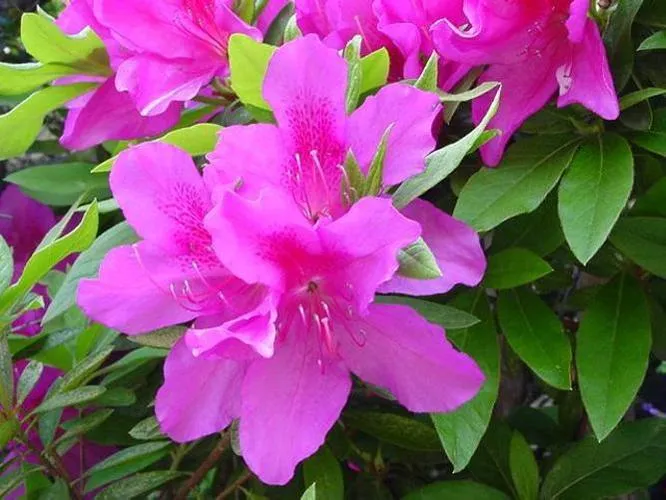
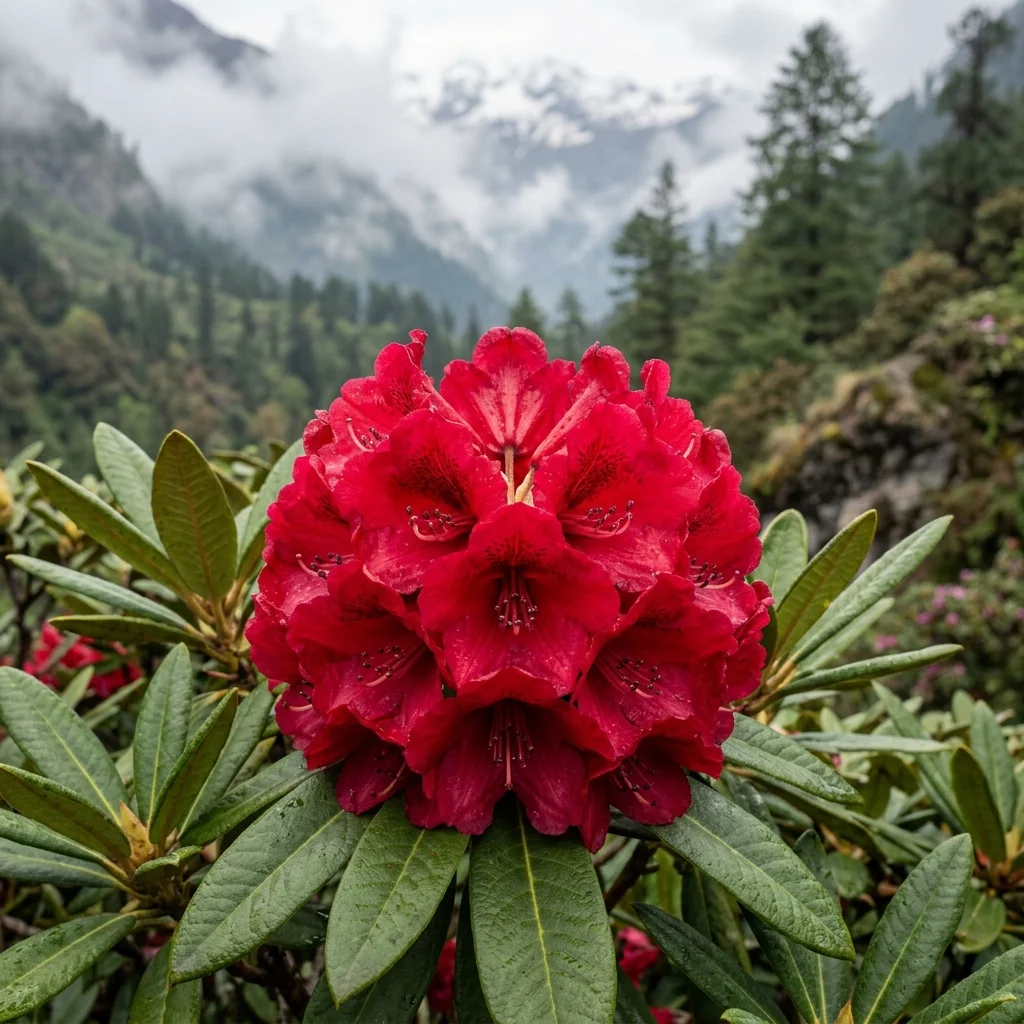
Key Differences: Azalea vs Rhododendron
The primary botanical relationship to understand is that all Azaleas are taxonomically classified within the genus Rhododendron ( primarily in subgenera Tsutsusi and Pentanthera), meaning every Azalea is technically a type of Rhododendron, though not every Rhododendron is an Azalea. In the field, the most reliable scientific way to tell them apart is to count the stamens inside a single blossom: true Azaleas almost always possess 5 long, protruding stamens (one per petal lobe) in tubular or funnel-shaped flowers borne in small clusters of 2 to 3 at the stem tips.
In contrast, true large-leaved Rhododendrons (such as Rhododendron arboreum and Rhododendron ponticum) feature 10 or more stamens tucked inside wide, bell-shaped blossoms that open in massive, dome-like spherical trusses of 10 to 20 flowers. Vegetatively, Azaleas are typically smaller, finer-textured shrubs (many of which are deciduous) with small, thin, pointed leaves covered in fine stiff hairs, whereas Rhododendrons grow into large, bold evergreen shrubs or woodland trees with thick, leathery, paddle-shaped leaves whose undersides are often coated in a rusty or silvery scaly layer (indumentum).
Botanical & Care Comparison Table
| Feature | Azalea | Rhododendron (Burans) |
|---|---|---|
| Family | Ericaceae | Ericaceae |
| Colors Available | Magenta, Hot Pink, Salmon, Scarlet Red, White, Yellow, Orange (deciduous types) | Crimson Red, Deep Rose, Lavender-Purple, Blush Pink, Pure White |
| Bloom Season | Mid-to-late spring (April–June; Encore cultivars rebloom in autumn) J F M A M J J A S O N D | Early to mid-spring (March–May; February–April in Himalayan habitats) J F M A M J J A S O N D |
| Maintenance Level | Low to Moderate (requires acidic soil pH 4.5–6.0, pine-bark mulch, and light pruning right after bloom) | Low (deadhead spent flower trusses carefully above new leaf buds; protect from drying winter winds) |
| Sunlight Needs | Morning Sun with Afternoon Dappled Shade (deciduous types tolerate more sun) | Dappled Woodland Shade to Partial Sun (scorches in harsh afternoon sun or reflected heat) |
| Watering Needs | Moderate (shallow fibrous roots require consistent moisture and sharp drainage) | Moderate (requires moist, humus-rich, well-aerated acidic soil; intolerant of waterlogged clay) |
| Pet Toxicity | 💀 Highly toxic to cats, dogs, and livestock (contains cardiotoxic grayanotoxins) | 💀 Highly toxic to cats, dogs, horses, and humans (nectar and leaves contain grayanotoxins) |
| Fragrance | Unscented in most evergreen types; intensely sweet clove-honeysuckle scent in native deciduous azaleas | Mildly herbaceous to lightly sweet floral fragrance in select species |
| Pests & Diseases | Susceptible to Lace Bugs, Powdery Mildew, Phytophthora Root Rot, and Spider Mites. | Susceptible to Root Rot, Vine / Leaf Weevils, Rust Disease, and Cercospora Leaf Spot. |
| Typical Uses | Foundation borders, Japanese woodland gardens, bonsai specimens, colorful spring hedges | Shaded woodland focal points, large evergreen privacy screens, mountain and estate landscapes |
How to Spot the Differences (Visual Identification)
Spot the features below to easily distinguish between the two plants in the wild or garden:
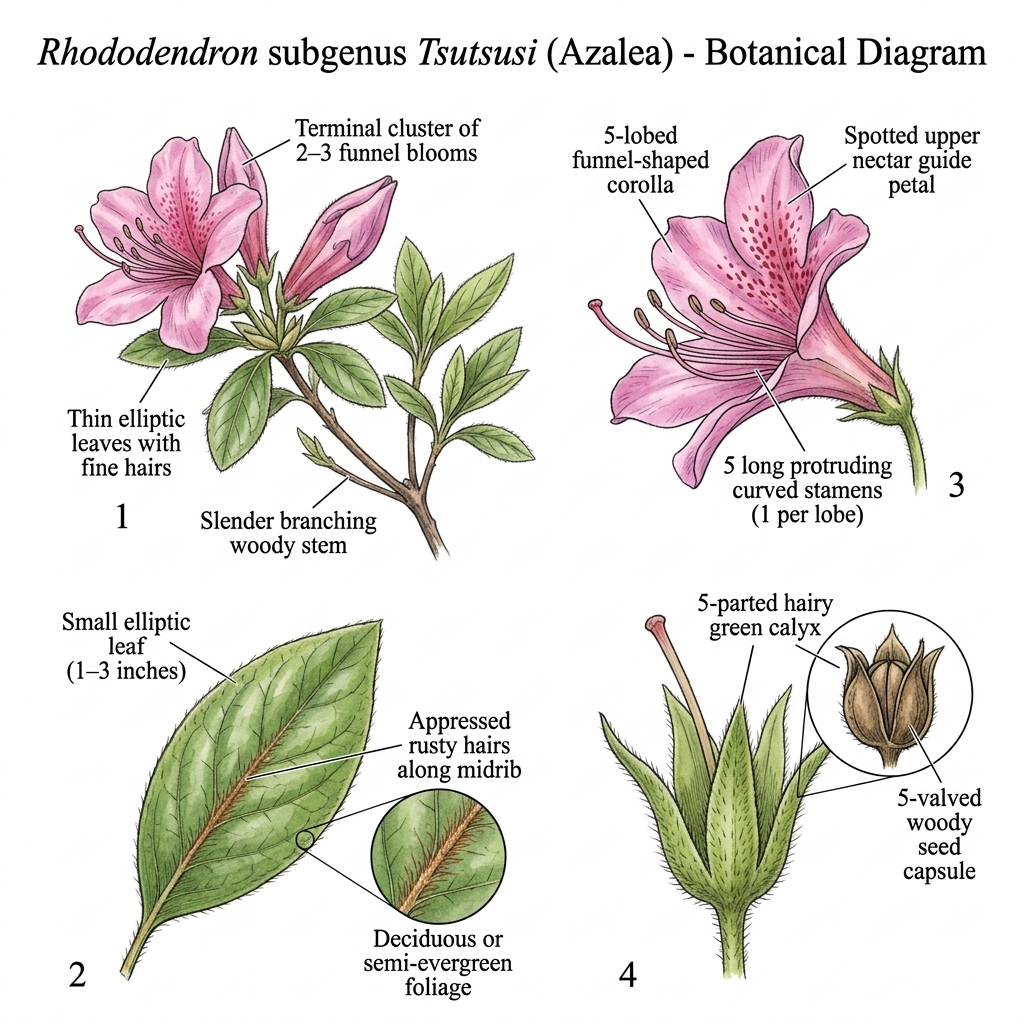
- Exactly 5 protruding stamens: Flowers contain 5 long, curved stamens—one corresponding to each of the 5 corolla lobes.
- Funnel-shaped blooms in small clusters: Blossoms are tubular-funnel shaped and open in small groups of 1 to 3 per stem tip, smothering the entire bush.
- Small, thin, hairy leaves: Leaves are compact (1 to 3 inches long), narrow-elliptic, and often feature fine, stiff appressed hairs along the midrib.
- Deciduous or compact semi-evergreen habit: Many species drop their leaves in autumn after turning fiery orange-red, staying compact (2 to 6 feet tall).
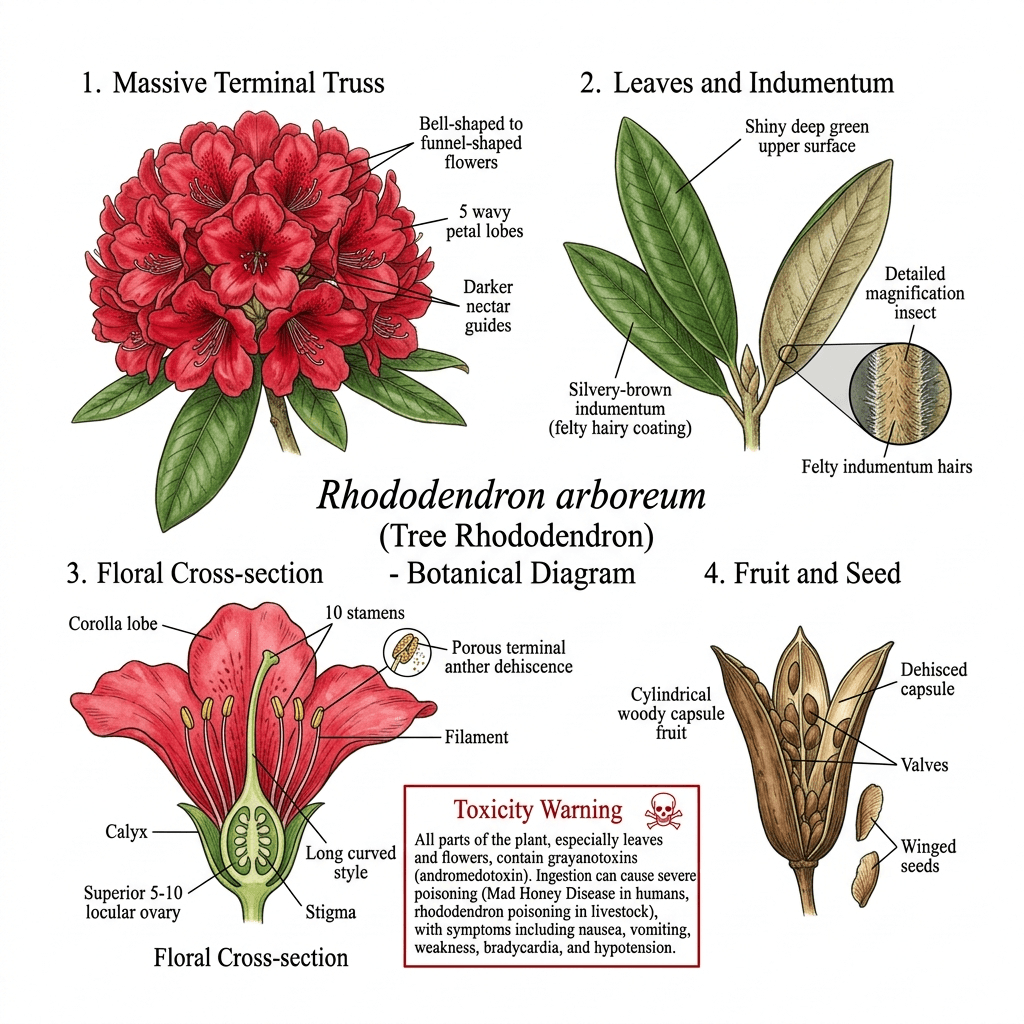
- 10 or more stamens per flower: Each blossom houses 10 to 20 prominent stamens arranged inside a deep bell-shaped throat.
- Large spherical flower trusses: Blooms are gathered into massive, ball-like terminal domes (corymbose racemes) of 10 to 20 individual bells.
- Large, thick leathery evergreen leaves: Broad, glossy, oblong leaves (4 to 8 inches long) that curl lengthwise like cigars in freezing weather.
- Scaly or fuzzy leaf undersides: Undersides of leaves are smooth, scaly (lepidote), or clothed in a dense, velvety tan-to-rust felt (indumentum).
Which Should You Choose?
- Choose Azalea if you have a smaller garden bed or foundation border and want a compact shrub completely blanketed in brilliant pink, coral, red, or golden-orange funnel blossoms—or choose reblooming Encore varieties for both spring and autumn color.
- Choose Rhododendron if you need a bold, architectural evergreen backdrop or woodland specimen with large leathery foliage and dramatic, globe-shaped trusses of bell-like spring flowers.