
Ash Weevil
Myllocerus subfasciatus
About Ash Weevil
The Ash Weevil (*Myllocerus subfasciatus* and *Myllocerus undecimpustulatus*, family Curculionidae, order Coleoptera) is a destructive, highly polyphagous chewing snout beetle native to Southern Asia that has established invasive populations in tropical and subtropical agricultural regions worldwide. This broad-spectrum pest infests over 150 host plants, with severe economic damage reported in Solanaceous crops (especially brinjal/eggplant, tomatoes, and chilies), okra, cotton, and major fruit orchards (pomegranate, guava, mango, and citrus).
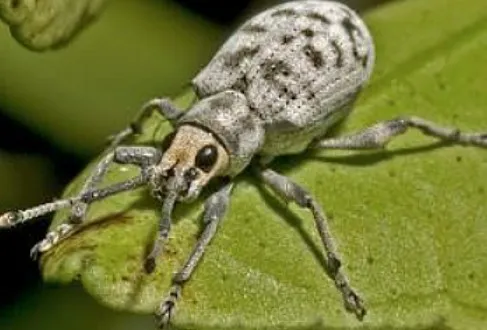
The dual-stage life cycle of the Ash Weevil makes it doubly destructive. Adult weevils are compact (3 to 6 mm long), pearlescent ash-grey to greyish-white beetles with a broad, short snout and faint dark or yellowish-brown maculae on their elytra. Adults feed on above-ground foliage, while their subterranean larvae (grubs)—which are creamy white, legless, C-shaped grubs with light brown head capsules—feed aggressively on root hairs, taproots, and root crowns in the soil.
Diagnosing an Ash Weevil infestation is straightforward due to its signature marginal leaf feeding pattern. Adult beetles chew inwards from the leaf edges, carving out highly distinctive, jagged, semi-circular scalloped notches along the margins. In severe infestations, leaves are skeletonized down to their midribs. Below ground, root grazing by grubs starves the plant of water and nutrients, resulting in generalized chlorosis (yellowing), sudden midday wilting, stunted shoot growth, and complete seedling collapse.
Post-harvest and storage considerations: While primarily a field and orchard pest, adult Ash Weevils frequently hitchhike into produce storage crates, hiding beneath the calyx caps of harvested eggplants, pomegranates, and guavas. In warm, poorly ventilated packing sheds, surviving adults contaminate produce and continue feeding on green calyx tissue, accelerating fungal decay and rendering fruits unmarketable.
Ash Weevils exhibit strong seasonal population spikes during the warm, pre-monsoon and summer months (March to June). A single mated female deposits 300 to 500 tiny, oval, light-yellow eggs in the soil around the root zone. Hatching grubs tunnel through soil for 30 to 50 days before constructing oval earthen pupal chambers. Adult beetles emerge with a lifespan of up to 4 months.
| Target Crops / Plant Hosts | Severity Rating | Key Symptoms & Damage Mode |
|---|---|---|
| Brinjal / Eggplant (Solanum melongena) | Extreme (⭐⭐⭐) | Severe leaf scalloping, root severance, total plant wilting & collapse |
| Okra, Chili Pepper & Tomato | High (⭐⭐) | Marginal notches, seedling damping, blossom & bud drop |
| Pomegranate, Guava & Citrus | High (⭐⭐) | New shoot defoliation, fruit calyx contamination in crates |
| Ornamental Hibiscus & Roses | Medium (⭐) | Aesthetic leaf margin notches, reduced flowering vigor |
Sustainable Integrated Pest Management (IPM) incorporates cultural, biological, and organic methods. Shaking plant branches in the early morning over a white cloth exploits the weevil's natural thanatosis (playing dead) behavior to collect and destroy adults. Subterranean grubs are effectively controlled using entomopathogenic nematodes (*Heterorhabditis bacteriophora*) and soil-incorporated neem cake. For companion diagnostic guides, consult our Plant Disease Identifier Hub, or view profiles on Root-Knot Nematodes, Cutworms, and Stem Borers.
Taxonomy & Features
- Scientific Taxonomy: *Myllocerus subfasciatus* (Family: Curculionidae, Order: Coleoptera, Class: Insecta). Commonly known as Ash Weevil, Grey Weevil, and Sambal Vandu.
- Diagnostic Leaf Scalloping: Adults feed on leaf margins, leaving behind classic semi-circular, jagged notched borders on eggplants, okra, and orchard trees.
- Subterranean Root Grubs: Legless, C-shaped white larvae feed on fibrous roots and taproot bark, causing severe mid-day wilting and seedling death.
- Thanatosis Defense Mechanism: When disturbed, adults immediately drop to the ground and feign death, blending seamlessly into leaf litter and soil.
- Ash-Grey Morphological Markings: Distinctive pearlescent grey-white body with a broad, stout snout and faint yellowish-brown spots on hard elytra.
- Post-Harvest Calyx Contamination: Adults harbor under fruit calyx caps in harvested brinjal and pomegranate crates, spreading into storage and transit.
- Organic & Biological Controls: Highly responsive to morning branch-shaking, 5% NSKE neem spray, *Beauveria bassiana*, and beneficial EPN nematodes.
Seasonal Outbreak Calendar
Outbreak risk and activity timeline for Ash Weevil based on seasonal climate patterns:
Names in Different Languages
Affected Plant Species
Vegetables & Crops
- Eggplant / Brinjal (Solanum melongena - highly susceptible)
- Okra / Ladyfinger (Abelmoschus esculentus)
- Chili Pepper
- Tomato
- Cowpea & Beans
- Sweet Potato
Flowers & Ornamentals
- Hibiscus
- Roses
- Jasmine
- Chrysanthemums
- Zinnias
- Bougainvillea
Fruits & Berries
- Pomegranate
- Guava
- Mango
- Citrus (Lemon, Sweet Orange)
- Cashew
- Apple
Prevention & Cure
Natural & Organic Methods
- Morning Branch Shaking & Thanatosis Collection: Shake infested branches over a white sheet or inverted umbrella in the cool morning hours; collect and drown dropped weevils in soapy water.
- Neem Cake Soil Application: Incorporate organic neem cake (250 kg/ha or 50g per garden pot) around the root zone to inhibit female egg-laying and destroy young root grubs.
- Beneficial Entomopathogenic Nematodes (EPN): Drench moist soil with predatory nematodes (Heterorhabditis bacteriophora or Steinernema carpocapsae) to parasitize and kill subterranean grubs within 48 hours.
- Botanical Sprays (NSKE 5% / Neem Oil): Spray 5% Neem Seed Kernel Extract (NSKE) or cold-pressed Azadirachtin (10,000 ppm at 2 ml/L) as a feeding deterrent against adult leaf notches.
- Bio-fungal Sprays (Beauveria bassiana): Apply Beauveria bassiana (1x10^8 CFU/g at 5g/L) during humid conditions to infect and mummify adult weevil populations.
- Post-Harvest Storage Audit: Inspect and gently wipe the calyx rims of harvested eggplants and pomegranates before packing in clean, mesh-covered crates.
Chemical & Professional Control
- Foliar Knockdown: Spray Lambda-Cyhalothrin 5% EC (1 ml/L) or Chlorantraniliprole 18.5% SC (0.3 ml/L) to control heavy adult foliar infestations.
- Soil Treatment: Apply Fipronil 0.3% GR (20–25 kg/ha) or Chlorpyrifos 20% EC (2 ml/L drench) around the base of affected plants in non-organic commercial acreage.
- Orchard Tree Drench: Apply Imidacloprid 17.8% SL (0.5 ml/L) post-harvest around tree basins to control systemic grub populations.
Frequently Asked Questions
What is the scientific name, family, and order of the Ash Weevil?
The Ash Weevil is botanically and entomologically classified as Myllocerus subfasciatus (and Myllocerus undecimpustulatus), belonging to the Family Curculionidae (snout beetles/weevils), Order Coleoptera (beetles), and Class Insecta.
What are the key damage symptoms of Ash Weevil in Brinjal (Eggplant)?
Adult weevils feed on leaf margins, creating distinct semi-circular jagged or scalloped notches that can defoliate plants. Below the soil, the creamy-white grubs feed on root hairs and taproots, causing sudden midday wilting, nutrient deficiency symptoms, and seedling death.
How do you control Ash Weevil grubs in the soil organically?
The most effective organic soil treatments are applying beneficial Entomopathogenic Nematodes (Heterorhabditis bacteriophora) as a soil drench and incorporating organic Neem Cake into the soil, which repels egg-laying females and parasitizes grubs within 48 hours.
Why do Ash Weevils drop to the ground when touched?
This is an instinctive survival behavior called 'thanatosis' (playing dead). When the host plant is disturbed or shaken, the weevils immediately release their grip, tuck their snouts and legs, and fall into the soil litter where their grey camouflage hides them from predators.
Can Ash Weevils infest stored vegetables and fruits after harvest?
Yes. Adult weevils often seek shelter under the calyx rims of harvested eggplants, pomegranates, and guavas. In storage and transport crates, they feed on green calyx tissue and create wounds that allow post-harvest rot fungi to enter.
How can you differentiate Ash Weevil from other garden beetles?
Ash Weevils are identified by their pearlescent grey-white scale covering, short blunt snout (rostrum), small black/orange spots on their wing covers, and their unique marginal leaf-notching feeding pattern.
Recommended diagnostics based on crop family and symptoms:
Remedy Disclaimer & Safety Notice
This disease guide is for educational screening purposes only. Pathogen behavior, severity, and host susceptibility can vary dramatically based on seed variety, weather conditions, and regional microclimates. Chemical pesticides and organic treatments are subject to strict regional environmental regulations and registration mandates. Please verify all chemical registrations and review manufacturer safety labels carefully with local certified agronomists or agricultural extension service offices before applying.