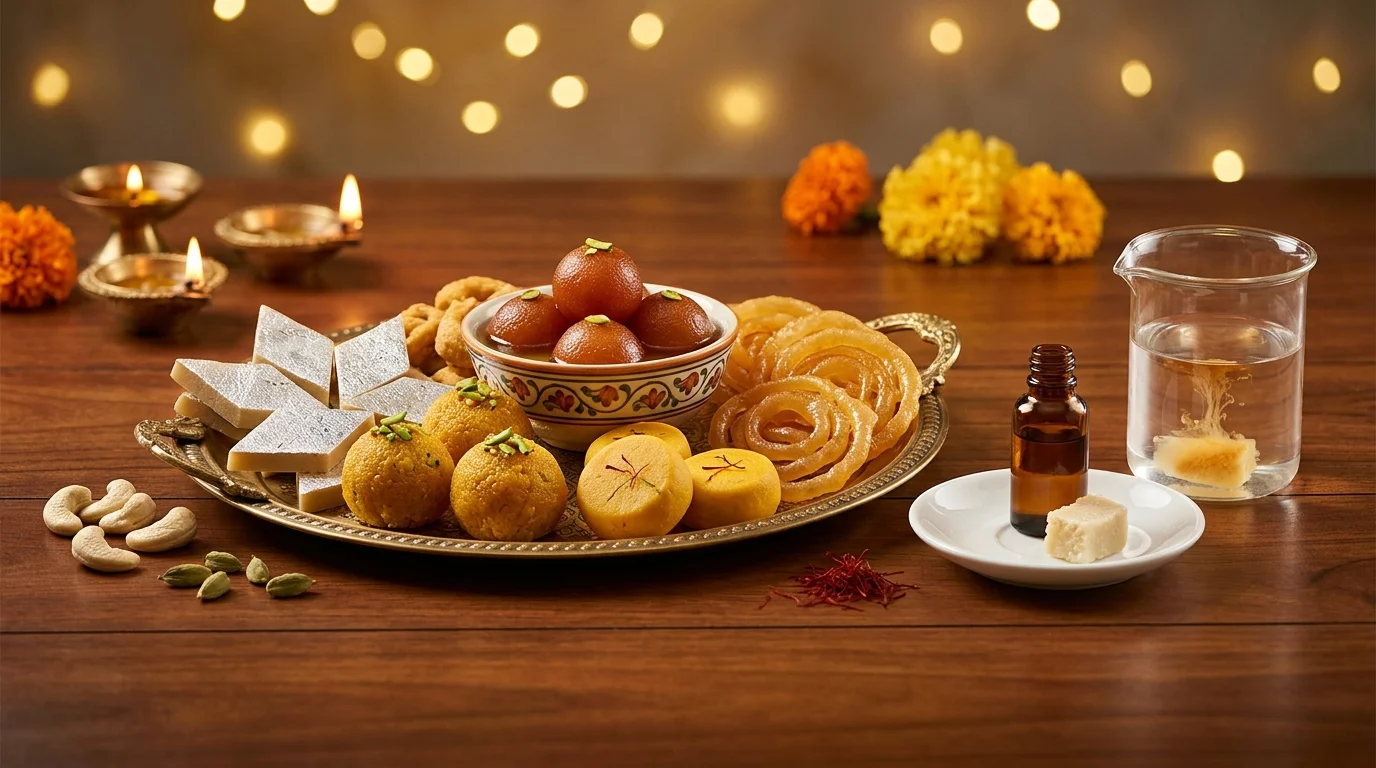
Kaju Katli Adulteration & Freshness Guide: Detect Aluminium Foil, Starch Fillers, Peanut Paste & Vanaspati
You can test Kaju Katli (Cashew Barfi) at home for toxic metallic aluminium foil replacing edible Chandi Vark, cheap refined flour (maida), potato, arrowroot, or rice starch fillers, hydrogenated vanaspati/palm oil, and peanut or melon-seed dilution using the Finger-Rub & Flame Foil Test, the Calibrated Iodine Paste Test, and the Warm Water Dispersion Test. Detecting trace peanut allergens, titanium dioxide (E171), and aflatoxins requires laboratory ELISA/HPLC/ICP-MS analysis.
Drop Kaju Katli (Cashew Barfi) photo here to test purity
or click to browse • Supports JPG, PNG, WEBP • Paste with Ctrl+V
Inspection Guide
Click to enlarge
How to Test Kaju Katli for Fake Silver Foil, Starch & Peanut Fillers at Home
🔬 Scientific Home Adulteration Tests
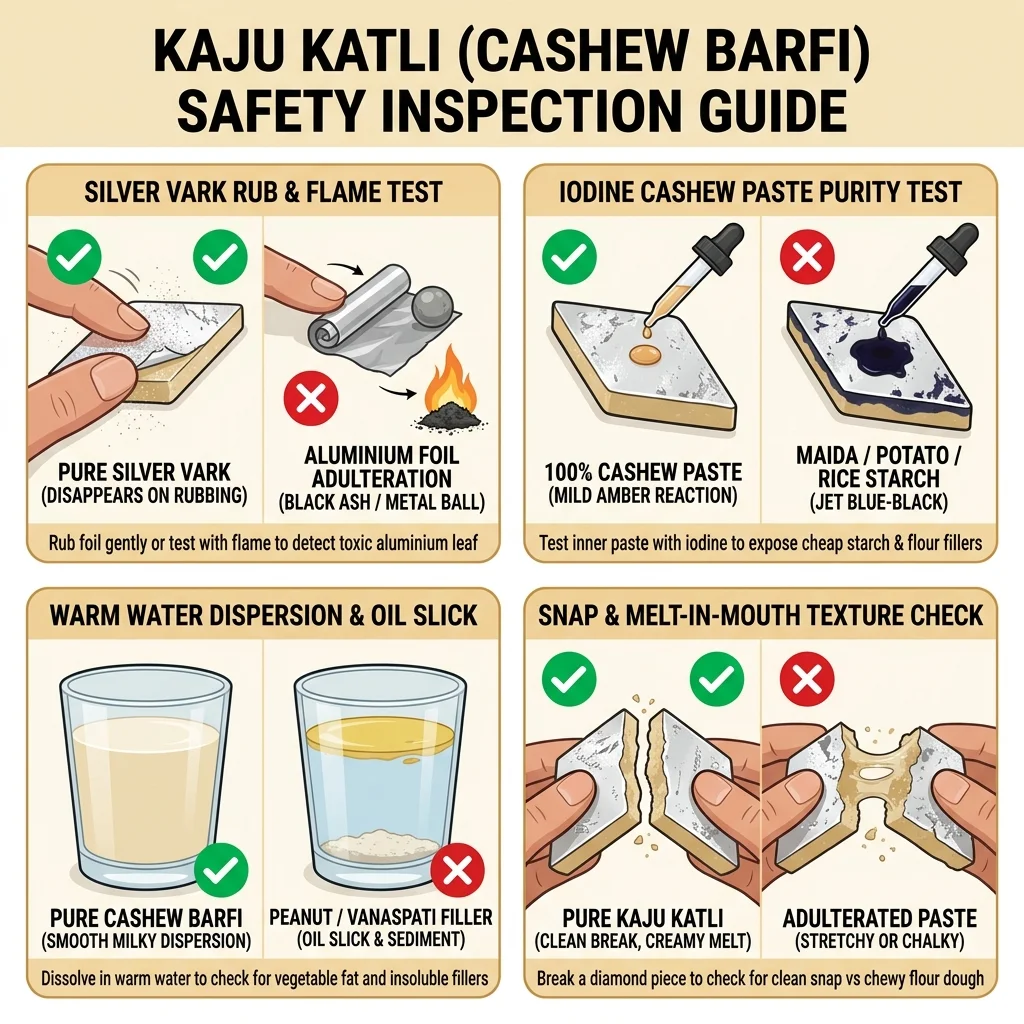
1. Finger-Rub & Flame Test for Silver Vark vs. Toxic Aluminium Foil
Peel or gently scrape a small flake of the metallic foil from the top of the Kaju Katli:
- Test A (Finger Rub): Rub the foil between your thumb and index finger. Pure 99.9% Chandi Vark is less than 0.2 microns thick and crumbles/vanishes into a weightless sparkle on your skin. Adulterated aluminium foil is thicker, cohesive, and rolls into a tiny dark-grey metal ball.
- Test B (Flame Check): Hold a flake of the foil with tweezers over a lighter flame. Pure silver glows and forms a tiny glistening silver bead without turning black; aluminium foil turns black immediately and chars into dark ash.
2. Calibrated Iodine Test on Inner Cashew Paste
Scrape off the top foil layer, take a small piece of the white inner Kaju Katli paste, mash it in 2 teaspoons of water, and add 1 drop of Iodine solution.
- 100% Pure Cashew Kaju Katli: Raw cashews naturally contain ~20–23% complex carbohydrates (including a small fraction of native nut starch), so pure Kaju Katli shows a mild amber-brown or very soft brownish-violet tint.
- Heavily Adulterated with Maida / Arrowroot / Potato / Rice Starch: Turns an instant, opaque jet-black or deep ink-blue, accompanied by a slimy, pasty sediment—confirming cheap cereal or tuber starch fillers.
3. Warm Water Dispersion & Oil-Slick Test
Dissolve a half-piece of Kaju Katli in half a glass of warm water (50°C), stir well for 60 seconds, and let it stand for 3 minutes.
- Authentic Kaju Katli: Disperses smoothly into a rich, uniform, milky-ivory cashew emulsion with a clean, sweet nutty aroma and almost no insoluble chalky residue.
- Vanaspati / Chalk / Flour Adulterated: Leaves a greasy, waxy film of hydrogenated vegetable fat floating on top, a heavy chalky or glutinous sediment at the bottom, or a distinct roasted-peanut odor rising from the warm water.
4. Diamond Snap & Melt-in-Mouth Palate Test
Hold a diamond piece of Kaju Katli at both ends and break it in half, then let a small piece dissolve on your tongue without chewing.
- Pure Kaju Katli: Breaks with a clean, tender, short snap revealing a velvety, fine-grained matte interior, and melts effortlessly on the tongue with a sweet roasted-cashew finish.
- Adulterated Kaju Katli: Bends like rubber or pulls with a chewy, stretchy resistance (gluten from maida or liquid glucose), OR crumbles into dry, gritty powder (excess sugar > 55% or cheap skimmed milk powder), and leaves a waxy coat on the palate.
Click to enlarge
How to Judge Kaju Katli Freshness, Cashew Oil Stability & Shelf Life
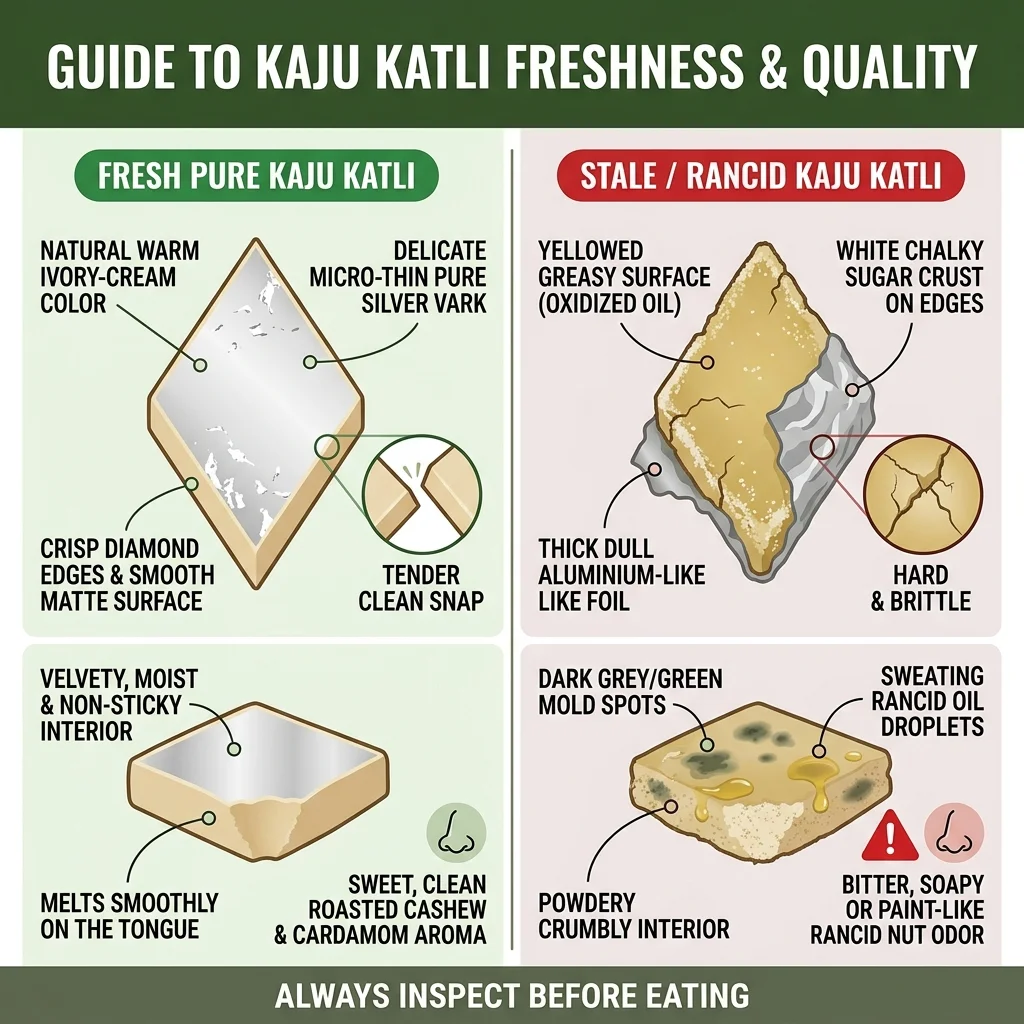
📊 Freshness & Quality Comparison
| Quality Marker | Fresh Pure Kaju Katli | Stale / Rancid / Adulterated Kaju Katli |
|---|---|---|
| Color & Surface | Warm natural ivory-cream; smooth matte satin finish | Yellowed, greasy, translucent patches OR chalky white sugar crust along edges |
| Silver Vark (If Present) | Micro-thin, delicate, bright silver leaf that vanishes on touch | Thick, dull grey metallic sheet that peels off in strips or rolls into a ball |
| Snap & Bite | Crisp diamond edges; breaks with a clean tender snap and melts on tongue | Hard, dry, and brittle like chalk, OR rubbery, chewy, and sticky on teeth |
| Aroma & Aftertaste | Clean, sweet, buttery cashew aroma with a hint of cardamom | Bitter, soapy, or "old oil paint" smell (oxidized cashew oil) or sour dairy odor |
🏠 Home Storage & Shelf-Life Best Practices
- Why Pure Kaju Katli Lasts Longer Than Milk Barfi: Because authentic Kaju Katli is made from low-moisture cashews and cooked sugar syrup without wet khoya/mawa, it has a naturally longer shelf life of 7–10 days at room temperature in a cool, dry climate and up to 3–4 weeks in the refrigerator inside an airtight container.
- Why Adulterated Kaju Katli Spoils Fast: When vendors secretly mix cheap khoya, boiled potato, or under-cooked starch into Kaju Katli, the high moisture causes souring and fungal mold within 3–4 days!
- Layer Separation Tip: Always place sheets of food-grade butter paper (parchment) between layers of Kaju Katli in an airtight box so the delicate silver vark and cashew oils do not stick or oxidize.
Quick Safety Tips
- Always rub the silver foil on one corner of the Kaju Katli before eating—if it rolls into a grey ball or feels thick and plastic-like, peel off or discard the foil as it is aluminium.
- Beware of Kaju Katli that looks snow-white like paper; real roasted cashew paste has a natural warm ivory-cream hue, whereas snow-white pieces often contain titanium dioxide bleach or refined flour.
- If anyone in your household has a peanut allergy, never serve loose, unbranded Kaju Katli—blending 25–40% blanched peanut paste is one of the most common cost-cutting frauds.
- Check the break and bite: authentic Kaju Katli is only 3–5 mm thick, snaps cleanly, and never sticks to your teeth.
- Test individual raw ingredients—cashews, silver foil, ghee, sugar, cardamom, and saffron—using their dedicated BioLens Food Guard guides before making Kaju Katli at home.
Primary Chemical Concerns
Health Risks & Impacts
Test Individual Raw Ingredients in Kaju Katli (Cashew Barfi)
Unlike single raw commodities, prepared sweets and bakery items can harbor adulteration across multiple base ingredients. Click any raw ingredient below to run its dedicated kitchen purity test:
Multilingual Local Names
Common Storage Pests
Sawtoothed Grain Beetle (Oryzaephilus surinamensis) & Indian Meal Moth
medium riskStorage pests that infest raw cashew kernels before grinding or invade unsealed Kaju Katli gift boxes.
Detection
- Fine webbing threads or tiny pinholes on the edges of diamond barfi pieces
- Dark specks of insect frass embedded inside the pale cashew paste
Prevention
- Inspect whole cashews by splitting a sample open before grinding at home
- Transfer Kaju Katli from cardboard sweet boxes into an airtight glass or steel container immediately after purchase
Corrective Action: What to do?
Discard any sweet box showing webbing, larvae, or insect specks.
Aspergillus flavus / parasiticus (Aflatoxin Mold) & Lipid Oxidation
high riskMycotoxin-producing molds that grow on improperly dried raw cashews and surface molds that form on moist, starch-adulterated barfi.
Detection
- Greyish-green or dark brown mold specks forming along the cut diamond edges
- Yellowish oil sweating on the surface accompanied by a bitter, paint-like rancid smell
Prevention
- Store in a cool, dry place below 20°C with parchment paper separating layers
- Avoid Kaju Katli that feels damp, clammy, or overly soft at purchase
Corrective Action: What to do?
Discard the entire box if mold spots or a bitter rancid oil taste is present; aflatoxins are heat-stable and cannot be removed.
Regulatory Corner: FSSAI (Food Safety and Standards Authority of India)
Regulation: FSS (Food Products Standards and Food Additives) Regulations — Silver Leaf (Chandi-ka-warq) & Nut Confectionery Standards
Legal Limit:Silver leaf must be >= 99.9% pure silver (Ag), free from aluminium, lead, and animal-gut (chandi-kutai) processing; Zero undeclared starch, peanut allergen, or non-dairy fat in Pure Kaju Katli.
Report Adulteration to FSSAI (Food Safety and Standards Authority of India)What CANNOT be Verified (Lab-Only)
- Inductively Coupled Plasma Mass Spectrometry (ICP-MS) on Foil Topping: Quantifies Aluminium (Al), Lead (Pb), Cadmium (Cd), and Nickel (Ni) vs. FSSAI 99.9% pure Ag standard for Chandi Vark.
- Peanut Allergen (Ara h 1 / Ara h 2) & Melon Seed DNA Detection: Performed via Quantitative ELISA and Real-Time PCR to expose nut substitution down to 1 ppm.
- Titanium Dioxide (E171) & Optical Brightener Screening: Determined via ICP-OES / Raman Spectroscopy.
- Aflatoxin B1, B2, G1, G2 in Ground Cashew Paste: Quantified via Immunoaffinity HPLC-FLD (maximum permitted total aflatoxins in nuts is 10–15 µg/kg).