Gulab Jamun Adulteration & Freshness Guide: Detect Fake Khoya, Starch, Detergent & Reused Oil
You can test Gulab Jamun and Kala Jamun at home for excess starch, potato, or refined flour diluting the khoya/mawa core, detergent or caustic soda from synthetic milk solids, reused oxidized frying oil, and fermented ropy sugar syrup using the Rinsed-Crumb Iodine Test, the Warm Water Oil-Slick & Froth Test, and cross-section porosity inspection. Quantifying exact acrylamide, total polar compounds (TPC), and synthetic sweeteners requires laboratory analysis.
Drop Gulab Jamun photo here to test purity
or click to browse • Supports JPG, PNG, WEBP • Paste with Ctrl+V
Inspection Guide
Click to enlarge
How to Test Gulab Jamun for Fake Khoya, Starch & Reused Oil at Home
🔬 Scientific Home Adulteration Tests
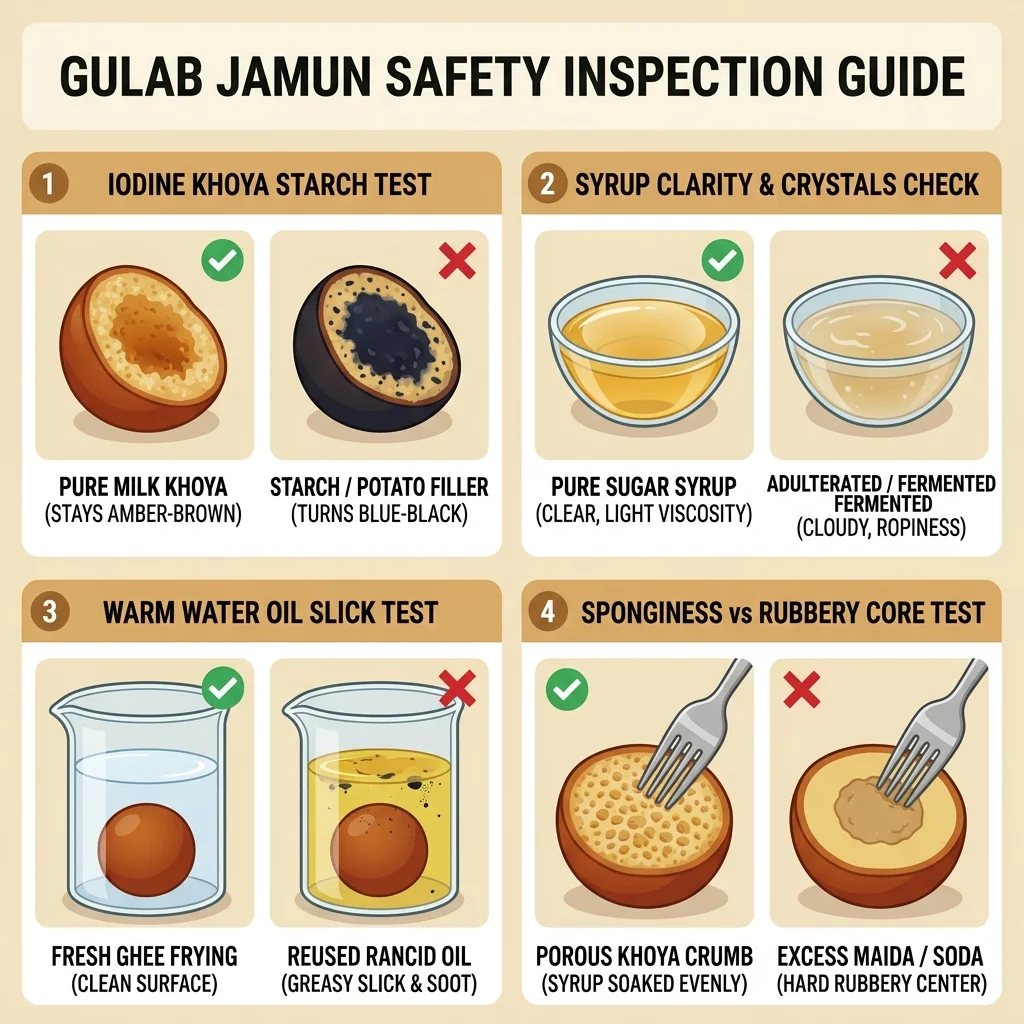
1. Rinsed-Core Iodine Test for Excess Starch vs. Pure Khoya
Cut a Gulab Jamun in half, scoop a pea-sized piece from the inner core, rinse it briefly in warm water to remove surface syrup, mash it in 2 teaspoons of water, and add 2 drops of Iodine solution (Povidone-Iodine).
- Authentic Khoya Gulab Jamun: Because traditional recipes use ~75–80% milk khoya/chhena and only a tiny binding pinch of flour, the solution shows an amber-brown or very faint bluish tint.
- Starch / Potato / Maida Adulterated: Turns an instant, opaque ink-black or deep indigo-blue, proving the ball is primarily cheap starch, boiled potato, or maida dough masquerading as milk khoya.
2. Warm Water Shake Test for Detergent, Soda & Reused Frying Oil
Place half a Gulab Jamun (with syrup drained) into a glass of warm water (50°C), mash it with a fork, shake or stir vigorously for 30 seconds, and let it sit for 2 minutes.
- Pure Khoya & Ghee Fried: Forms a clean, milky-white dairy suspension with a light, fragrant layer of melted ghee on top.
- Adulterated / Reused Oil: Produces a persistent, soapy white foam ring (detergent/washing soda in synthetic khoya) OR a dark, sticky, amber-brown oil slick containing tiny black carbon specks from burnt, repeatedly reused frying oil.
3. Cross-Section Honeycomb & Core Elasticity Check
Slice a Gulab Jamun cleanly through the center with a sharp knife and press both halves gently with the back of a spoon.
- Authentic Gulab Jamun: Displays a uniform, micro-porous honeycomb crumb where the clear sugar syrup has penetrated all the way to the center; springs back softly without feeling rubbery.
- Adulterated / Poorly Made: Reveals a dense, dry, whitish uncooked knot in the center or a tough, bouncy, rubber-ball texture caused by excess maida and sodium bicarbonate (baking soda).
4. Chashni (Syrup) Clarity, Ropiness & Aftertaste Check
Lift a spoonful of the sugar syrup from a height of 10 cm and taste a small drop.
- Pure Chashni: Crystal-clear golden liquid with a clean one-thread viscosity and natural cardamom/rose aroma; leaves no chemical aftertaste.
- Adulterated / Spoiled Chashni: Cloudy, bubbly, or forms long slimy mucilaginous threads ("ropiness" from bacterial spoilage), or leaves a lingering bitter-metallic aftertaste on the tongue (saccharin/cyclamate adulteration).
Click to enlarge
How to Judge Gulab Jamun Freshness, Syrup Stability & Spoilage
📊 Freshness & Quality Comparison
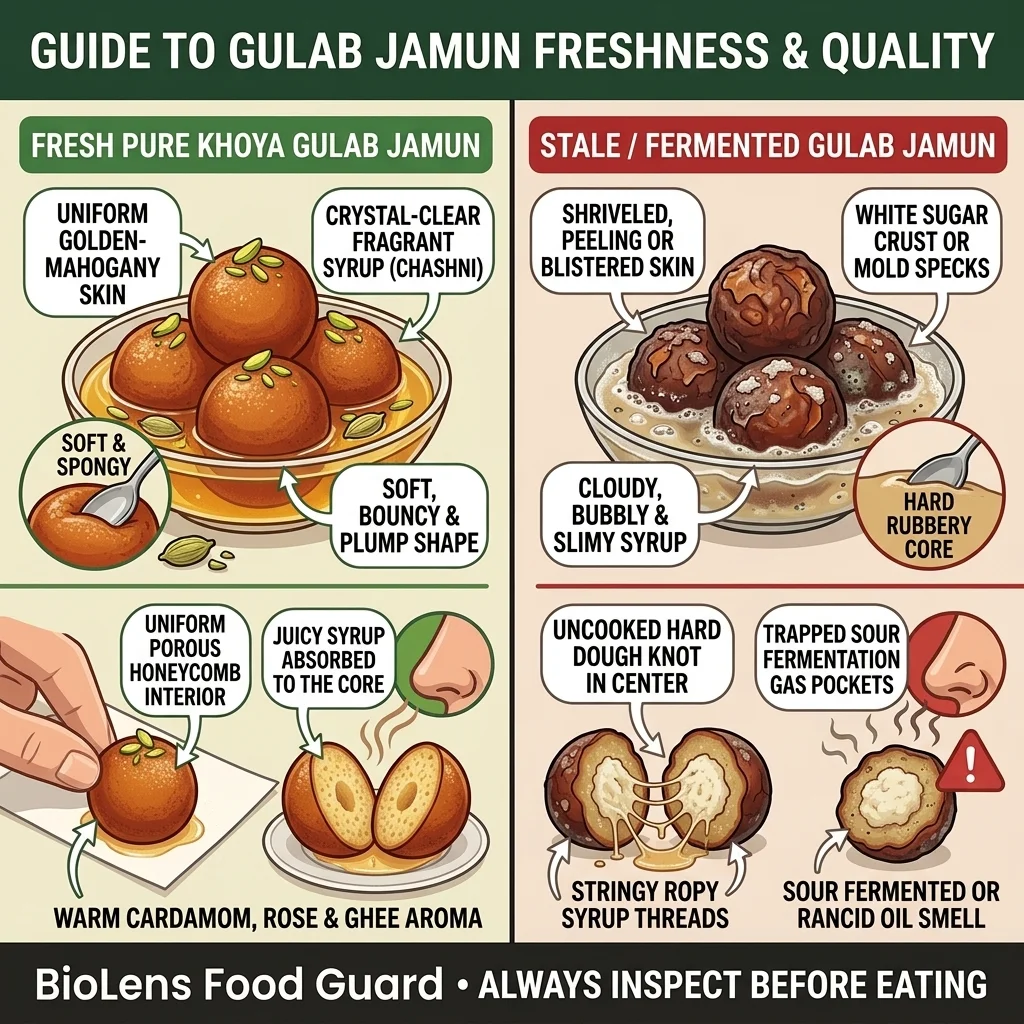
| Quality Marker | Fresh Pure-Khoya Gulab Jamun | Stale / Fermented / Spoiled Gulab Jamun |
|---|---|---|
| Outer Skin | Smooth, intact, uniform golden-mahogany surface | Shriveled, blistered, peeling skin, or disintegrating into mush |
| Internal Crumb | Evenly porous honeycomb; juicy with syrup right to the core | Hard, dry dough knot in center OR waterlogged, sour, mushy paste |
| Sugar Syrup (Chashni) | Crystal-clear amber liquid with light, clean flow | Cloudy, frothy with tiny fermentation bubbles, slimy/ropy, or heavily crystallized |
| Aroma & Flavor | Warm caramelized milk, ghee, cardamom, and rose water | Sour curdled milk smell, sharp vinegar/yeast note, or acrid burnt oil taste |
🏠 Home Storage & Shelf-Life Best Practices
- Fresh Halwai Gulab Jamun: Because warm sugar syrup combined with milk solids (khoya) is a high-moisture medium, fresh Gulab Jamun stays safe for only 24–36 hours at room temperature in warm weather. Refrigerate in an airtight glass or food-grade steel container for up to 5–7 days.
- Canned / Vacuum-Packed Tin Gulab Jamun: Unopened commercial tins undergo thermal retort sterilization and last for 4–6 months, but once opened, transfer the contents out of the metal tin into a glass bowl immediately, refrigerate, and consume within 3–4 days.
- Serving Precaution: Always use a clean, dry serving spoon to scoop Gulab Jamun; a single drop of tap water or saliva introduced into the syrup triggers rapid Leuconostoc ropy slime and yeast fermentation.
Quick Safety Tips
- Always cut the first Gulab Jamun in half before eating—if the center is a dry, rubbery white lump or smells like rancid oil, do not consume the batch.
- Examine the sugar syrup (chashni) carefully; tiny gas bubbles, cloudiness, or a sour smell indicate active yeast fermentation.
- Beware of ultra-dark "Kala Jamun" sold at steep discounts—vendors often re-fry unsold, souring Gulab Jamuns to a dark black crust to hide spoilage.
- Verify whether packaged Gulab Jamun tins use pure milk khoya/milk powder and ghee or palm oil and refined wheat flour on the nutrition label.
- When making Gulab Jamun at home, test your khoya/mawa, paneer, ghee, maida, sugar, cardamom, and saffron individually using BioLens Food Guard.
Primary Chemical Concerns
Health Risks & Impacts
Test Individual Raw Ingredients in Gulab Jamun
Unlike single raw commodities, prepared sweets and bakery items can harbor adulteration across multiple base ingredients. Click any raw ingredient below to run its dedicated kitchen purity test:
Multilingual Local Names
Common Storage Pests
Slime-Forming Bacteria (Leuconostoc mesenteroides) & Osmophilic Yeasts
high riskMicroorganisms that rapidly ferment sugar syrup enriched with leached milk proteins from Gulab Jamun.
Detection
- Micro-bubbles rising to the top of the sugar syrup and a distinct sour, alcoholic, or vinegary smell
- Syrup forms long, sticky, mucilaginous threads ("ropiness") when dripped from a spoon
Prevention
- Refrigerate Gulab Jamun below 5°C immediately after cooling and keep the container tightly sealed
- Never dip a used or wet spoon into the storage bowl
Corrective Action: What to do?
Do not attempt to re-boil fermented Gulab Jamun; heat-stable Staphylococcal or Bacillus toxins may remain. Discard the entire container.
Sugar Ants & Domestic Houseflies (Musca domestica)
medium riskExternal vectors attracted to open trays of warm chashni in sweet shops and kitchens, transmitting enteric pathogens.
Detection
- Uncovered sweet trays in retail shops without glass sneeze-guards or insect mesh
- Floating insect fragments or specks in the sugar syrup
Prevention
- Purchase only from hygienic outlets keeping syrup trays enclosed in covered display cases
- Store home bowls with airtight silicone-gasket lids
Corrective Action: What to do?
Discard any syrup or sweet exposed to flies or ants.
Regulatory Corner: FSSAI / Codex Alimentarius
Regulation: FSS (Food Products Standards and Food Additives) Regulations — Milk-Cereal Based Sweets & Khoya Standards
Legal Limit:Zero tolerance for urea, detergents, neutralizers, and non-dairy fat in declared Khoya/Ghee Gulab Jamun; Frying oil Total Polar Compounds (TPC) must not exceed 25%.
Report Adulteration to FSSAI / Codex AlimentariusWhat CANNOT be Verified (Lab-Only)
- Urea, Neutralizers (Sodium Carbonate/Hydroxide) & Detergents in Khoya Core: Detected via paradimethylaminobenzaldehyde (DMAB) colorimetric assay, Rosalic acid test, and Methylene Blue Active Substances (MBAS) analysis.
- Total Polar Compounds (TPC) & Peroxide Value of Extracted Frying Fat: Quantified via Silica Gel Column Chromatography (FSSAI maximum limit for frying oil is 25% TPC).
- Reichart-Meissl (RM) & Polenske Values: Differentiates pure dairy milk fat (RM 28–32) from hydrogenated vegetable fat and palm stearin (RM < 2) in the extracted khoya and frying medium.
- Staphylococcus aureus Coagulase-Positive & Enterotoxin Screening: Performed via ELISA and microbiological plating on milk-solid sweets.