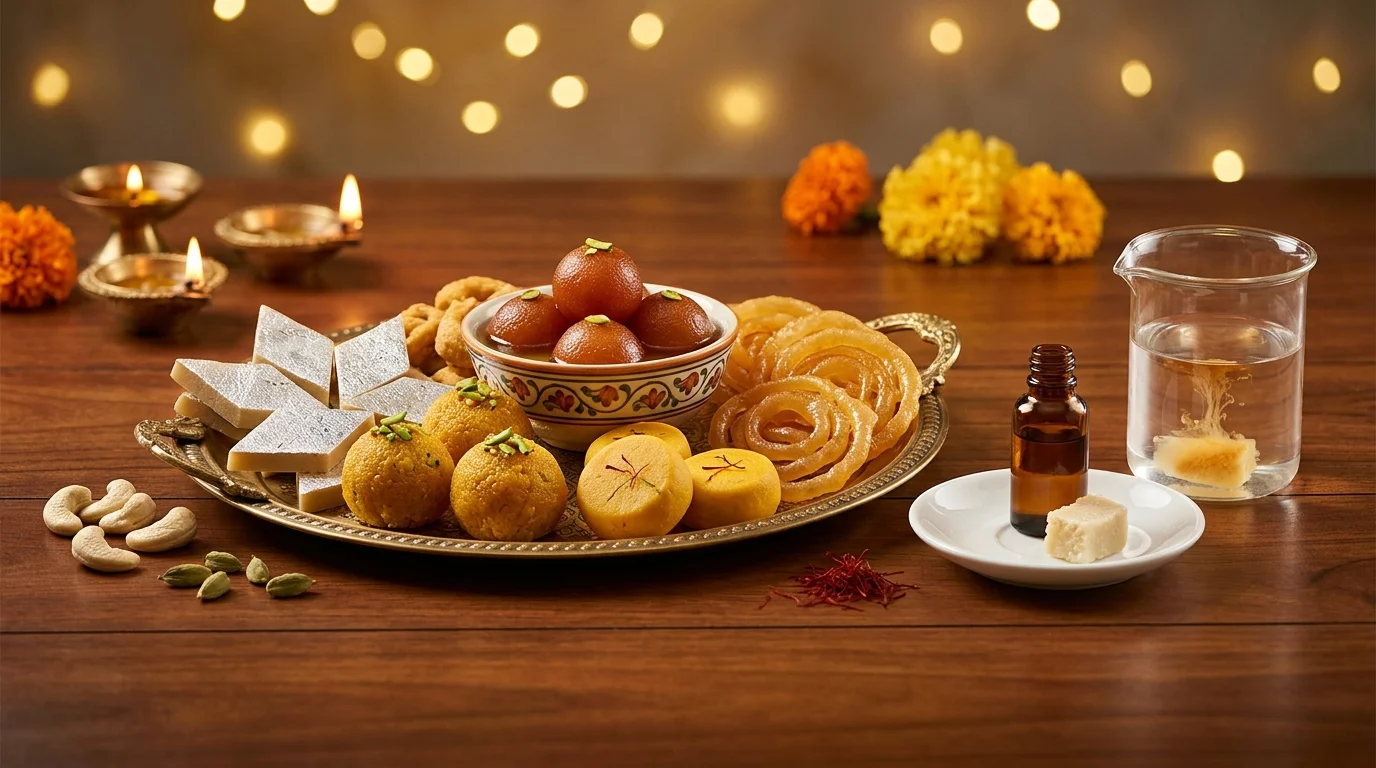
Ladoo Adulteration & Freshness Guide: Detect Metanil Yellow, Vanaspati & Kesari Dal
You can screen Motichoor, Boondi, and Besan Ladoos at home for banned Metanil Yellow industrial dye, cheap starch/maida fillers, hydrogenated vanaspati replacing pure desi ghee, and toxic aluminium leaf replacing silver vark using the Acid Color-Reaction Test, the Iodine Starch Test, and the Palm Melt Test. Detecting trace Lathyrus sativus (Kesari dal) neurotoxin (BOAA) and exact trans-fat levels requires laboratory HPLC/GC analysis.
Drop Ladoo (Motichoor & Besan) photo here to test purity
or click to browse • Supports JPG, PNG, WEBP • Paste with Ctrl+V
Inspection Guide
Click to enlarge
How to Test Ladoo (Motichoor & Besan) for Adulteration at Home
🔬 Scientific Home Adulteration Tests
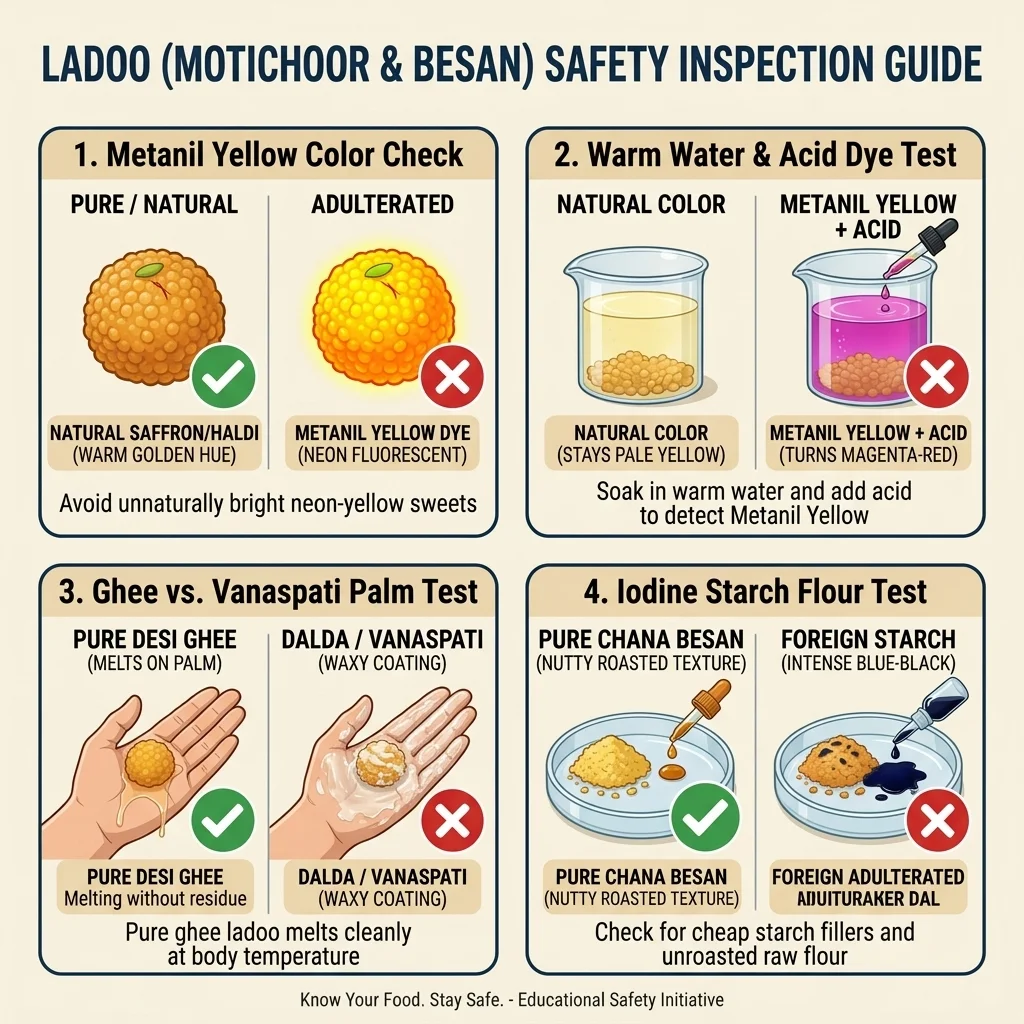
1. Warm Water & Acid Test for Metanil Yellow Dye
Crush 1 teaspoon of bright yellow or orange Motichoor/Boondi ladoo in 50 ml of warm water, filter or let the solids settle, and add 4–5 drops of concentrated lemon juice or white vinegar (or dilute HCl from a home testing kit) to the colored water.
- Pure Saffron / Turmeric Ladoo: The water is a soft golden-yellow and remains yellow or slightly paler when acid is added.
- Metanil Yellow Adulterated: If the water turns a vivid magenta-red or violet-purple, the ladoo is contaminated with banned industrial Metanil Yellow dye. Even if it stays glowing neon orange without saffron strands, it contains excessive synthetic Tartrazine/Sunset Yellow.
2. Palm Melt & Hot-Water Fat Test (Pure Ghee vs. Vanaspati)
Press a small piece of Besan or Motichoor ladoo firmly against your inner wrist or palm for 20 seconds, or drop a piece into warm water (40°C).
- Pure Desi Ghee Ladoo: Softens and melts smoothly at body temperature (32–35°C) with a natural nutty dairy fragrance, leaving no waxy coating on the roof of your mouth.
- Vanaspati / Palm Stearin Ladoo: Feels pasty and greasy, refuses to melt cleanly at body heat, leaves a thick white waxy film on the palate, and smells sharply of artificial butter/ghee chemical essence.
3. Iodine Test for Foreign Starch in Besan Ladoo
Note that pure chickpea flour (besan) naturally contains complex carbohydrates, so a raw iodine test shows a mild reaction. However, if a besan ladoo is heavily diluted with refined wheat flour (maida), rice flour, or arrowroot starch, dissolving a small defatted crumb in water and adding 1 drop of iodine produces an instant, ink-like jet-blue/black precipitate with a sticky, glutinous paste texture rather than granular roasted gram meal.
4. Garnish & Silver Vark Inspection
If your ladoo is topped with silver foil or green pistachio slivers:
- Rub the metallic foil between your fingers: pure Chandi Vark disintegrates into a weightless sparkle, whereas adulterated aluminium foil rolls into a cohesive grey metal ball.
- Soak green nut slivers in warm water: dyed peanuts masquerading as pistachios will bleed green dye into the water.
Click to enlarge
How to Judge Ladoo Freshness, Ghee Quality & Shelf Life
📊 Freshness & Quality Comparison
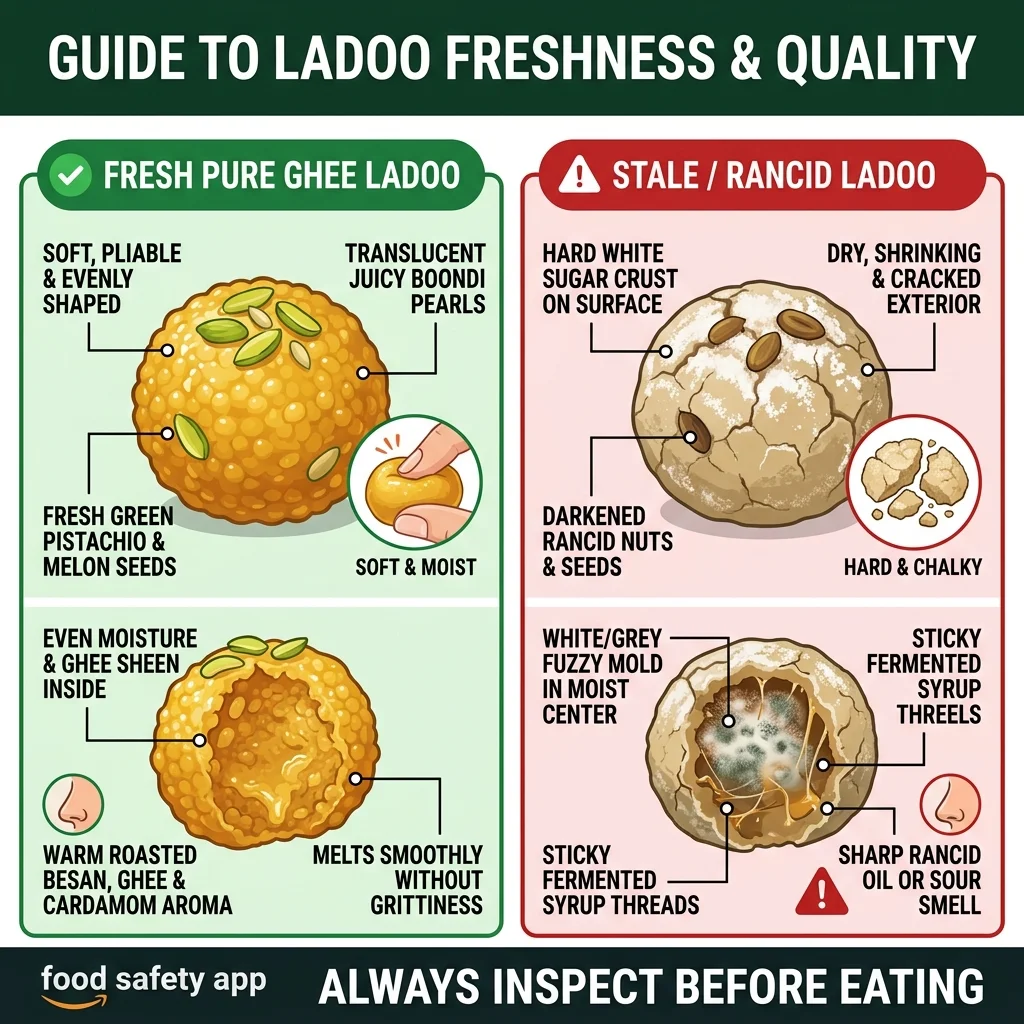
| Quality Marker | Fresh Pure-Ghee Ladoo | Stale / Rancid / Spoiled Ladoo |
|---|---|---|
| Boondi / Crumb Texture | Soft, juicy, translucent pearls (Motichoor) or melt-in-mouth granular roast (Besan) | Hard, dry, chalky outer sugar crust OR slimy, weeping syrup in the center |
| Surface Appearance | Warm golden-amber sheen; plump round shape that yields gently | Cracked, shrunken, dull surface with white crystallized sugar patches or fuzzy mold |
| Nuts & Melon Seeds | Crisp, ivory-white melon seeds and bright green/ivory nuts | Darkened, yellowed seeds with a sharp bitter or "old paint" rancid taste |
| Aroma | Fragrant roasted besan, warm desi ghee, and fresh cardamom | Sour fermented sugar odor (Motichoor) or stale, soapy, oxidized oil smell |
🏠 Home Storage & Shelf-Life Best Practices
- Motichoor & Boondi Ladoo (High Moisture): Because boondi pearls are soaked in sugar syrup (chashni), they have high water activity and spoil within 48–72 hours at room temperature. Store in an airtight container in the refrigerator and consume within 5–7 days.
- Besan Ladoo (Low Moisture): Properly roasted besan and pure ghee contain almost no free water, allowing Besan Ladoo to stay fresh for 2–3 weeks at room temperature in a cool, dry steel or glass jar.
- Warming Tip: Refrigeratedpure-ghee ladoos naturally firm up because dairy fat solidifies below 20°C; warm for 8–10 seconds before serving to restore their melt-in-the-mouth texture.
Quick Safety Tips
- Choose Motichoor and Boondi ladoos with a soft, muted golden-saffron hue; avoid glowing neon-orange or fluorescent-yellow sweets.
- Check the roof of your mouth after eating one bite—a lingering waxy coating is a unmistakable sign of hydrogenated vanaspati (Dalda).
- Inspect the melon seeds (magaz) and cashew pieces inside the ladoo; yellowed, translucent seeds with a paint-like smell indicate rancid oils.
- Buy festive sweets only from FSSAI-licensed halwais that display the mandatory "Best Before" date on non-packaged sweet trays.
- Test individual raw ingredients—besan, ghee, saffron, sugar, cardamom, and nuts—using their BioLens Food Guard pages when making ladoos at home.
Primary Chemical Concerns
Health Risks & Impacts
Test Individual Raw Ingredients in Ladoo (Motichoor & Besan)
Unlike single raw commodities, prepared sweets and bakery items can harbor adulteration across multiple base ingredients. Click any raw ingredient below to run its dedicated kitchen purity test:
Multilingual Local Names
Common Storage Pests
Red Flour Beetle (Tribolium castaneum) & Pulse Bruchid Fragments
medium riskStorage beetles that infest raw chickpea besan and melon seeds before sweet preparation or invade uncovered sweet boxes.
Detection
- Tiny reddish-brown beetles or dark chitin specks embedded in besan ladoo crumbs
- Bitter, pungent quinone odor in stale flour-based sweets
Prevention
- Sieve and inspect besan thoroughly before roasting and store ladoos in airtight stainless-steel or glass containers
- Keep sweet boxes away from raw grain and pulse storage bins
Corrective Action: What to do?
Discard any sweet box showing insect activity or dark insect fragments.
Osmophilic Yeasts (Zygosaccharomyces) & Aspergillus Mold
high riskSugar-tolerant yeasts and molds that thrive in the moist sugar syrup of Motichoor and Boondi ladoos.
Detection
- Sour, alcoholic fermentation smell and sticky, stringy syrup threads when breaking the ladoo
- White or greenish-grey fuzzy mold spots inside the moist core of the sweet
Prevention
- Refrigerate syrup-based Motichoor ladoos below 5°C within 24 hours of purchase
- Never touch sweets in a storage box with wet hands or a damp spoon
Corrective Action: What to do?
Immediately discard the entire batch if any sour odor, sliminess, or mold is detected.
Regulatory Corner: FSSAI (Food Safety and Standards Authority of India)
Regulation: FSS (Food Products Standards and Food Additives) Regulations & Mandatory Shelf-Life Display Order for Non-Packaged Sweets
Legal Limit:Zero tolerance for Metanil Yellow and Kesari dal (Lathyrus sativus); Permitted synthetic food colors max 100 mg/kg; Mandatory declaration of fat type (Desi Ghee vs. Vanaspati/Vegetable Oil).
Report Adulteration to FSSAI (Food Safety and Standards Authority of India)What CANNOT be Verified (Lab-Only)
- BOAA / β-ODAP Neurotoxin from Kesari Dal (Lathyrus sativus): Quantified via High-Performance Liquid Chromatography (HPLC) or Capillary Electrophoresis.
- Synthetic Azo Dye Quantification (Tartrazine, Sunset Yellow, Metanil Yellow): Determined via Reverse-Phase HPLC-DAD against the FSSAI 100 mg/kg maximum limit for permitted colors and zero-tolerance for Metanil Yellow.
- Baudouin Test & Fatty Acid Methyl Ester (FAME) Profile: Confirms hydrogenated vanaspati, palm oil, or animal tallow adulteration in extracted ladoo fat.
- Total Polar Compounds (TPC) & Peroxide Value: Measures thermal oxidation of reused frying oil and lipid rancidity.