Gujiya (Karanji) Purity & Freshness Guide: Detect Starch-Adulterated Khoya, Rancid Vanaspati & Moldy Filling
You can test Gujiya (Karanji / Pedakiya / Nevri) at home for starch, boiled potato, or detergent-adulterated khoya (mawa), reheated trans-fat vanaspati frying oil, fake aluminium leaf replacing pure silver vark, and internal fungal mold or rancid desiccated coconut using the Inner Filling Iodine Test, the Warm Water Froth & Fat Audit, and the Cavity Cross-Section Inspection. Laboratory GC-MS and polar-compound analysis are required to quantify exact trans-fat percentages and trace mycotoxins.
Drop Gujiya photo here to test purity
or click to browse • Supports JPG, PNG, WEBP • Paste with Ctrl+V
Inspection Guide
Click to enlarge
How to Test Gujiya (Karanji) for Synthetic Khoya, Starch, Vanaspati & Mold at Home
🔬 Scientific Home Adulteration Tests
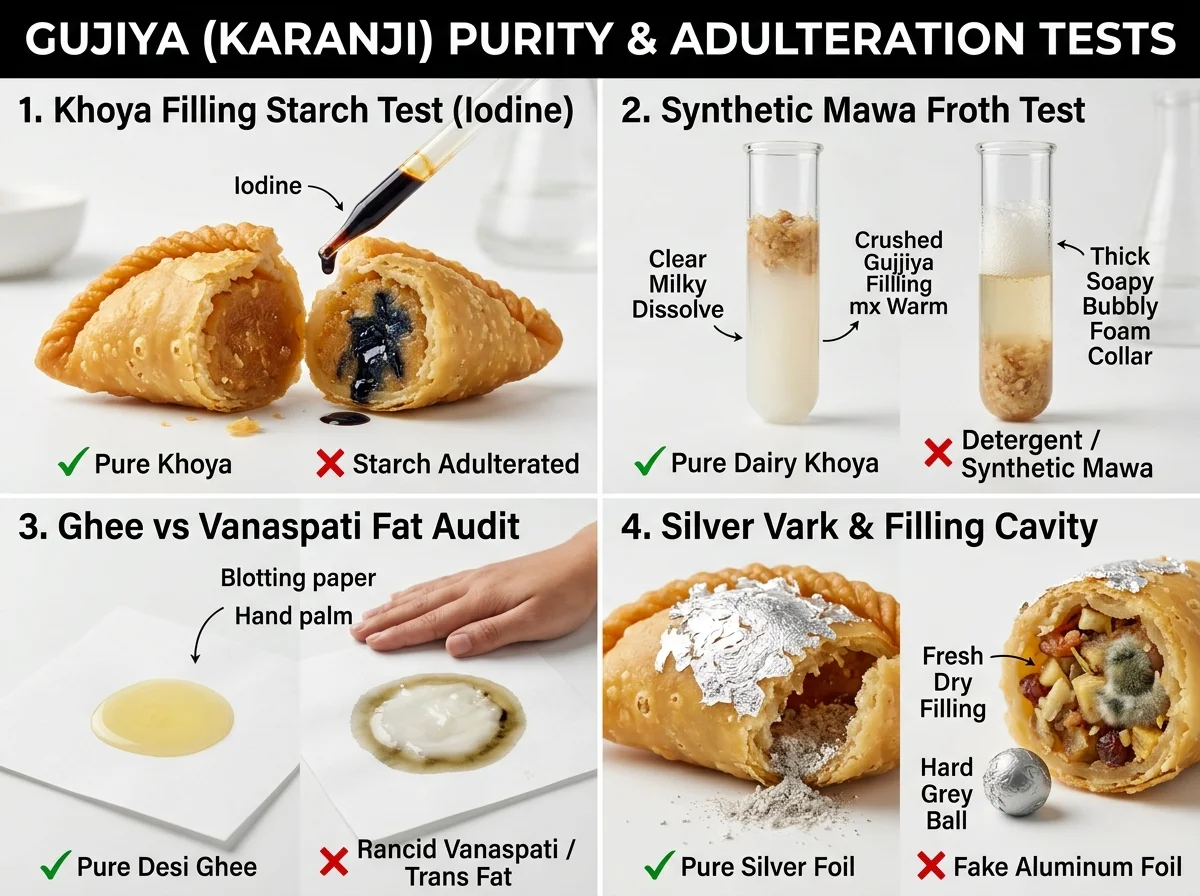
1. Inner Khoya Filling Iodine Starch Test (Quadrant 1)
Break open a Gujiya along its pleated seam and carefully scoop out 1 teaspoon of the white/brown khoya (mawa) lumps from the filling (avoiding the outer maida pastry crust and separating any visible suji granules if it is a mixed suji-mawa gujiya). Boil the isolated mawa sample with 2 teaspoons of water, let it cool, and add 2 drops of Povidone-Iodine solution.
- Pure Milk Khoya Filling: Pure coagulated milk solids contain zero starch. The cooled liquid remains a warm amber-yellow or pale brownish-orange.
- Adulterated with Potato / Arrowroot / Maida: Turns an immediate, dense dark blue or ink-black, proving the halwai replaced expensive milk mawa with cheap boiled potato mash or starch paste.
2. Warm Water Detergent Froth & Synthetic Mawa Audit (Quadrant 2)
Place 1 teaspoon of the inner Gujiya filling in half a glass of warm water (50°C), stir vigorously for 30 seconds, and observe the surface for 2 minutes.
- Authentic Dairy Mawa & Nuts: Disperses into a pleasant milky-beige suspension with roasted nut particles settling cleanly and a sweet cardamom-ghee aroma.
- Synthetic Detergent / Urea Mawa: Produces a thick, stubborn soapy white foam collar at the top that refuses to collapse, accompanied by an alkaline chemical smell or soapy aftertaste.
3. Pastry Crust Palm-Melt & Blotting Paper Oil Audit (Quadrant 3)
Press a piece of the flaky outer Gujiya shell and a pinch of the filling firmly onto a clean white blotting paper (or rub between your palms for 20 seconds).
- Fried in Pure Desi Ghee: Leaves a clean, fragrant translucent spot that smells of nutty clarified butter and melts effortlessly at body temperature (35°C) without coating the roof of your mouth.
- Fried in Reheated Vanaspati / Degraded Oil: Leaves a greasy, sticky, yellowish-brown halo smelling of stale paint or acrid smoke, and deposits a waxy, candle-like trans-fat coating on your palate.
4. Cavity Cross-Section & Silver Vark Rub Test (Quadrant 4)
Slice the Gujiya in half under bright light and inspect the hollow air pocket above the filling, as well as any metallic foil on the crust.
- Fresh & Pure: The inner cavity shows dry, crumbly golden-roasted khoya, clean coconut shreds, and plump raisins; real silver vark crumbles into vanishing micro-dust when rubbed between fingers.
- Spoiled or Fake: Reveals fine gray-white cobweb mold filaments bridging the cavity air gap (due to trapped steam when packed warm), rancid yellow coconut, or fake aluminium foil that rolls into a hard, dark-gray metallic ball when rubbed.
Click to enlarge
How to Judge Gujiya Freshness, Crust Flakiness & Filling Spoilage
📊 Freshness & Quality Comparison
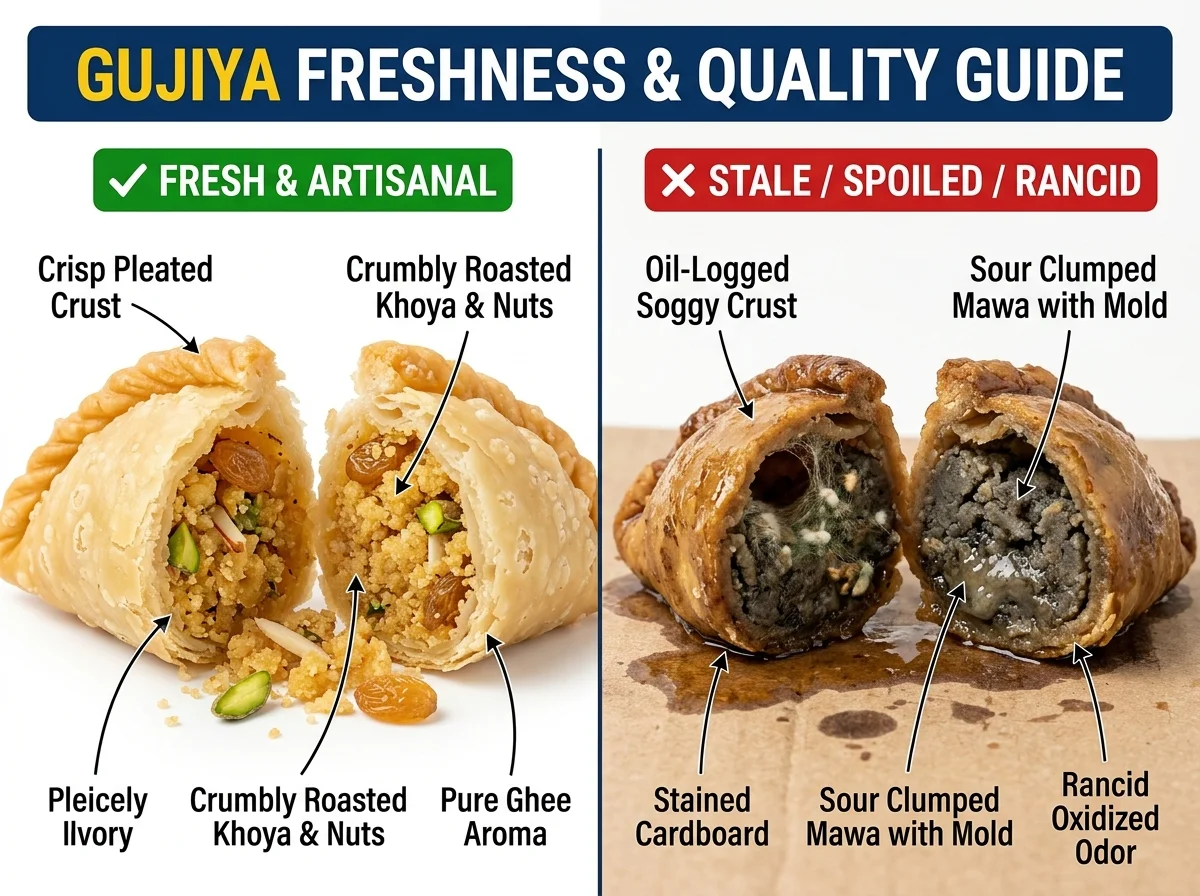
| Quality Indicator | Fresh Artisanal Gujiya (Karanji) | Stale / Rancid / Spoiled Gujiya |
|---|---|---|
| Outer Pastry Shell | Crisp, flaky, biscuit-golden crust with dry micro-blisters and neat pleats | Soggy, oil-waterlogged, leathery, or darkened brown from polymerized frying oil |
| Inner Khoya & Suji Filling | Fragrant, crumbly, golden-roasted mawa and grainy rava with distinct nuts | Wet, pasty, sour-smelling clump, or fine gray/green fungal threads inside the cavity |
| Coconut & Nut Aroma | Sweet roasted dairy, fresh cardamom, and nutty ghee bouquet | Sharp paint-like rancid coconut smell, musty stale nut odor, or fermented sourness |
| Mouthfeel & Palate | Short, melt-in-the-mouth pastry with clean sweet finish | Waxy trans-fat film on the roof of the mouth and throat-scratching acrid oil bite |
🏠 Proper Storage & Shelf-Life Guidelines
- Dry Suji & Coconut Karanji (No Khoya): Cool completely to room temperature on a wire rack for 2 hours after frying so zero internal steam remains trapped. Store in an airtight stainless-steel dabba or glass jar in a cool, dry cupboard for 14 to 21 days.
- Rich Khoya / Mawa Gujiya (Dry Shell): Because khoya contains 25–30% dairy moisture, store at room temperature for no more than 48–72 hours in cool weather. For longer storage (up to 10–12 days), refrigerate in an airtight container lined with parchment paper and re-crisp in an oven or air-fryer at 160°C for 4 minutes before serving.
- Syrup-Glazed (Chashni / Bahar) Gujiya: Added sugar syrup increases water activity; keep refrigerated at 2–5°C and consume within 4 to 5 days.
Quick Safety Tips
- Always break a Gujiya in half before eating—because the pastry shell is opaque and sealed, internal fungal mold in the moist khoya cavity is completely invisible from the outside.
- Understand the shelf-life difference: Mawa-filled Gujiya spoils within 3–4 days at room temperature, whereas dry Suji-Coconut Karanji lasts 2–3 weeks in an airtight tin.
- Avoid buying syrup-drenched (Chashni) Gujiyas displayed in open roadside trays exposed to dust, flies, and afternoon heat.
- If the fried crust smells like burnt plastic, old samosa oil, or bitter rancid coconut, discard the batch immediately.
- Audit every raw ingredient before homemade Holi or Diwali prep using our guides for Khoya/Mawa, Suji/Semolina, Maida, Ghee, and Desiccated Coconut.
Primary Chemical Concerns
Health Risks & Impacts
Test Individual Raw Ingredients in Gujiya
Unlike single raw commodities, prepared sweets and bakery items can harbor adulteration across multiple base ingredients. Click any raw ingredient below to run its dedicated kitchen purity test:
Multilingual Local Names
Common Storage Pests
Internal Cavity Molds (Aspergillus flavus, Penicillium & Eurotium spp.)
high riskXerophilic and moisture-loving fungi that colonize the warm, humid micro-climate inside sealed mawa and coconut pastry turnovers.
Detection
- Fine white, gray, or greenish cottony threads bridging the air pocket when the Gujiya is broken in half
- Musty, earthy, or sour fermented odor escaping as soon as the shell is cracked
- Bitter, ammoniacal, or acrid taste in the khoya and nut filling
Prevention
- Roast khoya and suji thoroughly over low heat until moisture evaporates
- Cool fried Gujiyas completely for 2–3 hours before sealing in containers
- Refrigerate mawa-based Gujiyas below 5°C if keeping beyond 48 hours
Corrective Action: What to do?
Discard the entire batch immediately; mycotoxins diffuse through porous pastry fat and cannot be neutralized by reheating.
Red Flour Beetles (Tribolium castaneum) & Indian Meal Moths (Plodia interpunctella)
medium riskPantry pests that infest dry suji-coconut karanjis stored for weeks in loosely lidded tins or carried over from infested semolina and nuts.
Detection
- Tiny pinhead exit holes in the dry pastry crust or webbing threads inside the nut filling
- Fine powdery frass at the bottom of the sweet box
Prevention
- Always sieve and inspect suji, maida, and nuts before preparing the filling
- Store dry karanjis in hermetic glass or steel containers
Corrective Action: What to do?
Dispose of infested sweets and sanitize storage tins with boiling water and sunlight drying.
Regulatory Corner: FSSAI (Food Safety and Standards Authority of India)
Regulation: Food Safety and Standards (Food Products Standards and Food Additives) Regulations — Khoya/Mawa Sweets & Frying Oil TPC Mandate
Legal Limit:Khoya filling must meet minimum 20–30% milk fat on dry basis with zero foreign starch, urea, or detergent; frying oil Total Polar Compounds (TPC) must not exceed 25%; trans fats capped at ≤ 2%.
Report Adulteration to FSSAI (Food Safety and Standards Authority of India)