How to Test Turmeric for Adulteration (Metanil Yellow, Lead Chromate, Chalk Powder)
⚡ Quick 60-Second Turmeric Purity Verdict (Lead Chromate & Dyes)
Toxic Heavy Metal Risk: Low-grade turmeric powder is frequently adulterated with carcinogenic Lead Chromate (PbCrO4), Metanil Yellow, and chalk/maida to give expired or low-curcumin rhizomes an intense bright yellow hue.
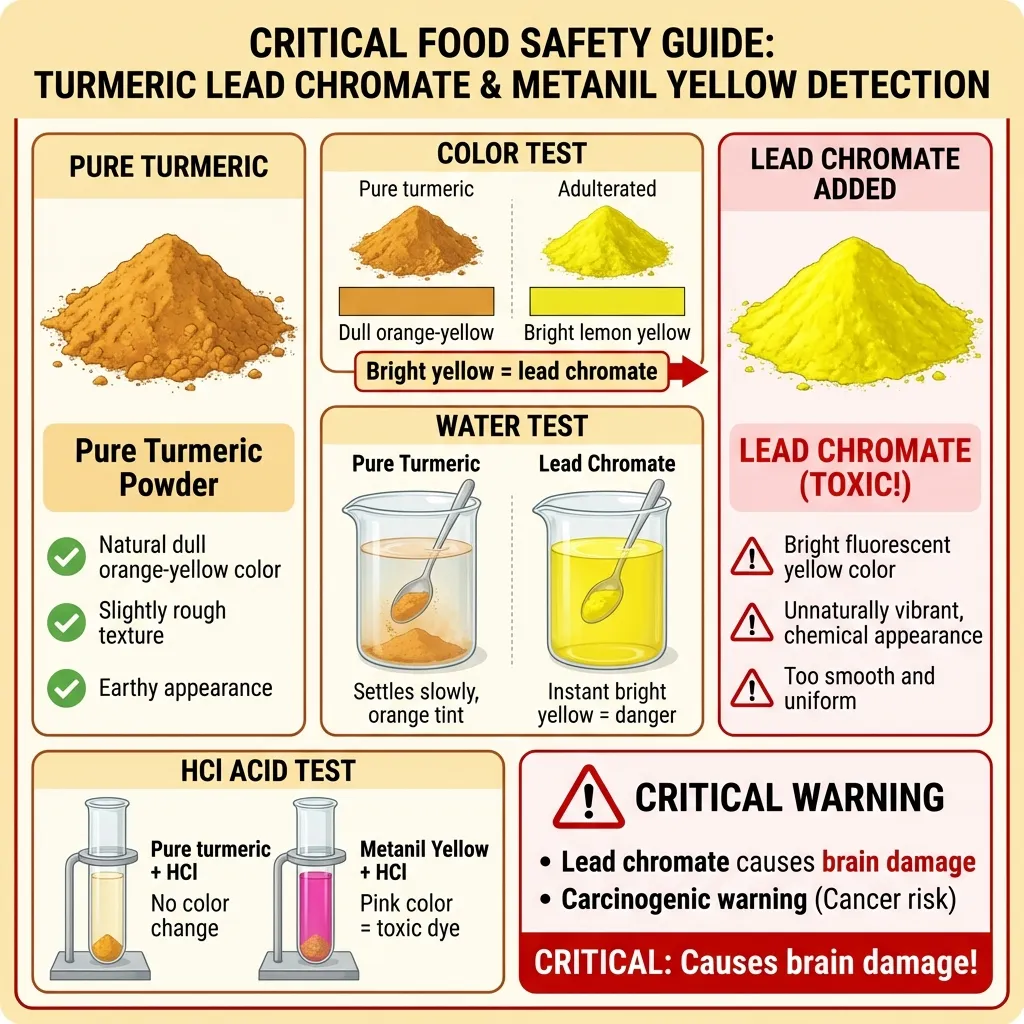
Add 1 tsp turmeric to a glass of warm water; do NOT stir. Pure turmeric settles slowly to the bottom leaving pale clear water. Chemical dye stains the water bright neon yellow instantly.
Mix turmeric with water and add a few drops of lemon juice or dilute HCl. Turns magenta-red. Add water: if it turns back to yellow, it's pure; if pink persists, Metanil Yellow is present.
Rub a pinch of dry turmeric on your palm for 10 seconds. Pure turmeric leaves a mild yellow oily stain that washes off easily. Lead chromate leaves an artificial chalky residue.
Drop Turmeric (Haldi) photo here to test purity
or click to browse • Supports JPG, PNG, WEBP • Paste with Ctrl+V
Inspection Guide
Click to enlarge
Turmeric (Haldi) Purity & Dye Audit
Turmeric is one of the most frequently adulterated spices, commonly treated with Metanil Yellow (toxic dye) or Lead Chromate to achieve a vibrant yellow-orange color.
1. The Hydrochloric Acid Test (Dye Detection):
In a test tube, take 1 tsp of turmeric powder and add a few drops of concentrated HCl. Add a little water. If the solution turns pink or magenta, Metanil Yellow is present. Pure turmeric remains yellow.
2. The Water Sediment Test (Purity):
Add a spoonful of turmeric to a glass of warm water. Pure turmeric will settle slowly at the bottom, and the water above will remain clear yellow. If the water becomes cloudy or a heavy white sediment (chalk/starch) settles, it is adulterated.
3. The Palm Rub Test:
Take a small amount of turmeric and rub it vigorously on your palm for 30 seconds. Pure turmeric will leave a deep, yellowish-orange stain that is hard to wash off. If it washes off easily or leaves a pale yellow, "powdery" look, it contains fillers.
4. The Paper Test (Lead Chromate):
Sprinkle a little turmeric on a piece of white paper and add a drop of water. If a bright yellow ring develops quickly around the powder, suspect Lead Chromate treatment.
Quick Safety Tips
- Perform the HCl test for Metanil Yellow - pink color is a danger sign
- Avoid turmeric that looks "too bright" or unnaturally orange
- Check for white sediment in the water test to detect starch/chalk
- Prefer buying whole turmeric roots and grinding them at home for 100% purity
Primary Chemical Concerns
Health Risks & Impacts
Multilingual Local Names
Common Storage Pests
Cigarette Beetle
medium riskSmall beetles that can infest stored spices, including turmeric powder.
Detection
- Small holes in the packaging
- Fine dust at the bottom of the container
Prevention
- Store in an airtight glass jar
- Keep in a cool, dark place
Corrective Action: What to do?
Discard infested samples; the beetles can spread to other spices quickly.
Regulatory Corner: FSSAI (Food Safety and Standards Authority of India) / US FDA
Regulation: Food Safety and Standards (Food Products Standards) Regulations 2011, Clause 2.9.27: Turmeric Whole and Powder & FDA CPG Sec. 585.525
Legal Limit:Curcumin content: Min 3.0% on dry basis; Total ash: Max 9.0%; Acid insoluble ash: Max 1.5%; Lead Chromate ($PbCrO_4$): 0.0% (Zero tolerance; total lead max 2.5 ppm); Metanil Yellow dye: 0.0%
Report Adulteration to FSSAI (Food Safety and Standards Authority of India) / US FDA