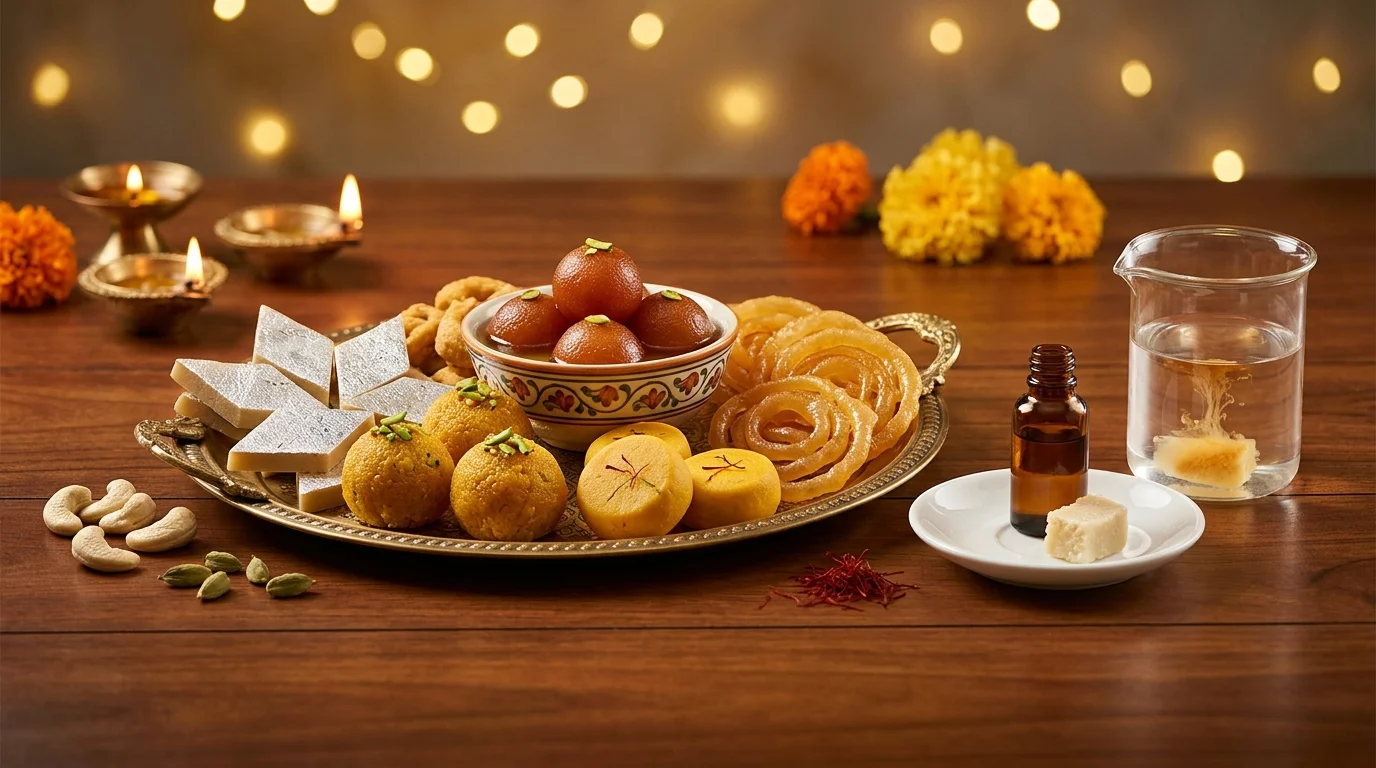
Peda (Milk, Mathura & Kesar Peda) Adulteration & Freshness Guide: Detect Fake Khoya, Starch, Detergent & Metanil Yellow
You can test Doodh Peda, Mathura Peda, Dharwad Peda, and Kesar Peda at home for synthetic khoya/mawa bulked with maida, potato, or blotting paper, detergent/urea emulsifiers, banned Metanil Yellow dye in Kesar Peda, and waxy vanaspati using the Cooled Slurry Iodine Test, the Warm Water Acid Dye Test, and the Hot Water Shake Foam Check. Quantifying microbial enterotoxins and heavy metals requires laboratory analysis.
Drop Peda (Doodh, Mathura & Kesar Peda) photo here to test purity
or click to browse • Supports JPG, PNG, WEBP • Paste with Ctrl+V
Inspection Guide
Click to enlarge
How to Test Doodh Peda, Mathura Peda & Kesar Peda for Adulteration at Home
🔬 Scientific Home Adulteration Tests
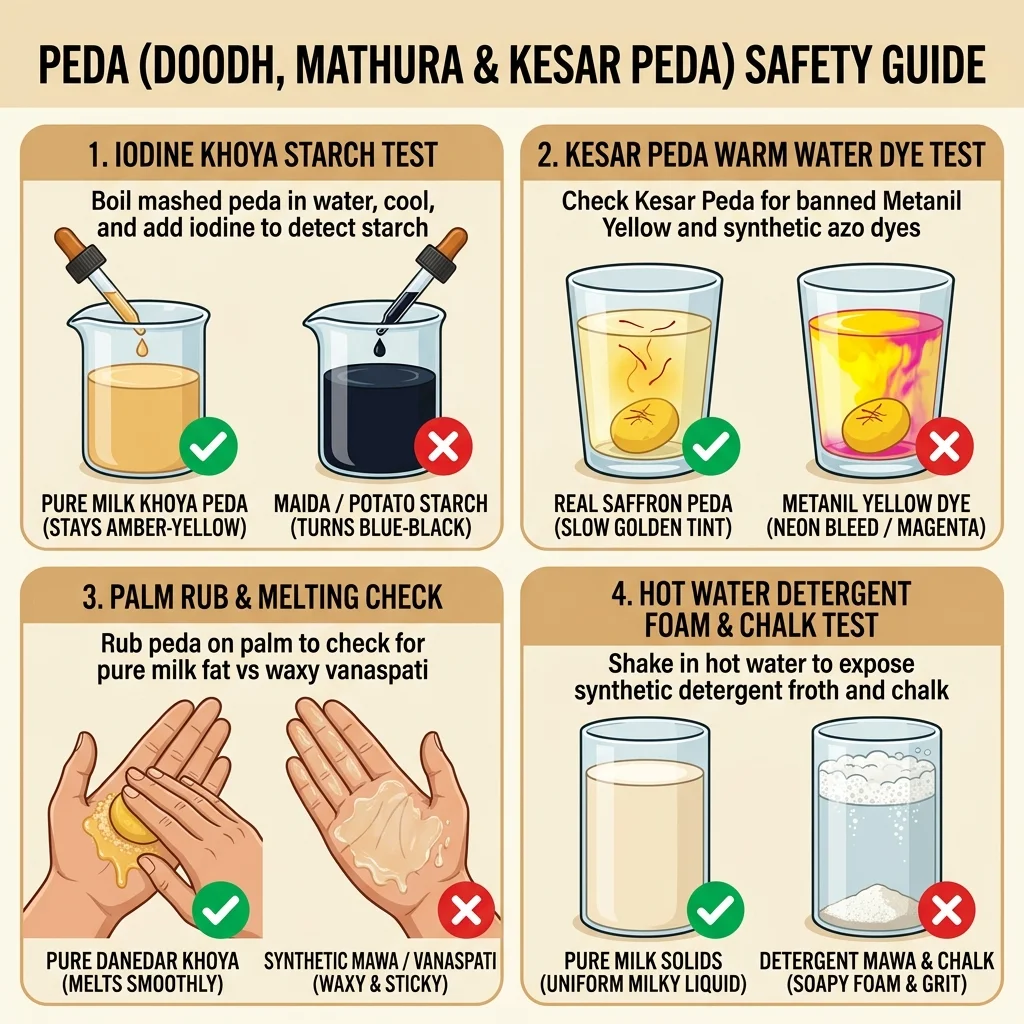
1. Cooled Slurry Iodine Test for Starch, Maida & Potato in Khoya
Take a 5g piece of peda, mash it in 2 tablespoons of water in a small steel spoon or cup, bring it to a brief boil for 30 seconds, let it cool completely to room temperature, and add 2 drops of Povidone-Iodine or Iodine Tincture.
- 100% Pure Milk Khoya Peda: Pure milk solids (khoya) and sugar contain zero starch; the solution remains creamy yellow-amber or pale brown.
- Adulterated with Maida / Potato / Cornstarch: Instantly turns intense dark blue, purple, or jet-black, proving that cheap starchy fillers were mixed into the mawa.
2. Warm Water & Acid Leach Test for Kesar Peda (Real Saffron vs. Metanil Yellow)
Drop a piece of yellow/orange Kesar Peda into half a glass of warm water, stir gently, and add 4–5 drops of concentrated lemon juice or white vinegar to the colored water.
- Pure Saffron Kesar Peda: Releases a slow, clear golden-yellow tint with visible real red saffron thread fragments that do not change to magenta when acid is added.
- Metanil Yellow / Synthetic Dye: Bleeds a neon yellow-orange cloud within seconds; adding acid turns banned Metanil Yellow into a bright magenta-red or violet hue.
3. Hot Water Shake Test for Detergent, Chalk & Ammonia Caramel
Place a crushed peda in a transparent jar half-filled with hot water, seal the lid, shake vigorously for 30 seconds, and let stand for 2 minutes.
- Authentic Dairy Peda: Disperses into a smooth, milky cream or warm caramel emulsion with a thin dairy foam that subsides quickly and zero gritty mineral sediment.
- Synthetic Detergent Mawa / Chalk / Chemical Caramel: Produces a thick, persistent soapy lather (rainbow detergent bubbles) at the top, leaves a white chalky sediment at the bottom, or leaches instant black-brown chemical caramel leaving pale bleached curds.
4. Palm-Rub & Palate Melt Test (Pure Milk Fat vs. Vanaspati)
Roll and press a small piece of peda firmly across your palm and taste a small bit.
- Pure Khoya & Ghee Peda: Exhibits a soft, fine-grained (danedar) texture that leaves a light, fragrant dairy-butter sheen on the skin and melts cleanly on the tongue with warm cardamom and nutmeg notes.
- Vanaspati / Blotting Paper Adulterated: Feels rubbery, fibrous, or pasty; clings to the teeth; and coats the roof of the mouth with a greasy, waxy film that does not melt at body temperature.
Click to enlarge
Peda Freshness, Shelf-Life & Safe Storage Guide
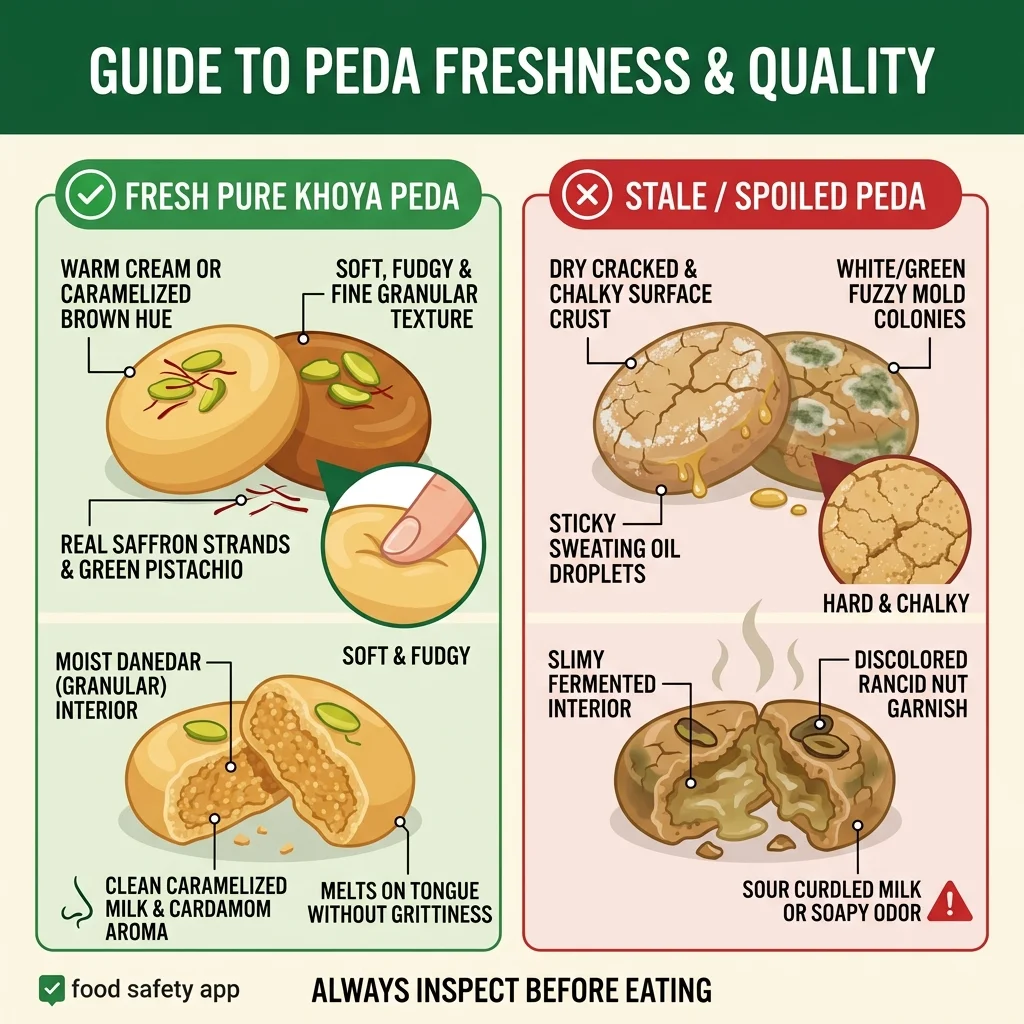
📊 Fresh vs. Stale / Spoiled Peda Comparison
| Quality Marker | ✅ Fresh Pure Khoya Peda | ❌ Stale / Fermented / Adulterated Peda |
|---|---|---|
| Surface & Color | Warm ivory-cream (Doodh), golden-saffron (Kesar), or rich caramelized brown (Mathura/Dharwad) with satin matte sheen | Dry chalky white sugar crust, sweating yellow oil beads, or fuzzy white/green mold spots |
| Crumb & Bite Texture | Soft, fudgy, fine granular (danedar) milk-fudge bite that yields gently and melts on the tongue | Rock-hard and crumbly, OR sticky, slimy, rubbery, and clinging to the teeth |
| Aroma Profile | Rich, sweet aroma of slow-reduced milk, desi ghee, cardamom, and nutmeg | Sour curdled-milk smell, sharp rancid oil odor, or soapy chemical detergent scent |
| Garnish Condition | Crisp green pistachio slivers and fragrant red saffron threads | Darkened, limp, bitter nuts or thick grey aluminium-like foil |
🏠 Storage & Shelf-Life Best Practices
- Moisture-Dependent Shelf Life: Soft, high-moisture Doodh Peda and Kesar Peda spoil within 48–72 hours at room temperature in warm weather and must be refrigerated at 2–5°C in an airtight box (lasting 5–7 days). Slow-roasted, low-moisture Mathura Peda and Dharwad Peda coated in boora sugar last 7–10 days in a cool, dry tin.
- Prevent Condensation Spoilage: Never pack warm pedas into sealed plastic boxes; trapped steam condenses on the lid and triggers rapid yeast and Aspergillus mold growth within 24 hours.
Quick Safety Tips
- Always cool the boiled peda-water slurry before adding iodine—heat temporarily uncoils the starch-iodine complex and can hide starch adulteration.
- Authentic Mathura and Dharwad pedas get their deep brown color from hours of slow milk-sugar Maillard caramelization (bhunai), so the brown color is uniform right to the core and smells nutty, never bitter.
- Check any silver-coated peda using the finger-rub test to confirm pure Chandi Vark rather than toxic aluminium leaf.
- Avoid buying uncovered pedas displayed in open trays near dusty roads or warm temple corridors without refrigeration.
- Consume fresh milk pedas within 3–4 days (or 7 days for low-moisture roasted Mathura/Dharwad pedas) and keep refrigerated below 5°C.
Primary Chemical Concerns
Health Risks & Impacts
Test Individual Raw Ingredients in Peda (Doodh, Mathura & Kesar Peda)
Unlike single raw commodities, prepared sweets and bakery items can harbor adulteration across multiple base ingredients. Click any raw ingredient below to run its dedicated kitchen purity test:
Multilingual Local Names
Common Storage Pests
Staphylococcus aureus, Bacillus cereus & Osmophilic Yeasts
high riskHeat-tolerant toxin-producing bacteria and sugar-tolerant yeasts that proliferate in moist milk solids left at ambient temperatures (25–38°C).
Detection
- Sour, acidic, or cheesy off-odor and a tacky, slimy film on the surface of the peda
- Tiny gas pinholes or spongy swelling in the center of soft milk pedas
Prevention
- Purchase only from hygienic shops displaying FSSAI manufacturing/expiry dates and keep refrigerated below 5°C
- Never leave prasad or gift boxes of Doodh Peda in a hot car or uncooled room for more than 4 hours
Corrective Action: What to do?
Discard the entire box immediately—re-heating or frying spoiled peda does NOT destroy heat-stable staphylococcal enterotoxins.
Aspergillus & Penicillium Dairy Molds
high riskFungal spores that germinate on the surface of pedas when moisture condenses inside closed sweet boxes.
Detection
- Circular white, bluish-green, or grey velvety spots on peda edges or around nut garnishes
- Musty, damp odor upon opening the sweet box
Prevention
- Store pedas in breathable food-grade parchment inside a clean refrigerated container
- Use clean, dry tongs or spoons when serving from a shared box
Corrective Action: What to do?
Discard the entire batch if any single piece in the box shows visible mold growth.
Regulatory Corner: FSSAI (Food Safety and Standards Authority of India)
Regulation: FSS (Food Products Standards and Food Additives) Regulations — Khoa / Mawa & Milk Products (Category 1.5 / 2.1.7)
Legal Limit:Milk fat in Khoa min 30% on dry weight basis; Zero added starch, maida, potato, urea, detergents, or non-dairy vegetable fat; Permitted synthetic food colors max 100 ppm; Mandatory "Best Before" date display on loose sweet trays.
Report Adulteration to FSSAI (Food Safety and Standards Authority of India)What CANNOT be Verified (Lab-Only)
- Baudouin & Butyro-Refractometer / GLC Fat Profile (FSSAI Milk Products Manual): Extracts lipid fraction from peda to detect hydrogenated vegetable oil (sesame oil marker), palm stearin, and foreign non-dairy fats via Reichert-Meissl (RM) and Polenske values.
- Urease-Nessler & Rosalic Acid Colorimetric Assays: Quantifies synthetic milk adulterants—urea (max natural limit 700 ppm in milk solids), neutralizers (sodium carbonate/bicarbonate), and anionic detergent surfactants (MBAS method).
- HPLC-DAD Synthetic Dye Quantification: Identifies banned Metanil Yellow, Orange II, and excess Tartrazine/Sunset Yellow above the 100 ppm FSSAI limit.
- Coagulase-Positive Staphylococcus aureus & Coliform Count (ISO 6888): Screens commercial khoya sweets for enterotoxin-producing bacterial contamination.