Soan Papdi Purity & Freshness Guide: Detect Metanil Yellow, Vanaspati Trans Fats & Khesari Flour
You can test Soan Papdi (Patisa) at home for toxic carcinogenic Metanil Yellow coal-tar dye, cheap hydrogenated vegetable fat (Vanaspati) substituting pure desi ghee, paralyzing Khesari dal flour or chalk in besan, and oxidized rancid fat spoilage using the Warm Water Insoluble Sediment Test, the Lemon Juice/Dilute Acid Pink Dye Test, and the Palm Body-Heat Melting Point Audit. Quantitative determination of industrial trans-fat percentages and artificial nut colorings requires accredited FSSAI laboratory testing.
Drop Soan Papdi photo here to test purity
or click to browse • Supports JPG, PNG, WEBP • Paste with Ctrl+V
Inspection Guide
Click to enlarge
How to Test Soan Papdi for Metanil Yellow, Vanaspati & Chalk at Home
🔬 Scientific Home Adulteration Tests
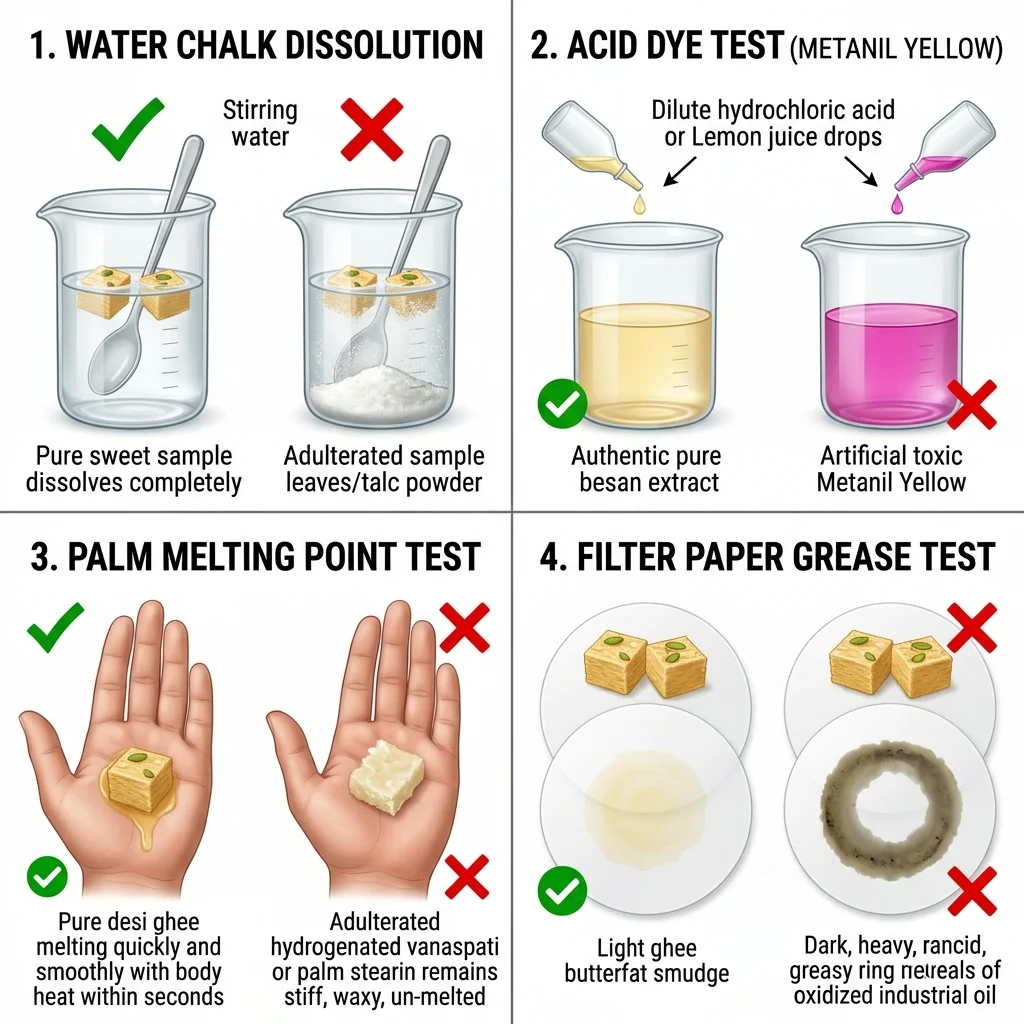
1. Water Dissolution & Chalk / Insoluble Residue Test (Quadrant 1)
Crush a 10-gram cube of Soan Papdi into a clear glass of warm purified water (60°C). Stir briskly with a spoon for 60 seconds and allow the suspension to stand undisturbed for 5 minutes.
- Pure Artisanal Soan Papdi: The sugar completely dissolves, while the finely roasted besan forms a uniform, golden-yellow suspension without heavy gritty precipitate. Pure desi ghee droplets float cleanly on top.
- Chalk / Talc / Plaster Adulterated: A distinct, heavy, white or greyish powdery sediment rapidly settles to the bottom of the glass. When rubbed between fingertips, this sediment feels gritty and gritty like chalk, indicating mineral adulterants.
2. Acid Dye Reaction Test for Banned Metanil Yellow (Quadrant 2)
Take 2 teaspoons of the dissolved Soan Papdi liquid from Test 1 in a small white porcelain cup. Add 10–15 drops of concentrated lemon juice or a few drops of dilute hydrochloric acid (muriatic acid) and observe any chromatic shift.
- Natural Turmeric / Saffron Hue: The natural plant carotenes and curcumin in besan may turn slightly deeper yellow-orange or faint red, but adding a splash of water instantly causes the pink tint to disappear.
- Toxic Metanil Yellow Present: The mixture turns an intense, bright magenta or electric fuchsia-pink that remains permanent and does not vanish upon diluting with water, confirming illegal chemical dye.
3. Palm Melting Point & Body-Temperature Test (Quadrant 3)
Place a thumbnail-sized flake of Soan Papdi directly onto your dry palm and press it gently with your thumb for 15 seconds.
- Pure Desi Ghee Soan Papdi: Pure cow ghee has a sharp melting point between 32°C and 35°C—lower than normal human core body temperature. The flaky sweet melts away effortlessly on your palm, releasing a rich, nutty, buttery aroma and leaving no sticky greasy coating.
- Vanaspati / Hydrogenated Palm Fat Adulterated: Hydrogenated vegetable oils melt at 40°C to 50°C. The flake remains stiff, pasty, and wax-like on your skin, requiring aggressive mechanical rubbing, and leaves a sticky, unctuous film that smells of stale shortening.
4. Filter Paper Trans Fat Grease Audit (Quadrant 4)
Crush a small cube between two sheets of plain white unprinted paper (or coffee filter paper) and leave in a warm room for 15 minutes.
- Authentic Ghee Sweet: Creates an even, translucent golden oil halo that smells fresh and aromatic, solidifying into a soft, semi-solid fat patch when cooled.
- Low-Grade Vanaspati / Stale Oil: Leaves an oily dark ring with a sour, acrid, or paint-like odor characteristic of oxidized trans fats, remaining sticky and tacky even after prolonged exposure.
Click to enlarge
How to Judge Soan Papdi Freshness, Flakiness & Storage Quality
📊 Freshness & Quality Comparison
| Quality Indicator | Fresh Artisanal Soan Papdi | Stale / Oxidized / Moisture-Damaged Soan Papdi |
|---|---|---|
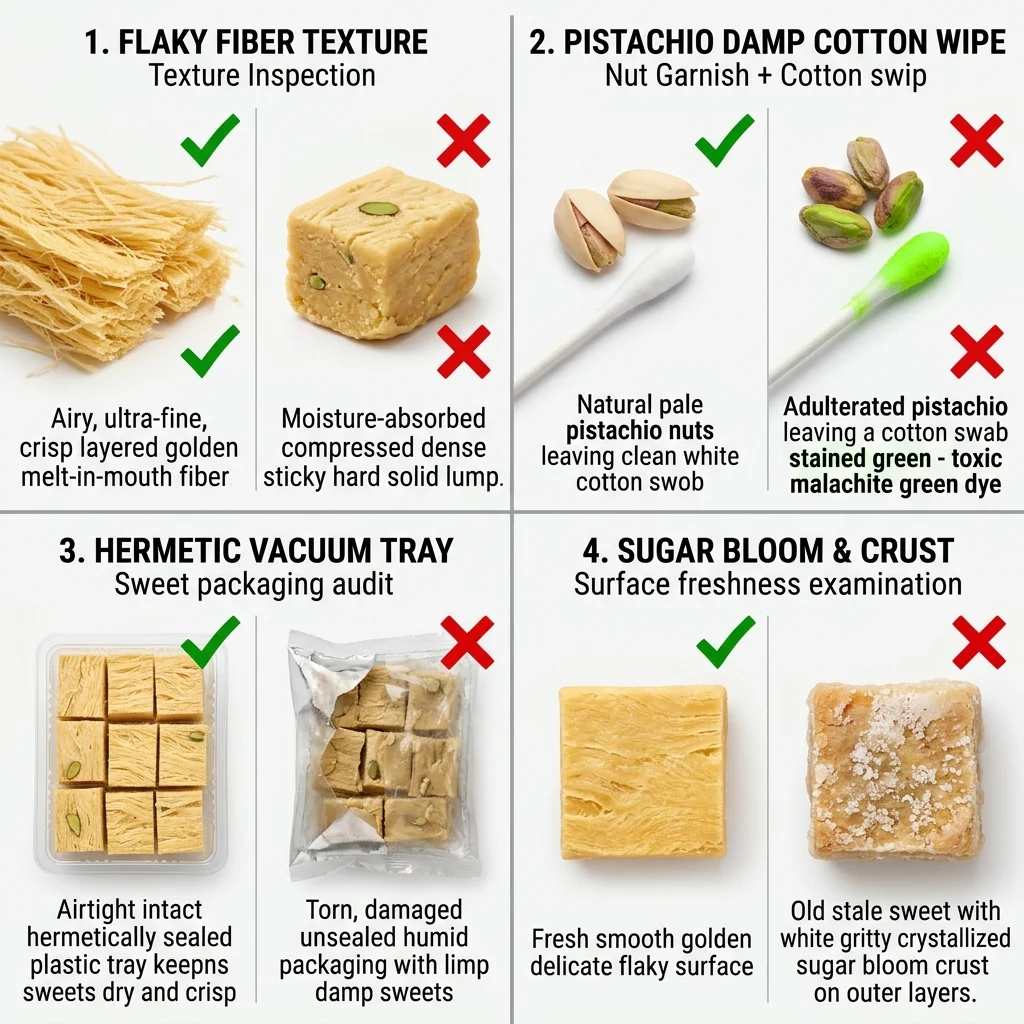
| Layered Fiber Texture | Light, airy, multi-layered fibrous strands; snaps crisp, melts instantly | Dense, fused, soggy brick; sticky exterior or gummy rubbery chew |
| Ghee Aroma | Rich, nutty, caramelized roasted chickpea and pure dairy aroma | Flat, paint-like, cardboard odor, or sour rancid oil smell |
| Surface Flakes | Golden-amber, delicate micro-filaments with crisp nut slivers | Hard white crystallized sugar bloom crust; discolored, oily wet spots |
| Nut Topping | Crisp, crunchy sliced almonds and natural green pistachios | Soft, leathery, bitter, or rancid-tasting nut fragments |
🏠 Proper Storage & Shelf-Life Guidelines
- Hermetic Sealed Factory Trays: Commercially vacuum-packed or nitrogen-flushed plastic trays inside cardboard boxes have a long shelf life of 4 to 6 months at cool room temperature (below 25°C), provided the outer poly-wrap remains intact.
- Once Opened: Once the inner plastic seal is broken, atmospheric moisture is greedily absorbed by the crystalline sucrose threads. Always transfer remaining cubes into an airtight, moisture-impermeable plastic or tin container with a tight lid.
- Never Refrigerate Uncovered: Cold refrigerator moisture condenses on the surface, dissolving the crisp fibrous structure into hard, solid sugar candy within 24 hours. Keep at room temperature in a dry, dark pantry.
Quick Safety Tips
- Check the ingredients label on boxed Soan Papdi: authentic traditional varieties list 'Desi Ghee' or 'Clarified Butterfat', never 'Vanaspati', 'Hydrogenated Fat', or 'Edible Vegetable Oil Blend'.
- Notice the internal mouthfeel: pure ghee Soan Papdi should dissolve instantly on the tongue without leaving a waxy coating on the palate.
- Inspect the green nut garnish: fake 'pistachio' flakes on budget brands are often cheap peanuts or dried coconut flakes dyed with brilliant green non-food dyes.
- Store opened Soan Papdi in a moisture-proof container; ambient humidity rapidly collapses the delicate pulled sugar threads into a gummy, sticky block.
- Verify pure ghee, besan, and sugar individually on BioLens Food Guard.
Primary Chemical Concerns
Health Risks & Impacts
Test Individual Raw Ingredients in Soan Papdi
Unlike single raw commodities, prepared sweets and bakery items can harbor adulteration across multiple base ingredients. Click any raw ingredient below to run its dedicated kitchen purity test:
Multilingual Local Names
Common Storage Pests
Ambient Moisture Absorption & Sugar Recrystallization ('Sugar Bloom')
high riskAtmospheric moisture entering open containers, causing pulled sucrose strands to fuse into a hard, sticky mass.
Detection
- Loss of delicate flaky separation; sweet turns gummy, rubbery, or rock-hard
- Moisture droplets forming inside the transparent container walls
Prevention
- Store in an airtight container with a tight silicone gasket immediately after opening
- Keep at cool room temperature; never refrigerate without hermetic seal
Corrective Action: What to do?
Once sugar bloom occurs and fibers collapse, flakiness cannot be restored, though it remains edible if no off-odors exist.
Flour Beetles (Tribolium castaneum) & Red Ants
medium riskPantry insects attracted to chickpea flour (besan) and sugar aroma in unsealed cardboard packaging.
Detection
- Fine powdery flour dust at the bottom of the tray
- Small reddish beetles crawling inside dry corners of cardboard carton
Prevention
- Inspect cardboard seals before purchasing; avoid damaged or pin-holed boxes
- Store sweets inside sealed glass or metal canisters in the pantry
Corrective Action: What to do?
Discard any box showing insect holes, webbed dust, or live beetles.
Regulatory Corner: FSSAI / Codex Alimentarius
Regulation: Food Safety and Standards (Food Products Standards and Food Additives) Regulations — Traditional Cereal & Pulse-Based Confectionery
Legal Limit:Zero Metanil Yellow; industrial trans fatty acids must not exceed 2.0% of total fat by weight; Peroxide Value must remain below 10 meq/kg fat; zero Khesari dal flour.
Report Adulteration to FSSAI / Codex Alimentarius