
Sweetened Condensed Milk Purity & Freshness Guide: Detect Palm Oil Substitutes, Starch & Bloated Cans
You can test Sweetened Condensed Milk (Mithai Mate / Milkmaid) at home for starch, maida, or maltodextrin thickeners, cheap palm oil substituting dairy butterfat ("filled milk" creamers), synthetic detergent/urea milk solids, and anaerobic microbial gas spoilage (swollen cans) using the Diluted Iodine Drop Test, the Warm Water Oil-Ring Dispersion Audit, and the Can Seam & Viscosity Check. Quantifying exact milk fat-to-SNF ratios and trace melamine or tin metal leaching requires certified FSSAI laboratory analysis.
Drop Condensed Milk photo here to test purity
or click to browse • Supports JPG, PNG, WEBP • Paste with Ctrl+V
Inspection Guide
Click to enlarge
How to Test Sweetened Condensed Milk for Starch, Palm Oil & Spoilage at Home
🔬 Scientific Home Adulteration Tests
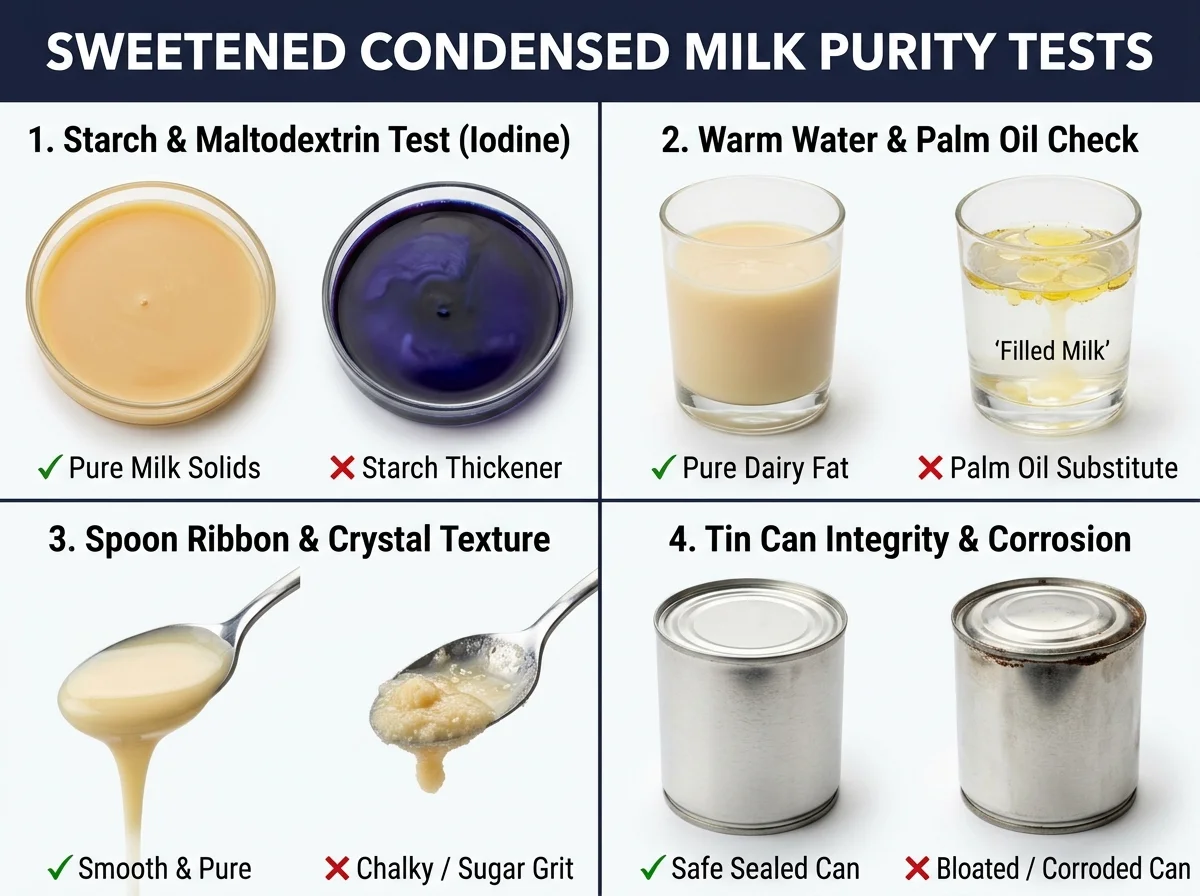
1. Diluted Iodine Test for Starch & Flour Thickeners (Quadrant 1)
Dissolve 1 teaspoon of condensed milk in 2 tablespoons of warm water in a small white saucer or clear glass until completely fluid. Add 2 to 3 drops of Povidone-Iodine tincture and swirl gently.
- Pure Dairy Condensed Milk: Contains only concentrated milk proteins (casein/whey), milk fat, lactose, and sucrose—zero starch. The liquid stays a uniform pale yellow-amber or light honey-brown.
- Starch / Maida Adulterated: Turns an instant dark blue, purple, or ink-black, exposing cheap cornstarch, arrowroot, or maida added to mimic the thick ribbon viscosity of real evaporated milk.
2. Warm Water Dispersion & Palm-Oil Ring Audit (Quadrant 2)
Stir 1 tablespoon of condensed milk into half a glass of hot water (65–70°C) for 30 seconds, then let the glass stand undisturbed for 5 minutes.
- Authentic Dairy Milk Fat: Natural milk fat globules are encased in phospholipid membranes that emulsify smoothly into hot water, creating a homogeneous, rich milky liquid with a clean, sweet caramelized dairy aroma.
- Palm Oil / "Filled Milk" Substitute or Detergent: Separates into distinct yellow greasy oil droplets or a slick vegetable-oil ring floating at the top (indicating palm oil substitution), or forms a stubborn soapy detergent foam collar with a chemical odor.
3. Spoon Ribbon Flow & Lactose Crystal Rub Test (Quadrant 3)
Lift a spoonful of condensed milk at room temperature and let it pour back into the bowl, then rub a drop between your thumb and index finger.
- Fresh & Pure Condensed Milk: Flows in a continuous, glossy, velvety ivory-cream ribbon that folds smoothly onto itself and feels completely silky between the fingers.
- Degraded, Gritty or Chalk-Adulterated: Drops in stiff, pasty globs or watery curds, and feels sandy or gritty between the fingers due to either insoluble chalk adulterants or severe lactose sugar crystallization from heat abuse.
4. Tin Can Integrity, Bulge & Fine-Print Label Audit (Quadrant 4)
Before opening any tin, press both flat ends of the can firmly with your thumbs and inspect the legal product title on the back label.
- Safe Authentic Dairy Can: Both metal lids are completely flat or slightly concave (sucked inward) with zero give; the inner tin wall is bright and rust-free; and the legal ingredient list reads simply: "Milk, Sugar (and Milk Solids)".
- Hazardous or Misleading Can: If the tin lid bulges outward, springs back when pressed ("flipper/springer can"), or hisses gas upon opening, discard it immediately due to microbial fermentation or Clostridium toxin risk! Also check the fine print: if it says "Sweetened Condensed Creamer" or lists Palm Oil / Vegetable Fat, it is not real dairy condensed milk.
Click to enlarge
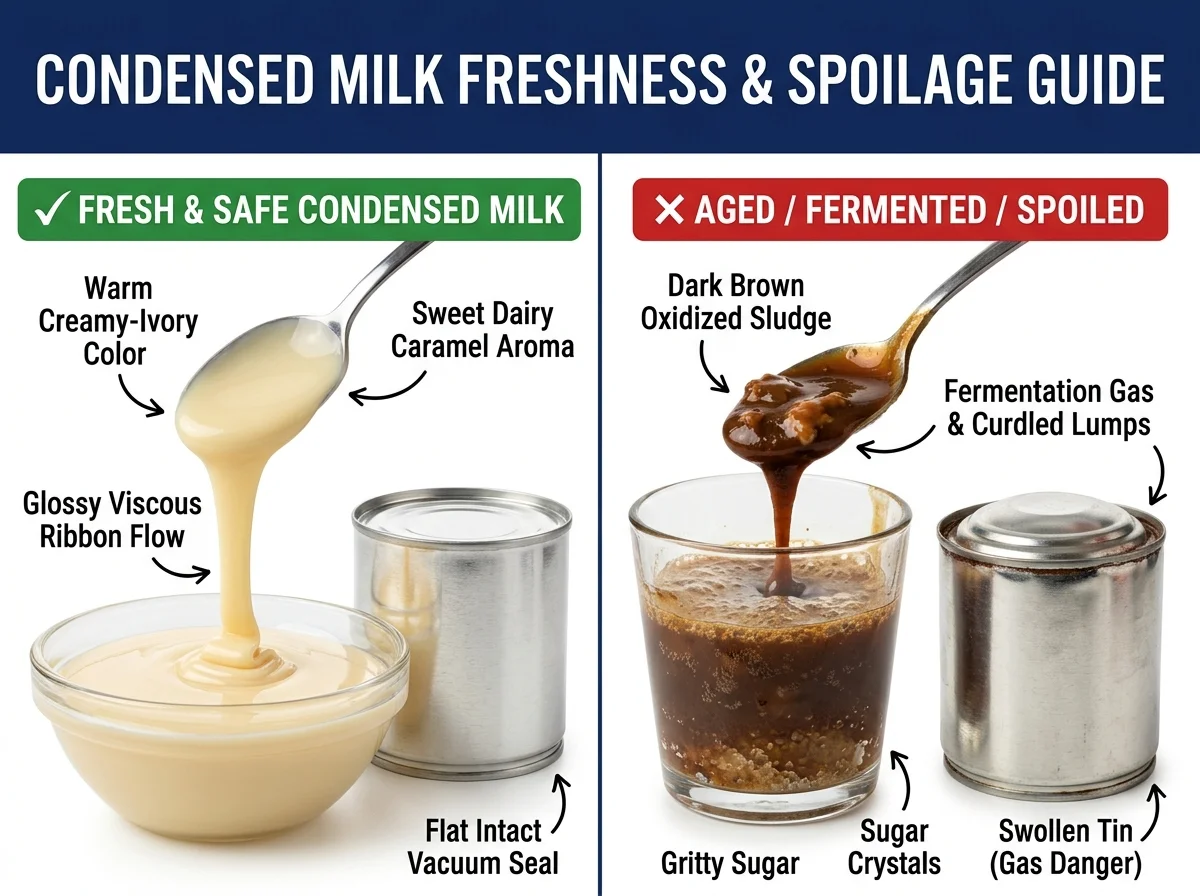
How to Judge Condensed Milk Freshness, Viscosity & Can Spoilage
📊 Freshness & Quality Comparison
| Quality Indicator | Fresh Pure Sweetened Condensed Milk | Spoiled / Heat-Abused / Imitation Condensed Milk |
|---|---|---|
| Color & Appearance | Warm, glossy ivory-cream to pale straw-yellow hue | Dark brown Maillard sludge, dull gray chalkiness, or separated yellow oil layer |
| Texture & Pour | Smooth, cohesive, viscous ribbon flow; silky on the tongue | Gritty sand-like lactose crystals, gelatinous age-gelation lumps, or fizzy bubbles |
| Aroma & Flavor | Clean, rich cooked-milk and sweet caramel notes | Sour fermented yeast smell, metallic tin aftertaste, or stale palm-oil odor |
| Can Condition | Flat, tight concave ends; clean golden internal food lacquer | Bulging/domed lid, hissing gas on puncture, or black corrosion spots along the seam |
🏠 Proper Storage & Shelf-Life Guidelines
- Unopened Cans: Store in a cool, dark pantry below 25°C for up to 12 months. Avoid storing cans near stoves or in hot warehouses (> 35°C), which accelerates non-enzymatic Maillard browning and age-gelation (turning the milk into a thick brown pudding inside the can).
- After Opening (The Glass Transfer Rule): Never store opened condensed milk inside its original metal tin! Exposure to oxygen strips tin ions from the cut metal edge into the milk. Pour leftovers into a clean, dry, airtight glass jar and refrigerate at 2–5°C for up to 14–21 days.
- Preventing Sugar Crust & Mold: Always use a bone-dry spoon when scooping from the jar; even a few drops of tap water dilute the surface sugar concentration (~62% osmotic barrier), allowing Aspergillus and osmophilic yeasts to grow on the surface.
Quick Safety Tips
- Always read the back ingredient panel: many budget cans sold alongside condensed milk are actually 'Sweetened Beverage Creamers' made from palm oil and maltodextrin rather than real milk fat.
- Never consume condensed milk from a bulging, swollen, deeply dented, or leaking tin can.
- Once a metal tin is opened, immediately transfer the remaining condensed milk into an airtight glass jar before refrigerating—leaving it in the open tin causes metallic tin leaching and oxidation.
- If condensed milk has turned dark mahogany brown (unless intentionally boiled into Dulce de Leche) or smells sour/yeasty, do not use it in no-bake desserts.
- Cross-verify companion mithai ingredients like Milk, Khoya/Mawa, Ghee, and Sugar on BioLens Food Guard.
Primary Chemical Concerns
Health Risks & Impacts
Test Individual Raw Ingredients in Condensed Milk
Unlike single raw commodities, prepared sweets and bakery items can harbor adulteration across multiple base ingredients. Click any raw ingredient below to run its dedicated kitchen purity test:
Multilingual Local Names
Common Storage Pests
Osmophilic Yeasts (Torulopsis / Zygosaccharomyces) & Mold 'Buttons' (Aspergillus repens)
high riskSugar-tolerant microorganisms that survive high osmotic pressure and ferment condensed milk, causing gas bloating in cans or firm brownish fungal 'buttons' on opened jars.
Detection
- Bulging or domed tin can lids ('swell cans') that hiss gas when punctured
- Small firm, reddish-brown or white coagulated mold clots ('buttons') floating on the surface
- Fruity, yeasty, or sour fermented odor
Prevention
- Never buy dented, rusted, or swollen cans
- Transfer opened condensed milk to a sterilized glass jar and only scoop with a clean, dry spoon
Corrective Action: What to do?
Discard the entire can or jar immediately; never scrape off surface mold buttons as fungal enzymes penetrate the liquid.
Sugar Ants & Cockroaches (Periplaneta americana)
medium riskHousehold pests drawn to sticky condensed milk drips around can rims and nozzle caps.
Detection
- Ant trails around pantry shelves or fridge door gaskets
- Contaminated crusty sugar rings around open tin rims
Prevention
- Wipe jar rims clean with a damp cloth and dry thoroughly before screwing the lid tight
- Never leave an open tin covered only with foil or a saucer
Corrective Action: What to do?
Discard any condensed milk that has been accessed by insects.
Regulatory Corner: FSSAI / Codex Alimentarius (CXS 282-1971)
Regulation: Food Safety and Standards (Food Products Standards and Food Additives) Regulations — Sweetened Condensed Milk (Regulation 2.1.4)
Legal Limit:Full-cream Sweetened Condensed Milk must contain minimum 9.0% milk fat and minimum 31.0% total milk solids; zero foreign vegetable fat, starch, urea, or detergent permitted.
Report Adulteration to FSSAI / Codex Alimentarius (CXS 282-1971)