How to Test Ice Cream for Adulteration (Washing Powder, Ethyl Acetate, Starch)
⚡ Quick 60-Second Ice Cream Purity & Detergent Verdict
Hydrogenated Vegetable Fat & Detergent Adulteration: Commercial frozen desserts are frequently disguised as ice cream using cheap palm oil analogs, non-dairy fats, washing powder/detergent frothing agents, and unapproved chemical emulsifiers.
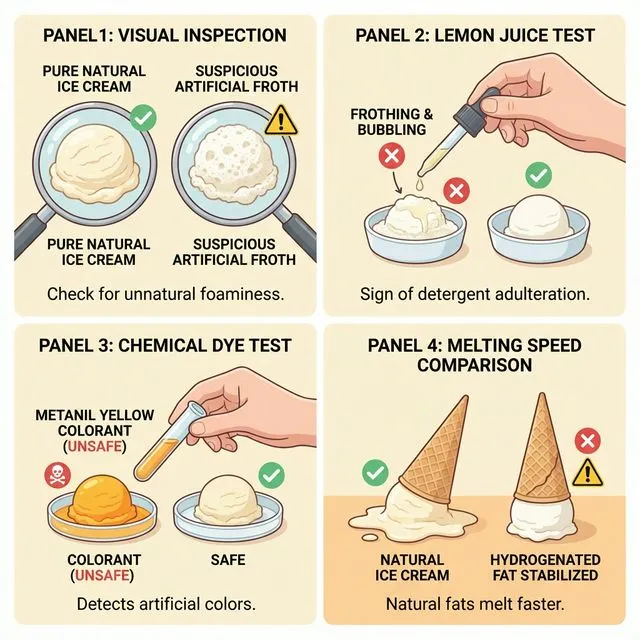
Melt 2 tbsp ice cream into liquid, add 1 tsp fresh lemon juice. Immediate foaming or persistent bubble ring indicates washing powder/detergent added to simulate thick creaminess.
Pure dairy ice cream melts smoothly at body temperature leaving no greasy film. Palm oil or vegetable fat blends leave an oily, waxy coating on the roof of the mouth and tongue.
Let a scoop melt at room temperature for 30 minutes. Pure ice cream melts into uniform creamy liquid. Adulterated fat blends separate into water curd and an oily curdled sludge.
To learn more about food safety tests and home adulteration detection, read our guides on Khoya (Mawa), Egg, and Yogurt & Greek Yogurt.
Drop Ice Cream photo here to test purity
or click to browse • Supports JPG, PNG, WEBP • Paste with Ctrl+V
Inspection Guide
Click to enlarge
Ice Cream Safety & Purity Check
Ice cream can be adulterated with detergents and ethyl acetate to create an unnaturally smooth, frothy texture that feels "premium."
1. The Lemon Juice Test:
Squeeze 3-4 drops of lemon juice onto a spoonful of melting ice cream. If it starts to foam, bubble, or release tiny gas pockets, it contains detergents or washing powder. Pure ice cream will simply curdle or thin out without bubbling.
2. The Iodine Test (Starch Detection):
Add a drop of iodine solution to a small amount of ice cream. If it turns blue or black, starch (used as a thickener) has been added. Pure dairy-based ice cream will not change color.
3. The Melt Profile:
Observe how the ice cream melts at room temperature. High-quality ice cream melts into a creamy, milky liquid. If it remains "stiff," "rubbery," or retains its shape even after 15 minutes, it contains excessive vegetable fats (vanaspati) and stabilizers.
4. The Taste and Smell:
If the ice cream has a sharp, "chemical" or fruity smell that reminds you of glue or paint thinner, it likely contains Ethyl Acetate. If it leaves a "soapy" or "metallic" after-taste, suspect detergents or artificial sweeteners.
Quick Safety Tips
- Perform the lemon juice test - bubbling indicates detergent
- Avoid ice cream that doesn't melt or remains "rubbery" at room temperature
- Check for a "soapy" after-taste or chemical smell
- Select products labeled "Real Milk" rather than "Frozen Dessert" (which use vegetable oils)
Primary Chemical Concerns
Health Risks & Impacts
Multilingual Local Names
Common Storage Pests
Not Applicable
low riskFrozen products are not susceptible to pests, but temperature fluctuations can lead to bacterial growth.
Detection
- Ice crystals on the surface
- Sour smell
Prevention
- Keep at a constant temperature below -18°C
- Ensure the container is sealed
Corrective Action: What to do?
Discard ice cream that has completely melted and refrozen.
Regulatory Corner: FSSAI (Food Safety and Standards Authority of India) / US FDA
Regulation: Food Safety and Standards (Food Products Standards) Regulations 2011, Clause 2.1.15: Ice Cream & Frozen Desserts & FDA 21 CFR 135.110
Legal Limit:Total solids: Min 36.0%; Milk fat: Min 10.0%; Milk protein: Min 3.5%; Non-dairy vegetable oils / animal body fat: 0.0% (must be labeled 'Frozen Dessert' if vegetable oil is used); Coliform count: Max 10/g
Report Adulteration to FSSAI (Food Safety and Standards Authority of India) / US FDA