Sheer Khurma Purity & Freshness Guide: Detect Synthetic Milk, Fake Saffron, Vanaspati & Date Mold
You can test Sheer Khurma (Sheer Qorma) at home for synthetic milk solids (urea/detergent adulteration), artificial coal-tar dyed fake saffron, cheap vanaspati substituting pure desi ghee, and internal fungal mold in dried dates (chhuhara) using the Milk Boiling Froth Test, the Saffron Warm-Water Halo Audit, and the Date Cross-Section Inspection. Laboratory HPLC/GC-MS testing is necessary to quantify trace aflatoxins and synthetic thickening gums.
Drop Sheer Khurma photo here to test purity
or click to browse • Supports JPG, PNG, WEBP • Paste with Ctrl+V
Inspection Guide
Click to enlarge
How to Test Sheer Khurma for Synthetic Milk, Fake Saffron & Vanaspati at Home
🔬 Scientific Home Adulteration Tests
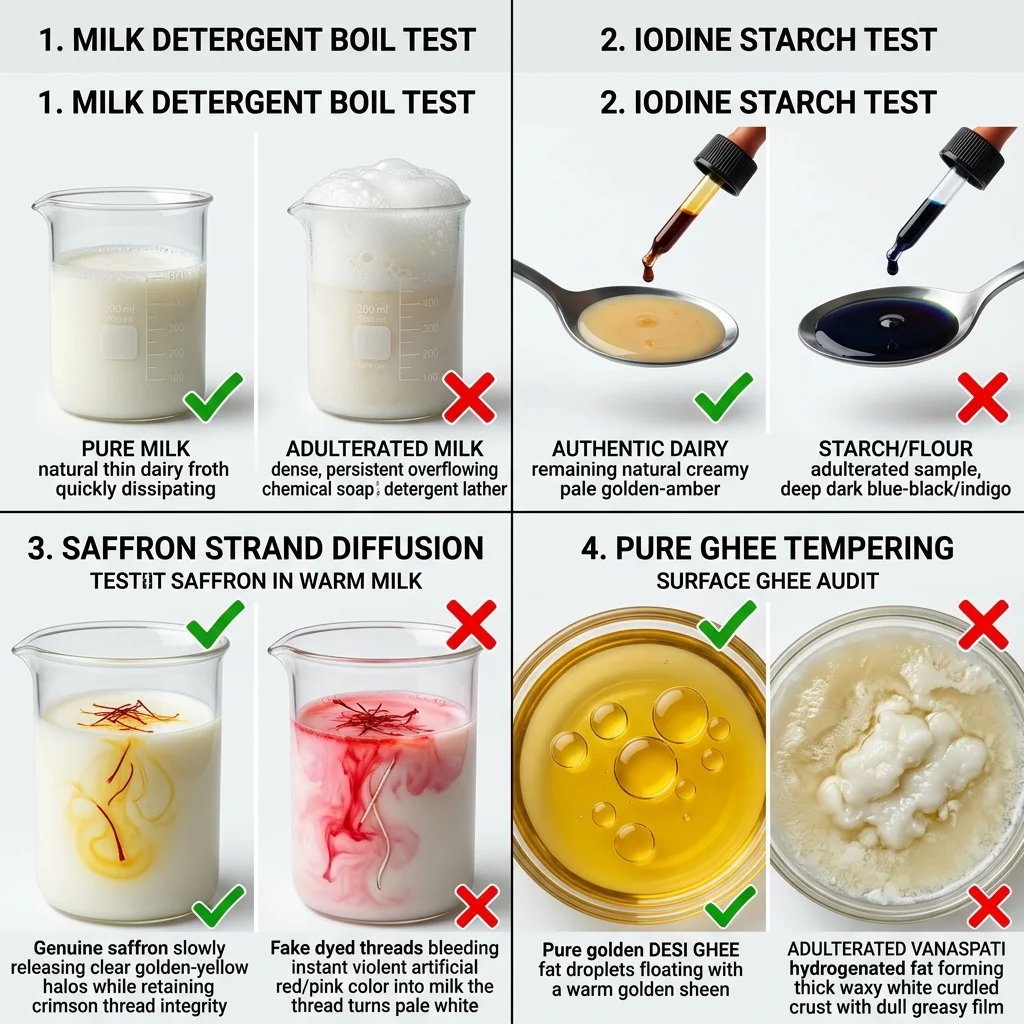
1. Milk Detergent & Boiling Froth Audit (Quadrant 1)
Take 3 tablespoons of the strained liquid milk base of Sheer Khurma (before adding nuts) or boil a small sample in a clean saucepan over medium heat.
- Pure Dairy Milk Base: Forms a delicate, thin layer of natural milk cream (malai) on top. When boiling, the froth dissipates rapidly once removed from the flame, releasing a sweet, clean, rich dairy scent.
- Synthetic Detergent Milk: Produces an abnormal, thick, persistent soapy foam or lather that billows excessively and fails to collapse after cooling. The froth leaves an alkaline, chemical after-taste or a bitter soapy film on the tongue.
2. Iodine Starch Thickener Detection Test (Quadrant 2)
Take 2 teaspoons of the cooled Sheer Khurma liquid in a small porcelain saucer, add 2 drops of Povidone-Iodine solution, and mix gently.
- Pure Milk-Reduced Sheer Khurma: Full-cream milk thickened naturally by slow reduction contains zero starch (vermicelli strands keep their starch bounded inside gluten). The liquid shows a soft creamy-amber or faint yellowish-brown hue.
- Adulterated with Starch / Flour / Arrowroot: Turns an immediate, dark indigo-blue or ink-black, proving commercial confectioners thickened the milk with cheap flour, cornstarch, or potato powder instead of slow reduction.
3. Saffron Thread Diffusion & Color Bleed Audit (Quadrant 3)
Isolate 2 visible reddish threads floating in the dessert, place them in a small glass with 2 tablespoons of warm water or milk, and observe the color diffusion over 5 to 10 minutes.
- Authentic Saffron Threads: Slowly and gradually emanate a luminous, clear golden-yellow halo without changing water color violently. The thread itself retains its crimson integrity and structural shape even after prolonged soaking.
- Dyed Fake Saffron (Tartrazine / Sunset Yellow): Bleeds an instant, aggressive neon red, crimson, or fluorescent orange dye within 10 seconds. The thread rapidly disintegrates, turns pale bleached white, and tastes bitter or chemical.
4. Pure Ghee Surface & Tempering Audit (Quadrant 4)
Observe the surface of warm Sheer Khurma in a clear glass bowl, or chill a spoonful in the refrigerator for 10 minutes.
- Pure Desi Ghee Tempering: Releases a fragrant, nutty, sweet dairy aroma. When warm, it forms glistening golden micro-droplets on the surface; when chilled, it solidifies into a soft, light fat film that melts effortlessly on the tongue.
- Vanaspati / Palm Stearin Adulterated: Emits a faint hydrogenated shortening or stale paint smell. When chilled, it forms a thick, opaque, chalky-white waxy crust that feels gritty and pasty in the mouth and refuses to melt cleanly.
Click to enlarge
How to Judge Sheer Khurma Freshness, Texture & Curdling Spoilage
📊 Freshness & Quality Comparison
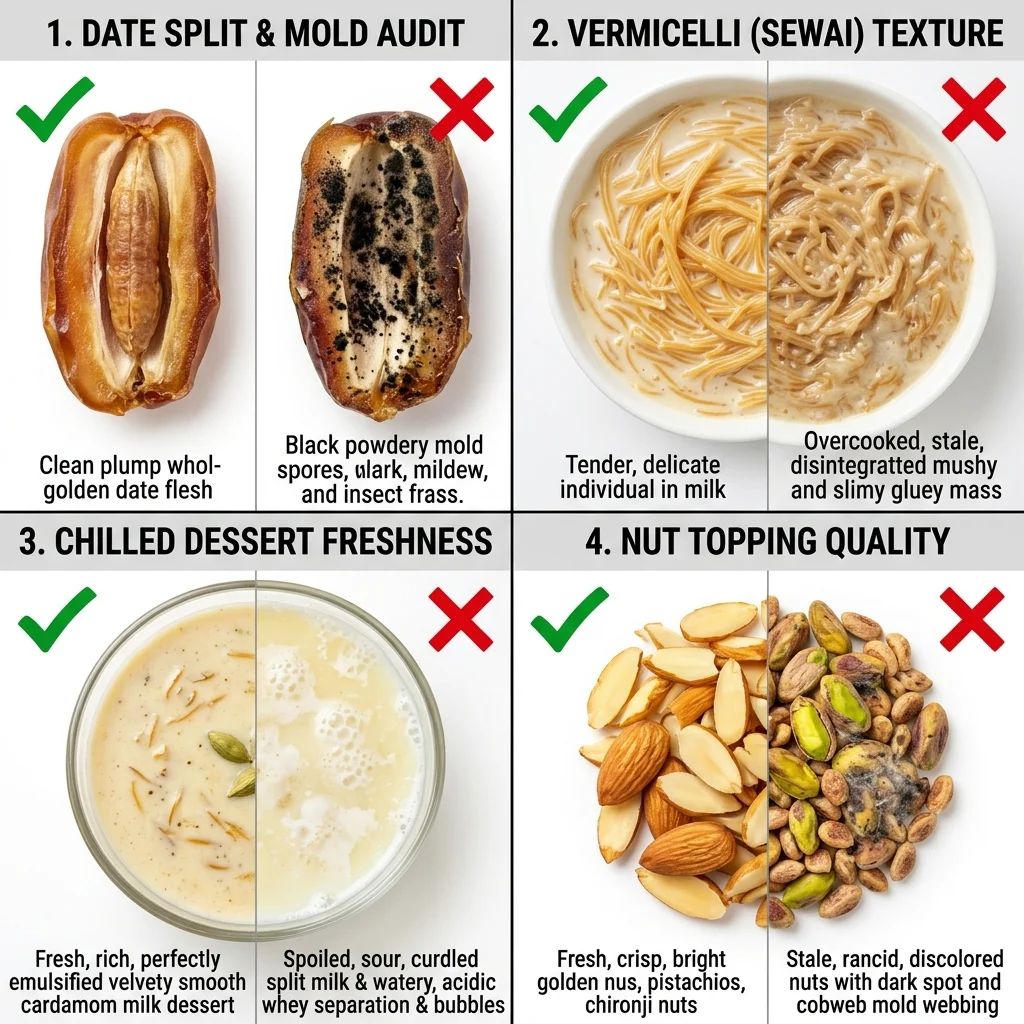
| Quality Indicator | Fresh Artisanal Sheer Khurma | Stale / Fermented / Curdled Sheer Khurma |
|---|---|---|
| Milk Base Emulsion | Velvety, homogeneous, creamy rich milk with warm ivory-golden saffron glow | Split, curdled milk proteins with watery acidic whey separation and tiny sour curds |
| Vermicelli (Sewai) | Distinct, tender, individually articulated golden roasted strands | Overcooked, mushy, disintegrated gluey paste, or clumped starch mass |
| Dried Date Cavity | Plump, chewy, wholesome amber-brown date flesh with clean seed channel | Powdery black fungal mold spores, bitter dry webbing, or insect boring holes |
| Aroma & Flavor | Rich caramelized dairy, aromatic cardamom, floral saffron, and roasted nuts | Sour, vinegary, fermented alcohol odor, or bitter rancid nut oil taste |
🏠 Proper Storage & Shelf-Life Guidelines
- Immediate Chilling: Because Sheer Khurma contains high-moisture whole dairy milk and cooked starches, leaving a warm pot at room temperature during summer Eid festivities leads to spoilage within 6 to 8 hours. Cool the pot in an ice-water bath and refrigerate immediately at 2–4°C.
- Refrigerator Shelf-Life: Properly stored in a sealed glass or stainless-steel container, Sheer Khurma stays fresh for 3 to 4 days.
- Freezing Technique: Sheer Khurma can be frozen for up to 1 month in portion-sized airtight freezer containers; thaw overnight in the refrigerator and warm gently on low heat with a splash of fresh warm milk to restore creamy emulsion.
Quick Safety Tips
- Always split dried dates (chhuhara) open lengthwise before cooking: inspect the seed cavity for black powdery mold spores, insect webbing, or tiny beetle frass.
- Check the cooking aroma: authentic Sheer Khurma has an unmistakable warm fragrance of slow-reduced milk, cardamom, saffron, and ghee—never a sour, soapy, or metallic note.
- Refrigerate cooked Sheer Khurma within 2 hours of cooking; cooked milk and starch vermicelli form an ideal breeding ground for foodborne Bacillus cereus toxins.
- Never reheat the entire large pot repeatedly: ladle out individual portions and reheat only what will be consumed immediately.
- Check companion ingredients like milk, ghee, saffron, cardamom, and almonds on BioLens Food Guard.
Primary Chemical Concerns
Health Risks & Impacts
Test Individual Raw Ingredients in Sheer Khurma
Unlike single raw commodities, prepared sweets and bakery items can harbor adulteration across multiple base ingredients. Click any raw ingredient below to run its dedicated kitchen purity test:
Multilingual Local Names
Common Storage Pests
Bacillus cereus & Lactic Acid Fermentation Bacteria
high riskSpore-forming foodborne pathogens and souring bacteria that multiply rapidly in cooked dairy-vermicelli puddings at room temperature.
Detection
- Separation of watery acidic whey and grainy curd clumps
- Sour, sharp, curdled smell and fizzy micro-bubbles
Prevention
- Refrigerate within 2 hours of cooking below 4°C
- Never leave large decorative serving bowls on party buffet tables all day
Corrective Action: What to do?
Discard curdled or sour Sheer Khurma immediately; reheating will not inactivate heat-stable emetic enterotoxins.
Dried Fruit Beetles (Carpophilus hemipterus) & Date Molds
medium riskInsects and fungal molds that infest stored dried dates (chhuhara) and nuts in humid pantries.
Detection
- Black powdery mold dust inside split dates
- Tiny round bore holes and granular insect droppings in date flesh
Prevention
- Inspect and wash all dried dates before cooking
- Store dried dates in airtight glass jars in a cool, dry place
Corrective Action: What to do?
Discard all moldy or insect-damaged dates; do not attempt to wash mold spores away.
Regulatory Corner: FSSAI / Codex Alimentarius
Regulation: Food Safety and Standards (Food Products Standards and Food Additives) Regulations — Milk Puddings & Cereal-Dairy Preparations
Legal Limit:Must contain pure milk solids with zero non-dairy fat in declared ghee preparations; zero synthetic colors except permitted food colors within statutory limits; zero aflatoxins above 10 ppb in dry fruits.
Report Adulteration to FSSAI / Codex Alimentarius