How to Tell If an Avocado Is Ripe, Safe & Real — Complete Quality Guide
⚡ Quick 60-Second Avocado Ripeness & Mold Verdict
Stem Cavity Mold (Anthracnose) & Premature Harvest: Immature avocados soften externally through forced ethylene gassing but retain rubbery, flavorless flesh, while stem ends harbor fungal rot.
Flick off the small wooden stem button at the top. If the cavity underneath is bright fresh green, the avocado is perfectly ripe. If it is dark brown or black, fungal decay is spreading. If it refuses to come off, the fruit is unripe.
Cup the avocado in your palm and squeeze gently. It should yield with slight, uniform softness. Never poke with fingertips, which bruises the delicate oil-rich flesh inside.
Avocados rank #1 on the EWG Clean 15 list because their thick pebbled skin prevents pesticide penetration—over 98% of tested conventional avocados show zero pesticide residues.
To learn more about food safety tests and home adulteration detection, read our guides on Olive Oil, Lychee, and Shrimp & Prawns.
Drop Avocado photo here to test purity
or click to browse • Supports JPG, PNG, WEBP • Paste with Ctrl+V
Inspection Guide
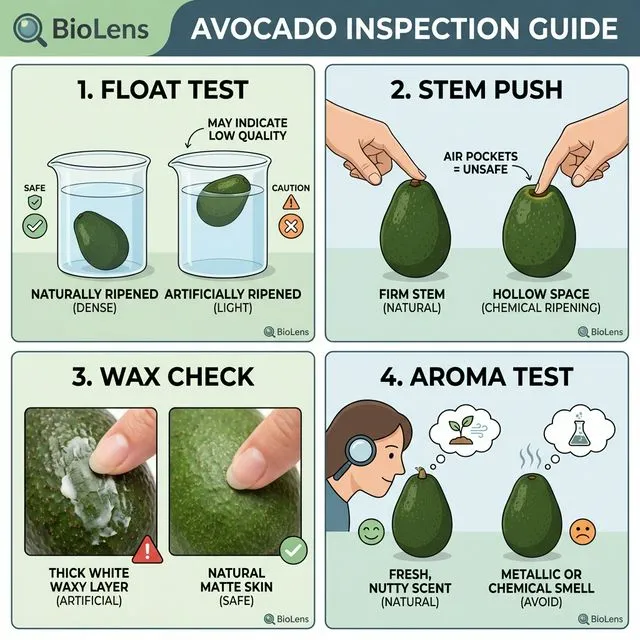
Click to enlarge
Avocado Ripeness & Purity Audit
Avocados are among the most artificially ripened fruits in global supply chains. Over 80% of commercially sold avocados in the US are treated with ethylene gas post-harvest. Here is how to detect it — and how to pick the perfect avocado every time.
1. The Stem-Pop Test (Most Reliable Ripeness Check):
Gently flick the small stem cap (button) at the top of the avocado. ✅ Green underneath = ripe and fresh. ❌ Brown or black underneath = overripe, likely has interior browning. ❌ Stem won't budge despite soft skin = artificial gassing — the peel softened but flesh hasn't ripened naturally.
2. The Palm Press Test (Firmness vs Ripeness):
Cup the avocado in your full palm and apply gentle, even pressure. Do NOT press with fingertips — this causes bruising. ✅ Yields slightly but springs back = perfectly ripe. ✅ Firm with no give = 2–3 days away from ripe. ❌ Mushy, dents stay = overripe. ❌ Soft in patches but hard elsewhere = uneven artificial ripening.
3. The Skin Scrape Test (Wax & Coating Detection):
Gently scrape the skin with a clean fingernail. ✅ Natural avocado skin is slightly oily but produces no flakes. ❌ White, waxy flakes = industrial wax coating applied post-harvest. ❌ Unusually shiny, mirror-like skin = heavy wax or oil coating.
4. The Water Soak Test (Fungicide Check):
Soak the avocado in warm water for 10 minutes. ✅ Clean water = minimal treatment. ❌ Oily sheen or chemical smell in water = heavy fungicide (Thiabendazole / Imazalil) treatment. Always scrub with baking soda and water before cutting — this removes up to 90% of surface residues.

Click to enlarge
Is the Black Inside Safe? Avocado Flesh Guide
One of the most-searched avocado questions in the US: 'Is my avocado safe to eat if it's black inside?' Here is the definitive answer:
✅ Light brown streaks on cut surface = SAFE (oxidation)
When avocado flesh is exposed to air, it browns quickly due to an enzyme reaction — the same as a cut apple. This is completely harmless. Squeeze lemon juice on cut avocado to prevent it.
⚠️ Dark brown patches throughout = BORDERLINE (overripe)
Extensively browned flesh is overripe and has an unpleasant bitter taste. It is technically safe to eat the unaffected parts, but quality is poor. Scoop out and discard the dark sections.
❌ Black fibrous strings running through the flesh = DISCARD (vascular disease)
Dark, stringy, thread-like fibers throughout the flesh indicate a fungal vascular disease (Lasiodiplodia or Colletotrichum). This is NOT safe to eat — the fungal mycelium has colonised the fruit's vascular tissue. The fruit may smell fermented or sour.
❌ Grey, watery, translucent flesh = DISCARD (freeze damage or deep rot)
Grey, mushy, translucent flesh usually indicates freeze damage during shipping or advanced internal decay. The cell structure has broken down. Discard entirely.
Quick Summary Table:
| Appearance | Cause | Safe? |
|---|---|---|
| Light brown on cut surface | Air oxidation | ✅ Yes |
| Brown streaks near skin | Overripe | ⚠️ Cut away |
| Black fibrous strings | Vascular fungal disease | ❌ Discard |
| Grey, watery, mushy | Freeze damage / deep rot | ❌ Discard |
| Bright green/yellow, creamy | Fresh, ideal | ✅ Perfect |
Quick Safety Tips
- Use the stem-pop test first — it's the most accurate ripeness indicator
- Press with your full palm, never fingertips, to avoid bruising the fruit
- Avoid avocados with a mirror-like gloss — a slight matte finish is natural
- Always scrub avocado skin with baking soda + water before slicing
- A soft avocado with a stuck stem = artificially gassed — avoid it
Primary Chemical Concerns
Health Risks & Impacts
Multilingual Local Names
Common Storage Pests
Avocado Thrips
low riskTiny insects that cause rusty, scarred patches on the skin surface — cosmetic damage only, does not affect flesh safety.
Detection
- Rusty brown or silver scarring on the outer skin
- Rough, sandpaper-like texture in patches
Prevention
- Cosmetic only — does not affect flesh quality or safety
- Inspect the stem-end; if clean and green inside, fruit is fine
Vascular Fungal Disease (Black Strings)
high riskLasiodiplodia or Colletotrichum infection causes dark, fibrous, thread-like strands running through the flesh.
Detection
- Black or very dark brown fibrous strings inside the flesh
- Sour or fermented smell when sliced
- Flesh may appear marbled with dark veins
Prevention
- Discard the entire fruit — do not eat any part
- Fungal mycelium spreads throughout the tissue
Regulatory Corner: US FDA / Codex Stan 197-1995 (Standard for Avocado)
Regulation: Codex Alimentarius Fresh Fruits Standards & USDA Grade 1 Avocado Specifications
Legal Limit:Minimum dry matter content (maturity index): Min 21.0% (Hass variety); Internal anthracnose decay / rot: Max 1.0%; Non-declared synthetic surface waxes: 0.0%
Report Adulteration to US FDA / Codex Stan 197-1995 (Standard for Avocado)