How to Test Saffron for Adulteration (Artificially Dyed Corn Silk, Colored Plastic Threads, Coconut Fibers)
⚡ Quick 60-Second Saffron (Kesar) Purity Verdict
Dyed Corn Silk, Shredded Plastic & Syrup Bulking: Saffron is the world's most adulterated spice. Commercial fakes use dyed dried corn silk, shredded plastic fibers, or sugar-syrup weighted threads.
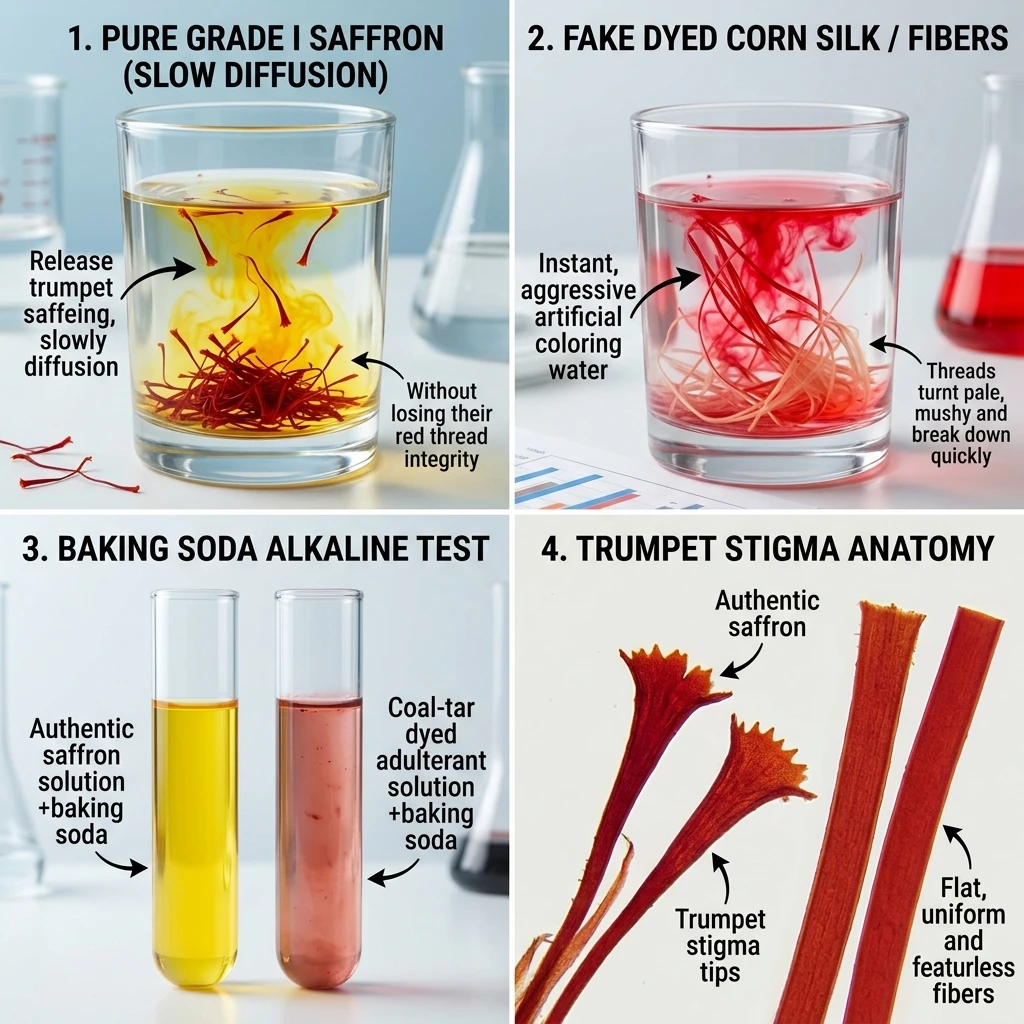
Drop 2–3 threads into warm water. Pure saffron slowly releases golden-yellow color over 10–15 min, retaining its deep red thread. Fake dyed saffron turns water crimson/neon pink in 10s and threads turn pale white.
Add saffron water to a pinch of baking soda. Pure saffron turns a golden-yellow hue. Adulterated coal-tar dyed saffron turns pink or reddish-orange.
Sniff and taste. Pure saffron smells sweet, hay-like, and floral, but tastes distinctly bitter. If a thread tastes sweet, it was weighted with sugar syrup.
To learn more about food safety tests and home adulteration detection, read our guides on Poppy Seeds (Khus Khus) and Star Anise.
Drop Saffron (Kesar) photo here to test purity
or click to browse • Supports JPG, PNG, WEBP • Paste with Ctrl+V
Inspection Guide
Click to enlarge
Saffron (Kesar) Purity and Authenticity Guide
Saffron is the world's most expensive spice, making it a prime target for adulteration with dyed corn silk, plastic threads, or exhausted saffron fibers.
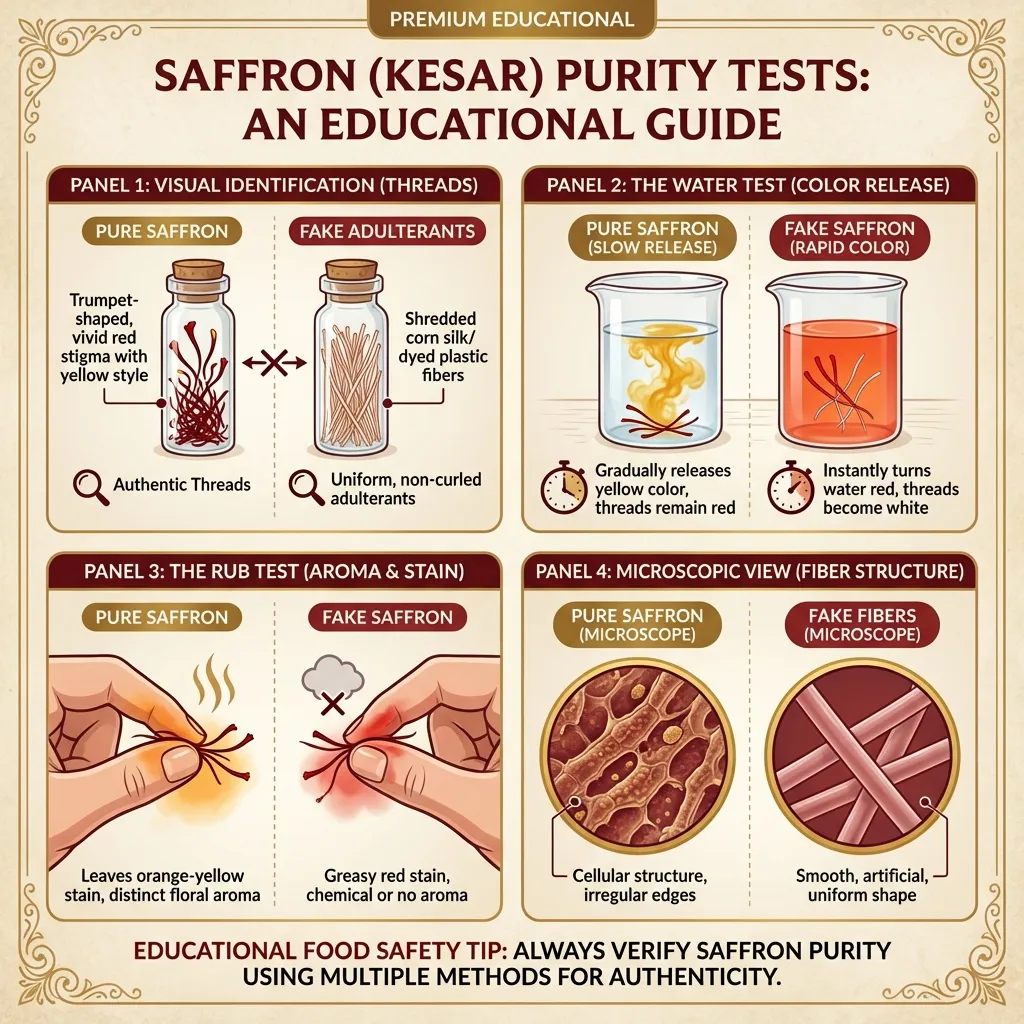
1. The Cold Water Test (Visual):
Place 2-3 threads of saffron in a cup of cold water.
- Pure Saffron: Will gradually release a bright yellow/golden color. The threads will maintain their red color and remain intact.
- Fake Saffron: Will immediately release a dark red or orange color (due to artificial dyes). The threads will lose their red color and may disintegrate or turn white.
2. The Shape Check (The Trumpet Test):
Look at the individual threads closely (use a magnifying glass if possible). Pure saffron threads are trumpet-shaped (flared at one end and thin at the base). If the threads are perfectly uniform, flat, or lack the flared end, they are likely corn silk or synthetic.
3. The Rub Test:
Take a thread that has been soaked in water and rub it between your fingers. Pure saffron threads are strong and will not break or turn into powder easily. Fake threads will disintegrate, crumble, or feel "mushy."
4. The Baking Soda Test:
Mix a small amount of baking soda in water and add saffron threads. Pure saffron will turn the water yellow. Fake saffron (dyed with certain chemicals) will turn the water red or pink.
5. The Aroma Test:
Pure saffron has a very distinct, complex aroma that is described as a mix of hay and honey (sweet yet earthy). If it smells metallic, like raw chemicals, or has no smell at all, it is fake.
6. Spices Dyeing Risk:
Synthetic dyes are a common adulterant in premium spices. Learn how to verify purity in our guide for Cardamom.
Click to enlarge
Saffron Freshness, Purity & Grade Standards Guide
Saffron does not spoil easily if kept bone-dry, but light and moisture degrade crocin and safranal rapidly:
| Quality Grade | Visual Stigma Appearance | Aroma & Flavor Profile | Food & Health Recommendation |
|---|---|---|---|
| 1. Super Mongra / Grade I (Finest) | Deep crimson-blood red stigmas, zero yellow style, trumpet tips | Sweet floral honeyed aroma, medicinal bitter bite on tongue | ✅ Highest Grade — Culinary, pregnancy milk, temple prasadam, wellness |
| 2. Lacha / Grade II (Standard) | Red stigmas attached to 10–15% yellow style base | Milder aroma, slightly slower color diffusion in liquids | ⏳ Standard Cooking — Biryani, kheer, festive desserts (requires extra threads) |
| 3. Aged / Oxidized (Stale) | Faded orange-brown tint, brittle threads turning to dust | Minimal scent, sluggish light amber diffusion in water | ⚠️ Potency Lost — Non-toxic but lacks coloring power and health benefits |
| 4. Adulterated / Dyed Silk | Artificially shiny crimson, sticky or oily coating | Harsh chemical or molasses aroma, sweet taste on tongue | ❌ Food Fraud — Dyed corn silk or exhausted fibers; discard immediately |
Critical Adulteration & Quality Signs:
- Instant Red Bleed: Water turning ruby red in 10 seconds indicates synthetic coal-tar dye.
- Sweet Taste: Real saffron is bitter. A sweet flavor indicates sugar syrup weighting.
Optimal Storage Practices:
- Keep in an airtight dark glass jar away from sunlight and kitchen steam.
- Do not refrigerate: temperature shocks introduce condensation that ruins stigmas.
Quick Safety Tips
- Pure saffron releases yellow color slowly in cold water
- Threads should be trumpet-shaped, not flat
- Avoid saffron that smells metallic or chemical
- Real threads do not lose their red color after soaking
Primary Chemical Concerns
Health Risks & Impacts
Multilingual Local Names
Common Storage Pests
Mites / Mold
medium riskMicroscopic pests or fungi that grow in humid conditions.
Detection
- Fine dust-like movement on the threads
- A musty or "damp cellar" odor
Prevention
- Keep in a small, airtight glass container
- Store in a cool, dark, dry drawer; avoid the fridge
Corrective Action: What to do?
If moldy, discard immediately; saffron is too delicate to "clean."
Sugar Ants
low riskHousehold ants attracted to saffron that has been adulterated with sugar syrup weighting.
Detection
- Ants congregating inside the saffron container
- Sticky thread clumping
Prevention
- Ensure threads are dry and unweighted
- Wipe jar exterior
Corrective Action: What to do?
Discard if adulterated with syrup; real saffron does not attract ants.
Khapra Beetle / Drugstore Beetle
high riskDry pantry pests that burrow into dried aromatic herbs and botanicals in warm storage.
Detection
- Fine powdery frass at the bottom of the vial
- Tiny circular pinholes in packaging
Prevention
- Keep containers hermetically sealed in cool conditions (<20°C)
Corrective Action: What to do?
Discard infested saffron immediately.
Regulatory Corner: FSSAI (Food Safety and Standards Authority of India) / ISO 3632 (Grade I Saffron Standards)
Regulation: Food Safety and Standards (Food Products Standards) Regulations 2011, Clause 2.9.20: Saffron (Kesar) Whole and Powder
Legal Limit:Crocin (Coloring strength at 440nm): Min 200; Safranal (Aroma strength at 330nm): 20–50; Picrocrocin (Bitter taste at 257nm): Min 70; Moisture: Max 12.0%; Added sugar syrup, honey, dyed corn silk, coal-tar azo dyes: 0.0%
Report Adulteration to FSSAI (Food Safety and Standards Authority of India) / ISO 3632 (Grade I Saffron Standards)