Suji / Semolina (Rava) Purity & Freshness Guide: Detect Iron Filings, Chalk Powder, Maida & Weevils
You can test Suji / Semolina (Bombay Rava / Chiroti Rava) at home for magnetic iron filings and roller-mill metal grit, chalk powder, soapstone, or washing soda, cheap bleached maida dilution, and hidden flour beetle or meal-moth webbing using the Paper Magnet Sweep Test, the Water Float & Sedimentation Test, and the Lemon Juice/Vinegar Effervescence Audit. Detecting trace pesticide residues or toxic boric acid dust requires certified FSSAI laboratory analysis.
Drop Suji / Semolina (Rava) photo here to test purity
or click to browse • Supports JPG, PNG, WEBP • Paste with Ctrl+V
Inspection Guide
Click to enlarge
How to Test Suji / Semolina (Rava) for Iron Filings, Chalk Powder & Maida at Home
🔬 Scientific Home Adulteration Tests
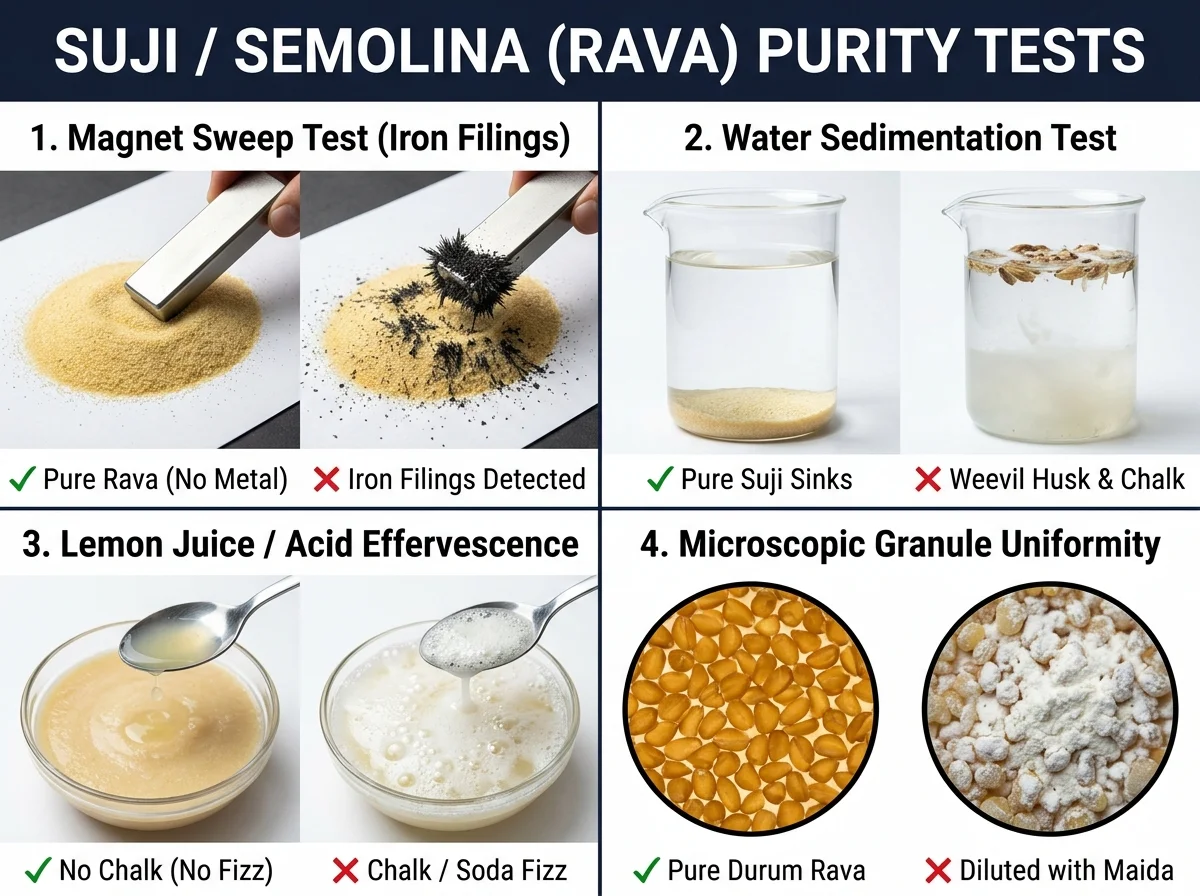
1. Dry Paper Magnet Sweep Test for Iron Filings (Quadrant 1 — Official FSSAI DART Test)
Spread 2 tablespoons of dry suji (rava) in a thin, even layer across a clean sheet of white paper. Wrap a strong household magnet (such as a neodymium fridge magnet) in a thin plastic bag or tissue and slowly sweep it just above and through the semolina granules.
- Pure Unadulterated Suji: The golden-cream wheat granules remain completely undisturbed on the paper; zero dark metallic bristles or black dust cling to the magnet.
- Adulterated with Iron Filings / Roller Grit: Sharp black or dark-gray metallic needles and iron dust whiskers immediately jump up and cluster around the magnet poles.
2. Glass of Water Float & Sedimentation Audit (Quadrant 2)
Drop 1 tablespoon of suji into a tall, transparent glass of room-temperature water, stir gently once, and observe for 3 minutes.
- Pure Hard-Wheat Semolina: Healthy, dense endosperm granules sink cleanly to the bottom, leaving the water above relatively clear with zero floating debris.
- Infested or Chalk/Maida Adulterated: Hollow insect-bored husks, dead weevil fragments, and bran chaff float at the top, while maida or chalk turns the water opaque milky-white with a slimy flour paste on the surface.
3. Lemon Juice / Vinegar Effervescence Test for Chalk Powder (Quadrant 3)
Place 1 teaspoon of suji in a small glass bowl, add 2 tablespoons of white vinegar or freshly squeezed lemon juice (or dilute hydrochloric acid), and watch closely for 60 seconds.
- Pure Semolina: Wheat middlings do not react with kitchen acids; there is zero fizzing or bubbling.
- Adulterated with Chalk Powder / Washing Soda: Produces immediate, vigorous fizzing bubbles and foamy carbon dioxide effervescence, confirming calcium carbonate chalk or sodium carbonate adulteration.
4. Crystalline Rub & Dry Sieve Webbing Check (Quadrant 4)
Pinch a small amount of dry suji between your thumb and forefinger under bright light, and pass a cup of suji through a fine kitchen sieve.
- Authentic Durum Rava: Feels uniformly gritty, crystalline, and free-flowing with a warm pale-amber hue and a sweet, nutty wheat smell.
- Cut with Maida or Pest-Infested: Leaves a powdery white chalk/maida dust coating on your fingertips, or reveals sticky silk cobweb threads, clumped balls, and tiny reddish-brown beetles trapped in the sieve.
Click to enlarge
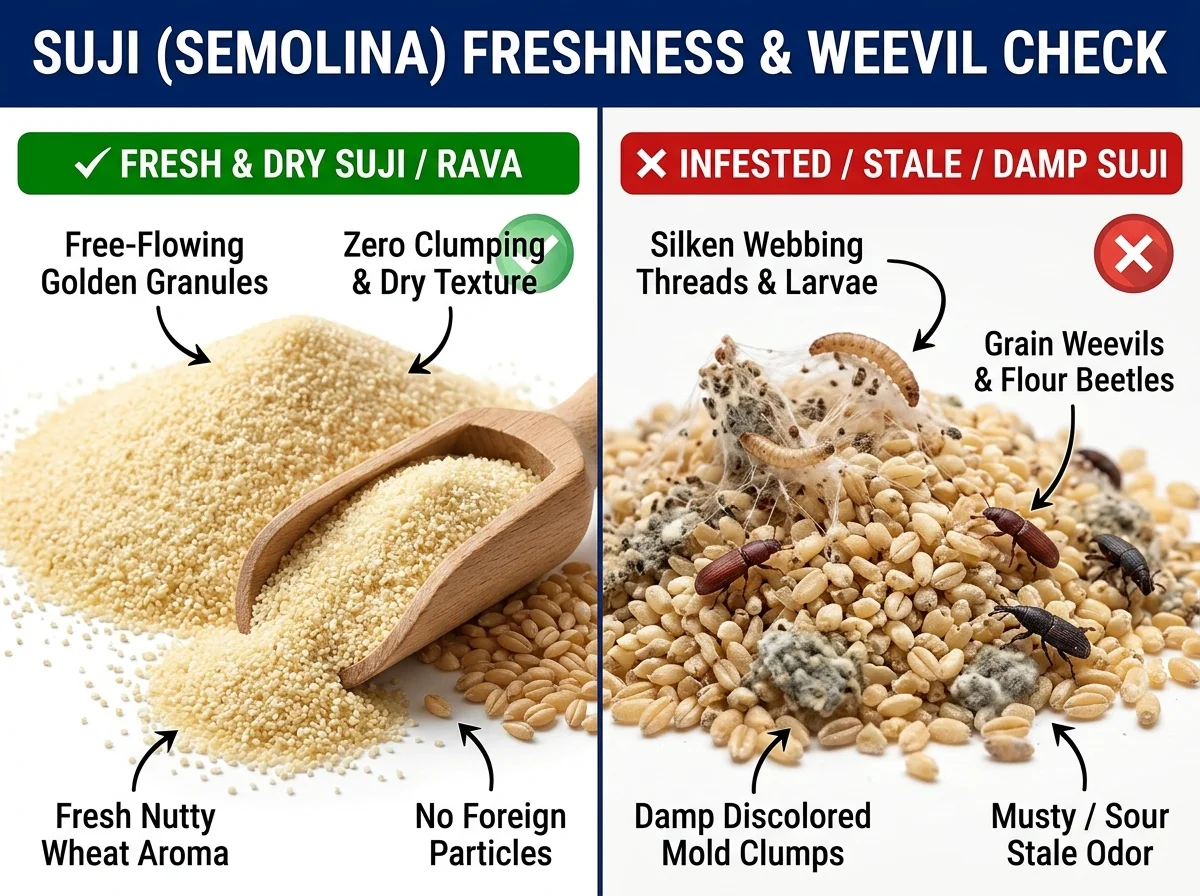
How to Judge Suji (Semolina) Freshness, Granule Quality & Weevil Infestation
📊 Freshness & Quality Comparison
| Quality Indicator | Fresh Pure Durum Suji (Rava) | Stale / Damp / Weevil-Infested Suji |
|---|---|---|
| Granule Appearance | Uniform, sharp-edged, translucent pale-golden or ivory crystals | Powdery white flour dust, dull gray clumps, or dark metallic specks |
| Flow & Texture | 100% dry, free-flowing like fine sand; gritty between fingers | Sticky clumps suspended by silk moth webbing or damp moldy balls |
| Aroma & Taste | Clean, sweet, nutty wheat endosperm fragrance | Musty, sour, rancid oil odor, or sharp pungent beetle-secretion smell |
| Roasting Behavior | Absorbs ghee evenly and blooms into fluffy, non-sticky grains | Turns into a gluey, pasty maida lump when hot water is added |
🏠 Proper Storage & Shelf-Life Guidelines
- Why Raw Suji Attracts Weevils Fast: Microscopic eggs of the Red Flour Beetle (Tribolium castaneum) and Lesser Grain Borer naturally survive milling inside wheat endosperm cracks. In warm, humid Indian kitchens (> 28°C), these eggs hatch within 3–4 weeks.
- The Pre-Roasting Secret (Doubles Shelf Life): Dry-roast raw suji on low flame for 5 minutes until warm to the touch, let it cool 100% on a wide plate, and transfer to an airtight glass or stainless-steel container with 2–3 dried bay leaves (tej patta) or whole dried red chilies. Pre-roasted suji stays pest-free for 4 to 6 months at room temperature.
- Refrigerator / Freezer Storage: Unroasted suji stored in a zip-top freezer bag in the refrigerator or freezer stays fresh and 100% weevil-free for up to 12 months.
Quick Safety Tips
- Always dry-roast suji in a heavy pan for 4–5 minutes over low heat (until aromatic without browning) and cool completely before storing—this thermal step eliminates hidden insect eggs embedded inside the wheat granules.
- Perform the 30-second Magnet Sweep Test on every new packet of loose or local-mill rava before cooking.
- If stored suji smells musty, sour, or shows clumps hanging from invisible silk threads (Indian meal moth larvae), discard the entire packet.
- Wash and rinse coarse upma rava briefly or inspect carefully if purchased from open mandi sacks where boric acid may have been dusted.
- Cross-check companion ingredients like Whole Wheat, Maida, Ghee, and Gujiya on BioLens Food Guard.
Primary Chemical Concerns
Health Risks & Impacts
Test Individual Raw Ingredients in Suji / Semolina (Rava)
Unlike single raw commodities, prepared sweets and bakery items can harbor adulteration across multiple base ingredients. Click any raw ingredient below to run its dedicated kitchen purity test:
Multilingual Local Names
Common Storage Pests
Red Flour Beetle (Tribolium castaneum) & Confused Flour Beetle (Tribolium confusum)
high riskSmall (3–4 mm) reddish-brown beetles that thrive in milled semolina and secrete foul-smelling benzoquinone toxins.
Detection
- Tiny reddish-brown oblong beetles crawling on the surface or trapped during sieving
- Pinkish-gray discoloration and a sharp, pungent, musty chemical odor in the suji
Prevention
- Dry-roast suji for 5 minutes on low heat, cool completely, and store in airtight glass jars
- Freeze newly purchased packets at -18°C for 48 hours to destroy dormant eggs
Corrective Action: What to do?
Discard heavily infested suji immediately; benzoquinone secretions cannot be removed by sieving or cooking.
Indian Meal Moth (Plodia interpunctella)
medium riskPantry moth whose cream-colored caterpillars spin sticky silken webs that bind suji granules into hanging clumps.
Detection
- Clumps of suji clinging to container walls by fine silk cobweb threads
- Small cream-white larvae or bronze-winged moths inside the pantry
Prevention
- Store in heavy glass or steel containers with tight silicone seals and 2 dried bay leaves
- Never mix a new packet of suji on top of an old batch without washing and drying the jar
Corrective Action: What to do?
Dispose of any suji showing silk webbing and scrub pantry shelves with warm vinegar water.
Regulatory Corner: FSSAI (Food Safety and Standards Authority of India)
Regulation: Food Safety and Standards (Food Products Standards and Food Additives) Regulations — Semolina (Suji or Rava) Regulation 2.4.2
Legal Limit:Moisture ≤ 14.5%, total ash ≤ 1.0% on dry basis, acid-insoluble ash ≤ 0.1%, alcoholic acidity ≤ 0.18%; must be 100% free from iron filings, chalk, boric acid, and insect infestation.
Report Adulteration to FSSAI (Food Safety and Standards Authority of India)