How to Test Black Nightshade for Adulteration (Artificial Purple/black Dyes, Copper Sulfate Spray, Unripe Solanine Toxin)
⚡ Quick 60-Second Black Nightshade (Manathakkali) Purity & Solanine Verdict
Toxic Unripe Solanine Berries & Botanical Contamination: Manathakkali (Solanum nigrum) foliage and berries are harvested with toxic green berries (high solanine alkaloids) and mixed with poisonous lookalikes.
Carefully sort through the berries. Only completely jet-black or deep purple-black berries are safe to consume. Green, yellowish, or mottled berries contain dangerously high solanine glycoalkaloids and must be discarded.
Examine any included flowers and leaves. True culinary Manathakkali has small white star-shaped flowers with prominent yellow central cones. If flowers are dull purple or bell-shaped (Atropa belladonna lookalike), discard immediately.
Touch a droplet of crushed leaf juice to the tip of your tongue and spit it out. Pure Manathakkali has a pleasant bitter herbal taste. A sharp burning, tingling, or numbing sensation indicates dangerous glycoalkaloids.
To learn more about food safety tests and home adulteration detection, read our guides on Tapioca (Cassava) and Turkey Berry (Sundakkai), and explore our diagnostic guide on dangerous vegetable look-alikes.
Drop Black Nightshade (Manathakkali) photo here to test purity
or click to browse • Supports JPG, PNG, WEBP • Paste with Ctrl+V
Inspection Guide
Click to enlarge
Black Nightshade Chemical Inspection
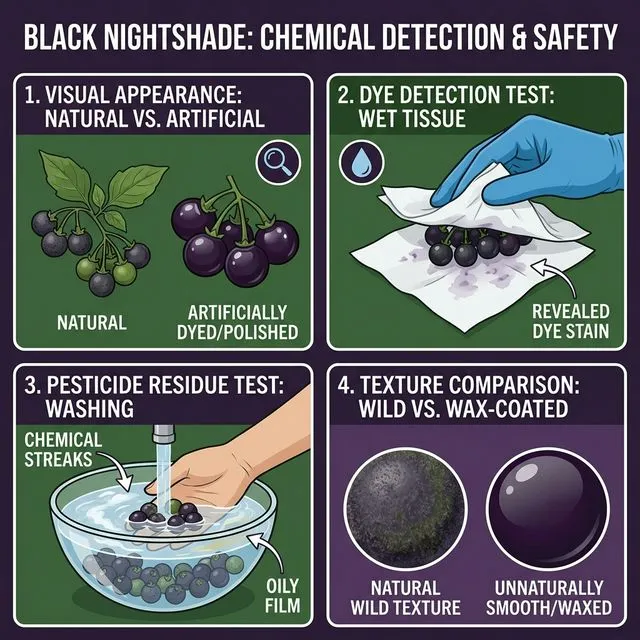
Black nightshade (Manathakkali) berries are prized for health, but can be treated with dyes to look uniform or sprayed with heavy pesticides.
1. The Water Soak Test (Dye Detection):
Soak a handful of ripe berries in warm water for 15 minutes. Pure berries will not color the water. If the water turns purple, blue, or blackish, it indicates the berries have been artificially dyed to look ripe and uniform.
2. The Surface Residue Check:
Examine the leaves and berries for any bluish-white powdery residue. This is often a sign of Copper Sulfate (Bordeaux mixture) spray, used as a fungicide. Excessive residue is toxic.
3. The Rub Test:
Gently rub a few ripe berries with a damp white tissue. Natural berries won't leave color unless crushed. If a purple stain appears on the tissue from just the surface skin, it's dyed.
4. The Ripeness Mix:
Naturally harvested berries come in varying stages (green, turning purple, deep black). If the entire bunch is perfectly uniform deep black with no green/red berries mixed in, suspect artificial ripening agents or dyes.
Quick Safety Tips
- Soak in salt and turmeric water for 30 mins to remove pesticides
- Avoid bunches that are 100% uniform in color
- Check for metallic taste (indicates chemical spray)
- Wash thoroughly to remove any powdery surface residues
Primary Chemical Concerns
Health Risks & Impacts
Multilingual Local Names
Common Storage Pests
Aphids
low riskSmall insects that can live on the underside of the leaves.
Detection
- Tiny green insects
- Sticky residue on the leaves
Prevention
- Wash thoroughly before use
- Store in a cool, ventilated place
Corrective Action: What to do?
Wash with a mild salt-water solution; the leaves are safe after cleaning.
Regulatory Corner: FSSAI (Food Safety and Standards Authority of India) / Ayurvedic Pharmacopoeia of India (API Part I, Vol III)
Regulation: Food Safety and Standards Act 2006 & API Standards for Solanum nigrum Linn.
Legal Limit:Total glycoalkaloids (solasonine/solanine): Safe culinary threshold only; Foreign botanical matter: Max 2.0%; Total ash: Max 16.0%; Acid-insoluble ash: Max 2.5%; Lead: Max 2.5 ppm
Report Adulteration to FSSAI (Food Safety and Standards Authority of India) / Ayurvedic Pharmacopoeia of India (API Part I, Vol III)