Mayonnaise Purity Guide: Detect Starch Bulking, Rancid Oils & Salmonella Spoilage
⚡ Quick 60-Second Mayonnaise Purity Verdict
Industrial Starch Bulking & Rancid Oil Dilution: Commercial budget mayonnaises frequently slash expensive egg yolk solids and vegetable oils below the legal 65% limit, replacing them with modified cornstarch, xanthan gum, cheap palm olein, and water.
Place 1 teaspoon of mayonnaise on a white saucer and add 1 drop of 2% iodine tincture. Pure mayonnaise (egg yolk + oil emulsion) remains light golden amber or yellowish. Starch-thickened fake mayonnaise instantly reacts with an intense deep blue, purple, or black color.
Freeze 1 tablespoon of mayo in a small cup for 2 hours, then let it thaw at room temperature. Authentic egg-lecithin mayonnaise breaks naturally into a clear golden oil layer. Starch/gum-gelled synthetic mayo curdles into a spongy, clotted, watery white mass.
Stir 1 teaspoon into half a cup of warm water (60°C). Pure mayonnaise emulsifies completely into a smooth, milky white liquid. Industrial thickeners and synthetic stabilizers precipitate out into slimy, gummy flakes that float on the water surface.
To explore related sauce purity tests and emulsion safety standards, read our verified investigations on Fresh Egg Safety, Tomato Ketchup & Puree, Extra Virgin Olive Oil, Mustard Seeds, and Shrimp & Prawns.
Drop Mayonnaise photo here to test purity
or click to browse • Supports JPG, PNG, WEBP • Paste with Ctrl+V
Inspection Guide
Click to enlarge
Mayonnaise Purity, Starch Bulking & Emulsion Audit
Mayonnaise is legally defined across international food codes (FDA 21 CFR 169.140, Codex Alimentarius CXS 168-1989) as a permanent emulsion of vegetable oil, egg yolk, and an acidifying ingredient (vinegar or lemon juice). Because vegetable oil and egg yolk solids are expensive, manufacturers frequently water down the formula, bulking the consistency with modified food starch, carboxymethylcellulose (CMC), and xanthan gum while marketing the product as "Real Mayonnaise."
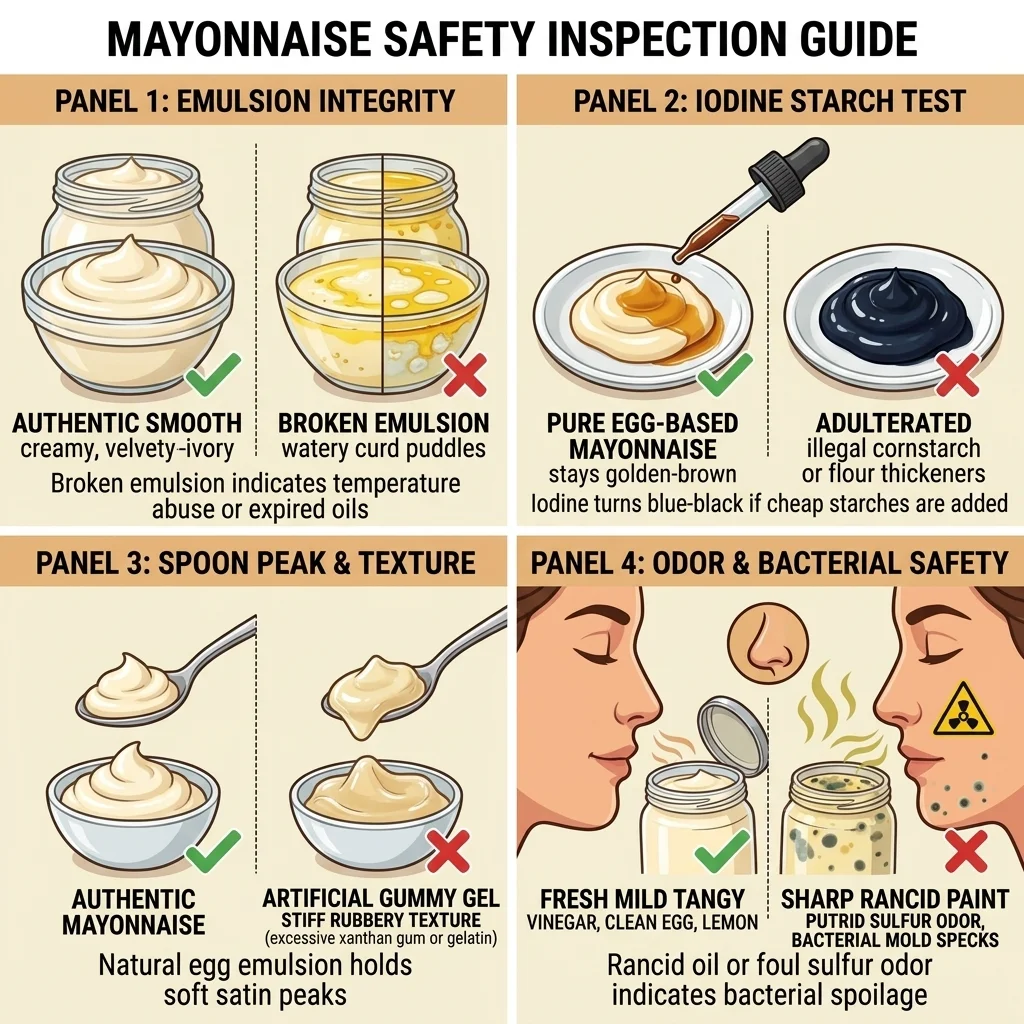
1. The Single Iodine Droplet Starch Detection Test:
Natural egg yolk contains lipids and proteins, but zero starch.
✅ Authentic Pure Mayonnaise: Place a tablespoon on a white plate and add 1 single drop of 2% Lugol's iodine tincture or medical povidone iodine. The droplet remains yellow-amber or pale reddish-brown.
❌ Adulterated Starch-Bulked Mayo: If modified cornstarch, potato starch, or flour fillers have been added to simulate viscosity, the iodine droplet instantly reacts with amylose, turning deep midnight-blue, dark purple, or jet black within 5 seconds.
2. The Freezer Thaw Emulsion Stability Test:
Egg yolk contains natural lecithin, a delicate organic emulsifier that binds oil droplets in a water matrix.
✅ Authentic Egg Emulsion: Scoop 1 tablespoon of mayo into a cup and freeze for 2 hours, then let it thaw at room temperature. The natural physical emulsion collapses completely, separating into a clean layer of golden liquid oil and curdled yolk solids.
❌ Artificially Stabilized Synthetic Mayo: Formulated with synthetic gums (guar gum, xanthan, modified starch). It maintains its stiff gel shape after thawing or weeps a clear watery liquid without releasing clean oil.
3. The Warm Water Dissolution Test:
Stir 1 teaspoon of mayonnaise into half a cup of warm water (approx. 60°C / 140°F).
✅ Pure Mayonnaise: The oil droplets disperse smoothly, creating an even, milky, homogenous white liquid with a clean aroma.
❌ Synthetic Filler Product: Thickening starches and cellulose gums fail to disperse smoothly, creating gummy, translucent, gelatinous floating clumps and sticky residues on the spoon.
4. Visual & Olfactory Spoilage Detection:
Examine the jar before spreading.
✅ Fresh Mayonnaise: Silky, glossy, ivory-cream surface with a clean tangy scent of vinegar and savory egg richness.
❌ Spoiled / Oxidized Mayo: Features a translucent, dark yellow, greasy crust around the jar rim, small fermented gas bubbles trapped in the emulsion, or a sour, putrid, rotten-egg sulfur stench.
Click to enlarge
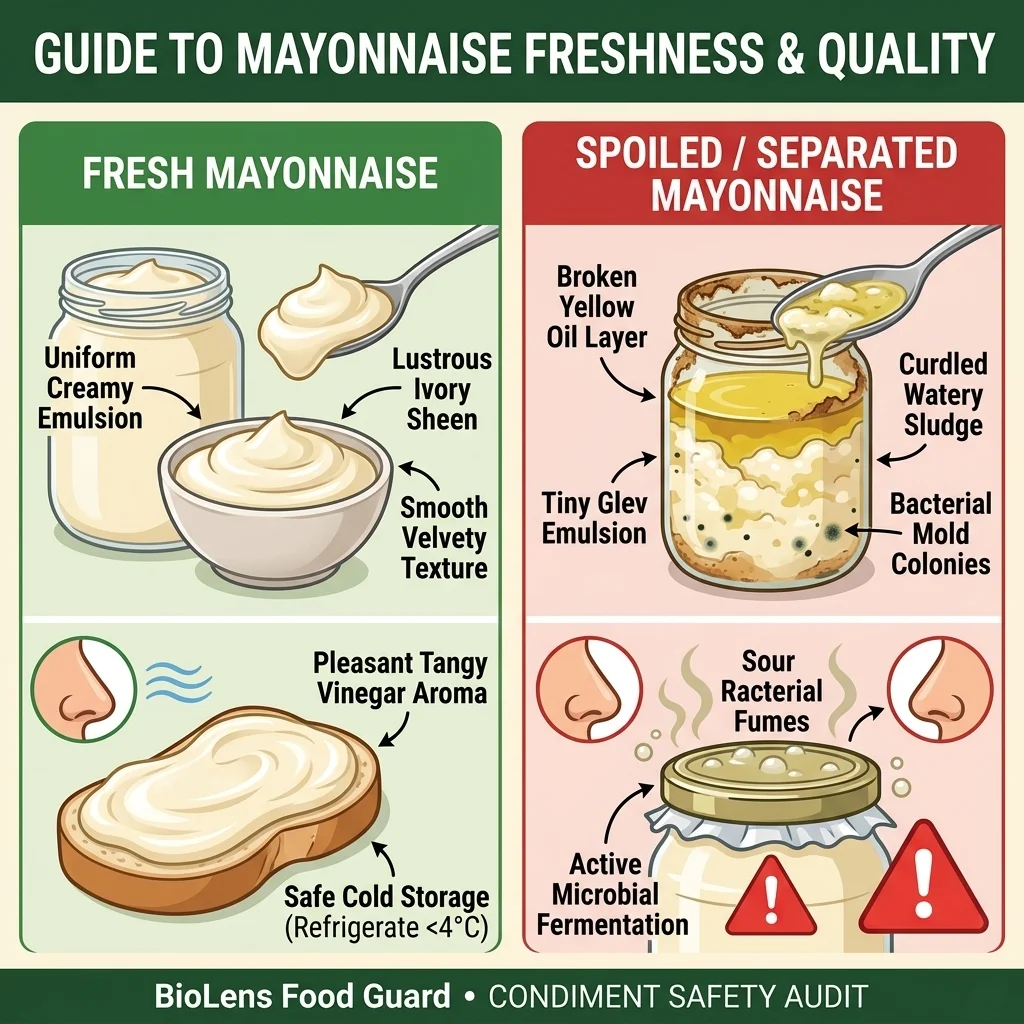
Mayonnaise Freshness, Emulsion Breakdown & Spoilage Matrix
Commercial mayonnaise is acidic enough (pH < 4.1 from vinegar and lemon juice) to prevent rapid microbial bacterial growth, but cross-contamination with bread crumbs, dirty knives, or warm ambient temperatures rapidly initiates bacterial spoilage and lipid oxidation. Here is how to evaluate freshness:
✅ Smooth Ivory Cream, Uniform Body, Crisp Tangy Scent = PRIME FRESHNESS
The emulsion is intact, velvety, glossy, and delivers a balanced tangy-savory aroma without oil pooling or drying.
⚠️ Slight Surface Yellowing, Minor Oil Weeping = MARGINAL (Stir & Check Smell)
Superficial moisture evaporation or slight physical separation. Stir thoroughly with a clean dry spoon; if smell and taste are fresh, consume within 5 days.
❌ Dark Yellow Oil Layer, Fermentation Gas Bubbles, Sour Odor = SPOILED (Discard)
Bacterial or yeast fermentation has compromised the emulsion, generating volatile organic acids and gas. Severe risk of foodborne poisoning.
❌ Mold Fuzz Around Jar Rim, Putrid Rotten-Egg Odor = TOXIC (Biohazard — Discard)
Microbial contamination by molds or spoilage bacteria. Ingestion can cause acute gastroenteritis. Never scrape off the mold layer—mycelium toxins penetrate the entire jar.
Quick Summary Table:
| Appearance & Texture | Scent & Palate Condition | Food Safety Action |
|---|---|---|
| Velvety ivory cream, glossy uniform emulsion | Clean tangy vinegar and savory egg aroma | ✅ Prime Quality — Keep refrigerated at 4°C |
| Minor oil sheen on top, easily stirred back in | Crisp balanced flavor, zero off-notes | ⚠️ Marginal — Safe; consume within 5 days |
| Instant dark blue/purple reaction with iodine | Watery mouthfeel, floury aftertaste | ❌ Reject (Starch-Bulked Low Quality Dressing) |
| Trapped gas bubbles, separated greasy oil crust | Pungent sour fermented odor or sulfur bite | ❌ Discard (Bacterial / Yeast Spoilage Hazard) |
| Visible grey/green mold specks around rim | Putrid rotten stench, curdled runny texture | ❌ Discard Immediately — High Food Poisoning Risk |
Quick Safety Tips
- Perform the 5-second iodine drop test: any blue or black color shift confirms illegal starch bulking
- Check the ingredient label: true mayonnaise must never list cornstarch, potato starch, or artificial gums
- Discard mayonnaise immediately if you notice trapped gas bubbles, an oily crust, or a sour sulfur stench
- Always refrigerate commercial mayonnaise promptly after opening (below 4°C / 40°F) to prevent bacterial growth
- Consume homemade mayonnaise prepared with raw unpasteurized eggs within 48 hours to avoid Salmonella risks
Primary Chemical Concerns
Health Risks & Impacts
Multilingual Local Names
Regulatory Corner: US FDA (21 CFR 169.140 Mayonnaise Standard) / Codex Alimentarius (CXS 168-1989) / FSSAI
Regulation: FDA Standard of Identity 21 CFR 169.140 & Codex Regional Standard for Mayonnaise
Legal Limit:Vegetable Oil Content: Min 65.0% (w/w); Egg Yolk Solids: Min 2.5% (w/w) or Min 6.0% whole egg; Added Starches/Gums: 0.0% in Standard Mayonnaise (products with starches must be labeled "Salad Dressing"); Salmonella: Absent in 25g
Report Adulteration to US FDA (21 CFR 169.140 Mayonnaise Standard) / Codex Alimentarius (CXS 168-1989) / FSSAI