Chicken Purity & Freshness Test: How to Detect Water Pumping, Chlorine Bleach, Fake Country Chicken & Spoilage
⚡ 60-Second Chicken Purity, Water-Pumping & Spoilage Verdict
Saltwater/Phosphate "Plumping", Chlorine Bleach Washes & Dyed "Country Chicken" Fraud: Commercial poultry cuts are frequently injected with 15%–30% saltwater, sodium tripolyphosphate (STPP), or carrageenan hydrocolloids to artificially inflate weight. In open wet markets, aging or spoiled chicken is washed in chlorine bleach or lime water to mask foul odors, while cheap spent-layer hens or broilers are rubbed with turmeric or synthetic yellow dyes to pass off as double-priced free-range "Country Chicken" (Desi Murga / Naatu Kozhi).
Sear a 100g chicken breast cube in a dry hot pan for 2 minutes. Pure chicken browns cleanly with <5% liquid loss. Water/STPP-pumped chicken floods the pan with milky salty foam and shrinks by 25%–30%.
Press the thickest part of the breast firmly. Fresh chilled chicken is pastel pink, non-sticky, and springs back in <1 second. If a pit remains, feels slimy, or smells of ammonia/chlorine, reject it.
Rub yellow "Country/Desi" chicken skin with a warm wet cotton ball—yellow stain proves turmeric/annatto dye fraud. Check breast fillets for thick white fat lines ("White Striping" myopathy).
Explore our companion protein, condiment, and marinade safety guides for Eggs, Salmon, Tuna, Shrimp & Prawns, Mayonnaise, Turmeric Powder, and Black Pepper.
Drop Chicken (Fresh & Cuts) photo here to test purity
or click to browse • Supports JPG, PNG, WEBP • Paste with Ctrl+V
Inspection Guide
Click to enlarge
4-Step Chicken Adulteration, Water-Pumping & Country-Chicken Authenticity Audit
Poultry is the world's most consumed meat protein, yet consumers face four pervasive supply-chain frauds: water/phosphate weight pumping, chemical bleach/formalin odor masking, rapid-growth broiler muscle defects, and turmeric-dyed fake free-range ('Country / Desi') chicken. Perform these 4 laboratory-backed home inspections in 60 seconds:
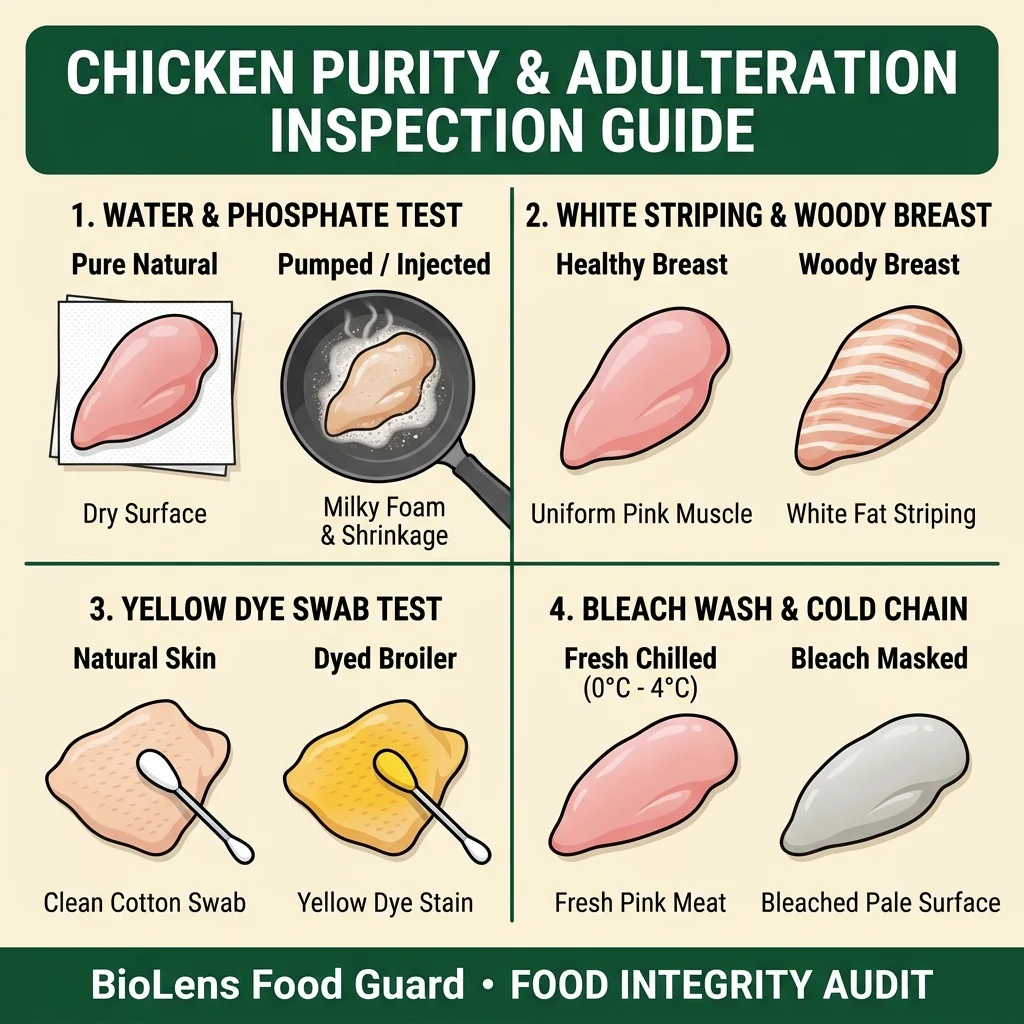
1. The Dry-Pan Sizzle & Tissue-Blot Test (Exposing Saltwater & STPP Phosphate 'Plumping'):
Unscrupulous processors and wet-market vendors inject chicken breasts and whole birds with saltwater brine and Sodium Tripolyphosphate (STPP), which raises muscle pH and forces protein fibers to trap up to 25% extra water.
- Paper Towel Blot: Press a dry white paper towel firmly against raw skinless chicken breast for 10 seconds. Genuine air-chilled or properly drained chicken leaves the towel nearly dry; water-pumped chicken immediately soaks through the towel.
- Dry-Pan Sizzle Test: Place a 100g cube of unmarinated chicken breast into a hot, dry non-stick skillet for 2 minutes.
- ✅ 100% Natural Chicken: Sizzles immediately, develops a golden-brown Maillard crust, and loses less than 5% moisture.
- ❌ Water/Phosphate-Pumped Chicken: Instead of searing, the meat boils in a pool of milky-white, salty foam, refuses to brown, shrinks by 25%–30% in volume, and turns unnatural and rubbery.
2. The Warm Cotton Swab & Bone-Anatomy Audit (Spotting Fake 'Country / Desi / Naatu' Chicken):
Authentic free-range country chicken (Desi Murga / Naatu Kozhi / Ayam Kampung / Pollo de Corral) commands 2× to 3× the price of industrial broiler meat. Fraudsters take cheap 6-week broilers or tough spent egg-laying hens and rub their skin with turmeric (Haldi), annatto, or yellow textile dye, sometimes scorching the skin over a gas flame to mimic traditional singeing.
- Cotton Swab Dye Test: Dip a white cotton ball in warm water mixed with 3 drops of lemon juice or cooking oil and rub the yellow chicken skin firmly for 15 seconds. Genuine xanthophyll pigment from corn/forage diet stays locked inside the subcutaneous fat; fraudulent turmeric or synthetic yellow dye immediately stains the cotton bright yellow-orange.
- Anatomical Check: Genuine free-range country chicken has darker pinkish-red, lean, firm breast meat, a thinner breastbone keel, and longer, denser leg bones with yellow marrow—whereas a dyed broiler has pale, plump, soft watery breast meat and brittle, porous leg bones with dark red/blackish marrow due to rapid 40-day cage growth.
3. Visual Muscle-Fiber Striation Audit ('White Striping' & 'Woody Breast' Myopathy Check):
Inspect raw skinless chicken breast fillets under bright kitchen light before purchasing.
- ✅ Healthy Muscle Tissue: Smooth, uniform pastel-pink muscle bundles with minimal fat only along the outer edges.
- ⚠️ 'White Striping' & 'Woody Breast' (Rapid-Growth Broiler Defect): Thick, parallel white striations of fat and scar tissue (collagen) running across the pink breast fillet like marble veins, accompanied by a hard, pale, bulging center that feels rigid like wood when squeezed. While not infectious, research shows White Striping increases fat content by +224%, reduces digestible protein, and results in tough, dry, chewy meat that cannot absorb marinades.
4. Chlorine Wash, Formalin & Proper Blood-Drainage Audit (Detecting Washed Spoiled or Dead-on-Arrival Birds):
When chilled poultry exceeds its shelf life and develops bacterial slime (Pseudomonas), dishonest sellers wash it in chlorine bleach, vinegar, or potassium permanganate to strip away the foul smell, or sell birds that died before slaughter (Tiren).
- Smell & Cuticle Check: Hold the raw chicken close and sniff the bone joint or cavity. Fresh chicken has a very mild, clean neutral scent. A swimming-pool chlorine odor, sharp chemical tang, or unnatural chalky-white bleached surface proves chemical washing of spoiled meat.
- Blood-Drainage & Neck Cut Check: Properly slaughtered healthy chicken bleeds out completely, leaving pale pink flesh. If the carcass looks dark bluish-red, has clotted dark blood inside the wing veins, or has a bruised/uncut neck vessel, the bird died of disease or heat stress prior to slaughter and must be rejected immediately.
Click to enlarge
Chicken Freshness, Cold-Chain Integrity & Bacterial Spoilage Matrix
Raw chicken has high water activity (aw > 0.98) and neutral-to-slightly-acidic pH (5.8–6.2), making it highly perishable. If stored above 4°C (40°F), psychrotrophic spoilage bacteria (Pseudomonas, Shewanella) and pathogens (Salmonella, Campylobacter) multiply rapidly, breaking down amino acids into foul-smelling putrescine, cadaverine, ammonia, and hydrogen sulfide. Evaluate every bird or cut using this matrix:
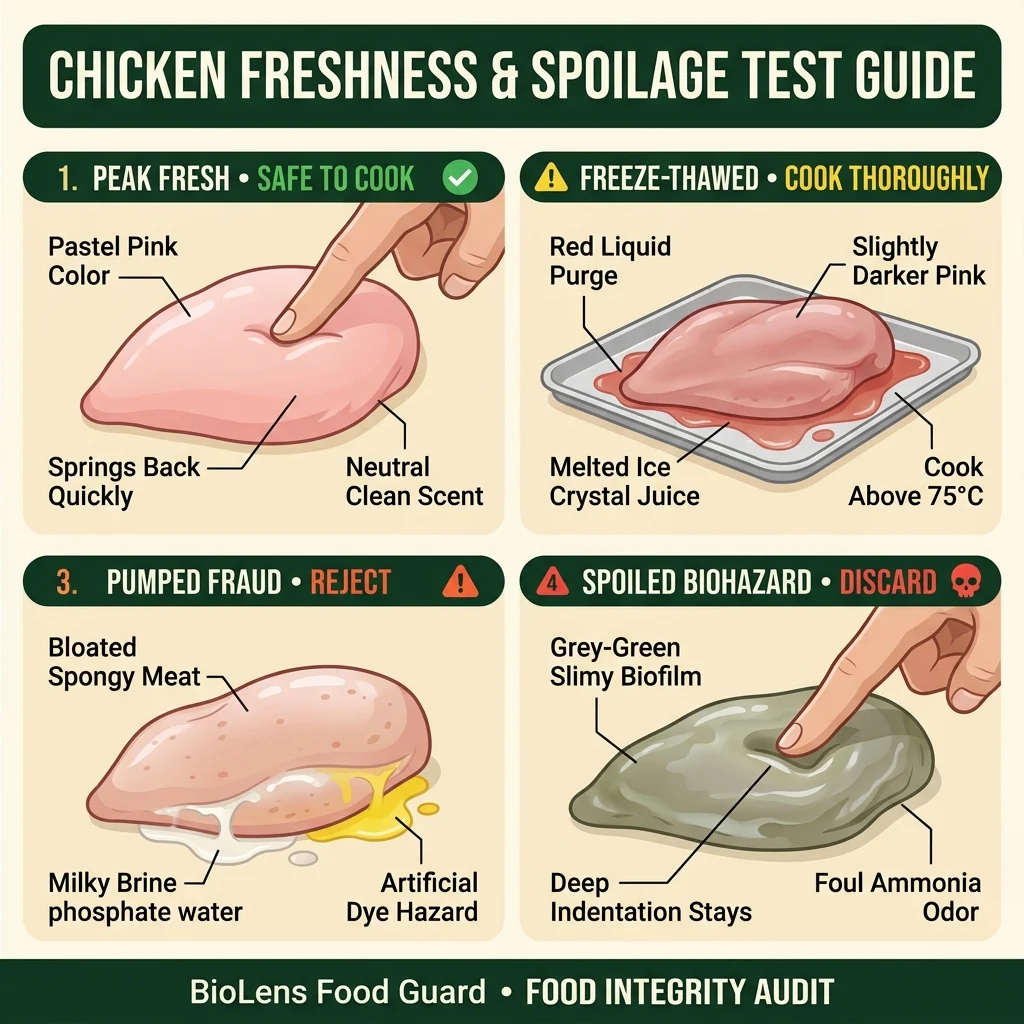
✅ Pastel Pink Hue, Firm Elastic Bounce (<1s), Moist Non-Sticky Surface & Neutral Scent = Peak Freshness
Pressing the breast with your fingertip leaves zero permanent indentation; the meat springs back immediately, and any liquid in the tray is minimal and clear.
⚠️ Darker Reddish-Pink Flesh with Thin Red Purge Liquid in Tray, Firm & Odorless = Thawed from Frozen (Safe if Cooked Thoroughly)
Freezing ruptures muscle cells via ice crystals, releasing red myoglobin protein water ('drip loss') upon thawing. It is safe to eat if cooked immediately to 75°C, but must never be refrozen raw.
❌ Swollen Glossy Pale Fillet, Releases Milky Foam in Pan & Shrinks 25%+ = Water / STPP Phosphate Pumped
Economic adulteration and excess sodium/phosphate load.
❌ Greyish-Green Cast, Tacky/Slimy Biofilm, Finger Pit Stays Indented & Ammonia / Rotten-Egg Smell = Spoiled Biohazard (Discard Immediately!)
Cooking kills live bacteria but cannot destroy heat-stable bacterial endotoxins and biogenic amines already formed in spoiled poultry.
Quick Summary Table:
| Flesh Color & Surface Texture | Finger Bounce, Drip Liquid & Odor | Food Safety Action |
|---|---|---|
| Clean pastel-pink flesh; cream/white fat; moist but never sticky | Springs back instantly (<1 sec); clear minimal purge; neutral scent | ✅ Peak Fresh Grade-A — Safe for all recipes (cook to ≥75°C) |
| Slightly darker pink; excessive thin red liquid (myoglobin) in tray | Slightly softer bounce; zero sour or ammonia odor | ⚠️ Freeze-Thawed Chicken — Safe if cooked immediately; do NOT refreeze raw |
| Pale breast crossed by thick parallel white lines & rigid hard center | Hard woody texture that does not compress normally; neutral odor | ⚠️ White Striping / Woody Breast — Safe but low quality & high fat |
| Swollen, overly glossy wet fillet OR yellow skin staining wet cotton | Oozes milky salty foam in hot pan OR turmeric dye rubs off skin | ❌ Reject — Water/Phosphate 'Plumping' or Fake Country-Chicken Dye Fraud |
| Dull grey, greenish, or yellowish-grey hue; sticky/slimy coating | Finger press leaves permanent pit; sharp ammonia, sulfur, or chlorine smell | ❌ Discard Immediately — Severe Salmonella / Campylobacter Spoilage Hazard |
Quick Safety Tips
- NEVER wash raw chicken under a running kitchen tap — water splashes Campylobacter and Salmonella bacteria up to 80 cm across sinks, dishes, and countertops
- Always check packaged chicken labels for 'Retained Water' or 'Contains up to 15% Broth/Phosphate Solution' to avoid paying meat prices for saltwater
- Test suspicious yellow-skinned 'Country/Desi' chicken with a warm damp tissue before buying to expose turmeric or synthetic dye rubbing off
- Use a dedicated colour-coded cutting board and knife for raw poultry, and sanitize surfaces immediately with hot soapy water
- Cook all chicken cuts to a minimum internal core temperature of 74°C–75°C (165°F) where juices run completely clear with zero pinkness near the bone
Primary Chemical Concerns
Health Risks & Impacts
Multilingual Local Names
Common Storage Pests
Blowflies / Bluebottle Flies (Calliphoridae) & Psychrotrophic Spoilage Bacteria (Pseudomonas / Campylobacter)
high riskIn unrefrigerated open butcher markets, blowflies deposit microscopic egg clusters (maggots) inside moist chicken cavities within minutes, while Pseudomonas and Campylobacter form slimy biofilms on warm cuts.
Detection
- Clusters of tiny 1 mm yellowish-white rice-like fly eggs in skin folds or bone joints
- Sticky, glistening grey-green slime and pungent ammonia or sulfur odor on the meat surface
Prevention
- Never buy poultry from open-air stalls where meat hangs unrefrigerated without fly screens or chillers
- Store raw chicken at 0°C–4°C on the lowest refrigerator shelf inside a sealed container and cook within 24–48 hours
Corrective Action: What to do?
Discard any fly-blown, slimy, or foul-smelling chicken in a sealed outdoor bin immediately and disinfect all contacted surfaces with hot soapy water and bleach.
Regulatory Corner: FSSAI (India) / USDA FSIS (9 CFR § 381.66 &Retained Water Rule) / EFSA & EU Reg. 543/2008 / Codex Alimentarius (CAC/GL 78-2011)
Regulation: Food Safety and Standards (Food Products Standards and Food Additives) Regulations, 2011 (Section 2.5: Meat and Meat Products) & USDA Retained Water in Raw Meat and Poultry
Legal Limit:Undeclared Added Water / Phosphates in Fresh Chilled Chicken: 0.0% (EU physiological water-to-protein ratio max 3.40 for skinless breast; USDA requires prominent '% Retained Solution' label); Colistin & Nitrofuran Antibiotics: 0.0 ppb (Banned in poultry); Formalin & Artificial Surface Dyes: 0.0% (Zero Tolerance); Salmonella in 25g ready-to-cook poultry: Absent
Report Adulteration to FSSAI (India) / USDA FSIS (9 CFR § 381.66 &Retained Water Rule) / EFSA & EU Reg. 543/2008 / Codex Alimentarius (CAC/GL 78-2011)