How to Test Fennel Seeds for Adulteration (Malachite Green, Pesticide, Grit/Stone Dust)
⚡ Quick 60-Second Fennel Seeds (Saunf) Purity Verdict
Malachite Green & Mineral Oil Alert: Stale, exhausted, or spent fennel seeds are artificially dyed with toxic Malachite Green dye and polished with mineral oil to impart an unnatural bright parrot-green color.
Moisten a white cotton ball with water or alcohol and rub a sample of fennel seeds. Pure saunf leaves zero green color. Dyed saunf instantly stains the cotton bright green.
Drop 1 tsp fennel seeds in a glass of warm water. Pure saunf floats and turns the water pale yellowish-green very slowly. Chemical dye bleeds a dark emerald green tint in seconds.
Pure natural saunf has a subtle greenish-brown, earthy matte color and a sweet licorice/anise aroma. Avoid fluorescent, artificially vibrant green seeds with chemical odor.
Drop Fennel Seeds (Saunf) photo here to test purity
or click to browse • Supports JPG, PNG, WEBP • Paste with Ctrl+V
Inspection Guide
Click to enlarge
Fennel Seeds (Saunf) Purity & Dye Audit
Fennel seeds are high-risk spices often treated with Malachite Green to look vibrant and "new" or coated with saccharin to mask the bitterness of old, low-quality seeds.
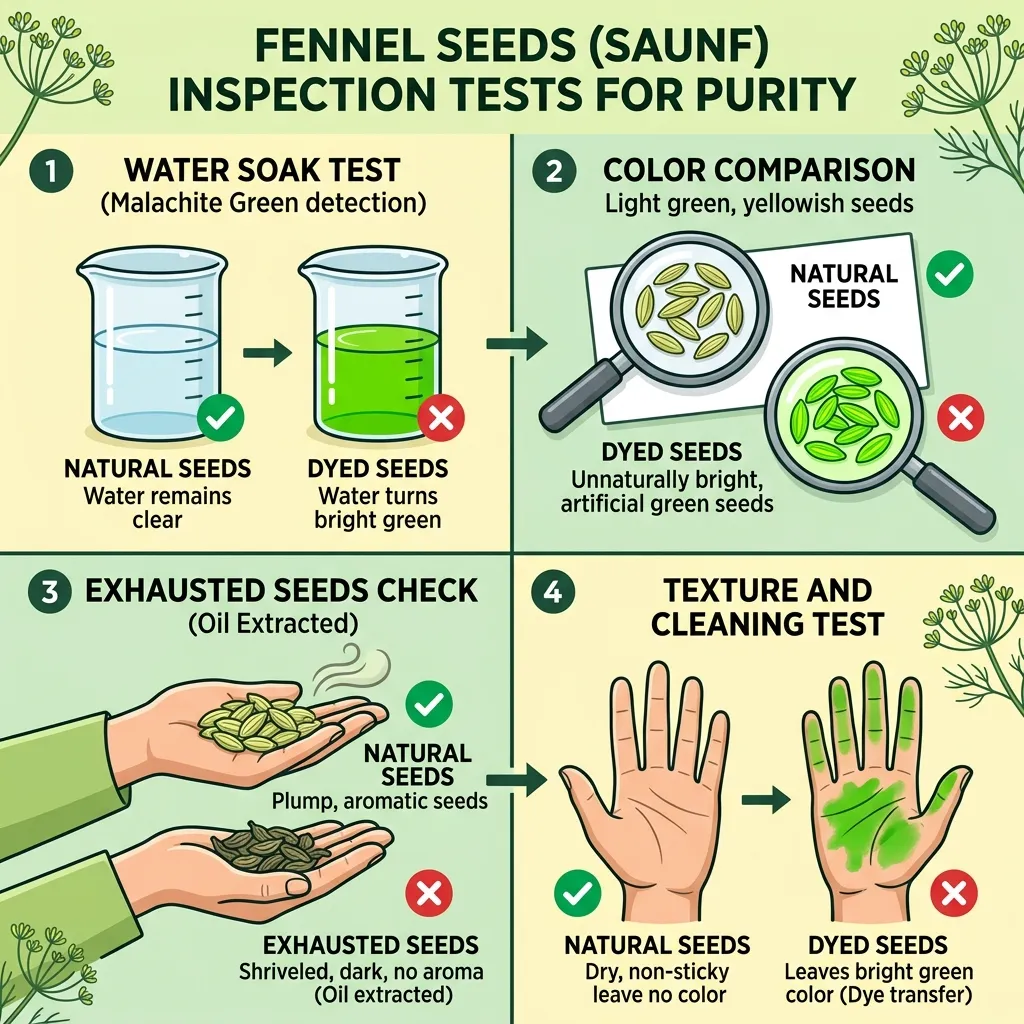
1. The Cotton Rub Test:
Rub a handful of fennel seeds on a wet cotton ball. If the cotton turns green or bluish-green, artificial dye like Malachite Green has been applied. Natural fennel color is subtle and does not rub off easily.
2. The Water Wash (Color Bleed):
Soak a spoonful of fennel seeds in warm water for 10 minutes. If the water turns bright green immediately, suspect artificial coloring. Natural fennel color leaches very slowly and turns the water a faint, pale yellow-green.
3. The Taste Profile (Sweetener Check):
Pure, high-quality fennel has a natural, mild sweetness and a strong licorice-like aroma. If you experience an intense, "cloying," or metallic sweetness that lingers on your tongue, it likely contains added Saccharin.
4. The Grit and Dust Check:
Spread a spoonful of fennel seeds on a white plate. Look for small, green-tinted stones or greyish grit. Some retailers add matching stone dust to increase the weight of the batch.
Quick Safety Tips
- Perform the cotton rub test for Malachite Green detection
- Avoid fennel seeds with an unnaturally cloying or metallic sweetness
- Choose seeds that are plump and have a strong licorice-like aroma
- Select "Unpolished" fennel seeds to avoid artificial coatings
Primary Chemical Concerns
Health Risks & Impacts
Multilingual Local Names
Common Storage Pests
Cigarette Beetle
medium riskA common pest that can infest stored spices, including fennel seeds.
Detection
- Small holes in the seeds
- Fine dust at the bottom of the container
Prevention
- Store in an airtight glass jar
- Keep in a cool, dry place
Corrective Action: What to do?
Discard infested samples; clean the storage area thoroughly.
Regulatory Corner: FSSAI (Food Safety and Standards Authority of India) / Spices Board
Regulation: Food Safety and Standards (Food Products Standards) Regulations 2011, Clause 2.9.11: Fennel (Saunf) Whole and Powder
Legal Limit:Extraneous matter: Max 1.0% by weight; Non-permitted artificial colors (Malachite Green): 0.0%; Volatile oil: Min 1.0% v/w
Report Adulteration to FSSAI (Food Safety and Standards Authority of India) / Spices Board