How to Test Okra for Adulteration (Malachite Green, Pesticide, Heavy Metals)
⚡ Quick 60-Second Okra Dye & Chemical Greening Verdict
Malachite Green Chemical Dipping & High Pesticides: Stale, dull okra pods are dipped in buckets of water mixed with toxic Malachite Green or copper sulfate to simulate fresh harvest shine.
Moisten a white cotton ball in clean water and rub firmly along the ridges and fuzzy skin of the okra pod. If the cotton turns light emerald green, chemical dye dipping is confirmed.
Bend the pointed tip (tail) of the okra. In fresh, tender okra, the tip snaps off crisply with an audible pop. In old, fibrous, chemically treated okra, the tip bends like rubber without snapping.
Rinse a batch of okra in a bowl of warm water. Pure okra leaves the water clear. Dyed okra releases greenish streaks into the wash water within minutes.
To learn more about food safety tests and home adulteration detection, read our guides on Nopales (Cactus Pads) and Brinjal (Eggplant).
Drop Okra (Ladyfinger) photo here to test purity
or click to browse • Supports JPG, PNG, WEBP • Paste with Ctrl+V
Inspection Guide
Click to enlarge
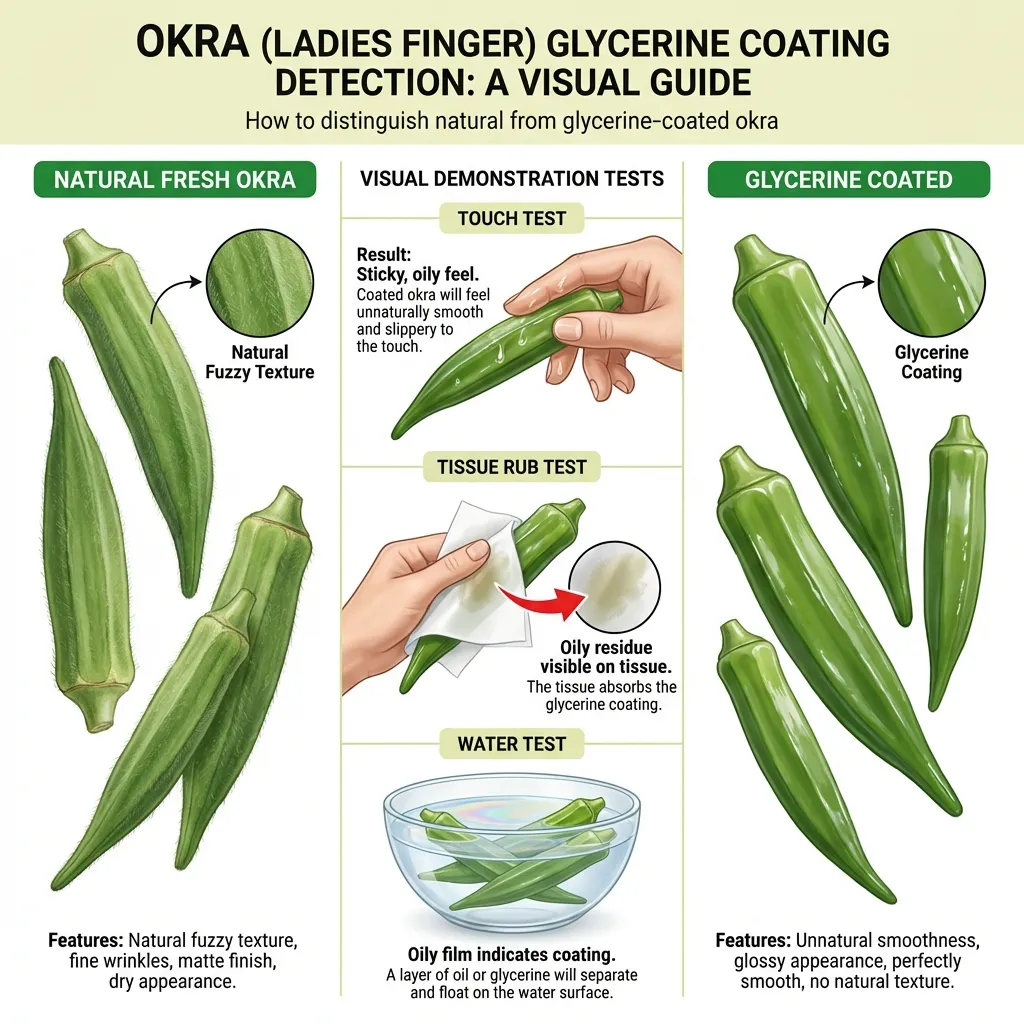
Okra (Ladyfinger) Purity & Dye Audit
Okra (Bhindi) is a high-risk vegetable frequently dyed with Malachite Green to look fresh and vibrant, even when the pods are old and wilting.
1. The Cotton Rub Test:
Rub a wet cotton ball on the green skin of the okra. If the cotton picks up a green or bluish-green tint, artificial dye like Malachite Green has been applied. Natural okra color does not transfer easily.
2. The Snap Test:
Try to snap the tip of the ladyfinger. A naturally fresh one will snap cleanly with a distinct sound. If it bends or feels "leathery" while being a vibrant green, it has likely been dyed and is actually old stock.
3. The Water Wash:
Soak okra in warm water for 15 minutes. If the water turns green, artificial coloring is confirmed. Natural chlorophyll remains inside the cells and won't leach into water.
4. The Stickiness and Seed Check:
Cut a ladyfinger. The internal seeds should be small and tender. If the interior looks "dried out" or the characteristic "slime" (mucilage) is absent or looks brownish despite a bright green exterior, suspect chemical "refreshing" agents.
Quick Safety Tips
- Perform the cotton rub test for Malachite Green detection
- Avoid okra that looks "neon" green or unnaturally glossy
- Select ladyfingers that snap cleanly at the tips
- Soak in salt water for 20 minutes to reduce surface pesticide load
Primary Chemical Concerns
Health Risks & Impacts
Multilingual Local Names
Common Storage Pests
Okra Fruit Borer
medium riskSmall caterpillars that bore into the pods and eat the seeds.
Detection
- Small entry holes on the pod
- Internal browning and larvae
Prevention
- Inspect for skin damage
- Store in a cool, ventilated place
Corrective Action: What to do?
Discard infested pods as they rot quickly and the larvae leave behind toxins.
Ash Weevil (Myllocerus subfasciatus)
medium riskSmall grey snout beetles that chew scalloped leaf margins and shelter under the green fruit calyx caps in harvest crates.
Detection
- Adult ash-grey weevils hiding beneath the green calyx cap
- Small feeding wounds and surface rot on the fruit shoulder
Prevention
- Inspect and wipe calyx caps before storing in mesh crates
- Store produce in cool, well-ventilated areas (10°C to 12°C)
Corrective Action: What to do?
Remove and discard calyx; trim any surface feeding marks before cooking.
Regulatory Corner: FSSAI (Food Safety and Standards Authority of India) / Codex MRLs
Regulation: Food Safety and Standards (Food Products Standards) Regulations 2011, Clause 2.3.6: Okra (Bhindi)
Legal Limit:Synthetic chemical dye dipping (Malachite Green, Copper Sulfate): 0.0% (Strictly Prohibited); Imidacloprid pesticide: Max 0.2 ppm; Monocrotophos: 0.0 ppm
Report Adulteration to FSSAI (Food Safety and Standards Authority of India) / Codex MRLs