Guia de Pureza da Canela: Detectar Casca de Cássia e Amido
Detectar adulteração de casca de cássia em canela
Para saber mais sobre testes de segurança alimentar e detecção de adulteração doméstica, leia nossos guias sobre Gengibre e Sementes de Coentro (Dhania).
Drop Canela (Dalchini) photo here to test purity
or click to browse • Supports JPG, PNG, WEBP • Paste with Ctrl+V
Inspection Guide
Click to enlarge
Detecção de canela vs. cássia
A canela verdadeira (Ceilão) é frequentemente substituída pela casca de cássia, que contém altos níveis de cumarina – um composto que pode ser tóxico para o fígado em grandes quantidades.
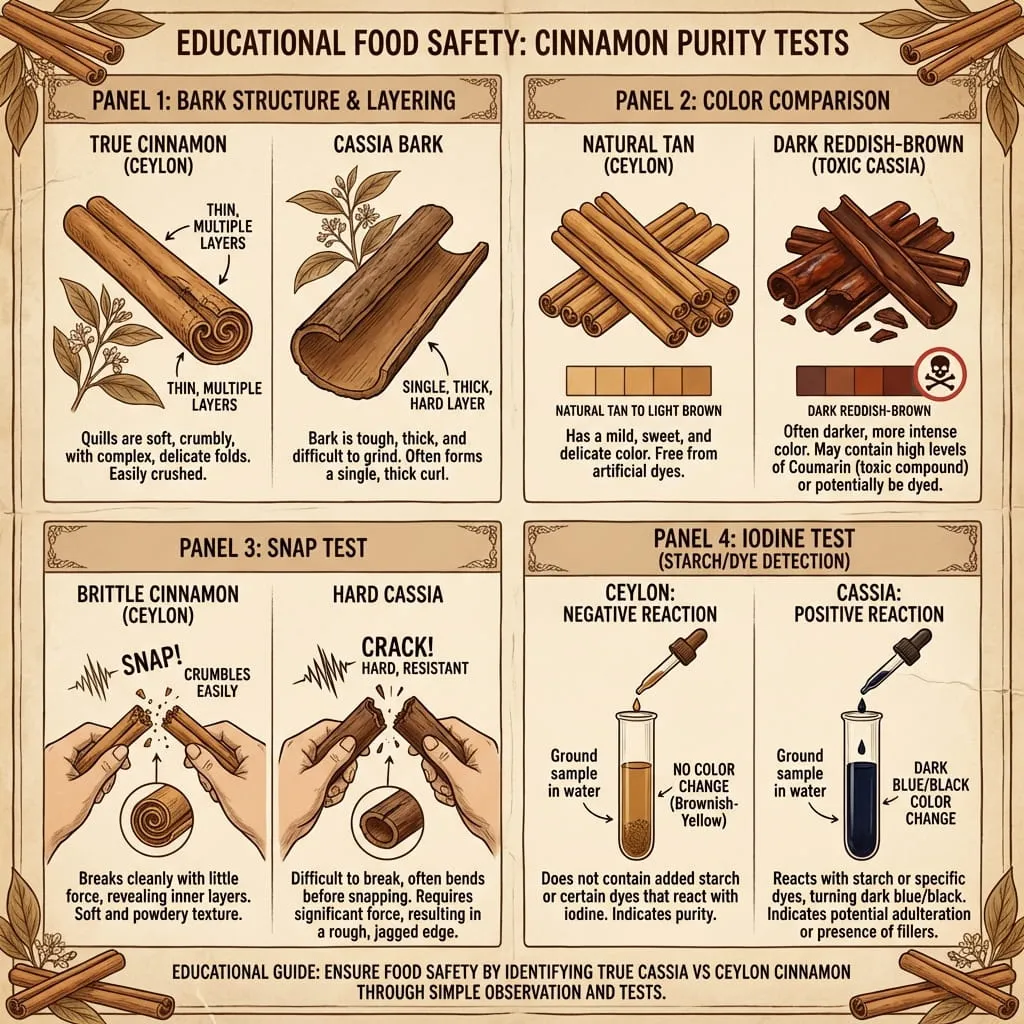
1. O teste de camada e textura (visual):
- Canela Verdadeira (Ceilão): Possui múltiplas camadas finas, semelhantes a papel, enroladas em uma pena. É quebradiço e pode ser facilmente esmagado com os dedos.
- Casca de Cássia: É espessa, dura e geralmente forma uma única camada espessa ou algumas camadas grossas. É muito difícil quebrar.
2. O teste de forma:
Observe as pontas dos palitos. A canela do Ceilão parece um charuto com muitas camadas finas dentro. A casca da cássia geralmente se enrola para dentro em ambos os lados, como um pergaminho, ou forma um único e grosso formato de “U”.
3. O teste de cores:
A canela do Ceilão tem uma cor castanho claro a castanho médio. A casca da cássia é geralmente de cor marrom-avermelhada mais escura. Se a cor parecer muito vibrante ou uniforme, pode ser tingida com cromato de chumbo.
4. O teste de iodo (detecção de amido):
Misture um pouco de canela em pó na água e adicione uma gota de iodo. Se a solução ficar preta azulada, isso indica a presença de amido ou de certos enchimentos. A canela pura tem uma reação mínima.
5. O Aroma e Sabor:
A verdadeira canela é doce e de sabor delicado. Cássia tem sabor muito mais forte, picante e “quente” com textura mais grossa.
6. Preocupações esgotadas com especiarias:
A extracção e substituição de óleos essenciais são riscos partilhados entre as especiarias. Consulte nosso guia de teste para Cardamomo.
Quick Safety Tips
- A verdadeira canela do Ceilão tem muitas camadas finas, como um charuto
- Evite casca grossa e dura (Cássia) para consumo regular
- A cor bronzeada clara é um sinal de canela do Ceilão
- As penas de canela devem ser quebradiças e fáceis de quebrar
Primary Chemical Concerns
Health Risks & Impacts
Multilingual Local Names
Common Storage Pests
Drugstore Beetles
low riskSmall brown beetles that bore tiny holes into spice barks.
Detection
- Tiny circular holes in the bark
- Fine powdery residue (frass) at the bottom of the container
Prevention
- Store in airtight glass jars
- Keep in a cool, dark place
Corrective Action: What to do?
Discard if infestation is heavy; light surface holes can sometimes be washed off if the interior is intact.
Regulatory Corner: FSSAI (Food Safety and Standards Authority of India) / European Commission / US FDA
Regulation: Food Safety and Standards (Food Products Standards) Regulations 2011, Clause 2.9.6: Cinnamon & EC Regulation No 1334/2008 & FDA 21 CFR 182.10
Legal Limit:Volatile oil: Min 1.0% (v/w); Coumarin limit in True Ceylon Cinnamon (Cinnamomum verum): Max 10 ppm; Cassia (Cinnamomum cassia containing up to 10,000 ppm coumarin) substitution: Prohibited unless distinctly labeled as Cassia
Report Adulteration to FSSAI (Food Safety and Standards Authority of India) / European Commission / US FDA