Tuna Safety Guide: Detect Carbon Monoxide Gassing, Escolar Fraud & Histamine Poisoning
⚡ Quick 60-Second Tuna Purity & Safety Verdict
Carbon Monoxide (CO) Red Gassing & Toxic Escolar Alert: Stale decomposing tuna loins are treated with carbon monoxide (CO) gas to permanently fix a neon-pink 'watermelon' color, while toxic, indigestible Escolar (oilfish) is widely substituted as 'White Tuna' causing acute digestive distress.
Leave a small fresh cut on a plate in the refrigerator exposed to air for 3 hours. Genuine untreated tuna contains natural myoglobin that oxidizes into dull brownish-red upon oxygen contact. CO-gassed chemically treated tuna stubbornly remains bright neon-pink for days.
Rub a cooked or raw flake between your fingertips. Real tuna (albacore/ahi) breaks cleanly along natural muscle striations with a lean, firm texture. Toxic Escolar feels slick, oily, excessively slippery, and leaves heavy wax-ester oil on your hands.
Smell and lightly touch the fish. Fresh tuna smells of clean marine ocean breeze. A sharp, stinging peppery prickle on the tongue or a faint pungent ammonia scent signals dangerous bacterial histamine accumulation (scombroid poisoning).
To explore complementary marine protein guides and healthy fat inspections, read our verified investigations on Wild vs Farmed Salmon, Shrimp & Prawns, Extra Virgin Olive Oil, Egg Freshness, and Fresh Avocado.
Drop Canned & Fresh Tuna photo here to test purity
or click to browse • Supports JPG, PNG, WEBP • Paste with Ctrl+V
Inspection Guide
Click to enlarge
Tuna Authenticity, CO Gassing & Histamine Safety Audit
Tuna (Thunnus) is the heavyweight champion of commercial pelagic seafood, powering both high-end sushi bars and staple canned pantries. However, because fresh tuna flesh naturally browns within days of harvesting due to myoglobin oxidation, industrial fleets treat low-grade, aging fish with carbon monoxide (CO) gas. This chemical treatment binds to the heme iron, locking in an artificial bright pink color that conceals bacterial decomposition.
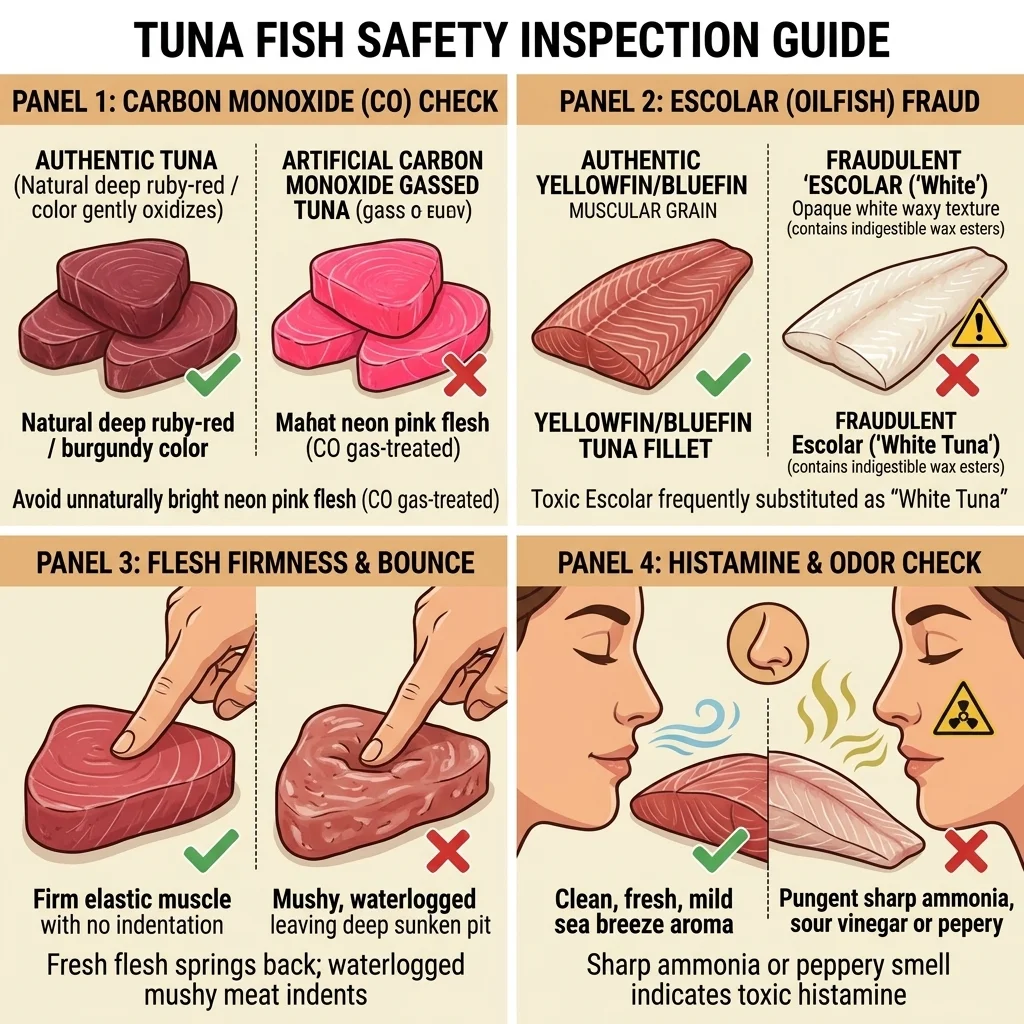
1. The 3-Hour Oxygen Exposure Browning Test:
Natural fresh tuna loins contain high concentrations of muscle myoglobin.
✅ Untreated Natural Tuna: When cut and placed in a refrigerator exposed to ambient air, the surface reacts with atmospheric oxygen and oxidizes from deep ruby red to dull reddish-brown within 2 to 4 hours. This natural oxidation proves the enzymatic pathways are intact.
❌ Carbon Monoxide Gassed Tuna: The carbon monoxide forms an extraordinarily stable carboxy-myoglobin complex. The flesh stubbornly remains an unnatural, translucent, fluorescent neon-pink (like watermelon candy) and will not brown even after 48 hours of air exposure.
2. The Muscle Flake & Escolar (Oilfish) Substitution Check:
In sushi restaurants and retail fish counters, over 80% of fish labeled as "White Tuna" or "Super White Tuna" is actually Escolar (Lepidocybium flavobrunneum).
✅ Authentic White Tuna (Albacore): Flesh is pale beige-pink, lean, firm, and separates along well-defined natural muscle lamellae (flakes) with zero slimy residue.
❌ Toxic Escolar Substitution: The meat is chalky porcelain-white with a greasy, buttery, extraordinarily slick texture. It contains over 20% gempylotoxin (indigestible wax esters) that the human digestive tract cannot break down, causing severe keriorrhea (explosive orange oily diarrhea).
3. The Tongue Peppery Tingling & Ammonia Sniff:
Scombroid fish like tuna contain high levels of the natural amino acid histidine. If the cold chain is broken even briefly, bacteria (Morganella morganii) convert histidine into toxic histamine.
✅ Safe Fresh Tuna: Smells like fresh salty sea air or clean ocean spray with a mild, rich, savory finish.
❌ Histamine Toxicity (Scombrotoxin): Emits a faint pungent ammonia or sour vinegar smell. Upon tasting, it produces an unmistakable sharp, peppery, burning, or tingling sensation on the tongue and lips. Cooking, frying, or canning will NOT destroy histamine once formed.
4. Canned Tuna Can Integrity & Metal Seam Check:
Examine the metal can before opening.
✅ Prime Can: Cylinder is smooth, lid is flat or slightly concave under vacuum, interior white enamel liner is pristine.
❌ Compromised Can: Bulging ends (botulinum gas), deep dents on rim seams, or blackened sulfur staining on the metal interior.
Click to enlarge
Tuna Freshness, Decomposition & Scombroid Safety Matrix
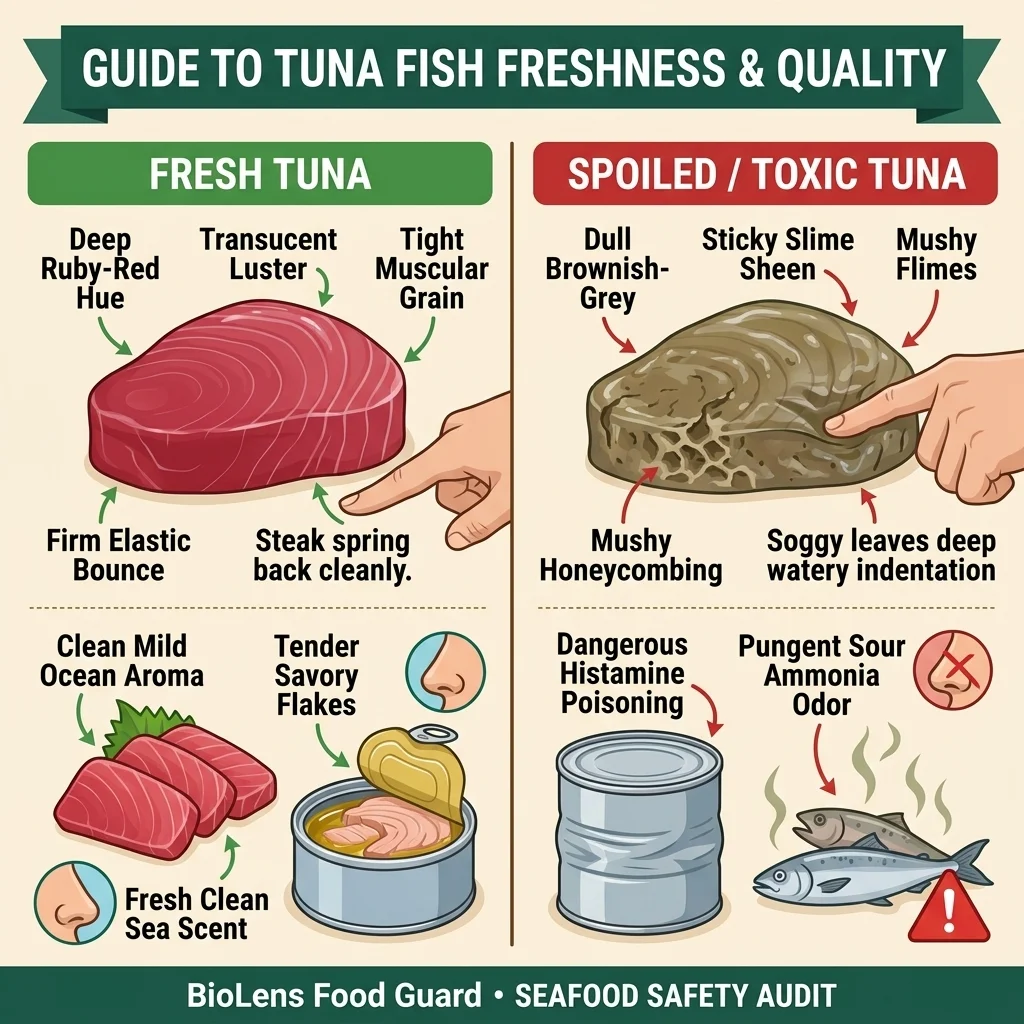
Tuna is a high-risk scombroid species that requires strict unbroken refrigeration at 0°C to 4°C from harvest to plate. Here is how to evaluate fresh loins and canned tuna:
✅ Translucent Ruby-Red, Firm Elastic Meat, Fresh Ocean Scent = PRIME (Sashimi Grade)
The flesh is dense, elastic, moist without weeping, and smells of fresh ocean brine. Safe for raw sushi consumption when properly deep-frozen for parasite control.
⚠️ Dull Red-Brown, Firm Texture, Neutral Aroma = GOOD / COOKED GRADE
Natural myoglobin oxidation has taken place. Completely safe and delicious when seared, grilled, or baked through to 63°C (145°F).
❌ Fluorescent Watermelon Pink, Watery Weeping, Zero Browning = CO GASSED (Cook Thoroughly)
Artificially colored with carbon monoxide smoke. Assess texture and scent strictly; if mushy or dull, discard.
❌ Pungent Ammonia Smell, Peppery Tongue Bite, Iridescent Slime = HISTAMINE TOXIN (Biohazard)
Advanced bacterial decomposition. Histamine levels exceed safety thresholds. Cooking does NOT neutralize scombrotoxin. Discard immediately.
Quick Summary Table:
| Appearance & Muscle Texture | Aroma & Palate Sensation | Food Safety Action |
|---|---|---|
| Translucent deep ruby-red, firm elastic recoil | Fresh sea breeze, mild marine sweetness | ✅ Prime Quality — Excellent for sashimi / searing |
| Natural brownish-red gradient, firm lean flakes | Clean neutral fish scent, savory finish | ✅ Safe (Natural Oxidation) — Cook thoroughly |
| Neon watermelon-pink, refuses to brown in air | Bland or faint chemical odor | ⚠️ CO-Treated — Verify firmness & smell strictly |
| Chalky porcelain-white, extremely oily/slick | Overly buttery, greasy residue on fingers | ❌ Discard (Toxic Escolar / Wax-Ester Fraud) |
| Soft mushy flesh, rainbow sheen, ammonia scent | Sharp peppery sting / burning on tongue | ❌ Discard Immediately — Severe Histamine Poisoning |
Quick Safety Tips
- Avoid fresh or frozen tuna with a uniform, fluorescent neon-pink color that refuses to brown in air (CO gas sign)
- Beware of "Super White Tuna" in sushi bars — ask for species verification to avoid toxic Escolar oilfish
- Immediately spit out any tuna that causes a sharp, peppery, tingling sensation on your tongue (histamine danger)
- Never consume canned tuna from swollen, dented, or leaking cans that lack vacuum seals
- Pregnant women and young children should choose light skipjack tuna over albacore/bigeye to minimize mercury intake
Primary Chemical Concerns
Health Risks & Impacts
Multilingual Local Names
Regulatory Corner: US FDA (CPG Sec. 540.525) / European Commission (Reg. EC No 2073/2005) / Codex Alimentarius (CXS 70-1981)
Regulation: FDA Fish and Fishery Products Hazards and Controls Guidance & Regulation (EC) No 1333/2008
Legal Limit:Histamine: Max 50 ppm (FDA Defect Action Level) / Max 100-200 mg/kg (EU Legal Limit); Carbon Monoxide (CO Gas): Strictly Prohibited in the European Union (0.0 ppm); Methylmercury: Max 1.0 ppm; Escolar Labeling: Mandatory advisory warnings in US/EU
Report Adulteration to US FDA (CPG Sec. 540.525) / European Commission (Reg. EC No 2073/2005) / Codex Alimentarius (CXS 70-1981)