How to Test Drumstick for Adulteration (Malachite Green, Pesticide, Heavy Metals)
⚡ Quick 60-Second Drumstick (Moringa Pod) Purity & Dye Verdict
Malachite Green / Copper Sulfate Baths & Oxytocin Abuse: Moringa pods are frequently soaked in green dye solutions to make yellowing pods appear crisp and tender, and forced with synthetic growth stimulators.
Moisten a piece of white cotton with liquid paraffin or vegetable oil and rub vigorously along the grooved valleys of the drumstick. Green dye transferring onto the cotton proves artificial Malachite Green coloring.
Snap the drumstick by hand. A fresh, young drumstick breaks cleanly with an audible snap, revealing tender juicy pulp and soft, translucent edible seeds. Woody, hollow pods that bend without breaking are aged.
Boil a 2-inch slice in a small cup of water for 3 minutes. Natural drumstick leaves water clear with a slight herbal tint. Artificial chemical dyes cause the boiling water to turn vivid neon-green.
To learn more about food safety tests and home adulteration detection, read our guides on Carrots and Turnip (Shalgam).
Drop Drumstick (Moringa Pod) photo here to test purity
or click to browse • Supports JPG, PNG, WEBP • Paste with Ctrl+V
Inspection Guide
Click to enlarge
Drumstick (Moringa) Purity & Dye Audit
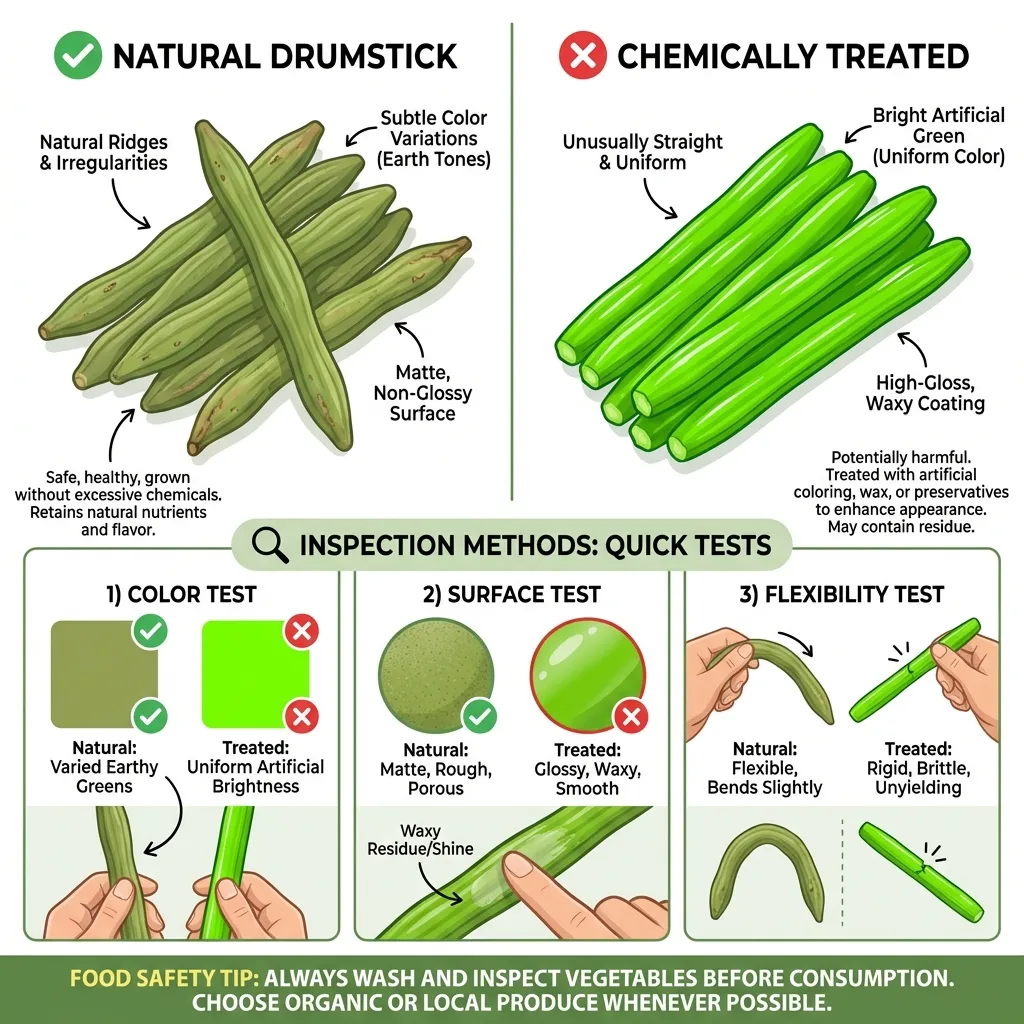
Drumsticks are often treated with Malachite Green to maintain an unnaturally vibrant green color, masking the fading appearance of old or dry pods.
1. The Cotton Rub Test:
Rub a wet cotton ball on the surface of the drumstick. If the cotton turns green or bluish-green, artificial dye like Malachite Green has been applied. Natural drumstick color will not rub off.
2. The Snap and internal Check:
Snap a drumstick in half. A naturally fresh one is crisp and the internal seeds/pulp look creamy-white. If the interior looks greyish, "dried out," or has a chemical smell despite a bright green exterior, suspect artificial coloring.
3. The Surface Texture:
Examine the pods for unnaturally uniform, "polished" green color. Natural drumsticks have slight color variations and a matte texture. If they look glossy and "neon" green, they are likely dyed.
4. The Water Bleed:
Soak drumsticks in warm water for 15 minutes. If the water turns green, artificial coloring is confirmed. Natural chlorophyll does not leach easily in warm water.
Quick Safety Tips
- Perform the cotton rub test for Malachite Green
- Avoid drumsticks that look "neon" green or unnaturally glossy
- Choose pods that are firm and not brittle or hollow-feeling
- Always wash thoroughly and peel the outer fibrous skin before cooking
Primary Chemical Concerns
Health Risks & Impacts
Multilingual Local Names
Common Storage Pests
Pod Fly (Gitona distigma)
medium riskThe most serious pest of Moringa, whose larvae feed on the internal seeds and pulp.
Detection
- Small entry holes on the pod surface
- Internal rotting and presence of white maggots
Prevention
- Inspect for skin punctures before buying
- Store in a cool, ventilated place
Corrective Action: What to do?
Discard infested pods; the rot makes them bitter and unpalatable.
Regulatory Corner: FSSAI (Food Safety and Standards Authority of India) / FSS (Contaminants, Toxins and Residues) Reg. 2011
Regulation: Food Safety and Standards (Food Products Standards and Food Additives) Regulations 2011, Clause 2.3.1
Legal Limit:Malachite green & synthetic food colorants: Strictly prohibited (0.0 ppm - Zero tolerance); Oxytocin injection: Banned under Section 18 of Drugs and Cosmetics Act; Lead MRL: Max 0.1 ppm
Report Adulteration to FSSAI (Food Safety and Standards Authority of India) / FSS (Contaminants, Toxins and Residues) Reg. 2011