How to Tell if Salmon is Fresh: Detect Synthetic Dye & Farmed Salmon Fraud
⚡ Quick 60-Second Wild vs Farmed Salmon Verdict
Synthetic Dye Feeding & Fake Wild Labeling: Farmed salmon is fed synthetic astaxanthin/canthaxanthin dyes to simulate deep wild pink color, and sold at a premium as wild Alaskan salmon.
Examine the fillet. Farmed salmon has wide, thick, distinct white fat lines between muscle bands. Wild salmon has extremely thin, subtle, or barely visible fat stripes.
Pure wild sockeye/coho salmon is naturally deep ruby-red or reddish-orange throughout. Farmed salmon is pale peachy-pink or artificially neon orange.
Press the flesh through the packaging. Wild salmon is lean, firm, and springs back instantly. Farmed salmon is soft, mushy, and easily leaves an indentation.
To learn more about healthy fats and protein safety, read our guides on Olive Oil, Egg, and Shrimp & Prawns.
Drop Salmon photo here to test purity
or click to browse • Supports JPG, PNG, WEBP • Paste with Ctrl+V
Inspection Guide
Click to enlarge
Salmon Purity & Dye Audit
Salmon (salmón) is the most consumed seafood in the United States, prized for its high omega-3 fatty acids. However, a significant portion of retail salmon is mislabeled, and over 70% is farm-raised. Because farmed salmon are raised in crowded net-pens and fed a dry pellet diet, they are naturally gray. To make them look like wild salmon, producers add synthetic, petrochemical-derived dyes (canthaxanthin or astaxanthin) to their feed. Farmed salmon also contains up to 10 times higher concentrations of cancer-causing PCBs than wild salmon, and is prone to rapid bacterial spoilage, leading to toxic histamine accumulation.
1. Wild-Caught vs. Farm-Raised Visual Audit:
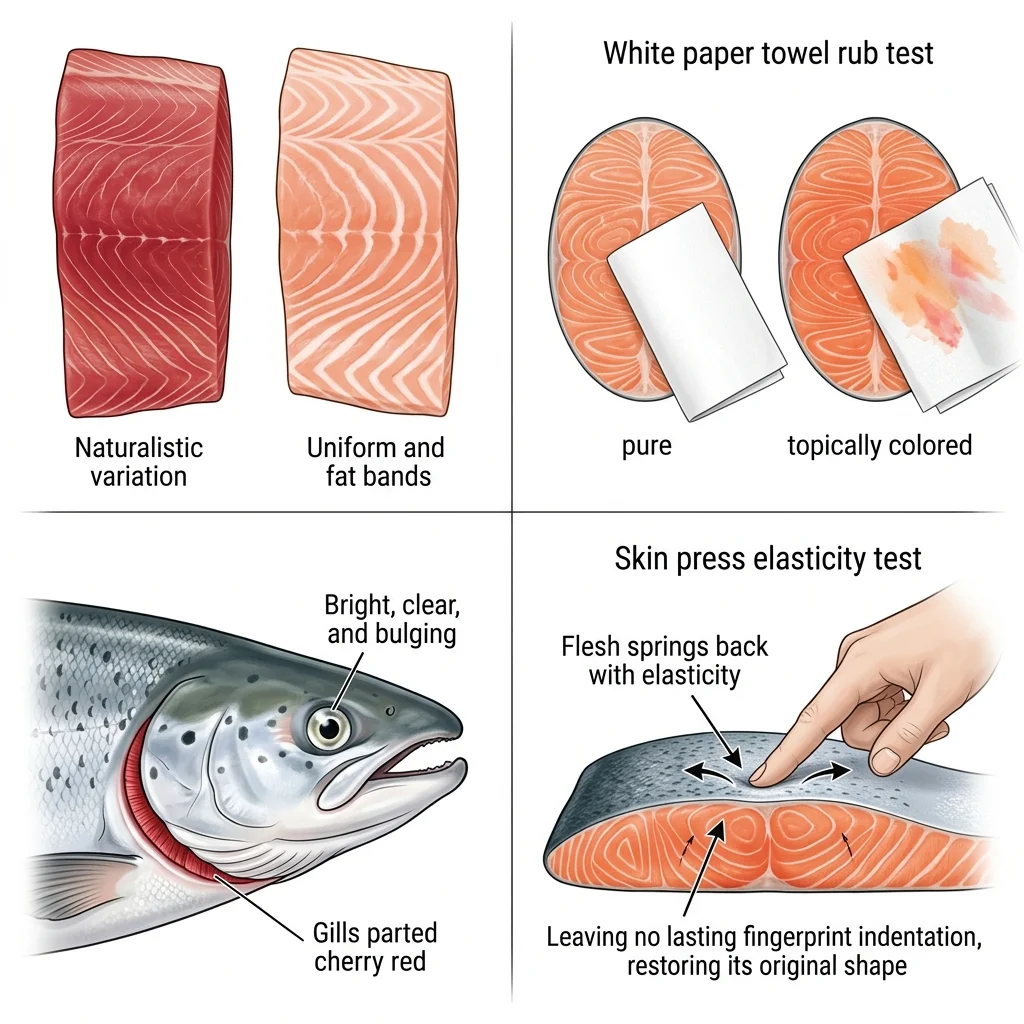
Examine the color and fat distribution of the fillet. Wild-caught salmon (such as Sockeye, Coho, or King) has a deep, vibrant, uneven orange-red or ruby-red color. It features very thin, delicate, white lines of fat. Farm-raised salmon has a pale, uniform pinkish-orange color. It has very thick, wide, prominent white bands of fat throughout the flesh, indicating a sedentary farm life.
2. The White Paper Rub Test (Topical Colorants):
Occasionally, unscrupulous vendors treat stale fish with topical food colorants or carbon monoxide to artificially restore a bright red color. Pat a fresh salmon fillet firmly with a clean, dry, white paper towel. Natural salmon pigmentation is bound within the muscle fibers and will not transfer. If the paper towel picks up a distinct orange or pink oily stain, the salmon has been topically dyed or chemically treated to hide decomposition.
3. Gill and Eye Freshness Audit (Whole Fish):
If buying whole salmon, inspect the eyes and gills. Freshly caught salmon has bright, clear, glossy, bulging eyes with black pupils. The gills must be bright cherry-red, clean, and free of mucus. Stale, chemically treated, or old fish will show cloudy, sunken, gray eyes and pale pink, brown, or slimy gills.
4. Skin Press & Elasticity Test:
Press your finger firmly into the thickest part of the salmon fillet or whole fish. The flesh of fresh salmon is highly elastic and will spring back immediately, leaving no permanent indentation. If the indentation remains visible or the flesh feels soft, mushy, and pasty, the cellular structure has collapsed due to age, advanced bacterial decomposition, or improper freezing cycles.
Click to enlarge
Salmon Freshness & Histamine Audit
Freshness is critical for seafood safety due to the rapid growth of temperature-sensitive bacteria.
1. Histamine (Scombroid) Accumulation:
When salmon is stored at improper temperatures, bacteria multiply and convert histidine into heat-stable histamine. This causes scombroid fish poisoning, which cannot be destroyed by cooking, baking, or freezing. Reject any fish that causes a tingling, peppery, or burning sensation on the tongue.
2. Sour or Ammonia Odor:
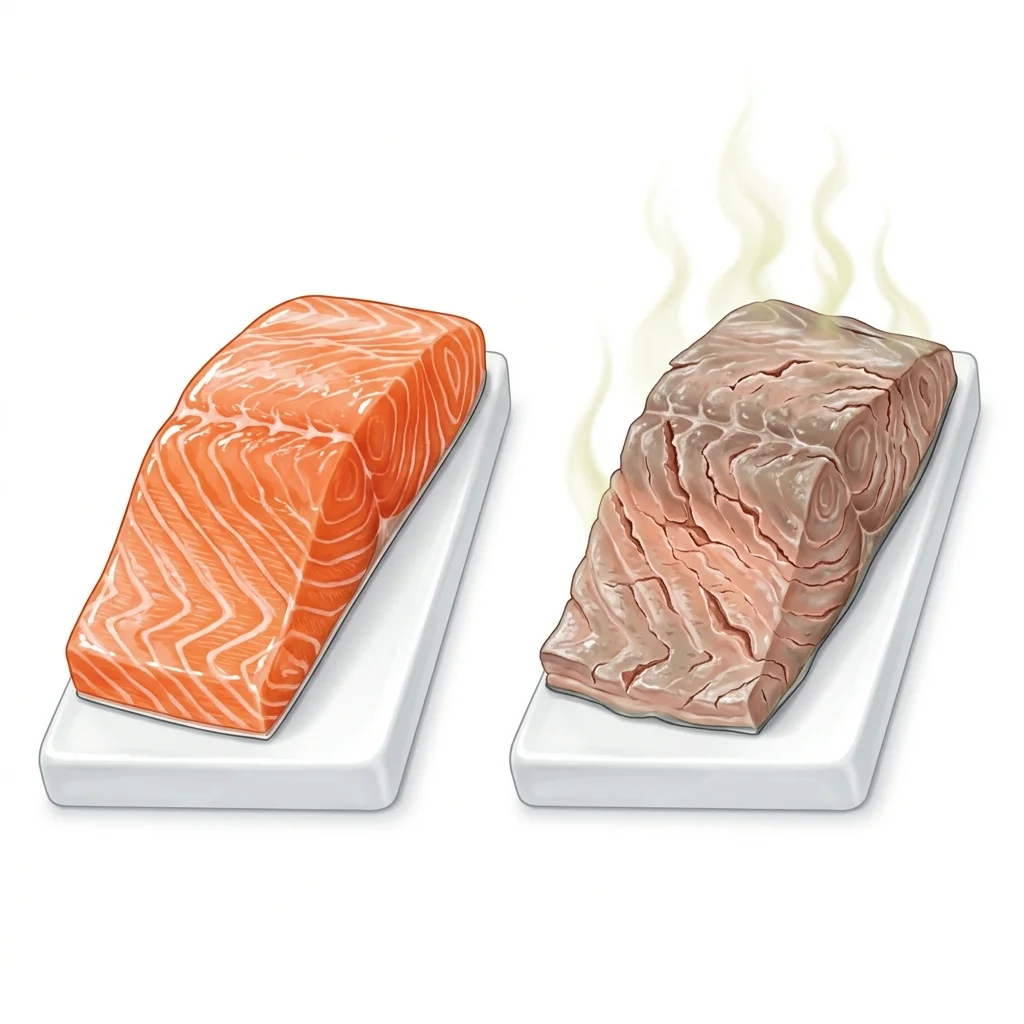
Fresh salmon has a mild, clean, ocean-breeze smell. Avoid fish that smells strongly 'fishy,' sour, or has an ammonia-like odor.
3. Muscle Gaping and Cracking:
Inspect the fillet structure. Slices that show 'gaping'—where the muscle layers flake apart, tear, and separate cleanly—reveal advanced enzymatic breakdown and poor handling.
Quick Safety Tips
- Look for deep ruby-red color and thin white fat lines to identify pure, wild-caught salmon
- Perform the press test: fresh salmon must spring back instantly without leaving a permanent fingerprint indentation
- Avoid fillets with uniform pale pink color and thick, wide white fat bands, which indicate farmed salmon with synthetic dyes
- Use a white paper towel to rub the fillet: any pink or orange dye transfer reveals artificial topical colorant fraud
Primary Chemical Concerns
Health Risks & Impacts
Multilingual Local Names
Regulatory Corner: FSSAI (Food Safety and Standards Authority of India) / US FDA (21 CFR 123 - Seafood HACCP) / EU Regulation 853/2004
Regulation: Food Safety and Standards (Food Products Standards) Regulations 2011, Clause 2.4.18: Fresh Fish & Fishery Products & FDA Seafood Guidance
Legal Limit:Histamine: Max 100 mg/kg (100 ppm); Total Volatile Basic Nitrogen (TVB-N): Max 35 mg/100g; Synthetic Carbon Monoxide (CO gas treatment to pink fresh): 0.0% (Unapproved color fixative prohibited); Methylmercury: Max 0.5 ppm; Lead: Max 0.3 ppm
Report Adulteration to FSSAI (Food Safety and Standards Authority of India) / US FDA (21 CFR 123 - Seafood HACCP) / EU Regulation 853/2004