
Yellow Oleander (Thevetia)
Cascabela thevetia
How to Identify Yellow Oleander (Thevetia)
EXTREMELY TOXIC & LETHAL. High concentrations of thevetin cardiac glycosides cause fatal heart block and arrhythmia in cats, dogs, horses, and humans. Read our Oleander Pet Guard Profile.
A comprehensive botanical identification guide to Cascabela thevetia (Yellow Oleander / Pila Kaner):
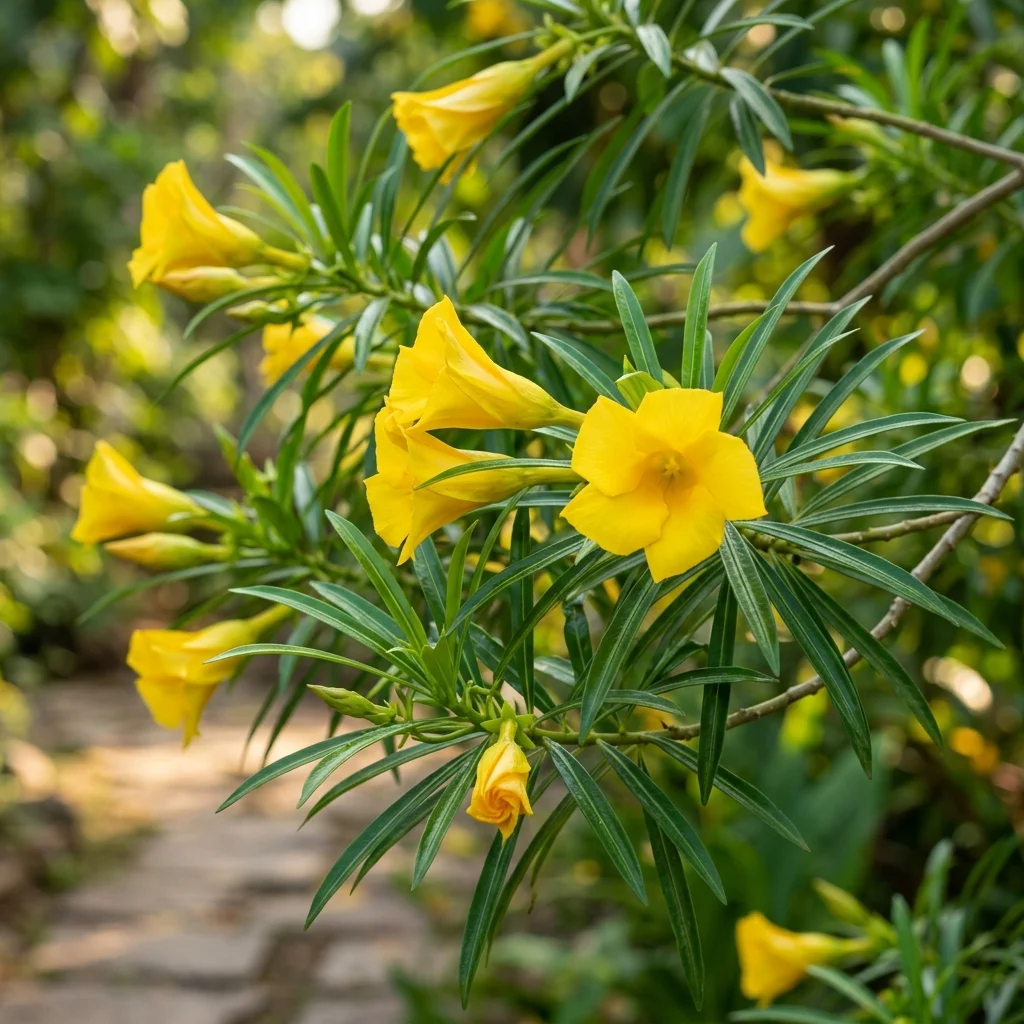
- Golden-Yellow Funnel Flowers: Flared tubular trumpet blossoms (2 to 3 inches long) with 5 spirally overlapping (contorted) petal lobes and a pleasant, light sweet fragrance.
- Linear Willow-like Foliage: Glossy, dark green, elongated linear leaves (3 to 6 inches long, 0.3 inches wide) with curled-under margins and a prominent lighter central midrib.
- Milky White Latex Sap: Copious white milky sap that immediately exudes when leaves, stems, or flower pedicels are broken or punctured.
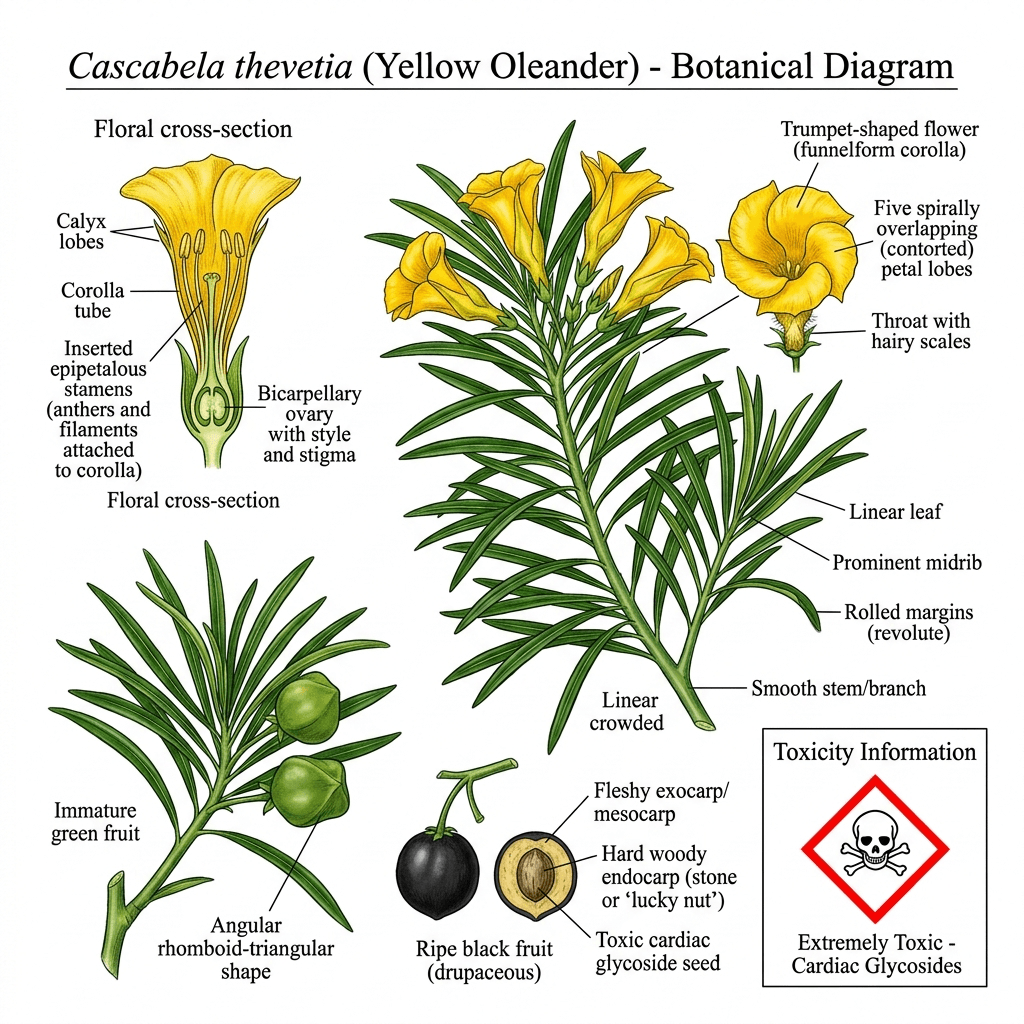
- Angular Rhomboid Fruit: Distinctive 4-sided, angular triangular drupe measuring 1.5 inches wide, turning from bright glossy green to dark purplish-black at maturity.
- Hard Woody Stone ('Lucky Nut'): Hard, smooth, triangular woody endocarp containing 2 to 4 toxic, heart-shaped seeds rich in cardiac glycosides.
Botanical Forms & Regional Variations
- By Flower Color Phase:
- Golden Yellow Form: The predominant wild and cultivated form bearing brilliant lemon-to-canary yellow funnel blooms.
- Apricot / Peach Form: A prized ornamental cultivar boasting warm peach, salmon, and apricot-tinted petals with a deeper orange throat.
- By Growth Stature:
- Shrub Form: Dense, multi-stemmed hedging shrub kept sheared at 6 to 10 feet tall for privacy screens and boundaries.
- Single-Trunk Tree Form: Pruned standard specimen tree growing 15 to 20 feet tall with a vase-shaped weeping canopy.
Care & Growing Guide
Yellow Oleander (Cascabela thevetia) Care & Growing Guide:
- Light: Full direct sunlight (at least 6 to 8 hours daily). Full sun produces dense foliage and continuous, heavy blooming.
- Soil: Highly adaptable to sandy, loamy, clay, or rocky soils. Requires sharp drainage; tolerates alkaline, acidic, and saline conditions.
- Watering: Water regularly during its first growing season to establish deep roots. Highly drought-tolerant once established; water only during extended dry periods.
- Propagation & Pruning: Easily grown from seeds or semi-hardwood stem cuttings. Always wear gloves when pruning to avoid skin contact with the irritating, toxic milky sap.
Seasonal Blooming & Hardiness
Seasonal Blooming Calendar (Tropical, Subtropical & Warm Arid Zones):
- Peak Bloom: Late spring through autumn (April through November in warm temperate zones; continuous year-round blooming in tropical Zones 10-11).
- Fruiting: Angular green fruit develops throughout summer, ripening to black in late autumn and winter.
- Life Cycle: Tough, long-lived woody evergreen perennial shrub or small specimen tree.
Bloom Timeline
About Yellow Oleander (Thevetia)
Yellow Oleander, botanically classified as Cascabela thevetia (formerly Thevetia peruviana) and famously celebrated in Indian culture as Pila Kaner, Lucky Nut, or the Be-still Tree, is a highly ornamental, heat-loving evergreen large shrub or small tree. Belonging to the dogbane family Apocynaceae (tribe Plumerieae), this striking tropical species is native to Central and South America and Mexico, but has naturalized extensively across tropical and subtropical regions worldwide, especially in India, Southeast Asia, Australia, and the Caribbean.
The plant typically grows 8 to 20 feet (2.5 to 6 meters) tall with an open, gracefully vase-shaped or rounded crown spreading 8 to 15 feet wide. It is densely cloaked in long, slender, glossy dark-green linear leaves measuring 3 to 6 inches long and just 0.25 to 0.5 inches wide, featuring rolled (revolute) edges and a prominent raised pale green midrib. The foliage is arranged spirally or in tight clusters along smooth, greyish-green woody branches that exude a copious, milky white latex sap when cut or bruised.
From late spring through autumn (and year-round in frost-free tropical climates), Yellow Oleander produces profuse clusters of showy, bell-shaped to funnelform flowers at branch tips. Individual blossoms measure 2 to 3 inches long and 1.5 to 2 inches wide, displaying a vivid bright golden-yellow or warm apricot-peach hue with a pleasant, delicate fragrance. The corolla features 5 overlapping, spirally contorted (twisted) petal lobes that flare widely from a narrow tubular throat equipped with five small hairy protective scales.
The actinomorphic reproductive morphology of Cascabela thevetia is represented by the family-specific floral formula ⊕ ⚥ K(5) [C(5) A5] G(2). This formula describes a radially symmetrical (actinomorphic), bisexual flower with a deeply 5-lobed calyx of acute green sepals. The corolla consists of 5 fused petals forming a funnelform tube with a contorted aesthetic in bud. Five stamens with short filaments are inserted (epipetalous) directly into the corolla throat, alternating with internal throat scales. The superior ovary is bicarpellary with a single style terminating in a large, disc-like stigma.
Following flowering, the plant produces distinctive, hard, angular drupaceous fruits that measure 1 to 1.5 inches in diameter with a unique rhomboid-triangular shape. The fruit begins bright green and fleshy, ripening to dull reddish-brown and ultimately a wrinkled blackish-purple. Inside lies a hard, woody, smooth triangular endocarp containing two to four seeds, historically known as 'lucky nuts' in traditional folklore.
For pet owners, veterinarians, and parents, Yellow Oleander demands the utmost caution: ALL PARTS OF THIS PLANT ARE EXTREMELY TOXIC AND POTENTIALLY LETHAL. Every tissue—especially the seeds and milky sap—contains dangerously potent cardiac glycosides, primarily thevetin A, thevetin B, thevetoxin, neriifolin, and peruvoside. Ingestion causes violent gastrointestinal irritation, profound bradycardia, cardiac arrhythmias, seizures, and fatal heart failure in cats, dogs, livestock, and humans. To study comprehensive clinical symptoms, decontamination protocols, and emergency guidance, see our specialized Pet Guard Profile for Oleander.
Yellow Oleander is easily distinguished from Common Oleander (Nerium oleander) by its radiant canary-yellow to peach funnel-shaped blooms and ultra-slender, willow-like linear leaves, whereas Common Oleander features broad lanceolate leaves and predominantly pink, red, or white flat-petaled blossoms. In frost-free ornamental landscapes, it is planted alongside tropical heat lovers like Oleander, Desert Rose, Plumeria, Allamanda, and Vinca. Explore our Flower Identifier to identify more tropical shrubs.
For more detailed botanical identification guides and toxicity audits, explore our companion profiles on Oleander (Rosebay), Desert Rose, and Plumeria.
Floral Formula & Features
Actinomorphic (radially symmetrical), bisexual, calyx of 5 green sepals with internal glands, corolla of 5 fused petals forming a funnelform tube with contorted overlapping lobes, 5 epipetalous stamens inserted in throat alternating with scales, bicarpellary superior ovary with single style, angular drupaceous stone fruit
- Scientific Name & Classification: Cascabela thevetia / Thevetia peruviana (Apocynaceae). Widely known as Yellow Oleander, Pila Kaner, Lucky Nut, and Be-still Tree.
- Identification Markers: Glossy linear willow-like leaves with rolled edges, milky white latex sap, bright yellow funnelform flowers with twisted petals, and angular triangular stone fruits.
- Floral Formula (⊕ ⚥ K(5) [C(5) A5] G(2)): Actinomorphic, bisexual flowers with 5 sepals, 5 fused petals in a contorted funnelform tube, 5 epipetalous stamens inserted into throat, and bicarpellary superior ovary.
- Growing Requirements: Full direct sun (6+ hours daily); highly drought, wind, heat, and salt-tolerant; thrives in poor, sandy, well-draining soils with neutral to alkaline pH (Zones 9b-11).
- Cultural Significance: Famed as 'Pila Kaner' in India; widely planted as an ornamental temple shrub and boundary hedge; revered in traditional lore for its golden blossoms offered in worship.
- Safety & Toxicity: EXTREMELY TOXIC & LETHAL. High concentrations of thevetin cardiac glycosides cause fatal heart block and arrhythmia in cats, dogs, horses, and humans. Read our Oleander Pet Guard Profile.
- Common Look-alikes: Distinguished from Common Oleander (Nerium) by its much narrower willow-like foliage and yellow funnel flowers, and from Allamanda by its woody upright tree form.
- Internal Links: Commonly planted in arid and tropical xeriscape gardens alongside Oleander, Desert Rose, Plumeria, and Allamanda; see more in our Flower Identifier.
Names in Different Languages
Botanical Classification: Yellow Oleander (Thevetia) belongs to the Apocynaceae family. Learn how to identify its floral symmetry, stamen arrangement, and structural formulas in our Botanical Family Classification Guide.
Toxicity & Safety
Always keep toxic plants out of reach of children and pets. Consult a veterinarian or medical professional immediately if ingestion is suspected.
Pet Safety Guide: For detailed toxicity symptoms, first-aid measures, and safe garden alternatives, see our full Pet Guard Profile for Yellow Oleander (Thevetia).
Frequently Asked Questions
What is Floral Formula?
A floral formula is a symbolic representation of a flower's structure using letters, numbers, and special symbols. It provides a concise way to describe the arrangement and number of floral parts.
This formula describes the flower's symmetry, sepals, petals, stamens, and carpels in a standardized format.
Formula Sequence
- Bract: Br or Ebr
- Bracteole: Brl or Ebrl
- Symmetry: % (Radial) or ⊕ (Bilateral)
- Sex: ♀ (Female), ♂ (Male), or ⚥ (Bisexual)
- Calyx/Sepal: K<number> (Free or Fused)
- Corolla/Petal: C<number> (Free or Fused)
- Androecium: A<number> (Free or Fused)
- Gynaecium: G<number> (Superior or Inferior Ovary)
Symbol Meanings
- Numbers: Indicate quantity of parts
- Parentheses (): Parts are fused together
- Plus (+): Parts in different whorls
- Underline: Superior ovary position
- Overline: Inferior ovary position
- ∞: Numerous parts (too many to count)
Understanding floral formulas helps botanists quickly identify and classify flowers based on their structural characteristics.
Similar Flowers
Discover flowers that share botanical characteristics
Same Family
4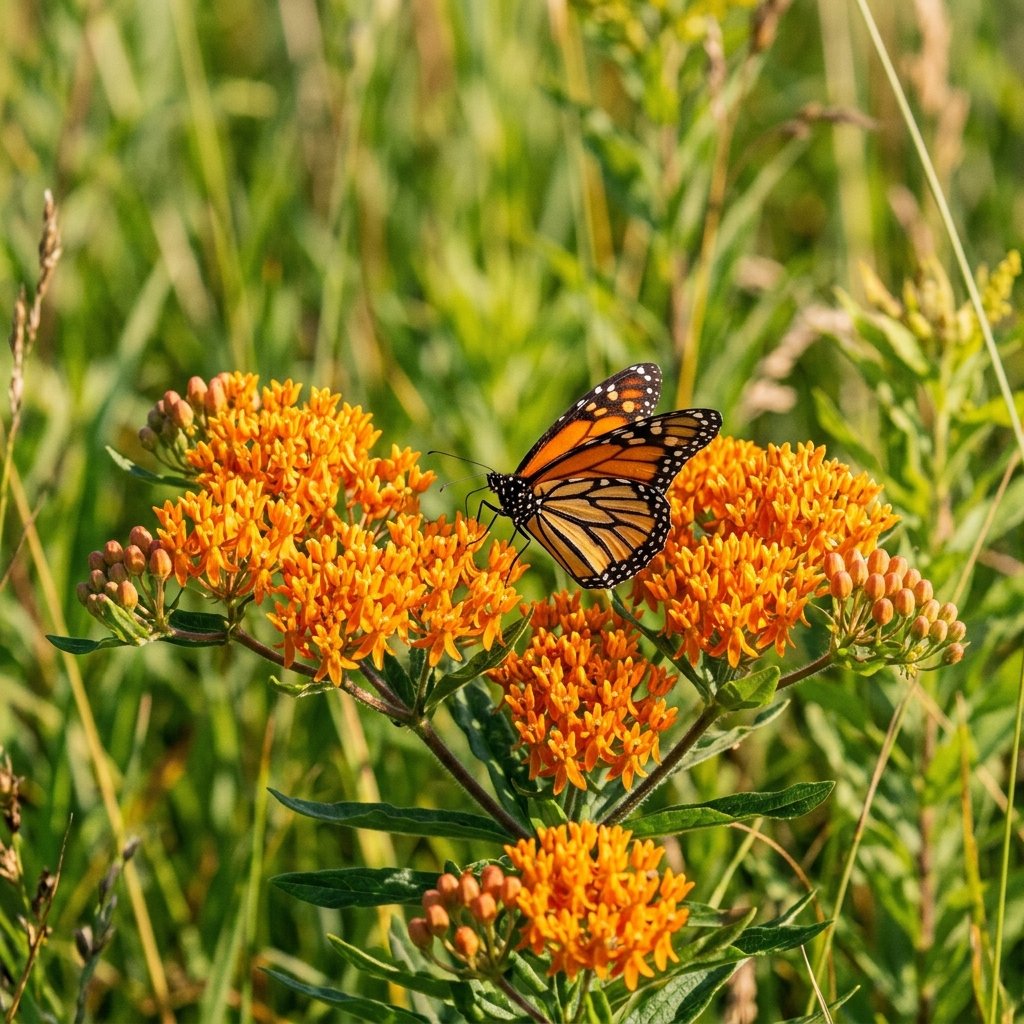
Butterfly Weed
Asclepias tuberosa
Butterfly Weed (*Asclepias tuberosa*) is arguably the most vivid and ecologically vital native wildflower of the American prairie and meadow, blazing in brilliant shades of fiery orange and golden-yellow in midsummer and serving as one of the most important nectar and host plants for the endanger...
Mandevilla
Mandevilla
Mandevilla, often referred to as the Rock Trumpet, is the undisputed queen of the tropical vertical garden. Belonging to the Apocynaceae family—the same family that hosts the famous Frangipani and Oleander—this genus comprises over 100 species of vigorous, woody climbing vines and mounding shrubs...
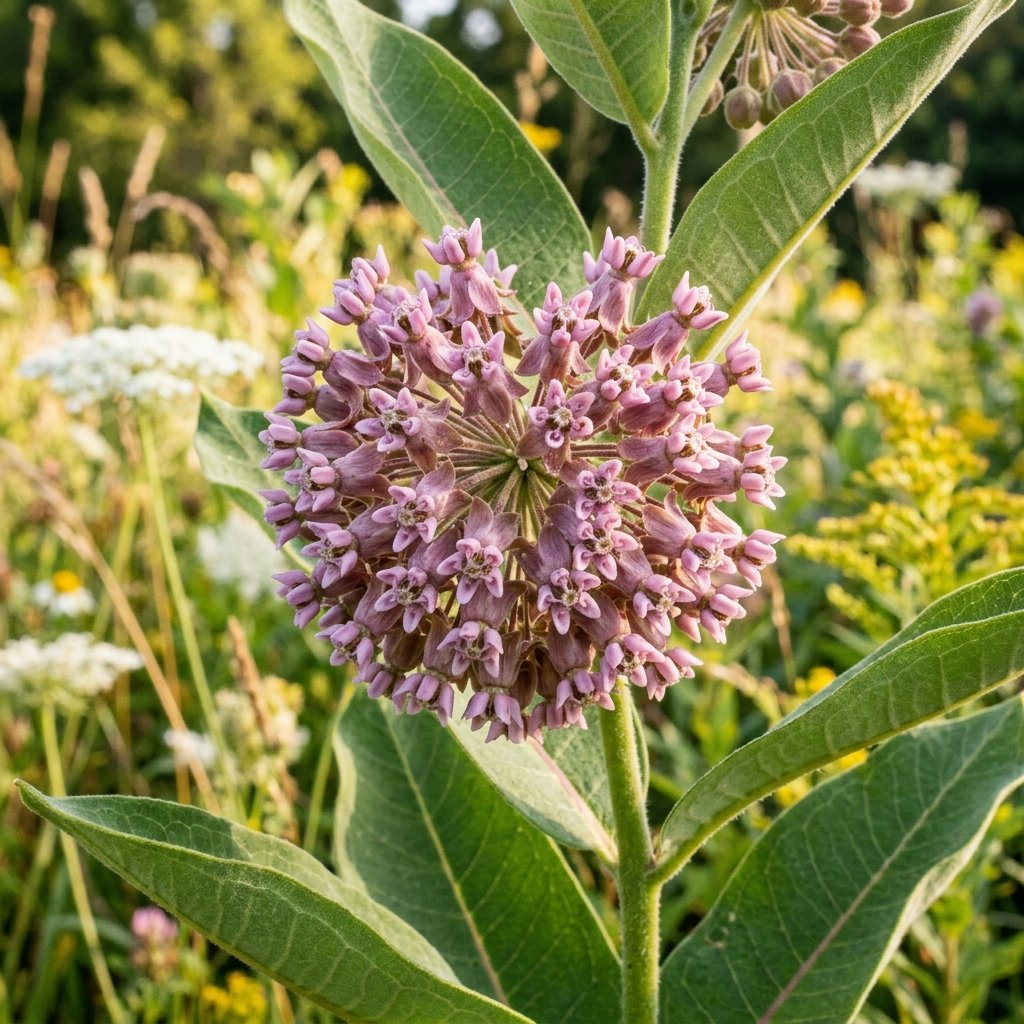
Common Milkweed
Asclepias syriaca
Common Milkweed (*Asclepias syriaca*) is the quintessential wildflower of eastern North American roadsides, meadows, and prairies — a robust, upright perennial producing large, globe-shaped clusters of dusky pink to mauve flowers with an intoxicating sweet fragrance in midsummer, followed by the...
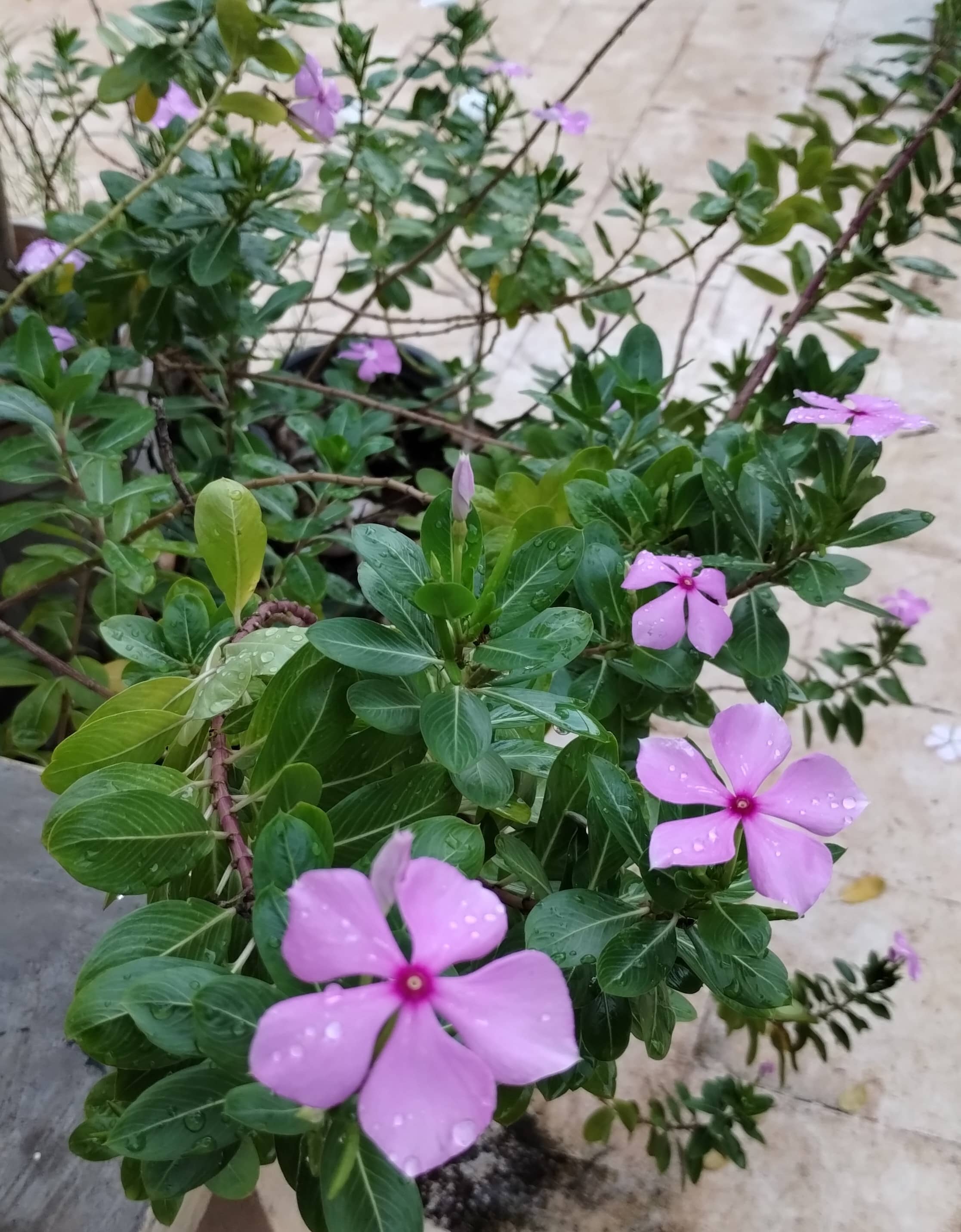
Vinca Rosea
Catharanthus roseus
Vinca Rosea (Catharanthus roseus), widely known as the Madagascar Periwinkle, is a plant of profound duality—equally celebrated as a resilient ornamental and a life-saving pharmaceutical powerhouse. Native to the dry forests of Madagascar but now naturalized across tropical regions worldwide, thi...
Similar Colors
2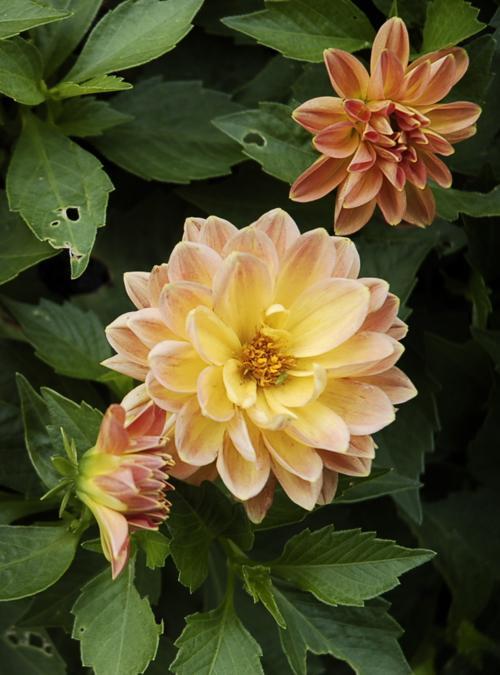
Pink-Yellow Dahlia
Dahlia pinnata (Hybrid)
The Pink-Yellow Dahlia is a spectacular, tuberous herbaceous perennial belonging to the vast Asteraceae family. Native to the mountainous highlands of Mexico and Central America, Dahlias have been heavily hybridized by botanists to produce an astonishing variety of geometric forms and vivid color...
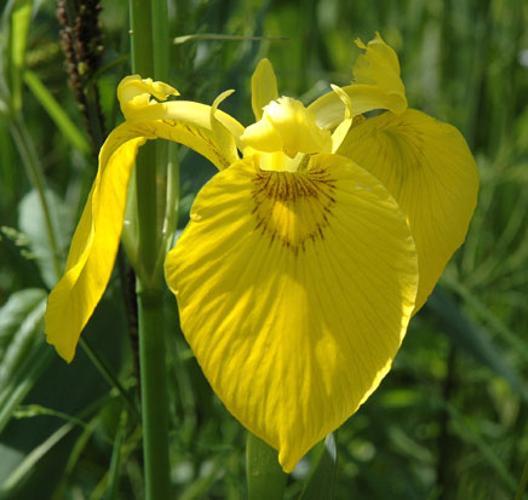
Yellow Iris
Iris pseudacorus
The Yellow Iris, scientifically classified as Iris pseudacorus and commonly known as the Yellow Flag or Water Flag, is a striking, highly vigorous wetland perennial plant belonging to the Iridaceae (iris) family. Native to Europe, Western Asia, and North Africa, this species thrives naturally in...
Similar Characteristics
4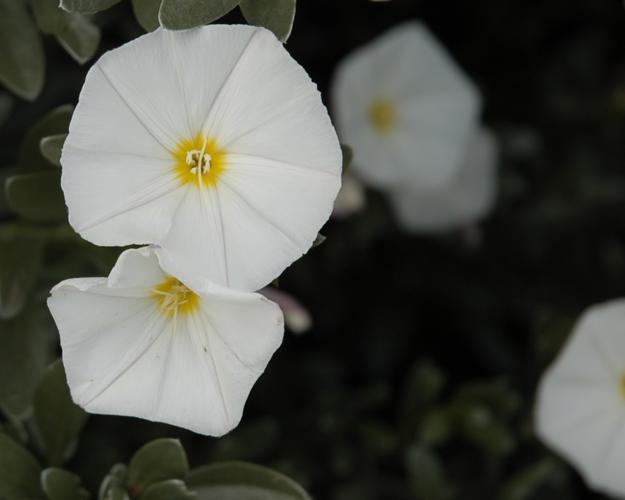
Silverbush
Convolvulus cneorum
The Silverbush, botanically classified as Convolvulus cneorum and widely referred to as the Silvery Bindweed or Bush Morning Glory, is an exceptionally elegant, compact evergreen shrub belonging to the Convolvulaceae (morning glory) family. Unlike its sprawling, climbing vine cousins, this specie...
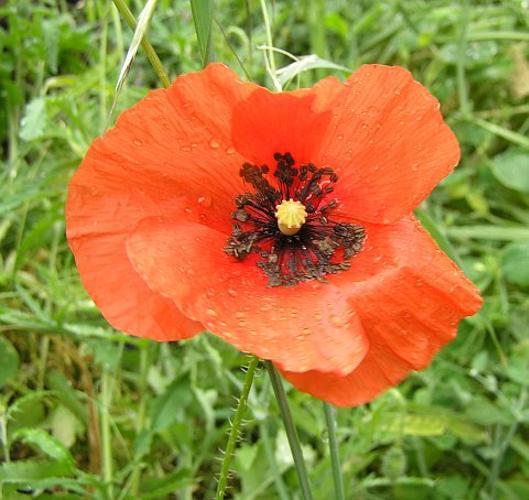
Corn Poppy
Papaver rhoeas
The Corn Poppy, botanically designated as Papaver rhoeas and commonly known as the Field Poppy, Flanders Poppy, or Red Poppy, is an exceptionally iconic, breezy, and resilient annual wildflower. Belonging to the family Papaveraceae (the poppy family, tribe Papavereae), this historically rich plan...
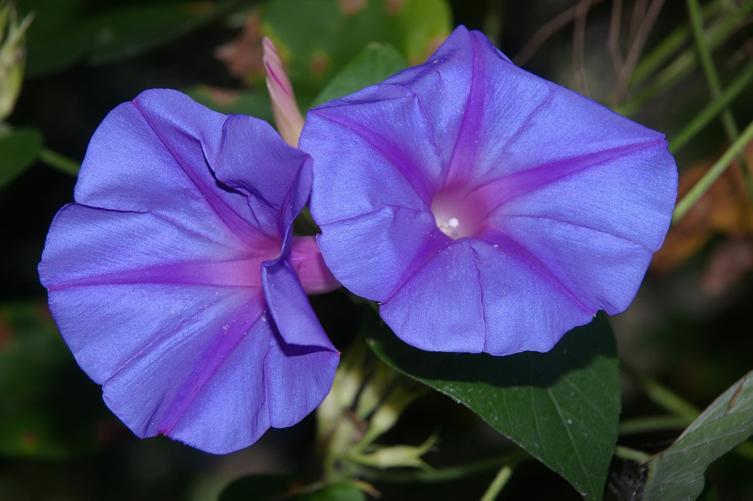
Morning Glory
Ipomoea tricolor
The Morning Glory, botanically designated as Ipomoea tricolor (and including the closely related *Ipomoea purpurea*), is an exceptionally vigorous, fast-growing climbing annual vine. Belonging to the family Convolvulaceae (the bindweed or morning glory family, tribe Ipomoeeae), this classic garde...
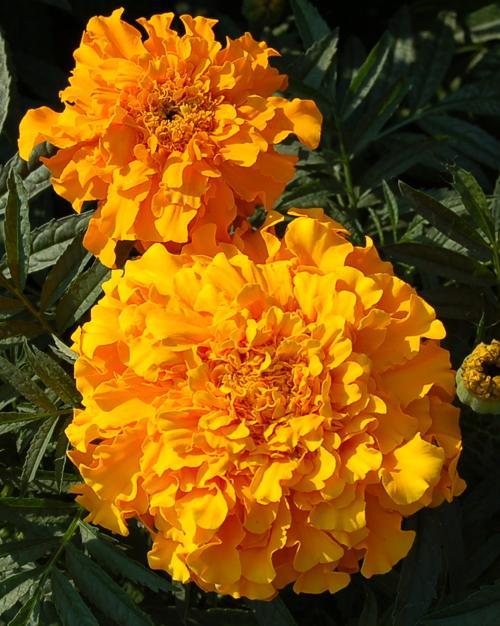
Marigold
Tagetes erecta
The Marigold, botanically classified under the genus Tagetes within the highly diverse Asteraceae (daisy or composite) family, is a cheerful, robust, and exceptionally popular herbaceous annual flower. Native to the warm, sun-drenched grasslands, mountain valleys, and open meadows of Mexico and C...