
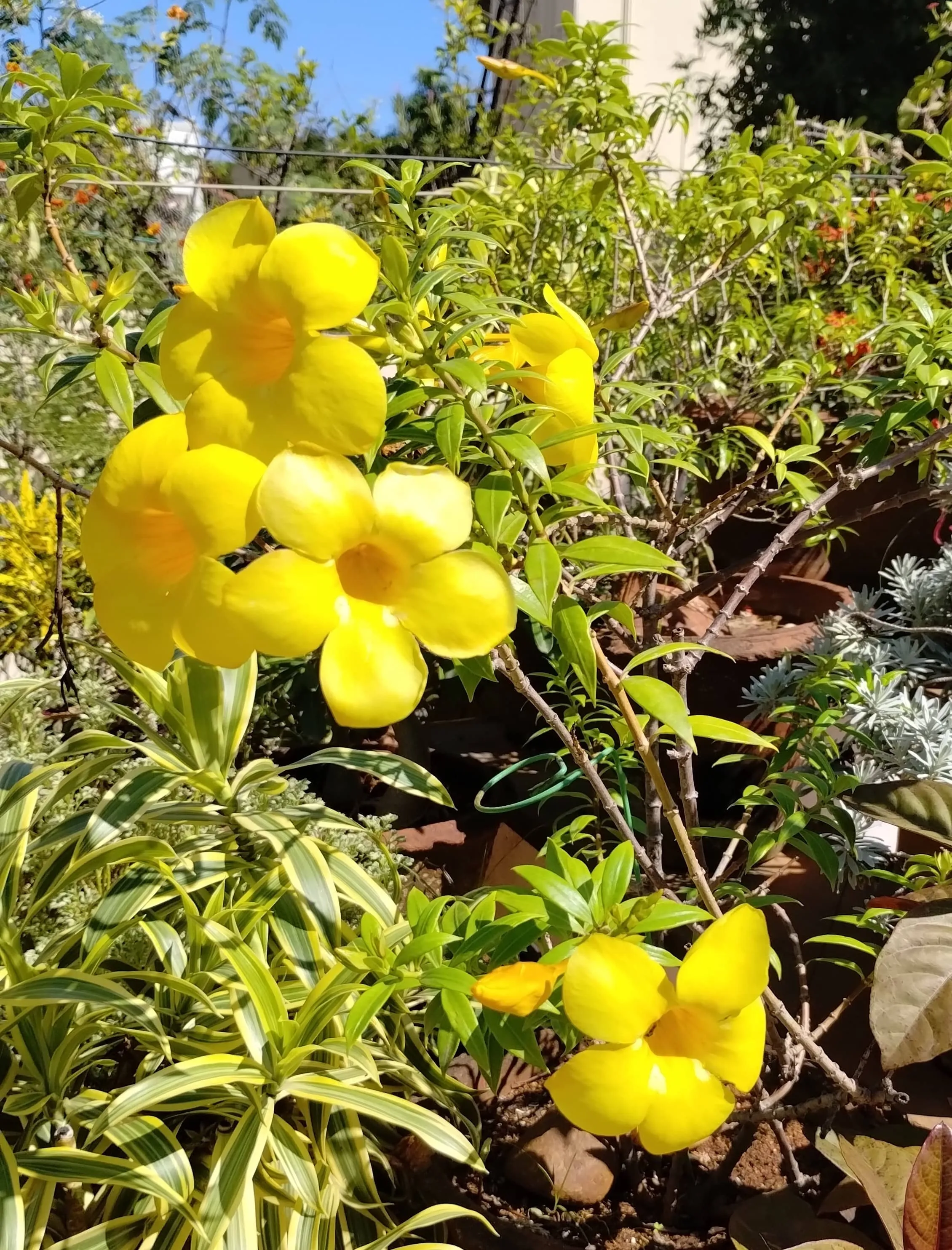
Allamanda
Allamanda cathartica
How to Identify Allamanda
TOXIC TO PETS. Contains cathartic resins and iridoids, alongside sticky milky sap, causing intense vomiting, diarrhea, and contact dermatitis.
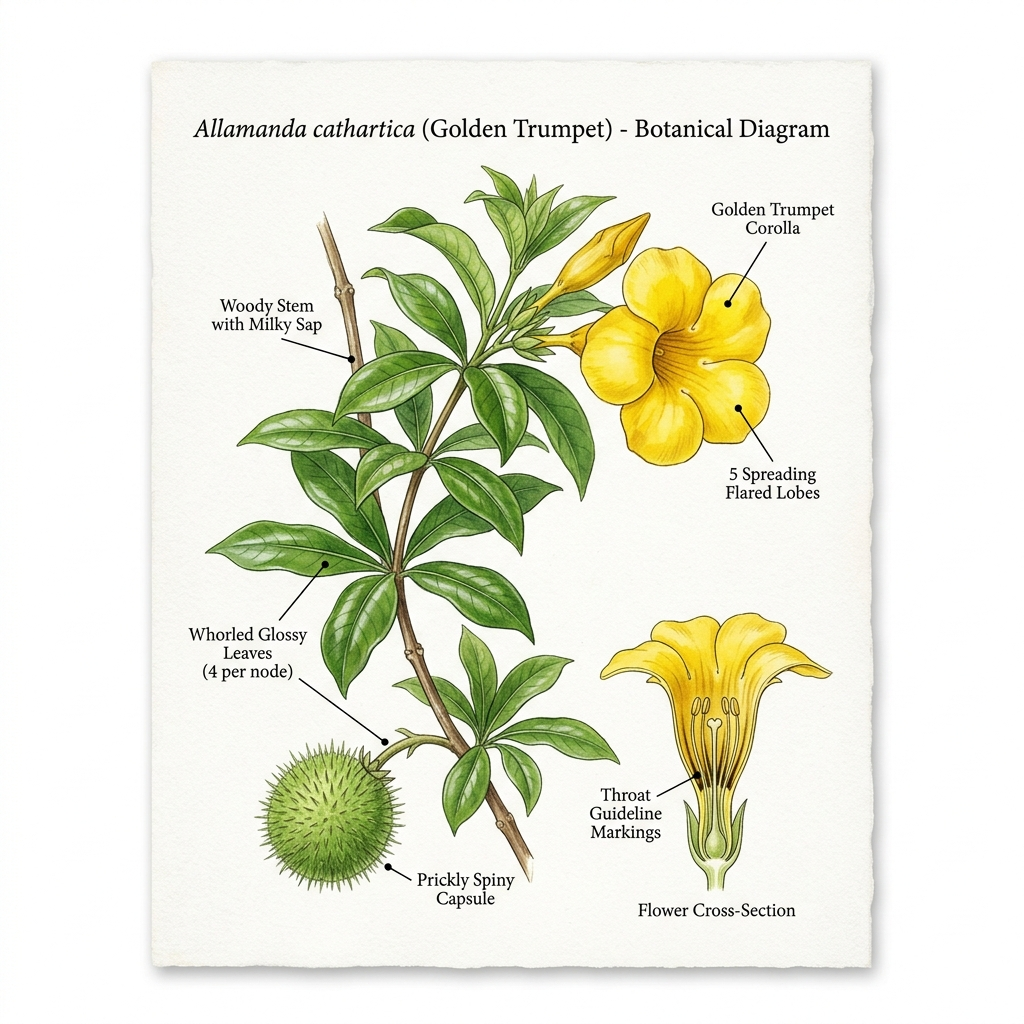
A detailed guide to identifying Allamanda (Allamanda cathartica / Golden Trumpet) by its key botanical features:
- Massive Golden Trumpet Corolla: Spectacular golden-yellow trumpet-shaped funnel flowers measuring 3 to 5 inches across, with 5 broad, overlapping flared petal lobes and faint orange guideline stripes inside the throat.
- Whorled Leathery Leaves: Glossy, deep-green, thick oblong-lanceolate leaves arranged in distinct whorls of 4 (sometimes 3 or 5) along the stems.
- Scrambling Woody Vine Habit: Vigorous evergreen scrambling shrub that climbs and clambers over supports, reaching 10 to 20 feet in tropical landscapes.
- Milky White Latex Sap: All stems, leaves, and cut surfaces readily bleed a thick, milky white sap when broken or pruned (a characteristic Apocynaceae feature).
- Prickly Burr Seed Capsule: Round, spiny, green globose capsule covered in soft prickles, maturing into a hard brown burr containing flat winged seeds.
Types & Cultivar Classifications of Allamanda
- By Flower Size & Cultivar:
- 'Hendersonii' (Henderson's Allamanda): The premier large-flowered cultivar featuring extra-large golden blooms up to 5 inches wide with reddish-brown tinged buds.
- 'Williamsii': Fragrant semi-double yellow flowers adorned with reddish-brown throat stripes.
- 'Grandiflora': Delicately textured pale lemon-yellow flowers on slender scrambling stems.
- By Growth Habit:
- Vining / Scrambling Allamanda: Vigorous climbing forms requiring pergolas, trellises, or arbor support.
- Bush Allamanda (Allamanda schottii): Compact, erect shrub growing 4 to 5 feet tall with abundant, slightly smaller yellow trumpet blooms.
Care & Growing Guide
Allamanda (Golden Trumpet) Care & Growing Guide:
- Light: Full direct sunlight (at least 6 to 8 hours daily). Generous sun exposure is vital to trigger abundant trumpet blooms.
- Soil: Rich, organically fertile, well-draining moist loam or sandy soil with a slightly acidic pH (5.5 to 6.5). Avoid alkaline soils that cause leaf chlorosis.
- Watering: Water freely and deeply throughout the warm spring and summer growing season, allowing topsoil to slightly dry between waterings. Reduce watering during winter dormancy.
- Pruning & Training: Tie scrambling stems to trellises or walls. Prune in early spring before fresh growth begins to control size and stimulate profuse flower-bearing shoots. Always wear gloves to protect skin from milky sap.
Seasonal Blooming & Hardiness
Seasonal Blooming Calendar (US Hardiness Zones 10-11 / Tropical & Subtropical):
- Peak Bloom: Late spring through autumn (typically May through November); blooms virtually year-round in hot tropical environments.
- Planting Time: Plant container nursery specimens or rooted semi-hardwood cuttings outdoors in mid-to-late spring once soil and night temperatures remain warm.
- Cold Sensitivity: Extremely frost-tender (Zones 10-11). Will suffer leaf drop and dieback if temperatures drop below 45°F (7°C); overwinter in warm bright greenhouses or sunny indoor sunrooms in cooler zones.
Bloom Timeline
About Allamanda
The Allamanda, botanically designated as Allamanda cathartica and commonly known as the Golden Trumpet, Common Trumpet Vine, or Yellow Bell, is a spectacular tropical evergreen perennial. Belonging to the family Apocynaceae (the dogbane family), this vigorous climbing vine or sprawling shrub is native to the warm, sunny riverbanks, coastal thickets, and forest margins of Brazil and northern South America. It is celebrated worldwide for its year-round display of massive, trumpet-shaped flowers.
This fast-growing woody plant exhibits an exceptionally flexible growth habit. If provided with a sturdy trellis, fence, or arbor, its twining stems can easily climb 10 to 20 feet tall; alternatively, it can be pruned regularly into a neat, compact, and free-standing shrub measuring 3 to 5 feet high. It features highly glossy, leathery, and deep-green lance-shaped leaves measuring 3 to 5 inches long, which are arranged in elegant whorls of 3 or 4 along light green stems.
From spring through autumn (and year-round in hot tropical zones), the stem tips carry abundant clusters of massive, funnel-shaped flowers measuring 3 to 5 inches across. Blossoms are typically a brilliant golden-yellow (though hybrid cultivars exist in rich shades of peach, purple, and cherry-red), featuring 5 broad, overlapping, and spreading lobes that flare outward from a narrow corolla tube decorated with delicate reddish-orange throat stripes.
The reproductive morphology of Allamanda cathartica is summarized by the classical dogbane floral formula ⊕ ⚥ K(5) C(5) A5 G(2). This formula states that the flowers are radially symmetrical (actinomorphic) and bisexual. The calyx consists of 5 fused sepals forming a small, green protective cup, and the corolla comprises 5 fused petals that create the characteristic trumpet shape. The androecium contains 5 free stamens attached directly to the inside of the corolla tube, while the gynoecium contains 2 fused carpels with a superior ovary.
The genus is named in honor of the 18th-century Swiss botanist and physician Frédéric-Louis Allamand, who collected and documented exotic plants in South America before sending specimens to Carl Linnaeus. The species name cathartica translates from Latin to 'purging,' referencing the plant's historically documented use as a powerful purgative. Famed in Sanskrit as Pilaghanti (पीलघंटी, meaning 'yellow bell') and in Bengali as Alakananda (অলকানন্দা), the flower symbolizes bright sunshine and radiant prosperity.
For pet owners and veterinarians, Allamanda represents a notable toxic concern. The plant is classified as TOXIC TO PETS, including dogs, cats, and horses. All parts of the plant contain toxic iridoid lactones, cathartic resins, and saponin compounds. Additionally, the stems release a thick, sticky, milky latex sap when cut or damaged. Ingestion of any part triggers severe gastrointestinal irritation, vomiting, and diarrhea. Direct skin contact with the milky latex causes painful contact dermatitis, itching, and redness. (Note: Since there is no existing pet-guard page in our database, we do NOT include a pet-guard link here; we advise training vines out of reach.)
Allamanda is occasionally confused with Yellow Bells (Tecoma stans) or Angel's Trumpets (Brugmansia). It is easily distinguished because true Allamanda species possess glossy, whorled leaves and release a thick, sticky, milky sap when cut, whereas Tecoma has serrated compound leaves and lacks milky sap, and Brugmansia has massive, hanging, pendulous bells. It makes a stunning specimen for sunny trellises; we recommend pairing it with other vigorous, heat-loving climbers like the Trumpet Vine or Tecoma. To explore more tropical climbing vines, browse our Flower Identifier.
Floral Formula & Features
Radially symmetrical, bisexual flower with 5 fused sepals forming a small calyx, 5 fused petals creating the trumpet shape, 5 free stamens, and 2 fused carpels with superior ovary typical of Apocynaceae
- Scientific Name & Classification: Allamanda cathartica (Apocynaceae). Famed as Golden Trumpet, Common Trumpet Vine, and Yellow Bell.
- Identification Markers: Glossy leathery leaves in whorls of 3-4, sticky milky latex sap, and large 3-5 inch golden-yellow trumpet-shaped flowers.
- Floral Formula (⊕ ⚥ K(5) C(5) A5 G(2)): Radially symmetrical, bisexual flowers with 5 fused sepals, 5 fused petals, 5 epipetalous stamens, and superior ovary.
- Growing Requirements: Full direct sun (6-8 hours daily); rich, moist, organic, well-draining soil. Highly frost-sensitive, thriving in hot humid areas (Zones 10-11).
- Cultural Significance: Genus name honors Swiss botanist Frédéric-Louis Allamand. Famed in Bengal as 'Alakananda,' symbolizing sunshine and prosperity.
- Safety & Toxicity: TOXIC TO PETS. Contains cathartic resins and iridoids, alongside sticky milky sap, causing intense vomiting, diarrhea, and contact dermatitis.
- Common Look-alikes: Confused with Yellow Bells (Tecoma stans) or Brugmansia, but easily distinguished by its glossy, whorled foliage and thick milky latex sap.
- Internal Links: Creates a beautiful wall of gold when trained along sturdy trellises beside other warm-climate favorites like Trumpet Vine or Tecoma; check our Flower Identifier.
Names in Different Languages
Botanical Classification: Allamanda belongs to the Apocynaceae family. Learn how to identify its floral symmetry, stamen arrangement, and structural formulas in our Botanical Family Classification Guide.
Toxicity & Safety
Always keep toxic plants out of reach of children and pets. Consult a veterinarian or medical professional immediately if ingestion is suspected.
Frequently Asked Questions
What is Floral Formula?
A floral formula is a symbolic representation of a flower's structure using letters, numbers, and special symbols. It provides a concise way to describe the arrangement and number of floral parts.
This formula describes the flower's symmetry, sepals, petals, stamens, and carpels in a standardized format.
Formula Sequence
- Bract: Br or Ebr
- Bracteole: Brl or Ebrl
- Symmetry: % (Radial) or ⊕ (Bilateral)
- Sex: ♀ (Female), ♂ (Male), or ⚥ (Bisexual)
- Calyx/Sepal: K<number> (Free or Fused)
- Corolla/Petal: C<number> (Free or Fused)
- Androecium: A<number> (Free or Fused)
- Gynaecium: G<number> (Superior or Inferior Ovary)
Symbol Meanings
- Numbers: Indicate quantity of parts
- Parentheses (): Parts are fused together
- Plus (+): Parts in different whorls
- Underline: Superior ovary position
- Overline: Inferior ovary position
- ∞: Numerous parts (too many to count)
Understanding floral formulas helps botanists quickly identify and classify flowers based on their structural characteristics.
Similar Flowers
Discover flowers that share botanical characteristics
Same Family
4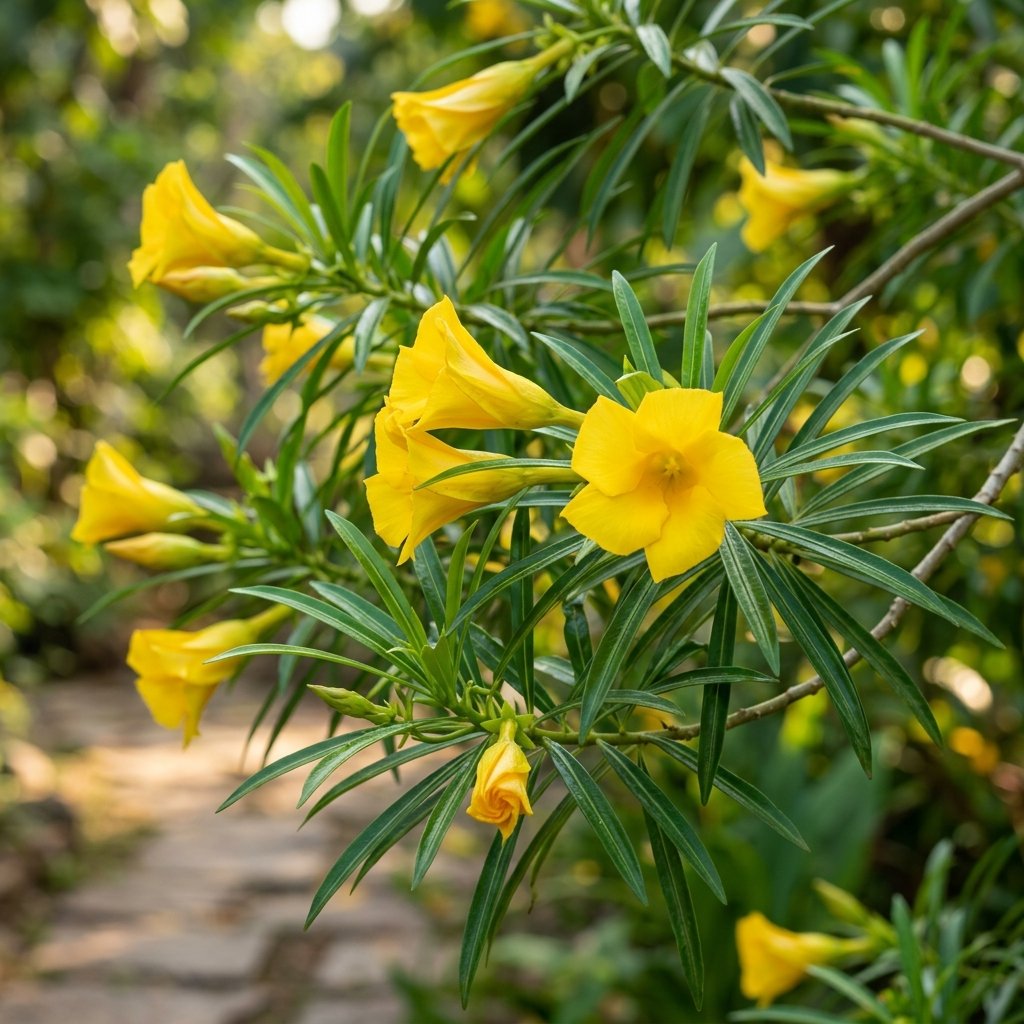
Yellow Oleander (Thevetia)
Cascabela thevetia
Yellow Oleander, botanically classified as *Cascabela thevetia* (formerly *Thevetia peruviana*) and famously celebrated in Indian culture as Pila Kaner, Lucky Nut, or the Be-still Tree, is a highly ornamental, heat-loving evergreen large shrub or small tree. Belonging to the dogbane family Apocyn...
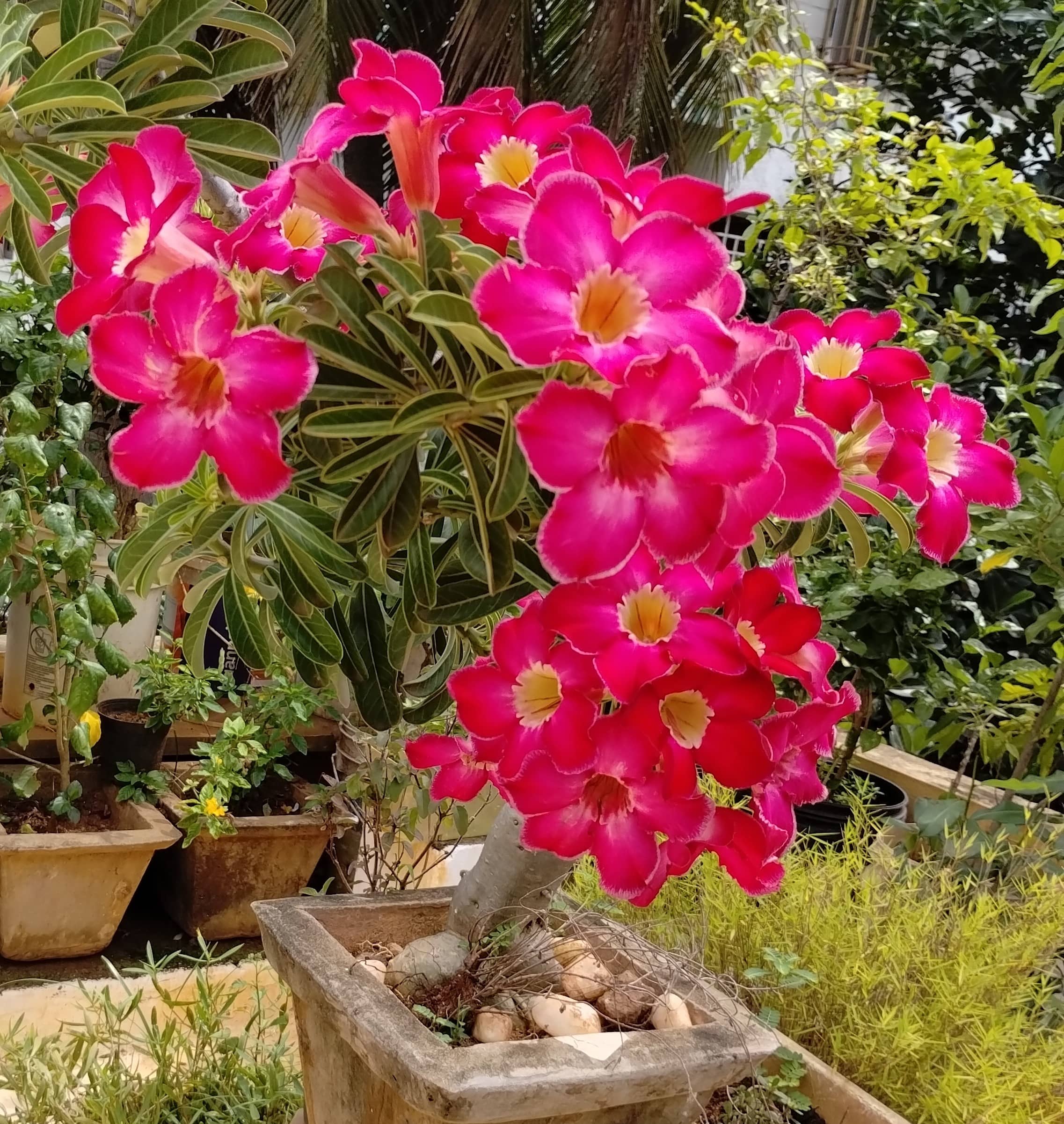
Desert Rose
Adenium obesum
The Desert Rose (Adenium obesum), a member of the Apocynaceae (Dogbane) family, is one of the most sculptural and striking succulent shrubs in the botanical world. Native to the arid regions of sub-Saharan Africa and the Arabian Peninsula, this plant has developed extraordinary adaptations to sur...
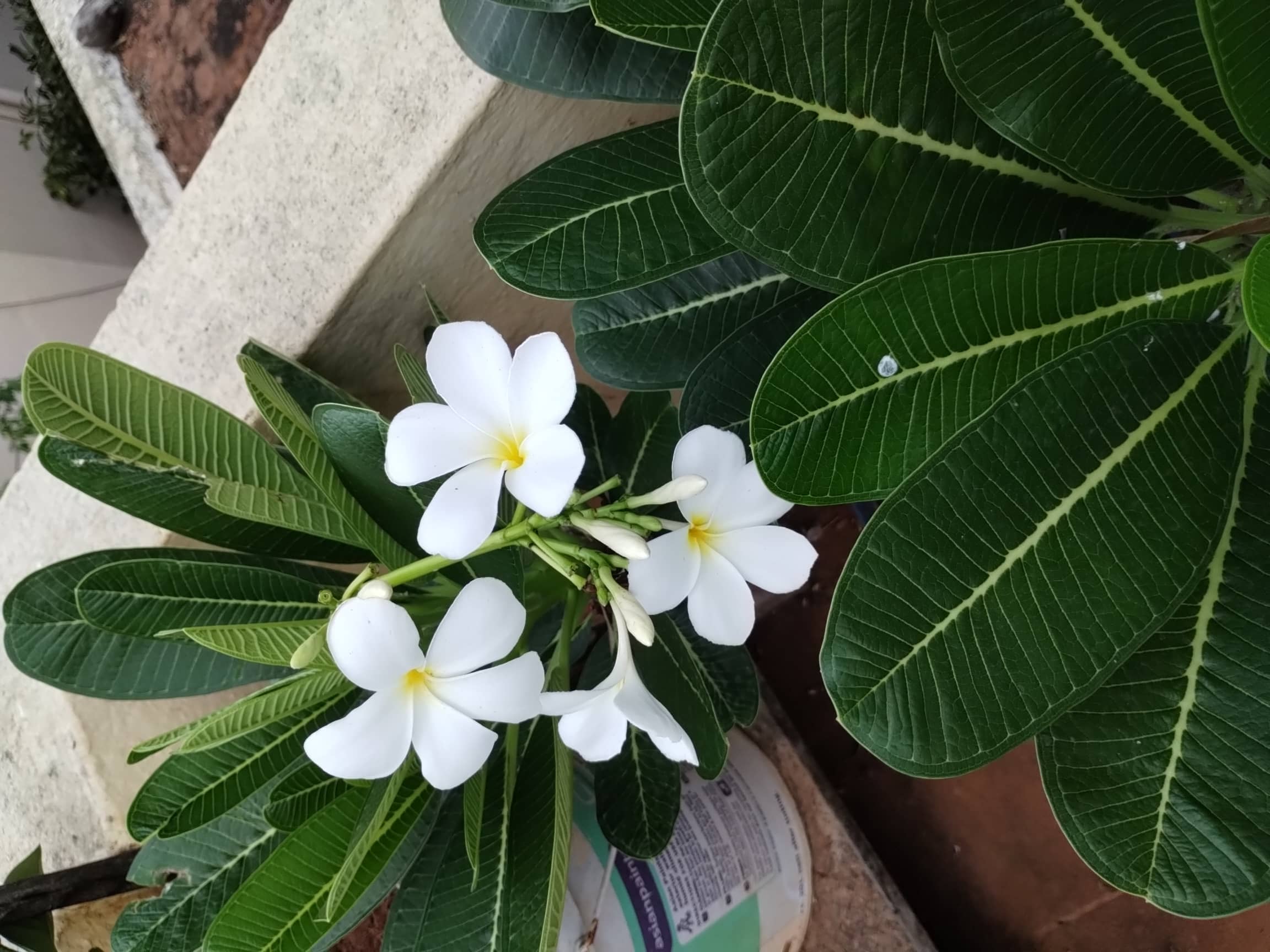
Plumeria
Plumeria Rubra
Plumeria, universally known as the Frangipani, is a genus of deciduous shrubs and small trees that serve as the quintessential symbol of tropical paradise. Belonging to the Apocynaceae (Dogbane) family, these plants are native to Mexico, Central America, and the Caribbean, but they have been embr...
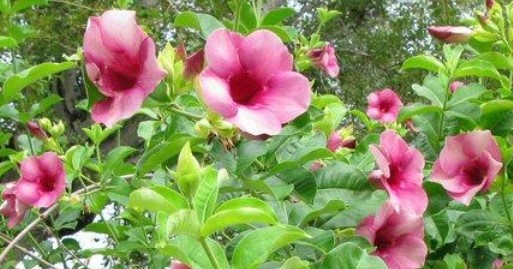
Mandevilla
Mandevilla
Mandevilla, often referred to as the Rock Trumpet, is the undisputed queen of the tropical vertical garden. Belonging to the Apocynaceae family—the same family that hosts the famous Frangipani and Oleander—this genus comprises over 100 species of vigorous, woody climbing vines and mounding shrubs...
Similar Characteristics
4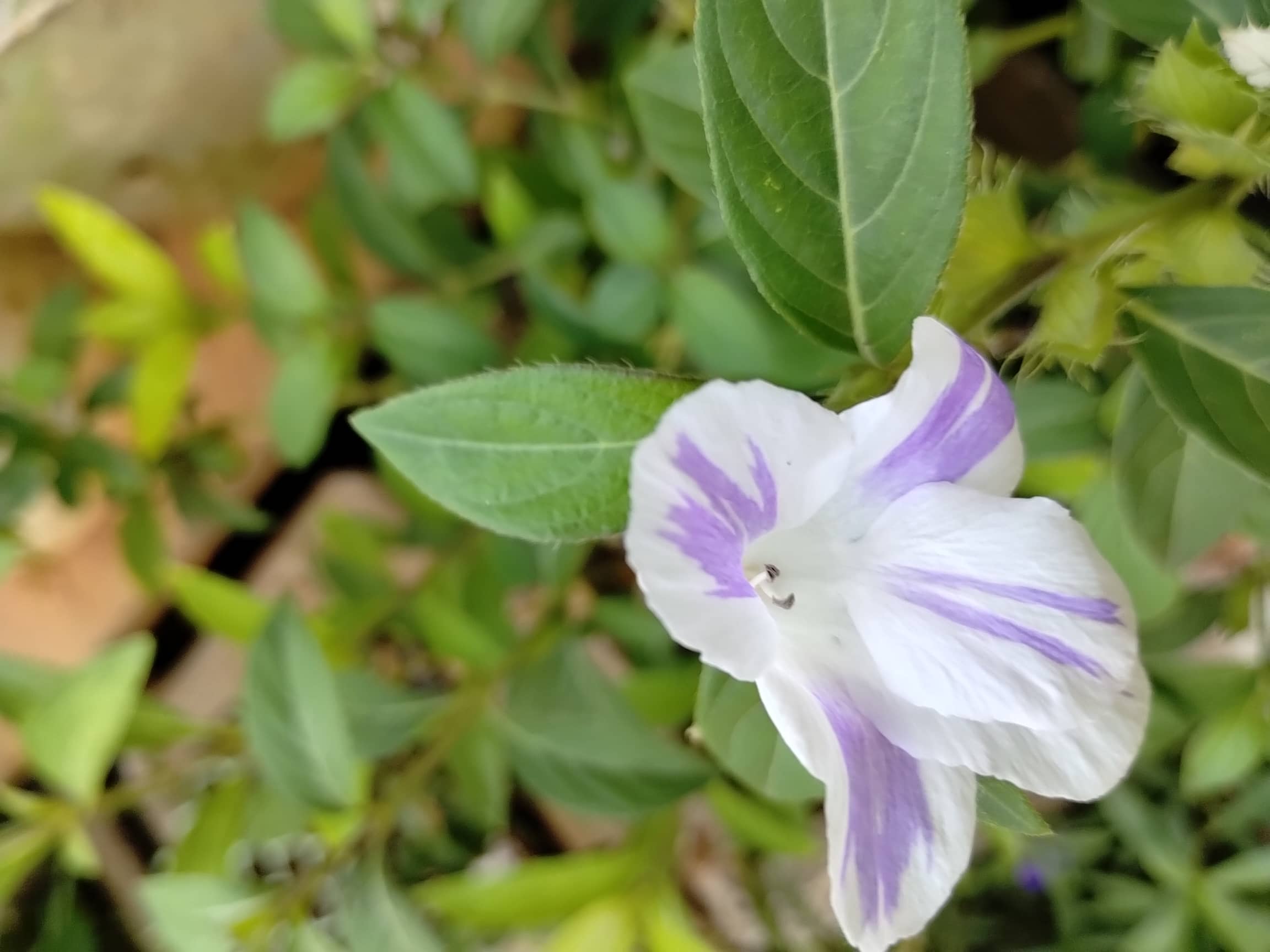
December
Barleria Cristata, Barleria prionitis
The December Flower, botanically classified under the genus Barleria within the family Acanthaceae (the acanthus family), is a highly attractive, fast-growing evergreen tropical shrub. Native to the sunny forest edges, dry riverbanks, and open scrublands of tropical Asia—spanning India, Myanmar,...
Yellow Oleander (Thevetia)
Cascabela thevetia
Yellow Oleander, botanically classified as *Cascabela thevetia* (formerly *Thevetia peruviana*) and famously celebrated in Indian culture as Pila Kaner, Lucky Nut, or the Be-still Tree, is a highly ornamental, heat-loving evergreen large shrub or small tree. Belonging to the dogbane family Apocyn...
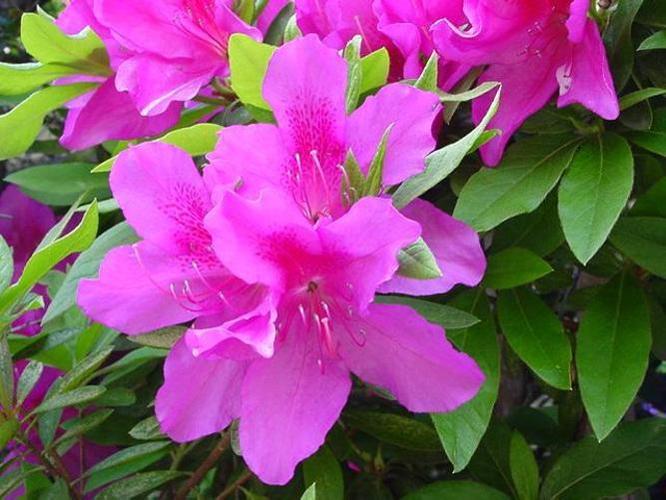
Azalea
Rhododendron (subgenus Tsutsusi)
The Azalea, botanically classified as Rhododendron (specifically under the subgenera Tsutsusi and Pentanthera) and belonging to the family Ericaceae (the heath family), is an exceptionally spectacular, heavy-blooming woody perennial shrub. Native primarily to the cool, damp woodlands, mountain sl...
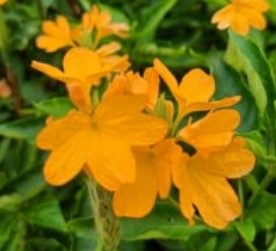
Crossandra Firecracker
Crossandra infundibuliformis
The Firecracker Flower, scientifically known as Crossandra infundibuliformis and popularly called Aboli or Kanakambaram in India, is a beautiful tropical evergreen shrub belonging to the Acanthaceae family. Native to the shady forest understories of southern India and Sri Lanka, particularly the...