Oregano & Dried Herbs Purity Guide: Detect Olive Leaf Fillers, Copper Dyes & Sand
⚡ Quick 60-Second Oregano & Dried Herbs Verdict
Global Herb Adulteration Alert: Extensive EU Food Fraud and consumer lab testing reveals that 40% to 70% of commercial dried oregano is heavily cut with spent olive leaves, myrtle, and sumac, chemically tinted with copper sulfate (CuSO4) or synthetic dyes to simulate fresh green harvests.
Sprinkle 1 tsp into a tall glass of cold water. Pure aromatic oregano leaves float buoyantly on the surface for over 15 minutes. Heavy sand, dirt grit, and dense ground olive leaves sink directly to the glass bottom within 60 seconds.
Vigorously crush a pinch between dry palms for 5 seconds. Authentic Mediterranean oregano bursts with a pungent, warm, slightly bitter thymol and carvacrol aroma. Olive leaf and myrtle fillers smell faintly of dry lawn clippings or dusty cardboard.
Mix 1 tsp crushed herb with 30ml warm water and 5 drops of household ammonia. Pure oregano water remains pale greenish-yellow. A bright turquoise or deep royal blue shift reveals illegal copper sulfate green dyeing.
To explore related culinary safety and home purity tests, explore our verified guides on Extra Virgin Olive Oil, Tomato Ketchup & Puree, Fresh Tomato, Cheese, and Garlic.
Drop Oregano & Dried Herbs photo here to test purity
or click to browse • Supports JPG, PNG, WEBP • Paste with Ctrl+V
Inspection Guide
Click to enlarge
Oregano Leaf Authenticity, Filler & Copper Dye Audit
Oregano is officially recognized by Interpol, Europol, and the European Commission as the single most adulterated herb on planet Earth. Because dried oregano is sold in crushed flakes, unscrupulous suppliers blend up to 70% shredded olive leaves, cistus, sumac, and myrtle leaves into retail bottles.
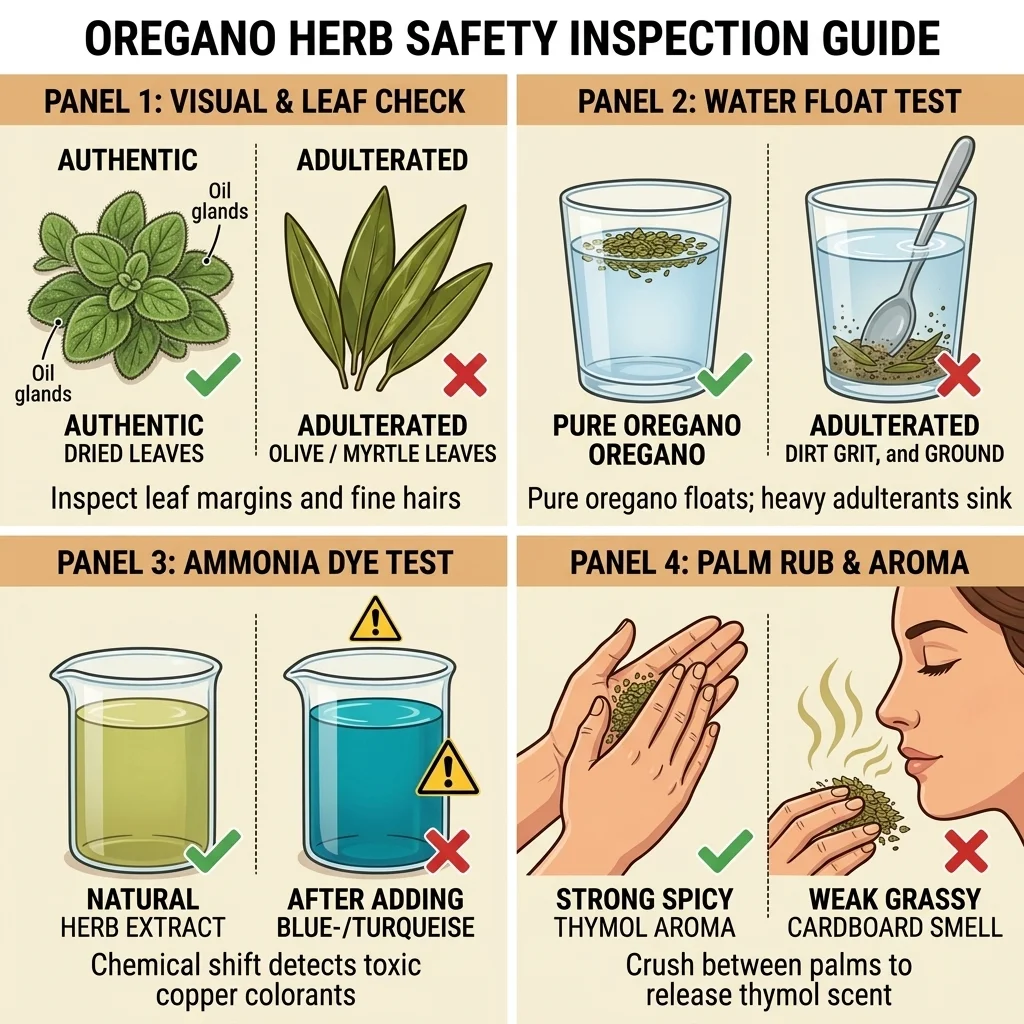
1. The Microscopic Leaf Vein & Serration Inspection:
Spread half a teaspoon across a clean sheet of white paper and examine under bright light with a 5x or 10x magnifying loupe.
✅ Authentic Oregano (Origanum vulgare / heracleoticum): Leaves feature distinct, fine oval contours with softly serrated (toothed) margins and microscopic glandular oil hairs (trichomes) dotting both surfaces.
❌ Adulterated Olive / Myrtle Leaves: Displays thick, stiff, completely smooth-edged (entire) leathery fragments with prominent central parallel veins, lack of glandular dots, and a pale silvery-grey underside.
2. The Cold Water Float & Sand Settling Test:
Sprinkle 1 teaspoon of dried oregano onto the surface of a tall glass filled with cold tap water. Do not stir.
✅ Pure Herb: Dried oregano leaves are lightweight, porous, and oil-rich; over 90% remain buoyant on the surface meniscus for 15 to 20 minutes.
❌ Mineral Sand & Bulking Leaves: Dense silica sand, dirt sweepings, and tough pulverized olive leaf stems sink to the very bottom within 30 to 60 seconds, creating a distinct sediment layer.
3. The Household Ammonia Copper Sulfate Test:
To make yellowed or old spent leaves look vibrant and freshly picked, processors soak them in toxic copper sulfate (CuSO4) baths.
✅ Pure Herb Solution: Mix 1 teaspoon oregano with 30ml warm water and add 5 to 6 drops of clear household ammonia. Pure oregano water remains natural pale yellow-green.
❌ Copper Contamination: In the presence of copper ions, ammonia forms a vibrant deep royal blue or cyan cuprammonium complex ($[Cu(NH_3)_4]^{2+}$), signaling chemical poisoning.
4. Palm Friction & Volatile Oil Release:
Take a pinch of crushed flakes and rub vigorously between clean palms for 5 seconds, then sniff immediately.
✅ High Grade Oregano: Friction fractures the glandular trichomes, instantly releasing an intense, warm, spicy, and camphoraceous thymol aroma that lingers on the skin.
❌ Spent or Diluted Leaves: Emits a bland, dusty, hay-like or cardboard scent with zero medicinal or herbal warmth.
Click to enlarge
Oregano Freshness, Volatile Oil Content & Spoilage Matrix
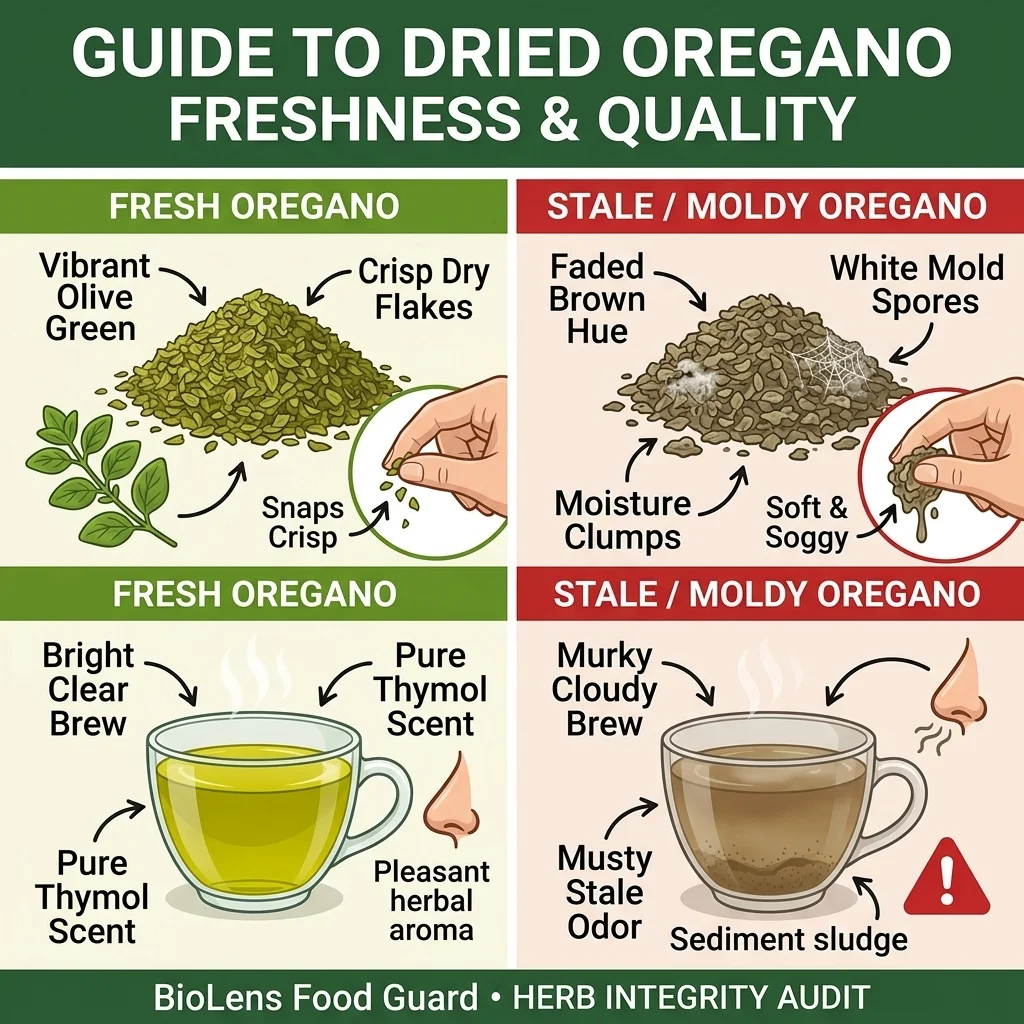
Dried culinary herbs do not rot rapidly like fresh produce, but they undergo insidious oxidative degradation and can harbor toxic storage molds when exposed to kitchen steam. Here is how to evaluate shelf quality:
✅ Deep Olive-Green, Fluffy Flakes & Potent Thymol Aroma = PRIME FRESHNESS
The dried herb retains rich chlorophyll pigments, soft pliable flakes, and releases potent essential oils on light contact. Ideal for pizza, roasted vegetables, and marinades.
⚠️ Dusty Pale Green-Grey, Diminished Scent = AGED / LOW OIL (Use 2x Quantity)
Volatile carvacrol and thymol oils have evaporated through air exposure. The herb is bacteriologically safe but culinarily weak; use double the quantity in simmering stews.
❌ Dark Brown / Ashy Grey, Zero Scent or Musty Cardboard Odor = EXHAUSTED (Discard)
Total oxidation of phenolic terpenes has occurred. The herb provides no seasoning value and adds only bitter astringency and fibrous indigestible chaff.
❌ Clumping, Webbing, White Fuzz or Sour Mildew Stench = MOLD / PESTS (Biohazard — Discard)
Steam exposure during cooking over open boiling pots introduces moisture, spurring Aspergillus mold colonization and drugstore beetle (Stegobium paniceum) webbing.
Quick Summary Table:
| Appearance & Texture | Scent & Condition | Food Safety Action |
|---|---|---|
| Rich olive-green, soft dry flakes, crisp fracture | Powerful pungent thymol & warm peppery aroma | ✅ Prime Quality — Store in airtight dark glass |
| Faded pale sage-green, powdery breakdown | Mild herbal scent, requires heavy crushing | ⚠️ Aged / Marginal — Double recipe dosage |
| Electric neon green or turquoise water bleed | Chemical aroma, ammonia turns solution blue | ❌ Discard (Adulterated with Copper Sulfate) |
| Heavy grit sinking in water, leathery shards | Faint dusty grass or cardboard odor | ❌ Discard (Heavily Diluted with Olive Leaves) |
| Webbing, insect frass, clumped mold patches | Musty basement or sour damp cellar odor | ❌ Discard Immediately (Mycotoxin / Infestation Risk) |
Quick Safety Tips
- Perform the water glass float test: sinking sediment reveals sand grit or heavy olive leaf fillers
- Avoid dried herbs with an unnaturally fluorescent electric-green color indicative of chemical copper baths
- Crush whole dried leaves between your fingers; authentic oregano must release an intense pungent thymol aroma
- Check under a 5x loupe for smooth-edged leathery shards, which indicate olive tree leaves rather than true oregano
- Purchase whole dried bunches on the stem whenever possible rather than finely ground powders to easily verify botanical morphology
Primary Chemical Concerns
Health Risks & Impacts
Multilingual Local Names
Regulatory Corner: European Commission (EU Food Fraud Network) / US FDA (CPG Sec. 525.600) / FSSAI (Spices Reg. 2011)
Regulation: Regulation (EC) No 178/2002 & FDA Compliance Policy Guide Sec. 525.600 (Botanical Herbs & Spices)
Legal Limit:Extraneous Foreign Leaves (Olive/Myrtle): 0.0% (Strictly Prohibited); Total Ash: Max 10.0% (w/w); Acid-Insoluble Ash (Sand/Silica): Max 2.0%; Volatile Essential Oil: Min 1.5% to 2.5% (v/w); Copper Salts / Synthetic Dyes: Strictly Prohibited (0.0 ppm)
Report Adulteration to European Commission (EU Food Fraud Network) / US FDA (CPG Sec. 525.600) / FSSAI (Spices Reg. 2011)