How to Test Garlic for Adulteration (Maleic Hydrazide, Chlorine Bleach, Heavy Metals)
⚡ Quick 60-Second Garlic Bleaching & Quality Verdict
Chlorine Bleaching & Heavy Metal Uptake: Cheap imported garlic is heavily bleached with chlorine compounds to make skins brilliantly white, and roots are shaven off to evade soil pathogen inspections.
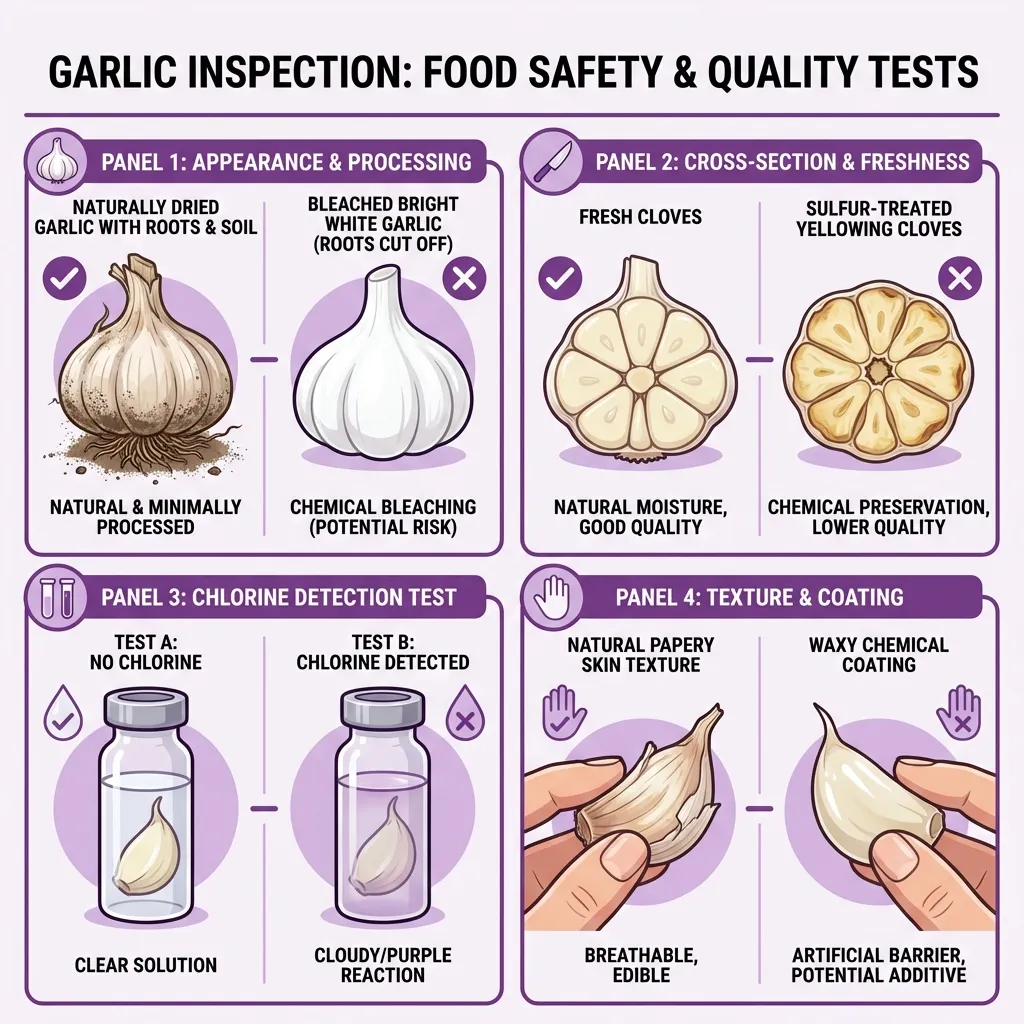
Inspect the bottom plate. High quality, safe local garlic retains natural fibrous hairy root roots. Bleached imported garlic has a concave, scooped-out, completely shaved root base.
Hold 2 heads of garlic. Naturally cured garlic feels heavy and dense in the palm. Chemically treated or irradiated garlic feels light, hollow, or desiccated.
Store at room temperature for 10 days. Natural healthy garlic eventually produces a green central sprout. Chemically irradiated garlic never sprouts and rots from within.
To learn more about food safety tests and home adulteration detection, read our guides on Moringa Leaves, Pumpkin, and Shrimp & Prawns.
Drop Garlic photo here to test purity
or click to browse • Supports JPG, PNG, WEBP • Paste with Ctrl+V
Inspection Guide
Click to enlarge
Garlic Purity & Chemical Audit
Garlic is often bleached with chlorine to achieve a bright white appearance and treated with Maleic Hydrazide to prevent sprouting during long storage or import.
1. The Root Check (Natural Growth):
Examine the base of the garlic bulb where the roots were attached. Naturally fresh garlic should have a slightly rough, brownish root-end with small dry root remains. If the root-end is perfectly flat, white, and looks "scooped" out, it has been mechanically processed and likely bleached.
2. The Sprouting Test:
Naturally fresh garlic will begin to sprout green shoots within 2-3 weeks at room temperature. If your garlic never sprouts even after months, it has been heavily treated with growth inhibitors (Maleic Hydrazide).
3. The Color and Skin Integrity:
Pure garlic has a slightly off-white to yellowish-beige skin, often with purple streaks. If the garlic is "stark white" or looks "bleached," suspect a chlorine wash used to remove soil and natural imperfections.
4. The Squeeze and Weight:
Fresh garlic bulbs are firm and feel heavy for their size. If a bulb feels light, "hollow," or spongy, it is old stock that has dehydrated or has been over-fumigated with chemicals (Methyl Bromide) to kill pests.
Quick Safety Tips
- Choose garlic with a visible root-end; avoid "flat-base" imported varieties
- Avoid garlic that is unnaturally bright white (bleached)
- If garlic fails to sprout after months, it likely contains growth inhibitors
- Select garlic with purple streaks - these are often more flavorful and less processed
Primary Chemical Concerns
Health Risks & Impacts
Multilingual Local Names
Common Storage Pests
Garlic Mite
low riskTiny pests that feed on the stored bulbs, causing them to dry out.
Detection
- Bulbs feeling light and hollow
- Fine white powder inside the cloves
Prevention
- Store in a cool, dry, well-ventilated area
- Avoid moisture
Corrective Action: What to do?
Discard infested cloves; they lose all flavor and medicinal value.
Regulatory Corner: FSSAI (Food Safety and Standards Authority of India) / FDA Compliance Policy Guides
Regulation: Food Safety and Standards (Food Products Standards) Regulations 2011, Clause 2.9.11 & FDA CPG Sec. 585.450
Legal Limit:Chlorine dioxide / synthetic bleach wash: 0.0% (Unapproved surface bleaching prohibited); Methyl bromide fumigation residue: Max 5.0 ppm; Lead: Max 2.5 ppm; Moldy / insect-damaged bulbs: Max 1.0%
Report Adulteration to FSSAI (Food Safety and Standards Authority of India) / FDA Compliance Policy Guides