How to Test Ivy Gourd for Adulteration (Malachite Green, Pesticides)
⚡ Quick 60-Second Ivy Gourd (Tindora) Purity & Dye Verdict
Malachite Green Dye Baths & Disguised Overripe Stock: Stale, refrigerated, or overripe tindoras are steeped in toxic Malachite Green dye to recreate vibrant green stripes, masking fibrous overmaturity.
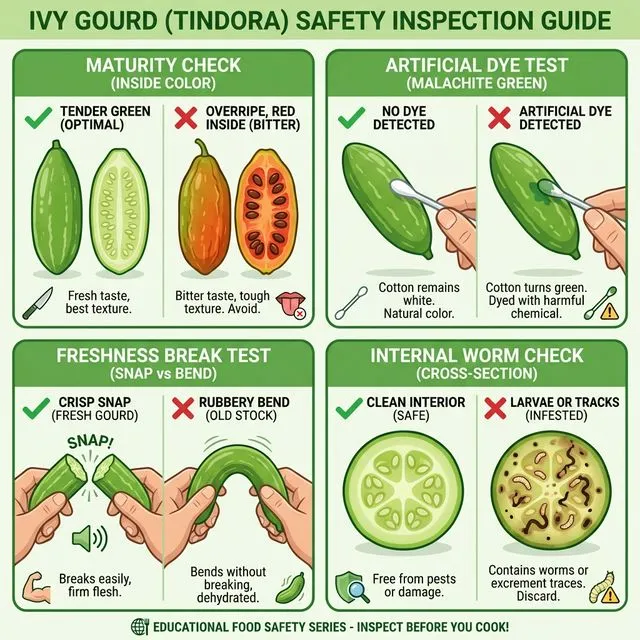
Rub a clean white cotton swab moistened with rubbing alcohol or water along the green-and-white striped rind. A bright green dye transfer onto the swab confirms hazardous Malachite Green dye.
Snap a tindora in half. Fresh, prime-quality ivy gourd snaps crisply, revealing tender pale-green flesh with soft white seeds. Red, fibrous interior with hard dark seeds reveals an overripe gourd disguised with dye.
Place 10 tindoras in a bowl of warm water for 15 minutes. Pure gourds do not alter water color. If the water takes on a distinct pale green or turquoise tint, synthetic dyes have been applied.
To learn more about food safety tests and home adulteration detection, read our guides on Chayote (Chow Chow) and Tapioca (Cassava).
Drop Ivy Gourd (Tindora) photo here to test purity
or click to browse • Supports JPG, PNG, WEBP • Paste with Ctrl+V
Inspection Guide
Click to enlarge
How to Inspect Ivy Gourd (Tindora)
Ivy Gourd (Tindora) is frequently dipped in Malachite Green to look fresh. Also, overripe gourds (seeds turned red) are less nutritious and have a different texture.
1. The Wet Cotton Test:
Rub the Tindora surface with a cotton ball soaked in water or oil. If the cotton turns green, it indicates Malachite Green dye. Natural Tindora shouldn't leave color.
2. The Snap Test:
Try to snap a Tindora in half. Fresh, tender ones snap cleanly. If it's rubbery and bends without snapping, it's old and likely chemically treated to look green.
3. The Interior Check:
Cut a few Tindora. They should be white/pale green inside with small tender seeds. If they are red/orange inside, they are overripe and may have a sour taste.
4. Visual Uniformity:
Look for unnatural uniform greenness. Natural Tindora has slight stripes or variation. A fluorescent, perfect green is a dye indicator.
5. Adulteration in Gourds:
To prevent chemical dye ingestion, perform the cotton rub test on ivy gourd and other popular gourds. See our verification guidelines for Ridge Gourd, Bitter Gourd, and Bottle Gourd.
Quick Safety Tips
- Perform rub test for green dyes
- Check for clean snap (not rubbery)
- Discard if inside is bright red/orange
- Soak in salt water for 20 minutes before use
Primary Chemical Concerns
Health Risks & Impacts
Multilingual Local Names
Common Storage Pests
Melon Fruit Fly (Bactrocera cucurbitae)
high riskFlies that lay eggs under the skin, leading to internal decay.
Detection
- Tiny puncture marks on the skin
- Internal browning
- Mushy spots
Prevention
- Inspect for skin punctures
- Store in the vegetable crisper
Corrective Action: What to do?
If internal rot is found, discard the entire vegetable to avoid bacterial pathogens.
Regulatory Corner: FSSAI (Food Safety and Standards Authority of India) / FSS (Contaminants, Toxins and Residues) Reg. 2011
Regulation: Food Safety and Standards (Prohibition and Restrictions on Sales) Regulations 2011 & Clause 2.3.1
Legal Limit:Malachite Green & industrial dyes: Zero tolerance (0.0 ppm); Synthetic food colors: Prohibited on fresh vegetables (0.0 ppm); Cypermethrin insecticide MRL: Max 0.5 ppm; Lead MRL: Max 0.1 ppm
Report Adulteration to FSSAI (Food Safety and Standards Authority of India) / FSS (Contaminants, Toxins and Residues) Reg. 2011