How to Test Green Peas for Adulteration (Malachite Green, Copper Sulfate, Pesticide)
⚡ Quick 60-Second Green Peas Malachite Green Verdict
Malachite Green Dye & Chemical Greening: Dried white peas or stale green peas are soaked in carcinogenic Malachite Green dye or Tartrazine/Brilliant Blue mixtures to appear fresh and sweet.
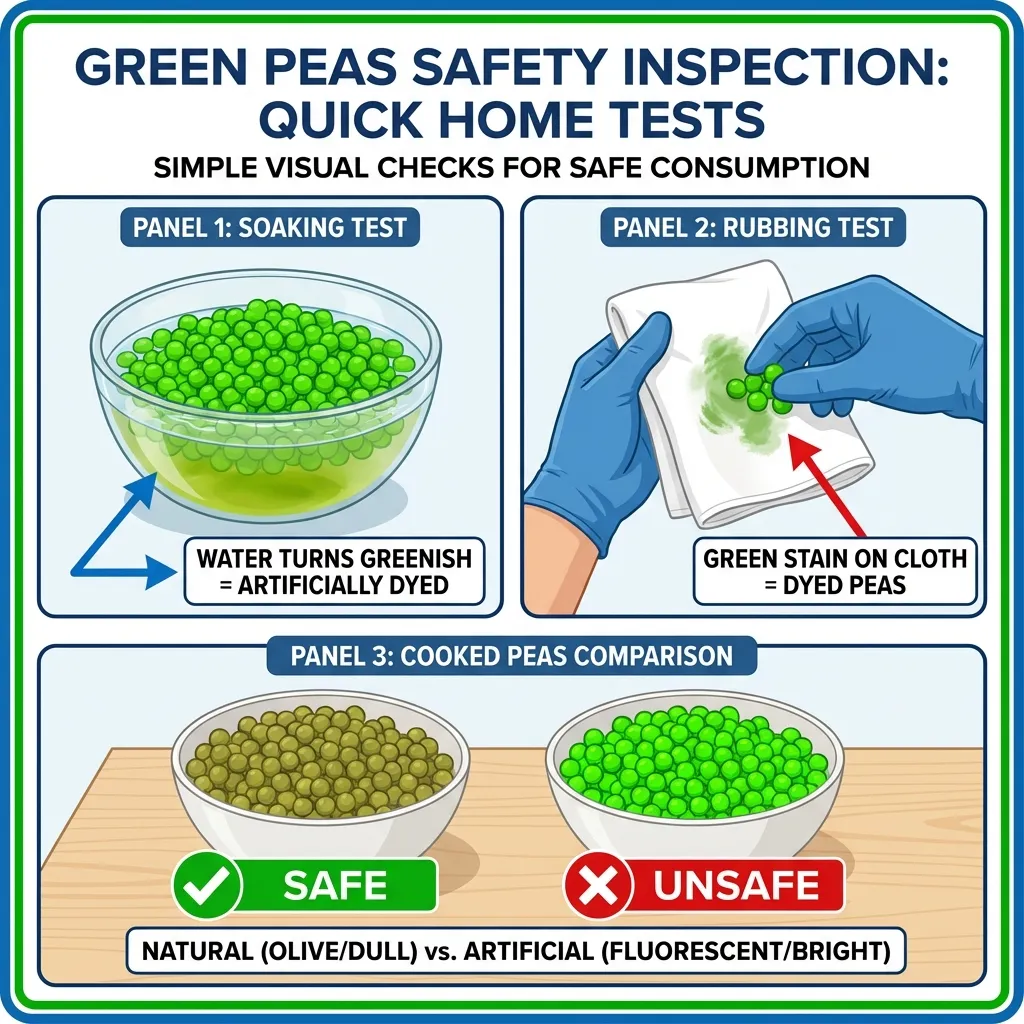
Place a small sample of green peas in a glass of warm water. Pure peas keep the water clear. Artificially dyed peas bleed bright emerald green dye into the water within 5 minutes.
Moisten a white cotton ball in water and rub across the outer skin. If the cotton turns vivid green, non-permitted chemical dye is confirmed.
Slice a pea in half. In naturally fresh green peas, the interior cotyledons are uniform soft pale green. In dyed white peas, only the outer skin is neon green while the center is chalky white.
To learn more about food safety tests and home adulteration detection, read our guides on Tomato, Potato, and Tomato Ketchup & Puree.
Drop Green Peas photo here to test purity
or click to browse • Supports JPG, PNG, WEBP • Paste with Ctrl+V
Inspection Guide
Click to enlarge
Green Peas Purity & Dye Audit
Green peas, especially when sold as shelled kernels, are frequently treated with Malachite Green or Copper Sulfate to maintain an unnaturally vibrant green color, even after they have lost their freshness.
1. The Cotton Rub Test (Kernels):
Take a few green peas and rub them with a wet cotton ball. If the cotton turns green or bluish-green, artificial dye has been applied. Natural pea color does not transfer easily.
2. The Water Wash (Color Bleed):
Soak a handful of peas in a glass of warm water for 15 minutes. If the water turns bright green or bluish, artificial coloring (Malachite Green) is confirmed. Natural chlorophyll remains inside the cells and won't leach.
3. The Texture Check:
Gently press a pea. A naturally fresh pea is slightly firm but yielding. If the pea feels "stiff" or "rubbery" while being a vibrant green, it may be old stock chemically "refreshed."
4. The Taste Profile:
Fresh green peas have a distinct, sweet, and nutty flavor. If they taste "chalky," bitter, or have a chemical after-taste, suspect dyes or preservative treatments.
Quick Safety Tips
- Perform the cotton rub test for Malachite Green detection
- Avoid peas that look "neon" green or unnaturally glossy
- Wash thoroughly and soak in salt water for 20 minutes to reduce surface chemicals
- Select "Unshelled" peas to ensure maximum freshness and lack of processing
Primary Chemical Concerns
Health Risks & Impacts
Multilingual Local Names
Common Storage Pests
Pea Weevil
medium riskSmall beetles that lay eggs on the pods; the larvae tunnel into the seeds.
Detection
- Small entry holes in the seeds
- Presence of tiny larvae inside the kernels
Prevention
- Inspect for skin damage before buying
- Store in a cool, ventilated place
Corrective Action: What to do?
Discard infested peas; the internal rot can be bitter and harmful.
Regulatory Corner: FSSAI (Food Safety and Standards Authority of India) / US FDA
Regulation: Food Safety and Standards (Food Products Standards) Regulations 2011, Clause 2.3.6: Fresh Vegetables & FDA CPG Sec. 585.600
Legal Limit:Non-permitted synthetic colorants (Malachite Green, Fast Green FCF, Tartrazine): 0.0% (Strict zero tolerance); Dimethoate pesticide residue: Max 0.5 ppm; Monocrotophos: 0.0 ppm
Report Adulteration to FSSAI (Food Safety and Standards Authority of India) / US FDA