How to Test Ragi for Adulteration (Rhodamine B, Iron Filings, Stone Dust)
⚡ Quick 60-Second Ragi Purity & Synthetic Dye Verdict
Rhodamine B Dye Wash & Sand/Grit Adulteration: Whole ragi and ragi flour are heavily adulterated with cheap red brick dust, fine clay grit, and soaked in carcinogenic Rhodamine B dye to mimic premium dark-red organic finger millet.
Stir 1 tsp ragi flour in a glass of clear water. Pure ragi settles to the bottom leaving a light brownish-tinted water. Bright fluorescent pink or magenta coloration confirms illegal Rhodamine B dye.
Stir 2 tbsp ragi in a bowl of water, let settle for 2 minutes, and carefully decant liquid. Rub the sediment between fingers. Gritty, scraping residue indicates heavy sand, stone dust, or brick powder fillers.
Pure ragi has a distinct earthy, grassy grain fragrance. An acrid chemical scent or bitter aftertaste indicates artificial coloring or pesticide contamination.
To learn more about food safety tests and home adulteration detection, read our guides on Rajma (Kidney Beans) and Poha (Flattened Rice).
Drop Ragi (Finger Millet) photo here to test purity
or click to browse • Supports JPG, PNG, WEBP • Paste with Ctrl+V
Inspection Guide
Click to enlarge
Ragi Purity & Dye Audit
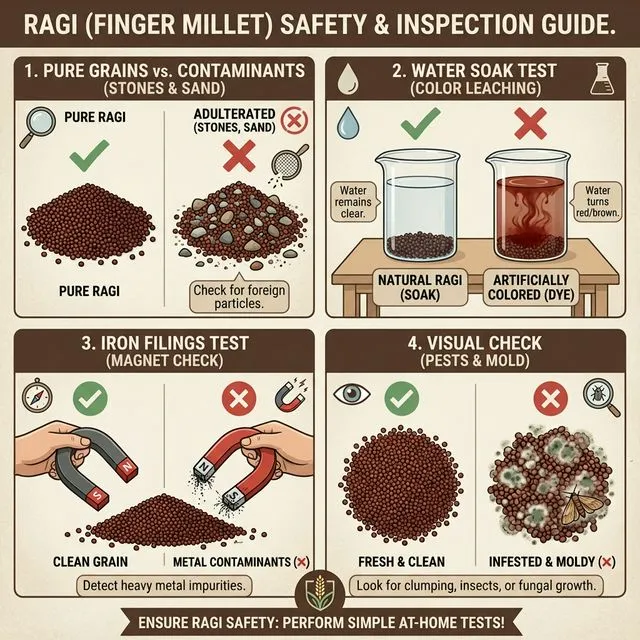
Ragi (Finger Millet) is high-risk for adulteration with artificial red dyes (like Rhodamine B) to look more "premium" and uniform, or may contain iron filings from heavy industrial grinding.
1. The Cotton Rub Test (Whole Seeds):
Rub a handful of ragi seeds with a wet cotton ball. If the cotton picks up a pink or reddish tint, artificial dye has been applied. Natural ragi color is stable and does not rub off.
2. The Magnet Test (Flour):
Spread ragi flour on a white paper. Move a strong magnet just above the surface of the flour. If tiny black particles jump to the magnet, the flour is contaminated with iron filings from the grinding stones/machinery.
3. The Water Soak (Color Bleed):
Soak a spoonful of ragi in warm water for 15 minutes. If the water turns bright pink or red immediately, suspect artificial coloring. Natural ragi color leaches very slowly and turns the water a pale brownish-pink.
4. The Grit and Sand Check:
Dissolve a spoonful of ragi flour in a glass of water. Pure ragi starch will settle slowly. If a layer of heavy sand or grit settles instantly at the bottom, it indicates poor cleaning or intentional adulteration with stone dust.
Quick Safety Tips
- Perform the magnet test to detect harmful iron filings
- Avoid ragi that releases a bright pink color into water
- Wash whole ragi seeds 3-4 times to remove surface grit and dust
- Prefer "Sprouted" ragi flour for maximum nutritional bioavailability
Primary Chemical Concerns
Health Risks & Impacts
Multilingual Local Names
Common Storage Pests
Grain Borer
low riskSmall beetles that can infest stored millet seeds.
Detection
- Small holes in the seeds
- Fine dust at the bottom of the container
Prevention
- Store in an airtight glass jar
- Keep in a cool, dry place
Corrective Action: What to do?
Discard heavily infested samples; sun-drying can kill early-stage infestations.
Regulatory Corner: FSSAI (Food Safety and Standards Authority of India) / BIS (IS 14433) / Codex
Regulation: Food Safety and Standards (Food Products Standards) Regulations 2011, Clause 2.4.6: Finger Millet (Ragi)
Legal Limit:Moisture: Max 12.0% by weight; Total ash: Max 3.0%; Acid insoluble ash: Max 0.5%; Rhodamine B / synthetic coal-tar dyes: 0.0% (Strict zero tolerance); Inorganic matter / sand: Max 0.5%
Report Adulteration to FSSAI (Food Safety and Standards Authority of India) / BIS (IS 14433) / Codex