How to Test Toor Dal for Adulteration (Metanil Yellow, Khesari Dal, Stone Dust)
⚡ Quick 60-Second Toor Dal Purity & Polish Verdict
Lead Chromate Polishing & Metanil Yellow Risk: Unpolished toor dal is treated with toxic Lead Chromate (PbCrO4) or synthetic yellow azo dyes to give dull, stale grains an artificial radiant golden shine.
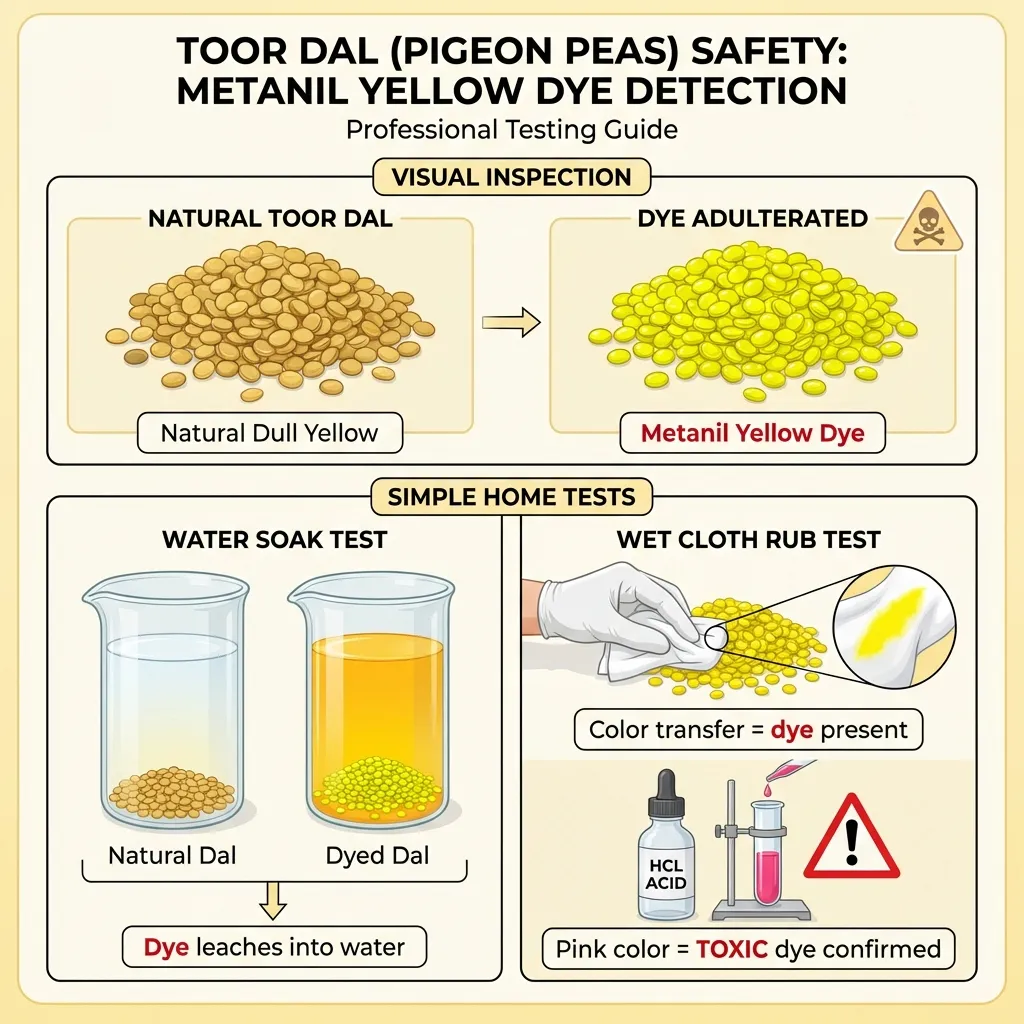
Place 1 tbsp toor dal in a glass of warm water. Pure unpolished dal keeps the water clear or slightly hazy. If the water turns vibrant neon yellow within 15 seconds, chemical dyes or lead chromate polish are present.
Add 5 drops of dilute HCl or strong vinegar to the yellow wash water. If the liquid turns intense crimson-pink, carcinogenic Metanil Yellow is confirmed.
Spread 50g on white paper. Check for squared, wedge-shaped grains. Pure toor dal is spherical with a flat edge. Wedge-shaped grains indicate toxic Khesari dal adulteration.
To learn more about food safety tests and home adulteration detection, read our guides on Chickpeas (Chana) and Moong Dal (Green Gram).
Drop Toor Dal (Pigeon Peas) photo here to test purity
or click to browse • Supports JPG, PNG, WEBP • Paste with Ctrl+V
Inspection Guide
Click to enlarge
Toor Dal Purity & Dye Audit
Toor Dal is high-risk for adulteration with Metanil Yellow (a toxic textile dye) to look more yellow and Khesari Dal (a toxic pulse) to increase weight at a lower cost.
1. The Hydrochloric Acid Test (Dye Detection):
In a test tube, take a small sample of Toor Dal and add a little water. Add a few drops of concentrated Hydrochloric Acid (HCl). If the solution turns pink or magenta, Metanil Yellow is present. Pure dal will not change color.
2. The Visual Shape Check (Khesari Dal):
Examine the dal kernels closely. Toor Dal kernels are uniform, round, and slightly oval. Khesari Dal kernels are irregular, wedge-shaped, and often have a flatter appearance on one side.
3. The Water Soak (Color Bleed):
Soak Toor Dal in warm water for 15 minutes. If the water turns bright yellow immediately, suspect artificial dyes. Natural dal color leaches very slowly and turns the water a faint, pale yellow.
4. The Rub Test:
Rub dry dal vigorously between your palms. If it leaves a bright yellow powdery residue on your skin, it is a clear sign of dye coating or lead chromate treatment.
5. Adulteration in Pulses:
Similar dye adulterations are also common in whole pulses. See our test guide for Chickpeas.
Quick Safety Tips
- Perform the HCl test for Metanil Yellow - pink color is a danger sign
- Inspect the shape - wedge-shaped kernels indicate toxic Khesari Dal
- Avoid dal that leaves a yellow powder on your hands
- Wash at least 3 times before cooking to remove surface dust and dyes
Primary Chemical Concerns
Health Risks & Impacts
Multilingual Local Names
Common Storage Pests
Pulse Beetle
medium riskSmall beetles that bore holes into the dal kernels.
Detection
- Small round holes in the seeds
- Fine dust at the bottom of the container
Prevention
- Store in an airtight glass jar
- Keep in a cool, dry place
Corrective Action: What to do?
Discard heavily infested samples; sun-drying can kill early-stage larvae.
Regulatory Corner: FSSAI (Food Safety and Standards Authority of India) / Codex Stan 171-1989
Regulation: Food Safety and Standards (Food Products Standards) Regulations 2011, Clause 2.4.6: Pulses (Whole and Split)
Legal Limit:Total ash: Max 5.0%; Acid insoluble ash: Max 0.5%; Moisture: Max 12.0%; Synthetic azo dyes (Metanil Yellow) & Lead Chromate: 0.0% (Strictly Prohibited); Uric acid: Max 100 mg/kg
Report Adulteration to FSSAI (Food Safety and Standards Authority of India) / Codex Stan 171-1989